Sleeper Effect: Do Doubted Messages Persuade More Later?
In three lines
- Who persuaded whom: The sleeper effect is the claim that a message people discount at first, often because they distrust its source, persuades them more later. Psychologists have studied it, and argued over it, since a 1949 report.
- Which stones: An army film and a 1951 study of trusted and distrusted sources, as a 2004 review of 72 data sets reports them, then that review’s own averages. In it discounted messages rose by d+ 0.08 on average, and no-message baselines changed by the same 0.08, a figure not significantly above zero.
- Outcome: The review called the overall result relative, with no absolute effect. It found a larger rise, about d+ 0.25, in narrower conditions: the discounting came after the message, and the audience was able and motivated to think about it.
Route through this piece (8)
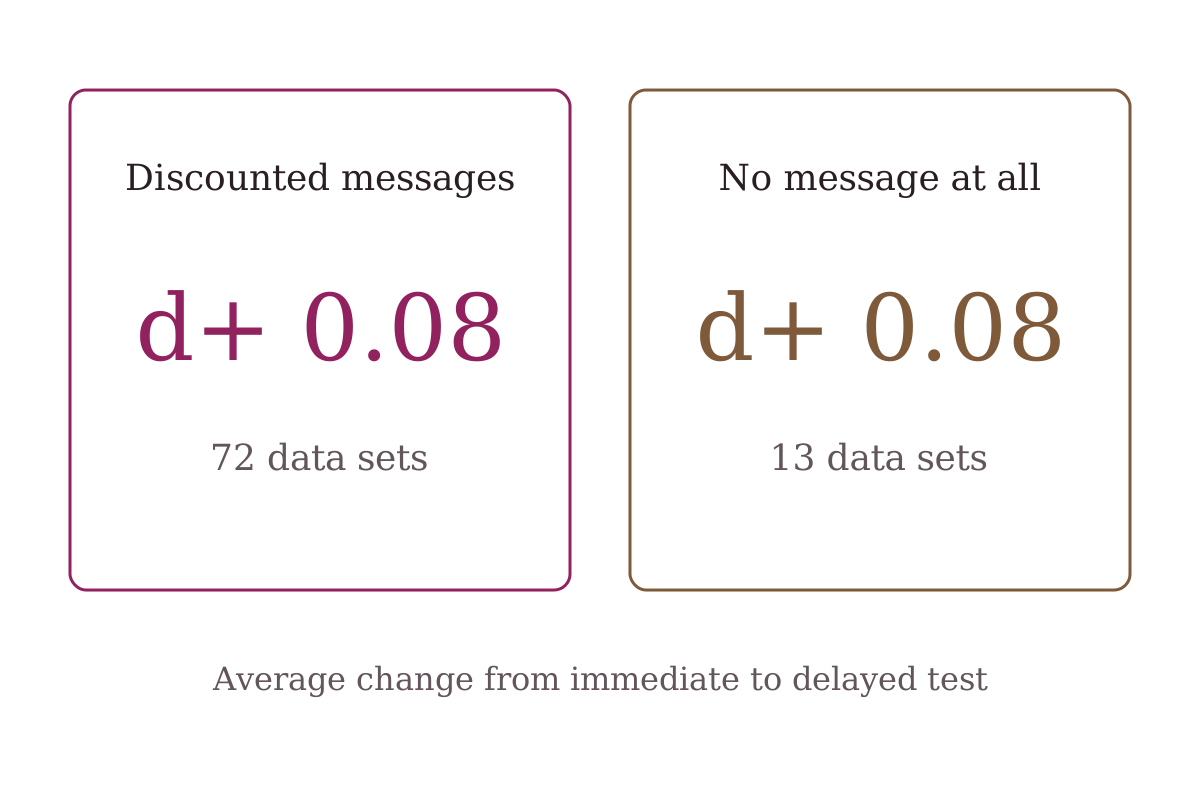
Two averages from the 2004 review, with the number of data sets behind each. The no-message interval, −0.02 to 0.20, includes zero. Random-effects figures. 2004.
"Two averages in the 2004 sleeper effect review" by Persuasion Dissected — https://persuasiondissected.com/persuaders/sleeper-effect/ — licensed CC BY 4.0: https://creativecommons.org/licenses/by/4.0/
Data: Kumkale and Albarracín, Psychological Bulletin 130 (2004), Table 4
In 2004 Tarcan Kumkale and Dolores Albarracín found at most two borderline sleeper effects in four 1951 data sets. That judgment (Psychological Bulletin, Recall mechanisms section) asks a reader to accept that one of the effect’s early tests was thin. The same authors also reject the opposite conclusion, that there was no effect to find. This page follows their review, the one full synthesis it could read, and leaves the 1951 paper itself as a bibliography entry.
What is the sleeper effect?
The sleeper effect is a delayed rise in persuasion among people who first discounted a message. The discount comes from a discounting cue, which is anything that makes a message look invalid, such as a doubtful source or a statement that the claims are false (Kumkale & Albarracín, introduction and The Present Meta-Analysis). Persuasion generally fades with time, which the review gives as the reason the effect looks counterintuitive (introduction).
The review separates two versions (Definition of the Sleeper Effect section). In an absolute sleeper effect, persuasion rises among people who got the cue, and a baseline group that saw no message does not show the same rise. A relative sleeper effect is weaker. It covers three patterns: cued messages fade less than messages from a trusted source, or they hold steady while those fade, or they rise only as much as the baseline does.
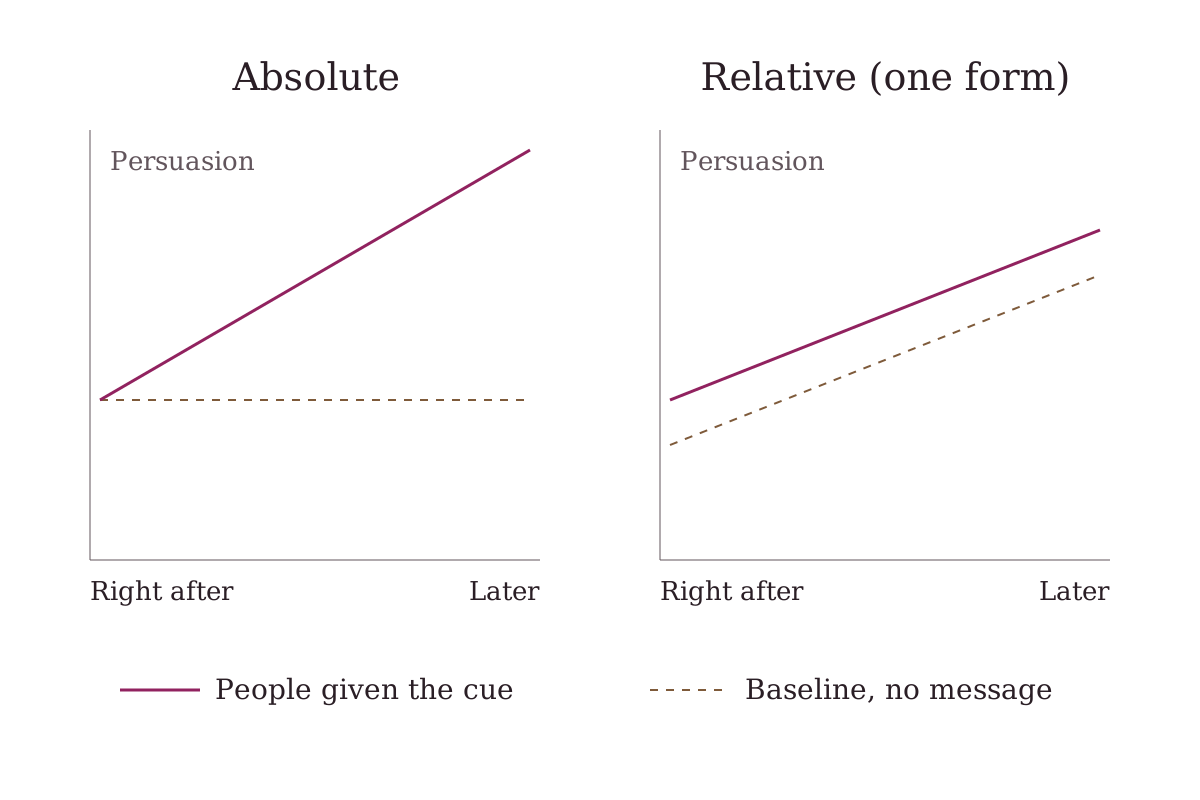
The absolute version and one relative version, as the 2004 review defines them. A schematic, not data. 2004.
"Absolute and relative sleeper effects" by Persuasion Dissected — https://persuasiondissected.com/persuaders/sleeper-effect/ — licensed CC BY 4.0: https://creativecommons.org/licenses/by/4.0/
The claim in one picture: a message stays while its source fades. An idea, not a study result. 1949 to 2004.
Illustration — not a historical depiction
Illustration: Persuasion Dissected. Generated schematic illustration — not a photograph or historical record. Reuse: CC BY 4.0 (https://creativecommons.org/licenses/by/4.0/), to the extent any rights exist.
The textbook description sounds like the first version. Researchers and textbook writers, the review says, have traditionally described a delayed increase in the impact of a message from a low-credibility source (Selection Criteria section).
Where did the sleeper effect come from?
The review traces the first known sighting to the US Army in World War II (Memory for the Source section). Carl Hovland, A. A. Lumsdaine and F. D. Sheffield measured soldiers’ opinions either 5 days or 9 weeks after an army propaganda film. As reported in the review, the gap between viewers and non-viewers was larger at 9 weeks, and viewers’ opinions had risen [study stub: experiment; n=unknown vs n=unknown, N=unknown; preregistered: not applicable].
Their 1949 book was read only as a bibliography entry, so no group figures appear on this page. The US government had counted mass persuasion a war earlier. The Four Minute Men left totals kept by their own organizers, while the Army study, as reported, compared people who saw the film with people who did not.
The review’s summary of the film study names no distrusted source. That element came with later experiments. Hovland and Walter Weiss printed the source on the same page as the message, on four topics: movie theaters, antihistamines, atomic submarines and a steel shortage (Table 1 and note 10) [study stub: experiment; n=unknown vs n=unknown, N=unknown; preregistered: not applicable]. Weiss, and Herbert Kelman with Hovland, followed in 1953.
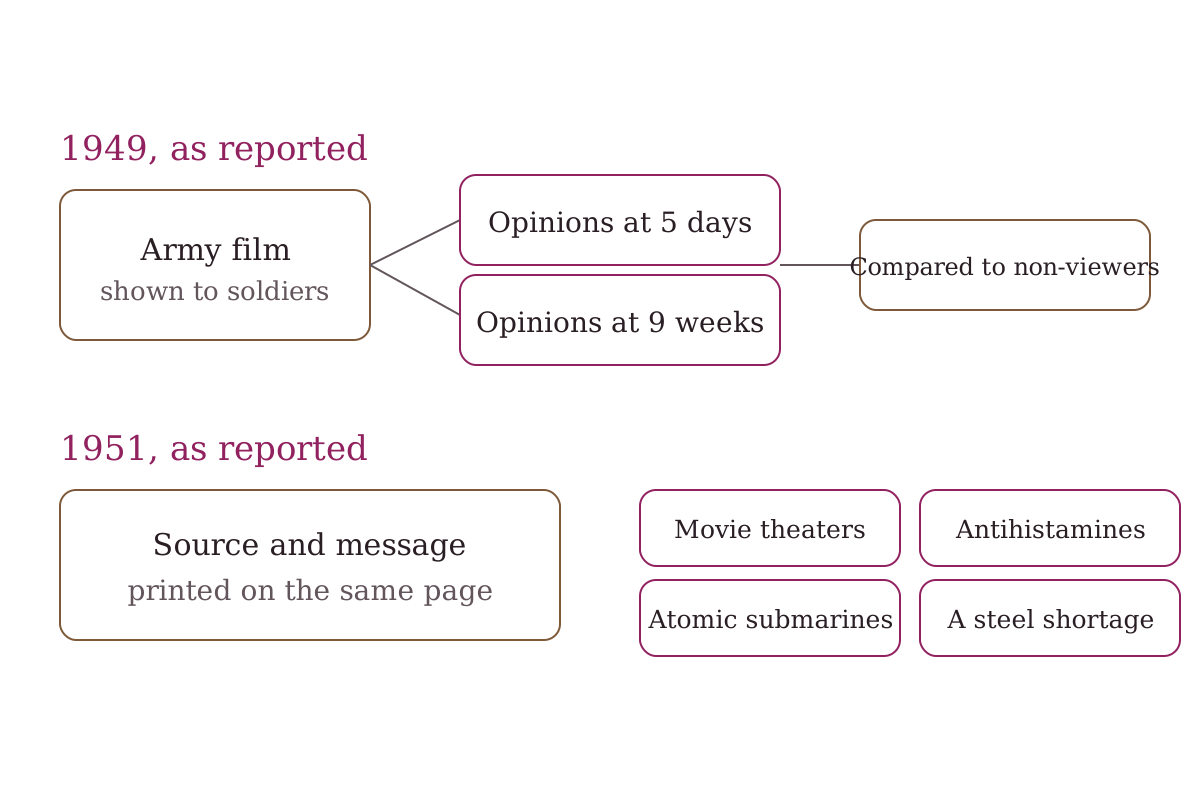
The two early designs as the 2004 review reports them. The original papers were not read for this page. 1949 and 1951.
"Two early sleeper effect designs" by Persuasion Dissected — https://persuasiondissected.com/persuaders/sleeper-effect/ — licensed CC BY 4.0: https://creativecommons.org/licenses/by/4.0/
Hovland’s first idea was forgetting: people lose the source and keep the message. Recall measures in that series showed people could still name the source at follow-up, so he and Weiss moved to dissociation, in which the source stays in memory but stops coming to mind with the topic (Forgetting and dissociation section). Kumkale and Albarracín object that the 1951 recall figures were pooled across conditions with and without the effect (Effects on Recall section; Recall mechanisms section). The judgment that opens this page belongs to that objection.
Why did researchers try to bury it?
In 1973 Noel Capon and James Hulbert reviewed the literature. By the 2004 account, they concluded the effect was so unreliable that researchers would do better to accept the null hypothesis, meaning no effect, than to keep studying it (introduction) [study stub: archival / review; N not applicable; preregistered: not applicable]. The same passage lists Paulette Gillig and Anthony Greenwald’s 1974 paper, the question at the top of this page, as reaching a similar conclusion. Both were read only as bibliography entries.
The replies can be followed in the titles. A 1978 paper by Charles Gruder and colleagues set out “Empirical tests of the absolute sleeper effect.”
A 1979 paper by Thomas Cook and colleagues is called “History of the sleeper effect: Some logical pitfalls in accepting the null hypothesis.” A 1988 paper by Anthony Pratkanis and colleagues includes the line “The sleeper effect is dead: Long live the sleeper effect.” Across 17 experiments, by the 2004 account, that team found the effect mostly when the cue followed the message (Differential decay section) [study stub: experiment; 17 experiments, n=unknown vs n=unknown, N=unknown; preregistered: not applicable].
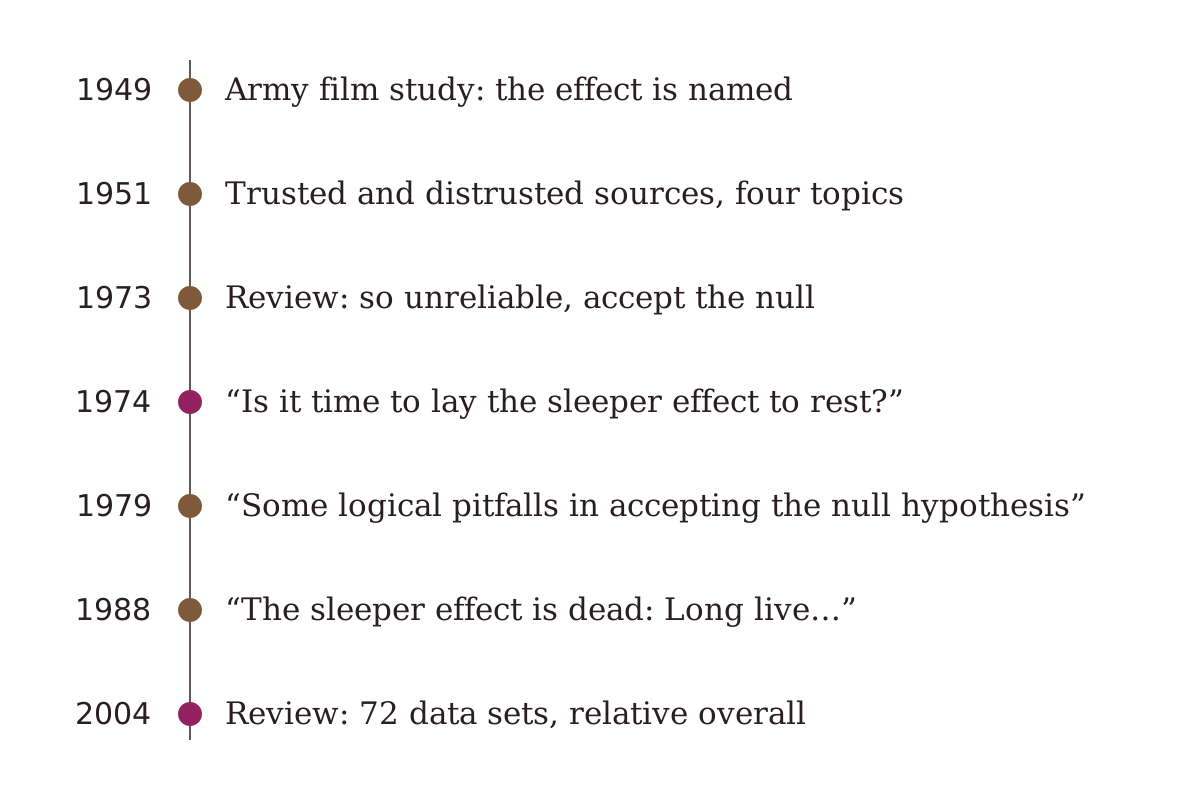
Seven steps in the argument, from the 1949 book to the 2004 review. Dated by publication. 1949 to 2004.
"The sleeper effect argument in paper titles" by Persuasion Dissected — https://persuasiondissected.com/persuaders/sleeper-effect/ — licensed CC BY 4.0: https://creativecommons.org/licenses/by/4.0/
On this site’s reading, the name held on through all of this, and it could be repeated without saying which version was meant. A finding’s label can run ahead of its text in other ways, as the English title of the 1784 report on animal magnetism did with one signer’s name. The list of these papers (where this data comes from) gives each record and how little of it was read.
What did the 2004 review find?
Kumkale and Albarracín searched for reports available by March 2003 and kept 72 data sets from 24 reports (Sample of Studies and Selection Criteria sections). For each condition they measured change from an immediate test to a delayed test, in standard-deviation units. Their d+ is a weighted average of those changes, and a positive value means persuasion rose [study stub: meta-analysis; k=72 data sets in 24 reports; total N=not reported; preregistered: not applicable].
The random-effects figures in their Table 4 run as follows:
- Trusted-source cue: d+ −0.23, across 47 data sets (N=1,589).
- Discounting cue: d+ 0.08, across 72 data sets (N=2,480).
- No message at all: d+ 0.08, across 13 data sets (N=425).
- Message with no cue: d+ −0.11, across 17 data sets (N=517).
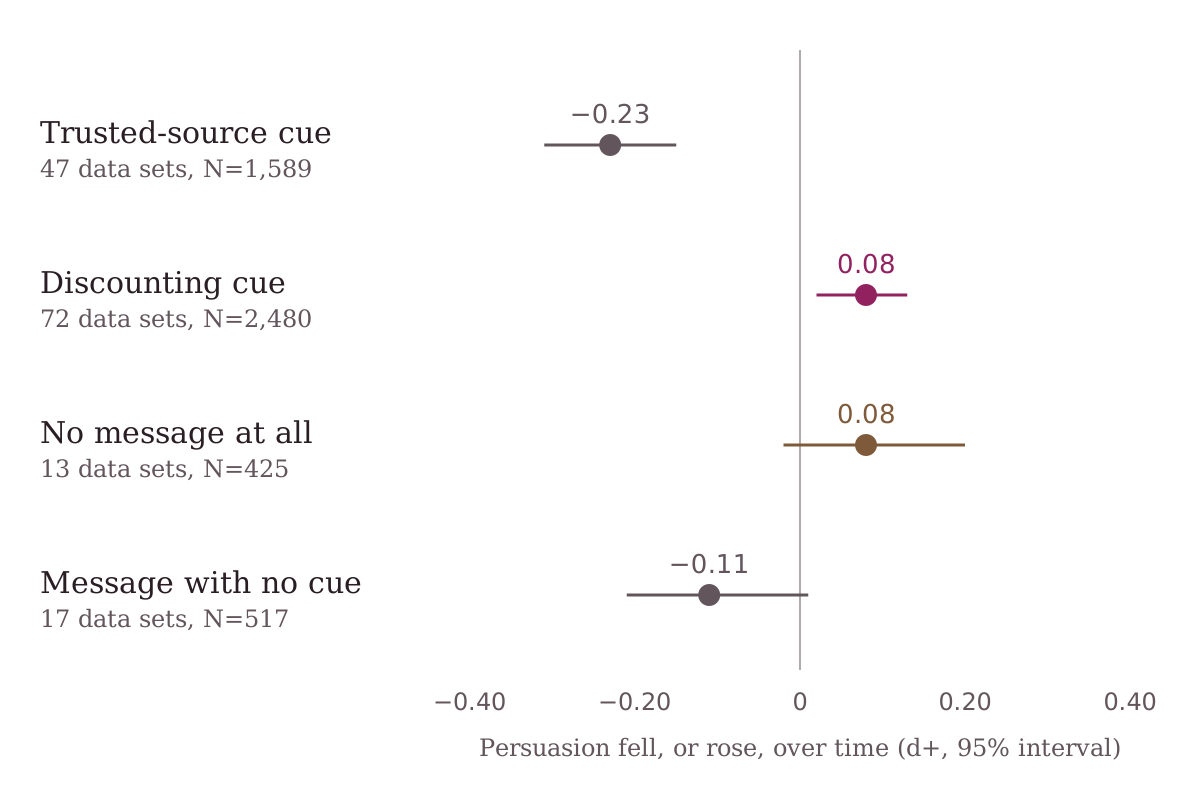
Average change in persuasion by condition in the 2004 review, with 95% intervals. Random-effects figures, Table 4. 2004.
"Change in persuasion by condition" by Persuasion Dissected — https://persuasiondissected.com/persuaders/sleeper-effect/ — licensed CC BY 4.0: https://creativecommons.org/licenses/by/4.0/
Data: Kumkale and Albarracín, Psychological Bulletin 130 (2004), Table 4
The discounted messages held up better than the trusted ones, a significant difference (Average sleeper effect section), and that gap is the relative effect. But the people who saw nothing moved by the same 0.08, so the authors declined to call the rise absolute. Their summary is that the overall analyses show the relative kind and not the absolute kind (Summary section).
Two limits sit beside that line. The baseline average rests on 13 data sets, and its interval runs from −0.02 to 0.20, so it does not differ significantly from zero (Average sleeper effect section). The authors also warn that effects varied widely across data sets, and that it would mislead to assume the effect is relative in all conditions (Summary section). They ruled out one rival explanation, a backlash that later wears off: cued groups started above baseline, not below it, at d+ 0.19 across 26 data sets (Table 3).
When did the effect look absolute?
The review’s answer depends mainly on when the cue arrived and on how able and motivated the audience was. In Table 5, a cue placed after the message gave d+ 0.24 when the message was repeated (11 data sets), 0.26 when the issue mattered to the audience (10) and 0.25 when the audience knew the topic (18). A cue placed before the message gave −0.06, −0.06 and 0.02 under the same three conditions.
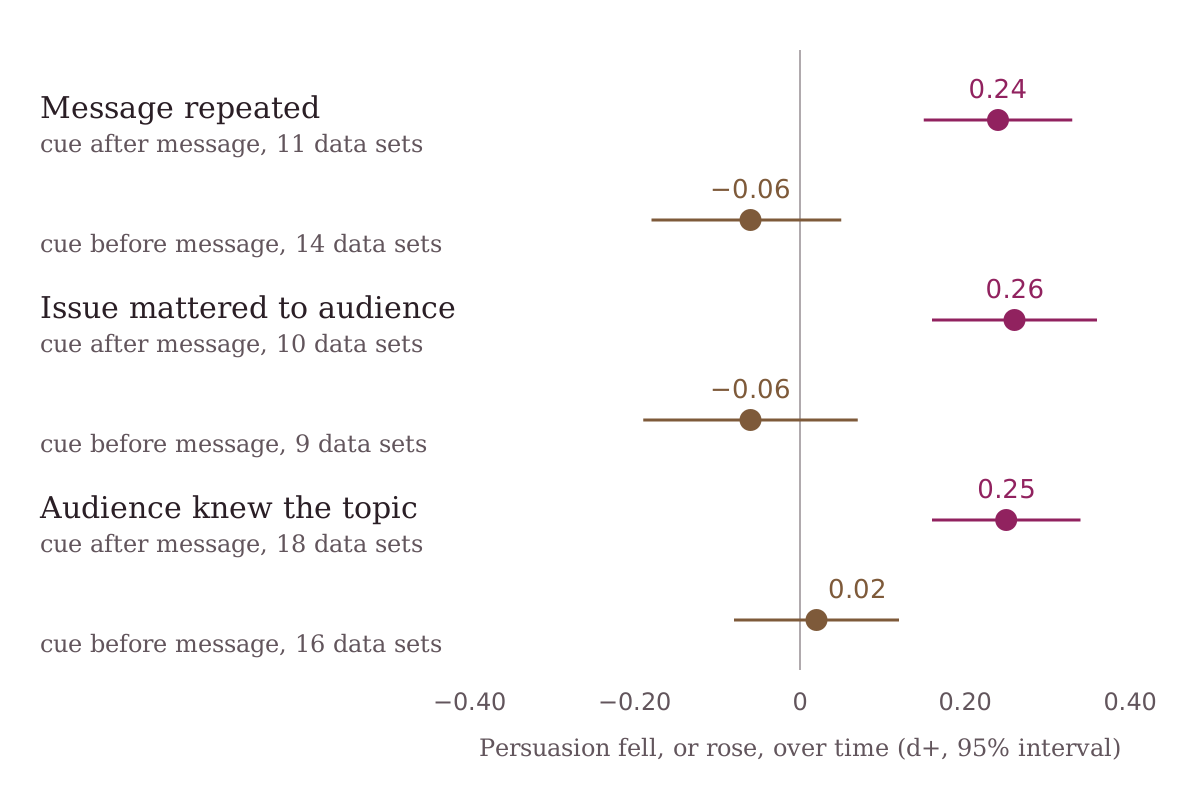
Change in persuasion by position of the cue, under three high-ability or high-motivation conditions. Random-effects figures, Table 5. 2004.
"Change in persuasion by position of the cue" by Persuasion Dissected — https://persuasiondissected.com/persuaders/sleeper-effect/ — licensed CC BY 4.0: https://creativecommons.org/licenses/by/4.0/
Data: Kumkale and Albarracín, Psychological Bulletin 130 (2004), Table 5
The authors put the average in those conditions at 0.25, significantly above the baseline, and read that as suggesting absolute effects (cue-timing results). They call the size mostly small to moderate (Magnitude section). The comparison runs across studies, however. A pooled test of the same interaction within studies, they note, was not yet possible (Discussion).
One 1999 experiment by Joseph Priester and colleagues fits the pattern, by the review’s report, with the effect only among people high in chronic motivation to think (Elaboration-likelihood section; cue-timing results) [study stub: experiment; n=unknown vs n=unknown, N=unknown; preregistered: not applicable].
The review adds one more condition. Across 26 data sets, the later rise was larger where the message had moved people less at first, which the authors read as the cue holding back a message that would otherwise persuade (B = −0.48, in the results on initial change).
The textbook version has the smaller figure. With a noncredible source as the cue, the average was d+ 0.02 across 45 data sets, against 0.22 across 15 for disclaimer notes (fixed-effects figures, Other Methodological Moderators section). The two are tangled, because disclaimers came after the message in all cases. A noncredible source placed last gave 0.09 across 9 data sets, and one placed first gave −0.02 across 36.
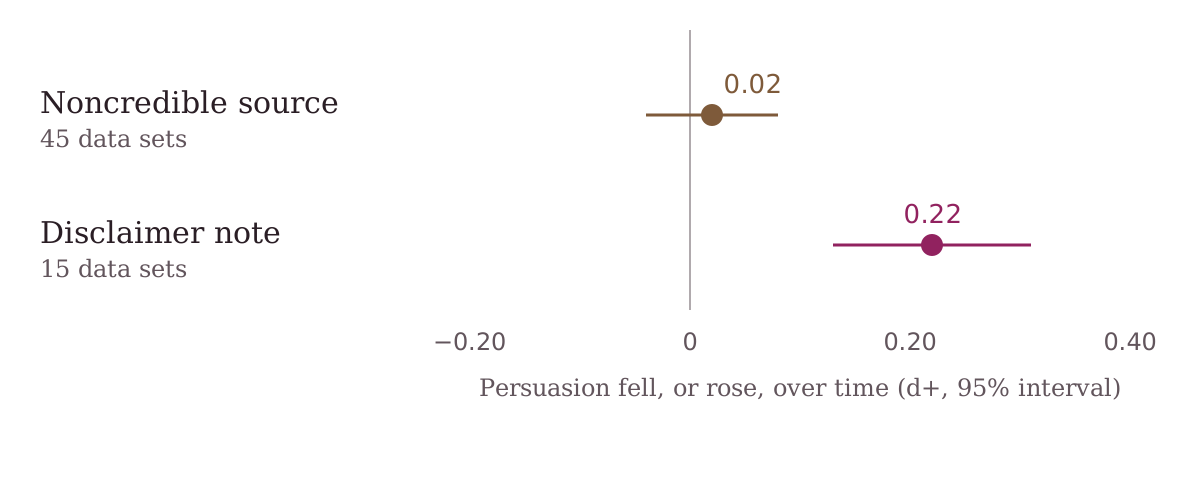
Change in persuasion by kind of discounting cue, with 95% intervals. Fixed-effects figures. Disclaimers all followed the message. 2004.
"Change in persuasion by kind of cue" by Persuasion Dissected — https://persuasiondissected.com/persuaders/sleeper-effect/ — licensed CC BY 4.0: https://creativecommons.org/licenses/by/4.0/
Data: Kumkale and Albarracín, Psychological Bulletin 130 (2004), Other Methodological Moderators section
Three lines in the author manuscript disagree with their neighbors. The Magnitude section says the 0.25 came with the cue placed first, while the cue-timing results and Table 5 place it after the message. This page follows those.
Table 5 prints −0.09 for low-relevance issues beside an interval of −0.02 to 0.21, which does not contain it, so the value is not used here. The Other Methodological Moderators section calls the 0.09 rise significant, though its interval, −0.03 to 0.21, includes zero. Crossref listed no correction as of 9 November 2026, a check that covers only corrections registered there.
How solid is the evidence behind the average?
The studies are small by the authors’ own account. A discounting-cue group typically held 27 people, too few to detect a small effect of d = 0.20 (Sample of Studies and Data Sets section). Table 2 adds the shape of the sample: 88% of data sets used university students, 89% were collected in the United States, and 42% had a no-message group.
Twelve of the 72 came from one 1988 paper, and the authors report that results held without them, in analyses they do not print (Selection Criteria section; cue-timing results). Their funnel plot and normal quantile plot showed no sign of publication bias. They note that reading a funnel plot involves subjective judgment, and they treat the quantile plot as the better method (Assessment of Publication Bias section).
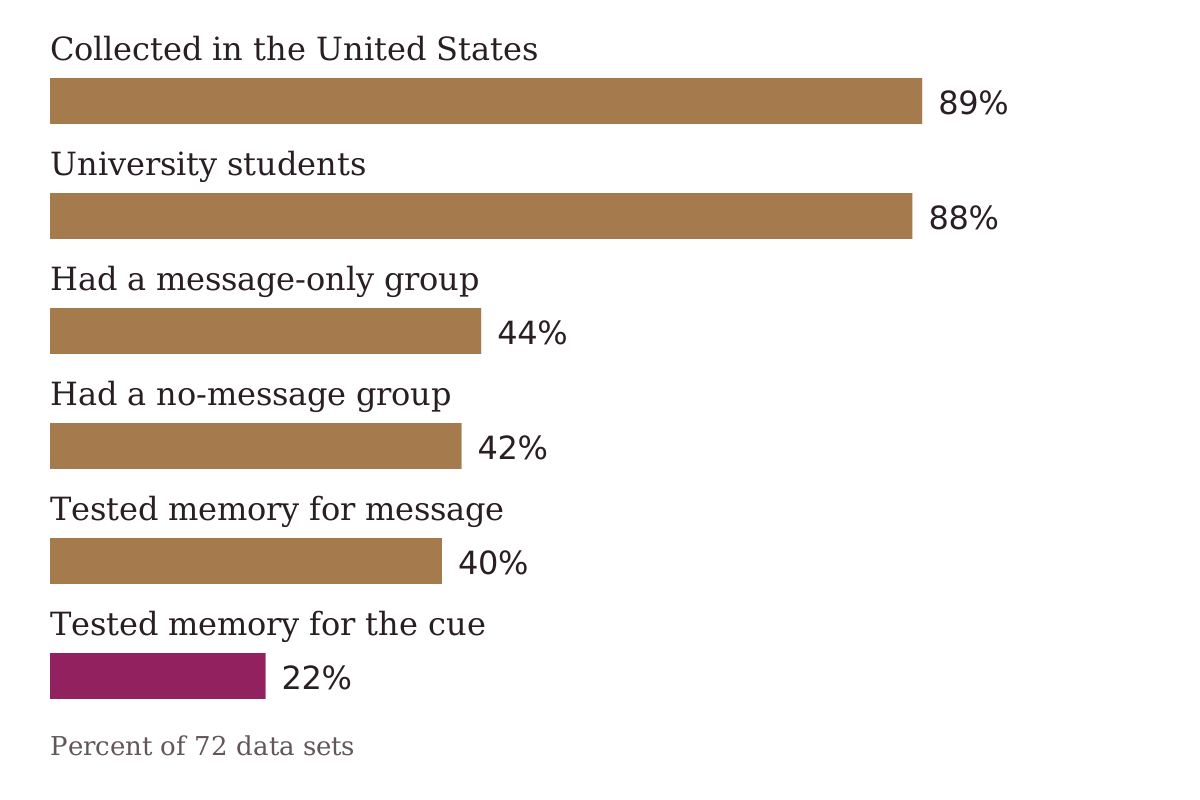
What the 72 data sets contain, as the 2004 review prints it. The 22% follows its text; the breakdown in Table 2 lists 22 data sets. 2004.
"What the 72 data sets contain" by Persuasion Dissected — https://persuasiondissected.com/persuaders/sleeper-effect/ — licensed CC BY 4.0: https://creativecommons.org/licenses/by/4.0/
Data: Kumkale and Albarracín, Psychological Bulletin 130 (2004), Table 2
The memory explanation rests on few data sets. By the paper’s text, 22% of data sets measured memory for the cue, though the breakdown in Table 2 lists 22 such data sets, which would be about 31% of 72. The regression linking recall to the effect rests on 11 of them: more recall of the source went with a weaker effect (Table 2; Effects on Recall section).
The authors read that as the most reliable evidence so far that fading recall plays a part, and they say their data cannot separate forgetting from dissociation (Recall mechanisms section). The length of the delay did not moderate the effect, and the authors suggest longer delays may reduce recall of arguments and source alike (Other Methodological Moderators section; Discussion).
Nothing in the review tests a historical case. It cannot say whether doubts about a showman’s exhibit, such as the Fiji mermaid, later wore off for anyone who saw it.
What came after 2004?
This page read one later study and did not survey the later literature. Albarracín, Kumkale and Patrick Poyner-Del Vento, in the Journal of Experimental Social Psychology 68 (online 2016, issue dated January 2017), reported a second pattern across three experiments. Their subtitle is “Not all sleeper effects are created equal.”
When attention went to the speaker, weak arguments from a credible source gained ground over time. When attention went to the arguments, strong arguments from a noncredible source gained ground, the older form of the effect [study stub: experiment; Exp. 1, n=48 to 62 in each of 4 conditions, N=215; Exp. 2, n=17 to 20 in each of 4 conditions, N=74; preregistered: unknown].
The delay was 45 minutes in the first two experiments and one week in the third. Two of the three authors wrote the review, so this is not an independent check.
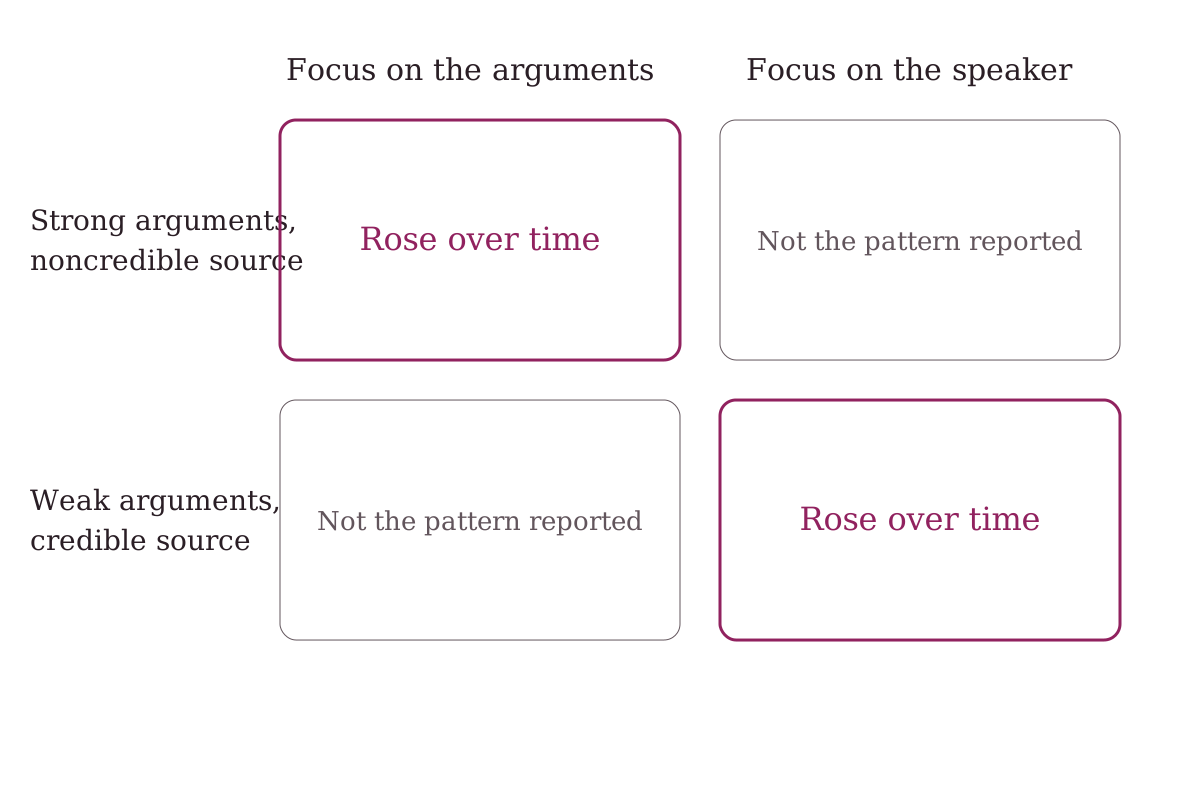
The 2016 study’s two sleeper patterns, as its authors report them. A schematic, not data. 2016.
"Two sleeper patterns in a 2016 study" by Persuasion Dissected — https://persuasiondissected.com/persuaders/sleeper-effect/ — licensed CC BY 4.0: https://creativecommons.org/licenses/by/4.0/
So the narrower claim stands in the sources read here. The broad one, that a doubtful source simply gains force with time, does not. No preregistered replication was read for this page, which is not the same as saying none exists. Other claims about persuasion have outrun their records in other ways, as with subliminal advertising.
Crossing map
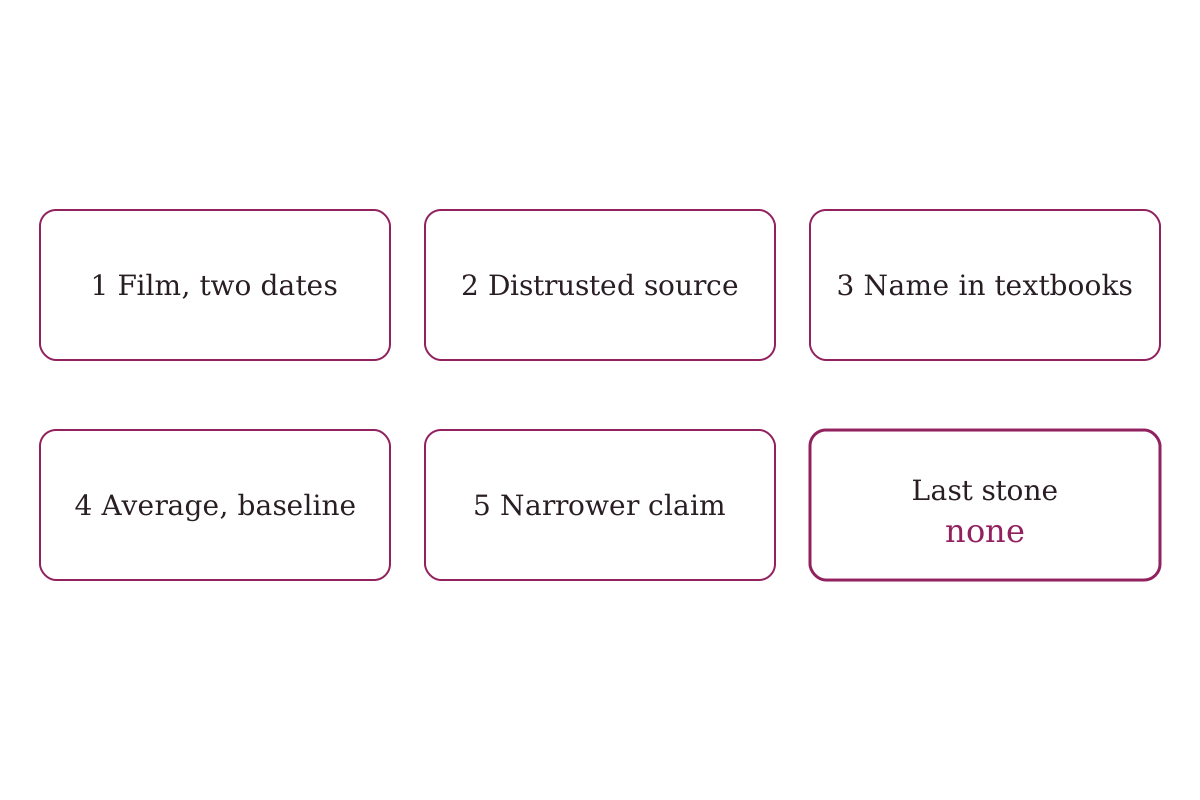
The stones of the sleeper effect’s reception, as the 2004 review reports them. 1949 to 2004.
"Crossing map of the sleeper effect’s reception" by Persuasion Dissected — https://persuasiondissected.com/persuaders/sleeper-effect/ — licensed CC BY 4.0: https://creativecommons.org/licenses/by/4.0/
- A film and two dates. Soldiers measured 5 days or 9 weeks after an army film, as reported in the review (Memory for the Source section) [1]; the book, bibliography only [4]
- A distrusted source. The 1951 design and the move from forgetting to dissociation, as reported (Forgetting and dissociation section; Recall mechanisms section) [1]; the paper, bibliography only [5]
- A name in the textbooks. The traditional description is a delayed rise for a low-credibility source (Selection Criteria section) [1]
- An average with a baseline. d+ 0.08 for discounted messages, 0.08 for no message, the second not significantly above zero (Table 4; Average sleeper effect section) [1]
- The narrower claim. About 0.25 with the cue last and an able, motivated audience (cue-timing results; Table 5) [1]
- No last stone in this case. The review states the distinction outright (Summary section) [1], and no record of what readers supplied was read, so the check for the last stone finds none
Sources
- Kumkale, G. Tarcan, and Dolores Albarracín. “The Sleeper Effect in Persuasion: A Meta-Analytic Review.” Psychological Bulletin 130, no. 1 (2004): 143–172. Copyright American Psychological Association; figures and paraphrase only. doi.orgRead: full text and footnotes; of the study-by-study Table 1, the 1951 rows only
- Albarracín, Dolores, G. Tarcan Kumkale, and Patrick Poyner-Del Vento. “How people can become persuaded by weak messages presented by credible communicators: Not all sleeper effects are created equal.” Journal of Experimental Social Psychology 68 (2017): 171–180. doi.orgRead: abstract, introduction, Experiment 1 method, Experiment 2 participants and the delays in Experiments 2 and 3
- Crossref record for 10.1037/0033-2909.130.1.143, checked for registered corrections and retractions. api.crossref.orgRead: record, as of 9 November 2026
- Hovland, C. I., A. A. Lumsdaine, and F. D. Sheffield. Experiments on Mass Communication. Princeton, NJ: Princeton University Press, 1949. As cited in the 2004 review, whose DOI is linked here; no record of the book itself was read. doi.orgRead: bibliography only
- Hovland, Carl I., and Walter Weiss. “The Influence of Source Credibility on Communication Effectiveness.” Public Opinion Quarterly 15 (1951): 635–650. doi.orgRead: bibliography only
- Weiss, Walter. “A ‘sleeper’ effect in opinion change.” Journal of Abnormal and Social Psychology 48 (1953): 173–180. doi.orgRead: bibliography only
- Kelman, Herbert C., and Carl I. Hovland. “‘Reinstatement’ of the communicator in delayed measurement of opinion change.” Journal of Abnormal and Social Psychology 48 (1953): 327–335. doi.orgRead: bibliography only
- Capon, Noel, and James Hulbert. “The Sleeper Effect—An Awakening.” Public Opinion Quarterly 37 (1973): 333–358. doi.orgRead: bibliography only
- Gillig, Paulette M., and Anthony G. Greenwald. “Is it time to lay the sleeper effect to rest?” Journal of Personality and Social Psychology 29 (1974): 132–139. doi.orgRead: bibliography only
- Gruder, Charles L., Thomas D. Cook, Karen M. Hennigan, Brian R. Flay, Cynthia Alessis, and Jerome Halamaj. “Empirical tests of the absolute sleeper effect predicted from the discounting cue hypothesis.” Journal of Personality and Social Psychology 36 (1978): 1061–1074. doi.orgRead: bibliography only
- Cook, Thomas D., Charles L. Gruder, Karen M. Hennigan, and Brian R. Flay. “History of the sleeper effect: Some logical pitfalls in accepting the null hypothesis.” Psychological Bulletin 86 (1979): 662–679. doi.orgRead: bibliography only
- Pratkanis, Anthony R., Anthony G. Greenwald, Michael R. Leippe, and Michael H. Baumgardner. “In search of reliable persuasion effects: III. The sleeper effect is dead: Long live the sleeper effect.” Journal of Personality and Social Psychology 54 (1988): 203–218. doi.orgRead: bibliography only
- Priester, Joseph, Duane Wegener, Richard Petty, and Leandre Fabrigar. “Examining the Psychological Process Underlying the Sleeper Effect: The Elaboration Likelihood Model Explanation.” Media Psychology 1 (1999): 27–48. doi.orgRead: bibliography only
Next crossing
- Animal magnetism — A 1784 report that tested a famous claim by taking away what its subjects could see.
- Subliminal advertising — A claim about unseen influence whose reputation traveled further than its record.
Cite this page
Persuasion Dissected. "Sleeper Effect: Do Doubted Messages Persuade More Later?." Persuasion Dissected. Published 2026-11-11. https://persuasiondissected.com/persuaders/sleeper-effect/. Accessed: add the date you read it.
Corrections
No corrections yet.
How pieces are checked · All corrections · Contact · Report an error (contact@persuasiondissected.com)