Animal Magnetism: The 1784 Panel Would Not Judge It by Cures
In three lines
- Who persuaded whom: Nine commissioners named by the king of France told him and the reading public in 1784 that animal magnetism, the healing fluid Mesmer claimed to have found, was “absolutely destitute of proof.”
- Which stones: They set cures aside, let Mesmer’s pupil Deslon stand in for Mesmer, then took away what subjects could see, using blindfolds, an orchard and a paper door.
- Outcome: In the commissioners’ reading of their own tests, effects followed belief and left the operation behind, and they blamed compression, imagination and imitation. In the 1785 translator’s account, Mesmer complained to the Paris parliament.
Route through this piece (10)
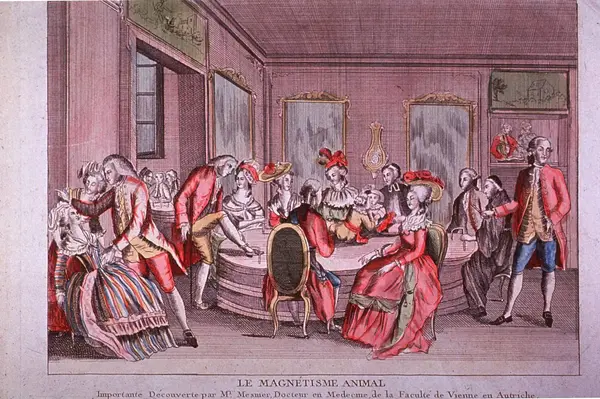
Le Magnétisme Animal, a French engraving of the treatment, captioned “Importante Découverte par Mr. Mesmer.” A print, not a record of any test. 1780s.
"Le Magnétisme Animal" by Unknown author. Public domain.
Full credit
"Le Magnétisme Animal" by Unknown author — https://commons.wikimedia.org/wiki/File:Le_Magn%C3%A9tisme_Animal_(36721856593).jpg — Public domain — Public domain in the US (published 178-) and in the EU (anonymous French print of the 1780s, 70 years passed); modified: resized to 1400 px wide; no crop
Case card
- Case
- The royal inquiry of 1784 into animal magnetism (Mesmer’s claim, Deslon’s practice)Rapport des commissaires (Paris: Moutard, 1784), p. 1
- Date range
- 12 March 1784 (commissioners named) to 11 August 1784 (report signed)Rapport des commissaires (Paris: Moutard, 1784), pp. 1, 62
- Place
- Paris and Passy: Deslon’s house, Franklin’s house, Majault’s house, Jumelin’s house, the ArsenalRapport des commissaires (Paris: Moutard, 1784), pp. 16, 18, 26, 30, 36, 39
- Persuader(s)
- Nine commissioners signing together: Franklin, Majault, Le Roy, Sallin, Bailly, d’Arcet, de Bory, Guillotin, LavoisierRapport des commissaires (Paris: Moutard, 1784), p. 62
- Audience
- The king of France, who ordered the report, and its readers in printRapport des commissaires (Paris: Moutard, 1784), p. 1
- The ask
- Accept, on the commissioners’ report of their own tests, that the magnetism without the imagination produces nothing and that the fluid has no proofRapport des commissaires (Paris: Moutard, 1784), p. 62; Report of Dr. Benjamin Franklin, and other commissioners (London: J. Johnson, 1785)
- Channel
- Printed report, Paris, 1784; English translation, London, 1785Rapport des commissaires (Paris: Moutard, 1784); Report of Dr. Benjamin Franklin, and other commissioners (London: J. Johnson, 1785)
- Outcome
- Unanimous by the report. By a letter the 1785 translator quotes, Mesmer complained to the Paris parliament, which on 6 September 1784 ordered him to lay out his doctrine; the sequel was not read for this pageRapport des commissaires (Paris: Moutard, 1784), p. 62; Report of Dr. Benjamin Franklin, and other commissioners (London: J. Johnson, 1785), postscript to the introduction
- Primary record
- Rapport des commissaires chargés par le Roi de l’examen du magnétisme animal (Paris: Moutard, 1784)Rapport des commissaires (Paris: Moutard, 1784), BIU Santé copy
In 1784, in Franklin’s orchard at Passy, commissioners led a blindfolded boy to four trees nobody had magnetized. M. Deslon, the pupil of Mesmer who chose the boy, had agreed that a touched tree should act on a sensitive subject. He stood far off, aiming his cane at a fifth tree, an apricot. The test asked one thing about animal magnetism: whether the effects would follow the operation or what the boy believed about it.
By the report the commissioners signed, the boy fainted at the fourth tree, about 24 feet from the apricot. Their summary of every such test is the line at the top of this page, and that line is what this page takes apart. Every account of the tests on this page, the orchard included, is the commissioners’ own, and no independent minutes were read.
What was animal magnetism, and who was Mesmer?
Animal magnetism was Mesmer’s name for a physical force that, he claimed, acted on the body and could heal it. The report opens by quoting him: “It is a fluid universally diffused; the vehicle of a mutual influence between the celestial bodies, the earth and the bodies of animated beings.” In his wording it could cure “immediately diseases of the nerves, and mediately other distempers.”
The biography comes from the unnamed translator of the 1785 English edition, who writes as an opponent. In that account Mesmer was a German physician who defended a thesis on the stars at Vienna in 1766. The Berlin academy rejected his principles in 1776, and he reached Paris early in 1778. There, the translator writes, “His patients increased rapidly.”
What the commissioners actually watched was the public treatment run by Deslon. Patients were arranged in ranks around an oak box, “about a foot or a foot and an half deep,” called the bucket, or baquet. Iron branches came out of its lid, a cord circled the patients, a piano played in the corner, and the people running the session held iron rods. Deslon told the commissioners that each of these carried the fluid.
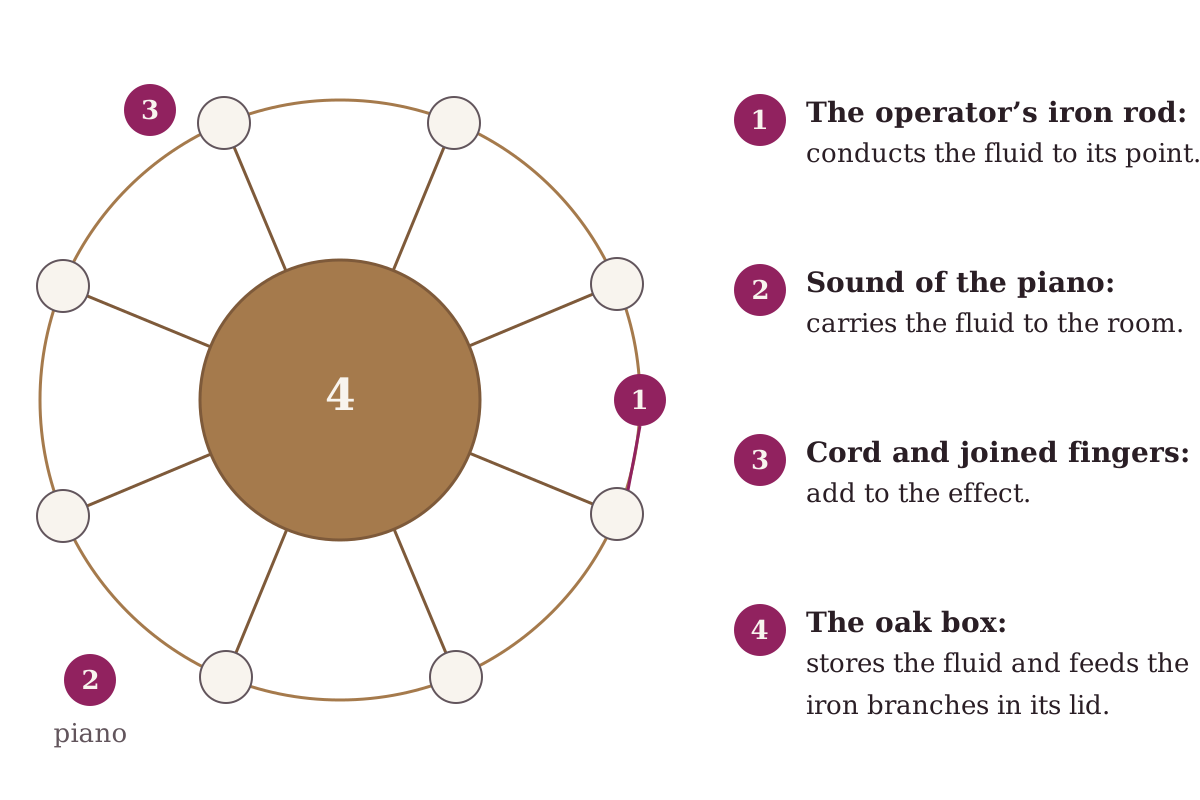
The bucket as M. Deslon described it to the commissioners, with his four claims numbered. A schematic, not to scale. 1784.
"The bucket as Deslon described it" by Persuasion Dissected — https://persuasiondissected.com/persuaders/animal-magnetism/ — licensed CC BY 4.0: https://creativecommons.org/licenses/by/4.0/
The commissioners tried an electrometer and an unmagnetized iron needle on the box and found “no substance either electric or magnetical.” They also saw the crises, convulsions that sometimes “lasted upwards of three hours,” with many women and few men among those affected. “Nothing can be more astonishing than the sight of these convulsions,” the report says, and it does not deny that something happened to these patients, because its question is what caused it.
Who wrote the 1784 report, and was it Franklin?
The king named four physicians of the Paris faculty on 12 March 1784, then added five members of the Royal Academy of Sciences at their request. One physician, Borie, died early in the work and Majault replaced him. Nine men signed on 11 August 1784: Franklin, Majault, Le Roy, Sallin, Bailly, d’Arcet, de Bory, Guillotin and Lavoisier.
The French title names a group, Rapport des commissaires. The 1785 London title puts one man first, Report of Dr. Benjamin Franklin, and other commissioners, and its introduction places him “at their head.” The report itself says “the weakness of his health hindered him from coming to Paris,” so he missed the Paris sessions, and some tests came to his house at Passy instead.
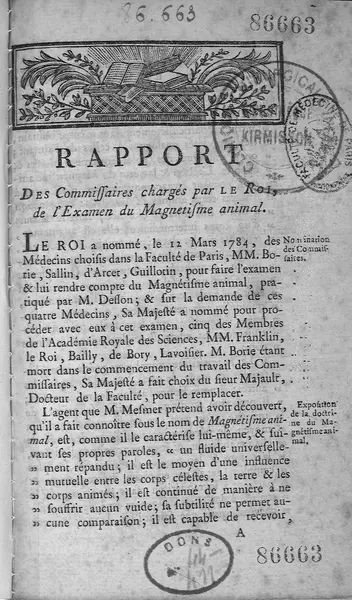
Opening page of the report, naming the commissioners and the “Magnétisme animal, pratiqué par M. Deslon.” Paris, 1784.
"Rapport des commissaires chargés par le Roi de l’examen du magnétisme animal, p. 1" by Commissioners named by the King of France. Public domain.
Full credit
"Rapport des commissaires chargés par le Roi de l’examen du magnétisme animal, p. 1" by Commissioners named by the King of France — https://archive.org/details/BIUSante_86663 — Public domain — Public domain in the US (published 1784) and in the EU (published 1784; life+70 of all nine signers long passed); modified: resized to 900 px wide; no crop
This page therefore credits every line to the commissioners as a body. On this site’s reading, the English title shows a report’s name starting to run ahead of its text, a pattern that comes up again with the sleeper effect.
Why did the commissioners refuse to judge by cures?
Deslon wanted the test to be his patients’ recoveries, “principally, and nearly exclusively,” and the commissioners refused. People get well without help, they argued, so that a treatment credited with those recoveries could look useful “when in reality it might have no action at all.”
They then quoted Mesmer against his pupil’s request. A member of the academy had once proposed cures to him as the proof. “It is a mistake,” replied he, “to imagine that this kind of proof is unanswerable; it cannot be demonstrated that either the physician or the medicine causes the recovery of the patient.”
So the report judges short-term effects on the body and calls cures evidence that is “always uncertain, often deceitful.” It does not measure whether Deslon’s patients improved. Deslon still maintained on 19 June that many had been “either entirely cured or infinitely amended.” The report itself grants that imagination has “a very frequent and considerable share in the cure of their diseases.” None of this is a view on treating anyone today.
What happened when they tried it on themselves?
The commissioners went first, at a private bucket, two and a half hours a session, weekly and then three days running. “Not one of the commissioners felt any sensation, or at least none which ought to be ascribed to the action of the magnetism.” Three did note minor symptoms, which the commissioners put down to their usual health or to pressure on the stomach, so the verdict is their own judgment of their own bodies.
Among sick people the count was closer: “Of fourteen sick persons five only appeared to feel any effect from the operation, nine felt no effect at all.” Three lower-class patients who felt something drew an explanation with no test behind it: such a person “is paid for his compliance” and hopes to satisfy the company. That is a suspicion about the subjects, voiced by the people running the session.
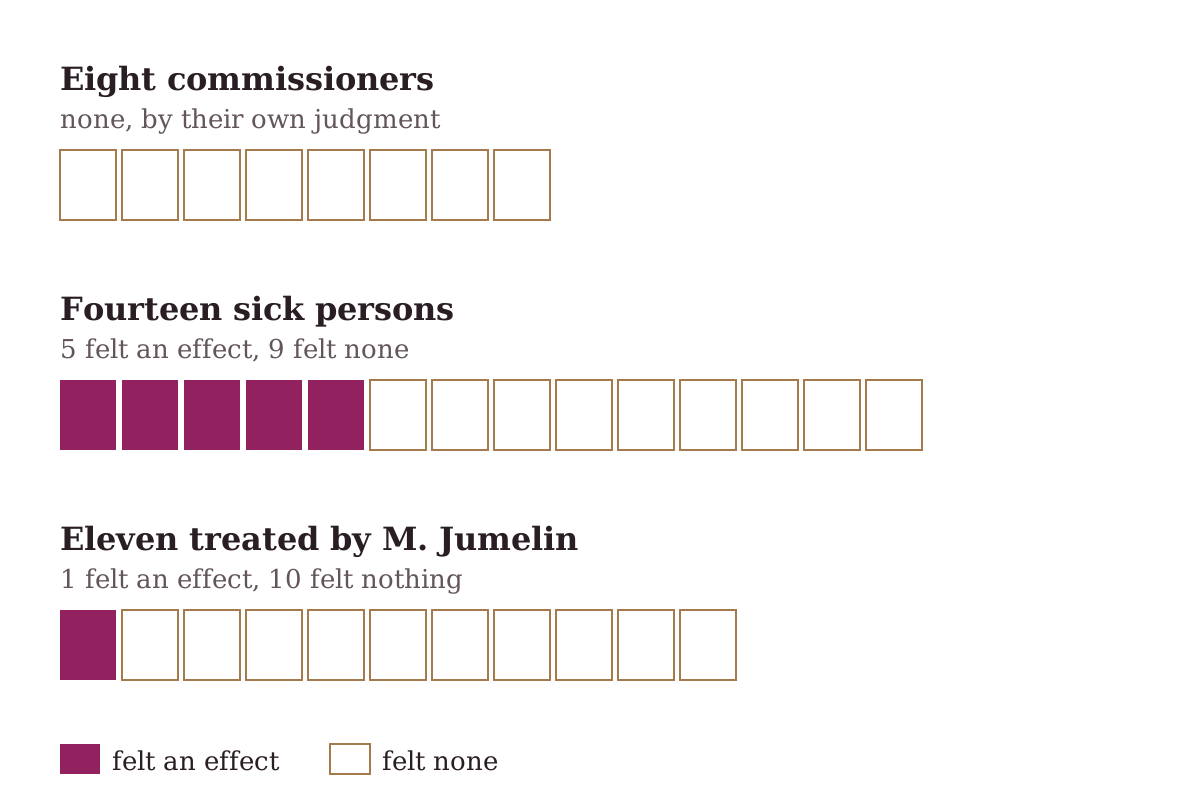
The commissioners’ tallies before the hidden tests, with effects as they judged them. 1784.
"What the commissioners tallied before the hidden tests" by Persuasion Dissected — https://persuasiondissected.com/persuaders/animal-magnetism/ — licensed CC BY 4.0: https://creativecommons.org/licenses/by/4.0/
What did the blindfold change?
The commissioners next heard of M. Jumelin, a physician who told them he was “a disciple neither of M. Mesmer, nor of M. Deslon.” Of eleven people he treated, one woman reported heat. They proposed to blindfold her “in order to observe what her sensations would be, when she could no longer know any thing respecting the conduct of the experiment.” The report tells the sequence in order:
- Blindfolded, treated. Now “the phenomena no longer answered to the places towards which the magnetism was directed.”
- Eyes open, hands on the upper belly. She reported heat, then fainted.
- Blindfolded, Jumelin moved away, silence requested, told it was happening. “The effects were the same, though no operation, either near or distant was performed.”
- Blindfolded, a quarter of an hour later, Jumelin signaled to treat her. At the stomach “she felt no sensation,” the back was the same, and the pains in her head went on.
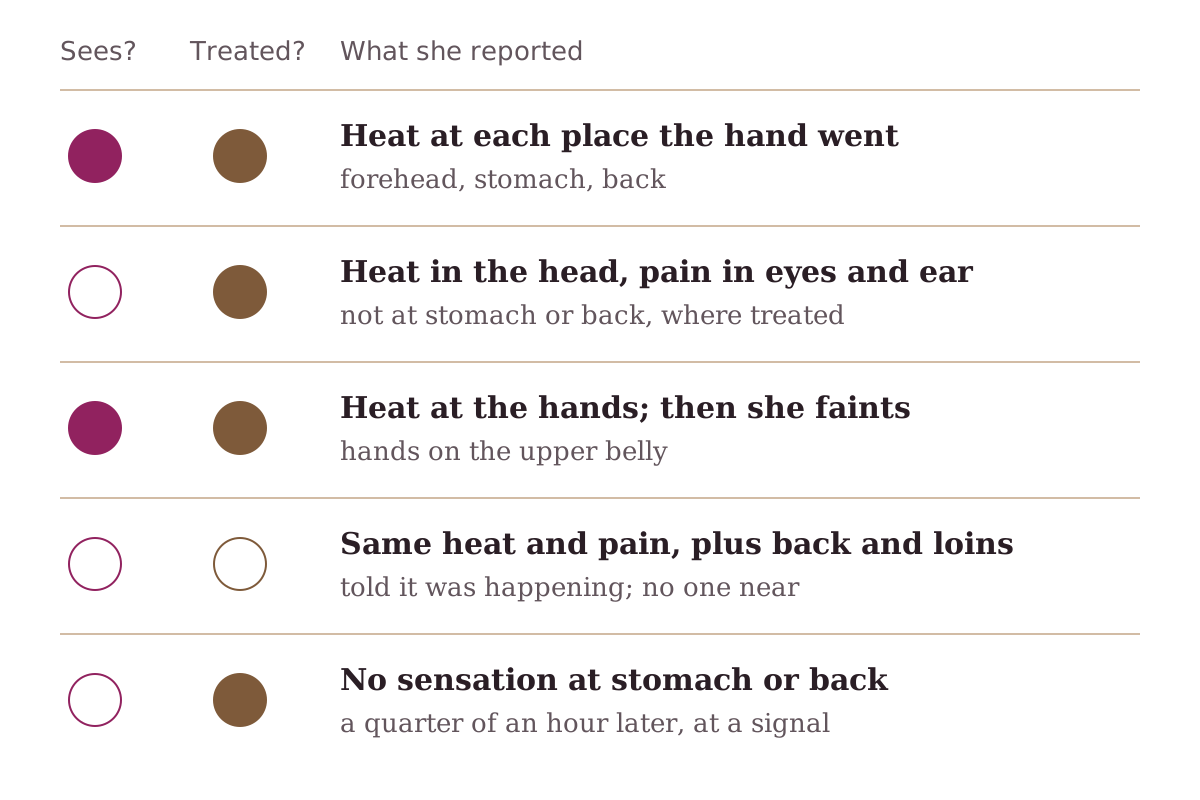
The woman tested at M. Majault’s house, in the order the report gives. 1784.
"The blindfold sequence at M. Majault’s house" by Persuasion Dissected — https://persuasiondissected.com/persuaders/animal-magnetism/ — licensed CC BY 4.0: https://creativecommons.org/licenses/by/4.0/
The commissioners expected one reply, that Jumelin’s method was not Mesmer’s. “It would be to no purpose to object, that the method of M. Jumelin was a bad one,” they wrote, “for at the present moment it was not proposed to bring the magnetism, but the imagination to the proof.” These sessions test what belief can do and leave Deslon’s practice for later.
The bandage gets a careful description, with elastic-gum cups packed with down and tied behind the head, so that no one wearing it could “receive even the smallest particle of light.” M. B----, a man of medical learning, wore it and felt a heat “which he compared to that of a stove” before anyone had treated him. Deciding what a person may learn before answering also shapes the Lizzie Borden trial.
Why did the boy faint at the wrong tree?
The orchard test was built to head off an obvious reply, that a subject might simply lack sensitivity. Deslon said it should work “provided the subject were extremely susceptible,” so the commissioners had him choose and bring the subject. He treated the apricot alone while the boy, about twelve, stayed in the house with a companion.
They wanted Deslon gone for the test itself, but he said he could not answer for its success unless he could “direct his cane and his countenance towards the tree.” So he stayed, far off, with commissioners standing between him and the boy to block signals. The boy embraced each tree for two minutes, the contact Deslon had prescribed.
| Tree (none treated) | Distance from the apricot | What the boy reported |
|---|---|---|
| First | about 27 feet | Sweating, a cough, a slight headache |
| Second | 36 feet | Stupefaction, pain in the head |
| Third | about 38 feet | Both worse; says he believes he is nearing the tree |
| Fourth | about 24 feet | Faints, limbs stiffen, carried to the grass |
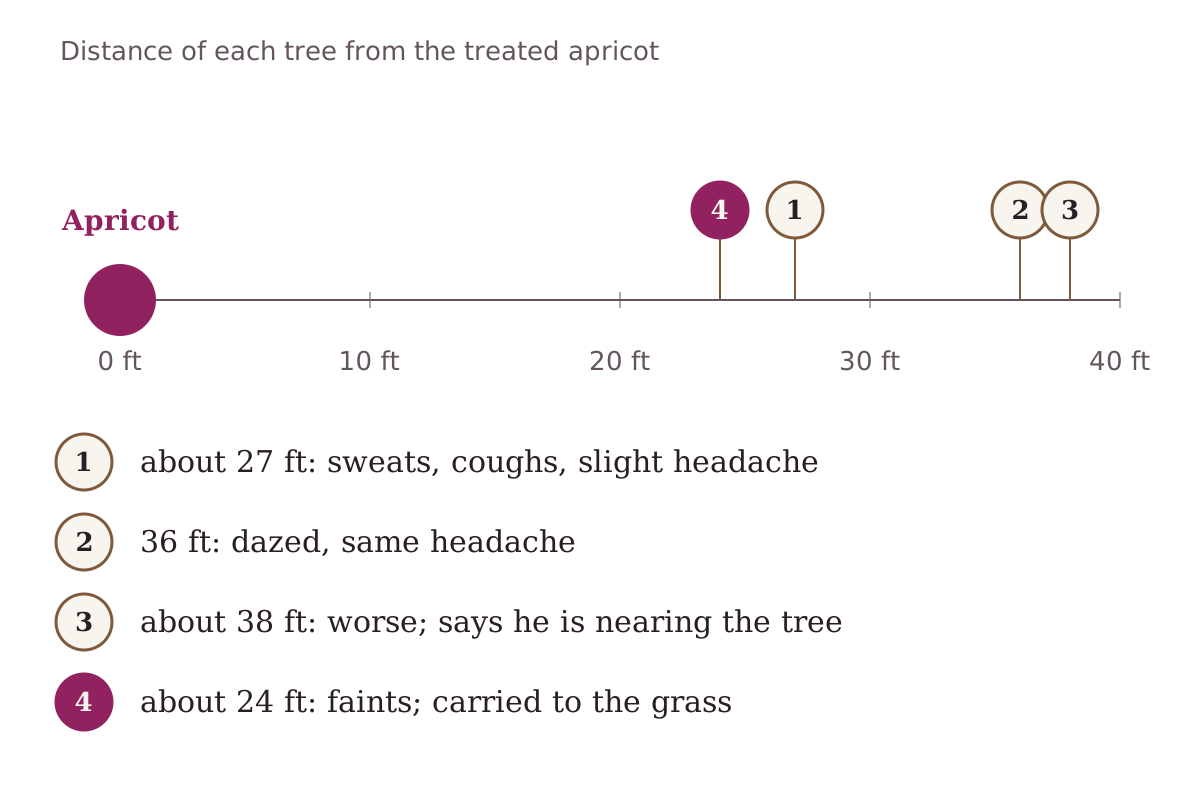
The four untreated trees by distance from the treated apricot, per the report. The fainting came at the fourth. 1784.
"Four untreated trees by distance from the apricot" by Persuasion Dissected — https://persuasiondissected.com/persuaders/animal-magnetism/ — licensed CC BY 4.0: https://creativecommons.org/licenses/by/4.0/
Deslon’s answer was that “all the trees by their very nature, participated of the magnetism,” reinforced by his presence. The report replied that a sensitive person then “could not hazard a walk in a garden without the risk of convulsions.” It added that the boy had sat opposite Deslon in the coach and “felt nothing.”
The report calls the test “entirely conclusive.” It covers one boy on one day, with the practitioner still in the orchard, and it rests on a statement the report supplies itself: “the boy knew that he was about to be led to a tree upon which the magnetical operation had been performed.” The report records no question put to him on that point.
What happened behind the paper door?
A margin note in the 1784 printing labels this test « Quatorzième expérience, qui prouve que le Magnétisme ne produit rien sans l’imagination », the fourteenth experiment, proving that magnetism produces nothing without imagination. The English text on Project Gutenberg does not carry these margin notes.
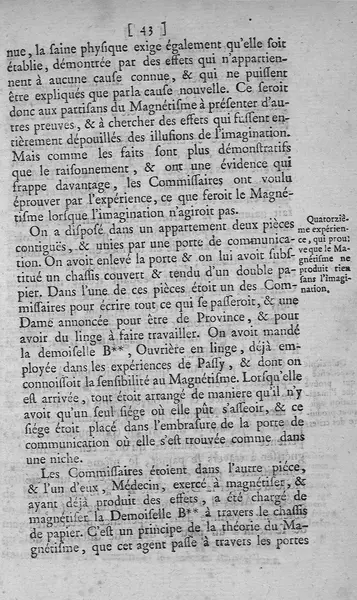
Page 43, with the margin note naming the paper-door test as the fourteenth experiment. Paris, 1784.
"Rapport des commissaires chargés par le Roi de l’examen du magnétisme animal, p. 43" by Commissioners named by the King of France. Public domain.
Full credit
"Rapport des commissaires chargés par le Roi de l’examen du magnétisme animal, p. 43" by Commissioners named by the King of France — https://archive.org/details/BIUSante_86663 — Public domain — Public domain in the US (published 1784) and in the EU (published 1784; life+70 of all nine signers long passed); modified: resized to 900 px wide; no crop
The commissioners replaced a door between two rooms with a wooden frame covered in a double layer of paper. Mademoiselle B---- was a seamstress whose sensitivity was known from Passy, where a shut door with nothing behind it had brought a crisis in the third minute. She was sent for on a pretext about a lady’s linen, and the only seat stood in the door frame.
From the far side, a physician among the commissioners treated her through the paper for thirty minutes, by Deslon’s rules, at a foot and a half, while she “conversed with much gaiety.”
The second half answered the objection that she was simply unreceptive that day. The same commissioner walked round and treated her in the open at the same distance, in the direction the theory said should do nothing. “In three minutes however she felt a sensation of dejection and suffocation,” and the crisis was complete within twelve. “The only ground of difference that remains,” the report says, “is the play that was afforded in the latter instance to the imagination.”
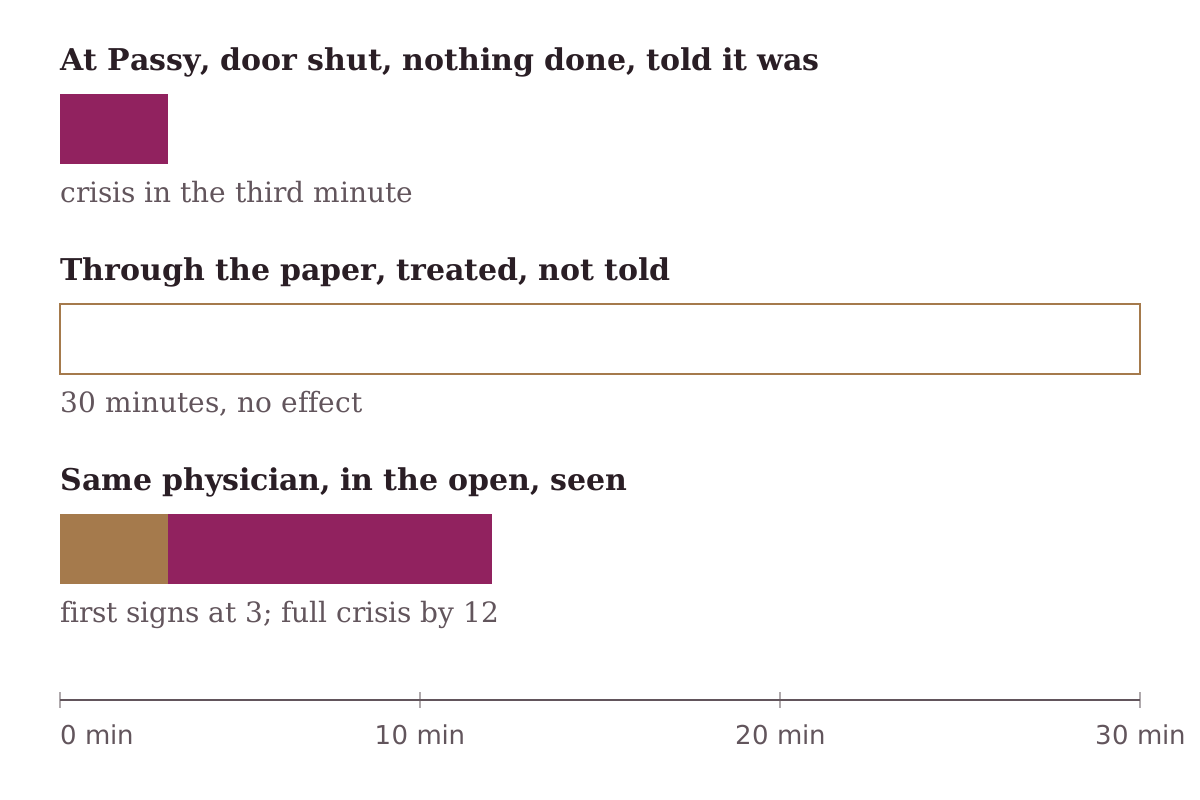
One woman in three sessions, by the commissioners’ timings. Passy, then the paper door, then the open room. 1784.
"One woman in three sessions, in minutes" by Persuasion Dissected — https://persuasiondissected.com/persuaders/animal-magnetism/ — licensed CC BY 4.0: https://creativecommons.org/licenses/by/4.0/
The cups gave a matching result in the tenth and eleventh experiments. Dame P----, already in a crisis from the anteroom on, as the report admits, was handed untreated china cups and reached a complete crisis at the fourth, and she then drank from the treated cup “with perfect calmness.” Later it was held behind her head for twelve minutes during an eye examination, and she noticed nothing.
The English says “basons” where the French says tasses. Seventeen of the report’s sessions have a row each in the CSV (where this data comes from), with French page numbers. It is a selection, and the eyes-open treatment at M. Majault’s house, for one, has no row.
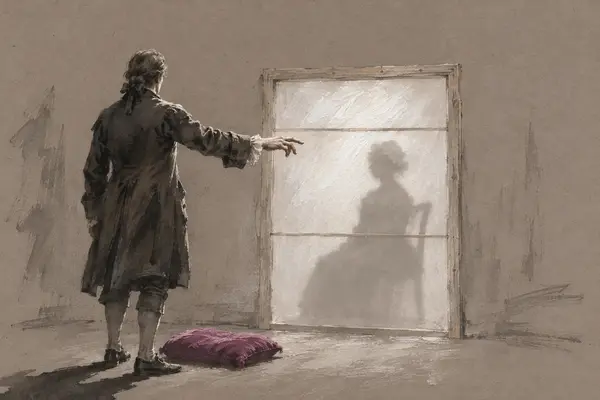
The paper door, as the report describes it: one seat in the frame and a physician on the far side. 1784.
Illustration — not a historical depiction
Illustration: Persuasion Dissected. Generated schematic illustration — not a photograph or historical record. Reuse: CC BY 4.0 (https://creativecommons.org/licenses/by/4.0/), to the extent any rights exist.
What did the report actually conclude?
The full claim is a pair: “the imagination without the magnetism produces convulsions, and that the magnetism without the imagination produces nothing.” The sentence then moves in two steps. It says “the existence of the fluid is absolutely destitute of proof,” and next “the fluid having no existence can consequently have no use.” No proof becomes no existence inside one sentence. A few pages earlier the report had said it flat: “this fluid has no existence.”
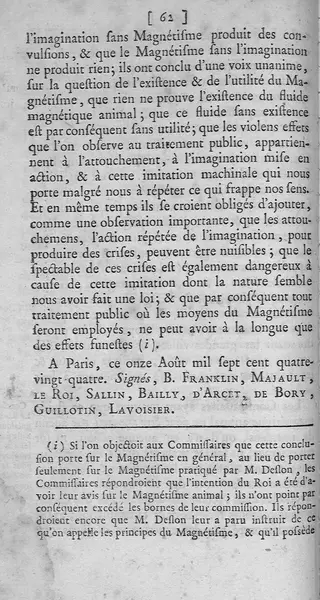
Page 62, with the sentence the ask comes from, the nine names and the start of note (i). Paris, 1784.
"Rapport des commissaires chargés par le Roi de l’examen du magnétisme animal, p. 62" by Commissioners named by the King of France. Public domain.
Full credit
"Rapport des commissaires chargés par le Roi de l’examen du magnétisme animal, p. 62" by Commissioners named by the King of France — https://archive.org/details/BIUSante_86663 — Public domain — Public domain in the US (published 1784) and in the EU (published 1784; life+70 of all nine signers long passed); modified: resized to 900 px wide; no crop
“Nothing” is also wider than the tests it sums up. M. B---- was “often feeling nothing when the operation was performed,” which stops well short of every time. The woman Jumelin treated blindfolded still reported heat and pain, in the wrong places, and the commissioners counted those reports as imagination at work.
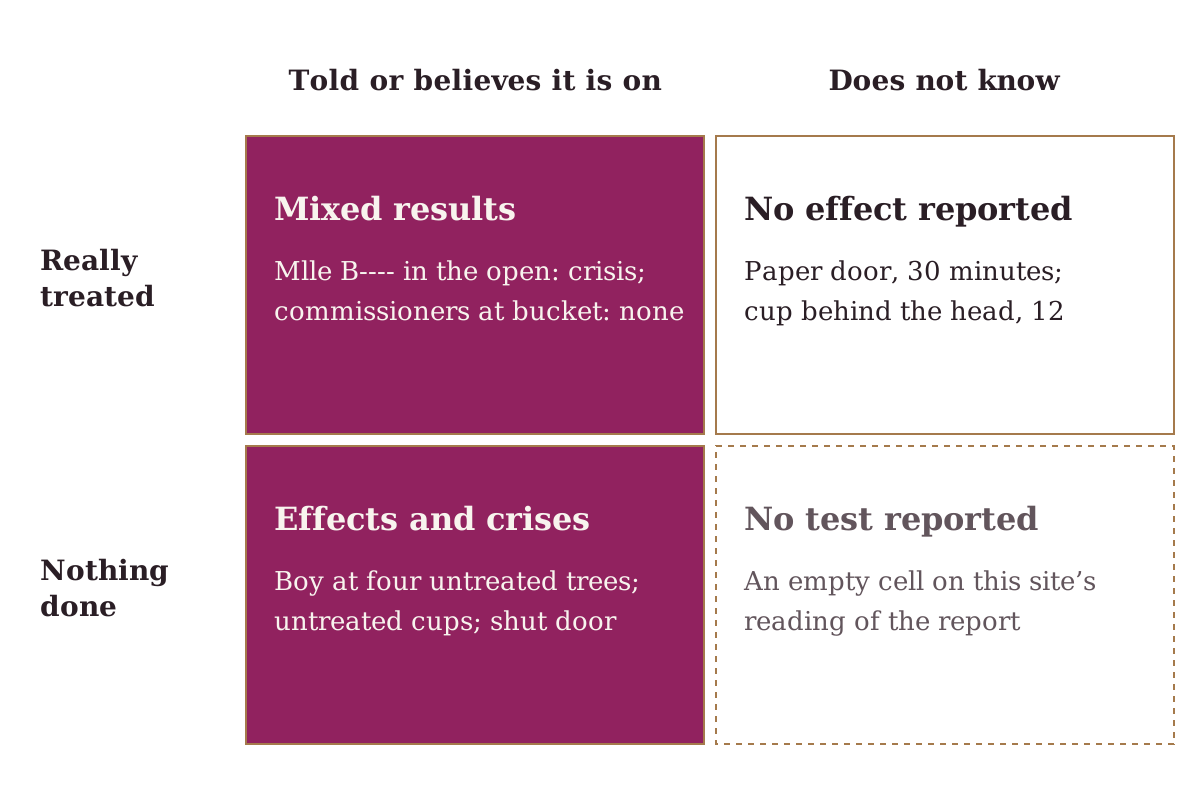
This site’s sorting of the report’s tests by what was done and what the subject believed. The empty cell is this site’s observation. 1784.
"The report’s tests sorted by treatment and belief" by Persuasion Dissected — https://persuasiondissected.com/persuaders/animal-magnetism/ — licensed CC BY 4.0: https://creativecommons.org/licenses/by/4.0/
| By the commissioners’ report | Told, or believes it is on | Does not know |
|---|---|---|
| Really treated | Mixed: Mlle B---- in the open, a crisis; commissioners at the bucket, nothing felt | No effect reported: paper door, 30 minutes; cup behind the head, 12 minutes |
| Nothing done | Effects and crises: the boy at four untreated trees; untreated cups; the shut door | No test reported, on this site’s reading |
Imagination is also not the report’s only cause. “Compression, imagination, imitation are therefore the true causes,” it says, pointing to hands pressed on the abdomen and to contagion in crowds, which it compares to theaters and armies. It ranks imagination first with a hedge: “There is room to believe that the imagination is the principal of the three causes.” It ends on a warning that public treatment “cannot fail in the end of producing the most pernicious effects.”
Deslon partly agreed: at the session of 19 June, the report says, he thought “the imagination had the greatest share in the effects.” In 1780, by a note in the report, he had already asked why “the physic of the imagination should not be brought into general use.”
Did the tests cover Mesmer himself?
No test in the report has Mesmer operating. The king’s order, as the report gives it, concerned “the animal magnetism practised by M. Deslon,” and the 1785 translator says Mesmer “refused to have any communication” with the commission. Yet the conclusion covers magnetism in general.
The commissioners saw that objection and answered it in a long note: “If it be objected to the commissioners that this decision concludes respecting the magnetism in general, instead of relating singly to the magnetism practised by M. Deslon,” they reply that the king wanted their view of animal magnetism.
Deslon, they add, had been Mesmer’s pupil for years and had treated the same patients: “The method which is followed at this day by M. Deslon can be no other than the method of M. Mesmer.” Mesmer’s theory they call “indifferent and superfluous.”
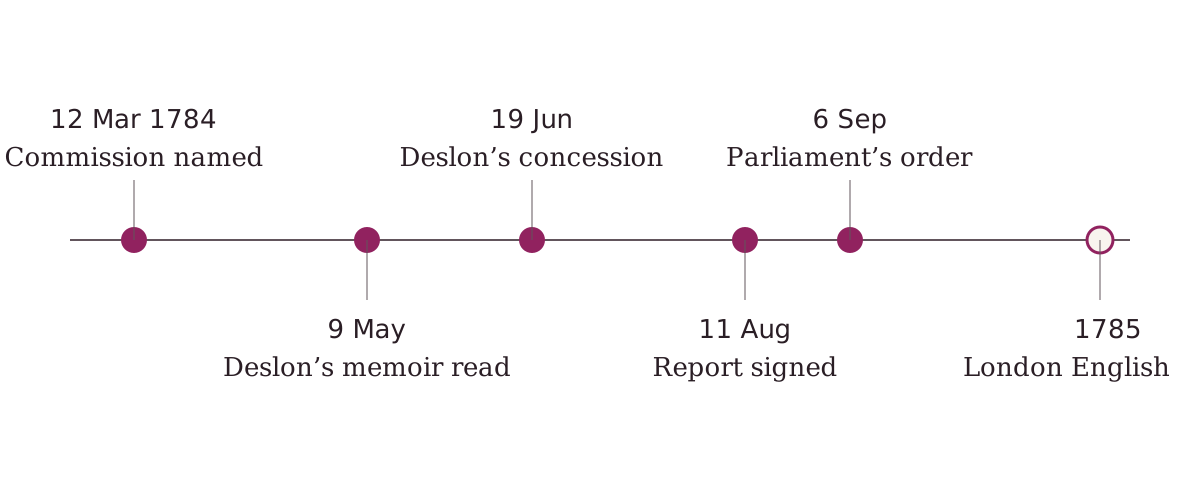
From the king’s order to the English edition. 12 March 1784 to 1785.
"From the king’s order to the English edition" by Persuasion Dissected — https://persuasiondissected.com/persuaders/animal-magnetism/ — licensed CC BY 4.0: https://creativecommons.org/licenses/by/4.0/
Mesmer’s side reaches this book only second-hand. A letter quoted in the translator’s postscript says he complained to the Paris parliament and asked for a new commission to examine “not his theory and practice, but” a plan. It then gives a ruling of 6 September 1784 ordering him to lay out his doctrine before four doctors, two surgeons and two pharmacists. Mesmer’s own reply and the sequel were not read for this page, so neither is reported here.
Is there a last stone in the report?
The report is open about how it is built: “These experiments we shall not confine ourselves to relate in the order of time, but shall follow the order of the facts they were intended to elucidate.” The commissioners also made “an infinite number of experiments” that it does not itemize. A reader gets what they chose to tell, in their words: “the demonstration was complete,” “entirely conclusive,” “the inevitable conclusion.” An official body’s account of its own work is also the main record of the Four Minute Men.
This site uses the last stone for a premise a persuader leaves unsaid and an audience supplies, and this case has none. The report states its conclusion outright, and it states its widest step, from Deslon to magnetism in general, in its own note. It rests on its own tests, told by men “charged with the mandates of the sovereign.”
The nearest candidate is a matter of wording. The French says « Le Magnétisme n’est donc qu’une vieille erreur », an old error, and calls the theory « fausse », false, while physicians « y ont été trompés », were deceived by it. It adds that someone tied the idea to the heavens « pour qu’il séduisît davantage », to seduce the more, naming no one. The text read for this page says of no practitioner that he lied, and it does not use the word imposture.
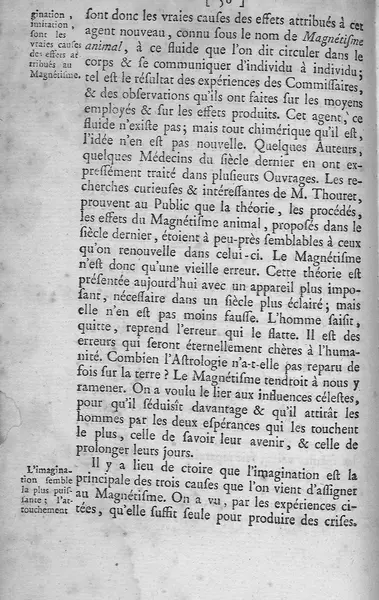
Page 56, where the report calls magnetism « une vieille erreur ». Paris, 1784.
"Rapport des commissaires chargés par le Roi de l’examen du magnétisme animal, p. 56" by Commissioners named by the King of France. Public domain.
Full credit
"Rapport des commissaires chargés par le Roi de l’examen du magnétisme animal, p. 56" by Commissioners named by the King of France — https://archive.org/details/BIUSante_86663 — Public domain — Public domain in the US (published 1784) and in the EU (published 1784; life+70 of all nine signers long passed); modified: resized to 900 px wide; no crop
The English edition goes further, because the same sentence reads “The magnetism then is no more than an old falshood.” The translator’s introduction says “the system of the animal magnetism is to be regarded as an imposture.” That is still no last stone. The report’s ask does not need a charge of fraud, and the same introduction opens by saying others had decried the system as “the juggle of an unprincipled impostor,” so the record does not show this reader getting the charge from the report.
The record shows one reader in print in 1785 going further than the nine signers, and a single translated word may carry less than it seems to. It shows nothing about what the king or the readers of Paris concluded.
Crossing map
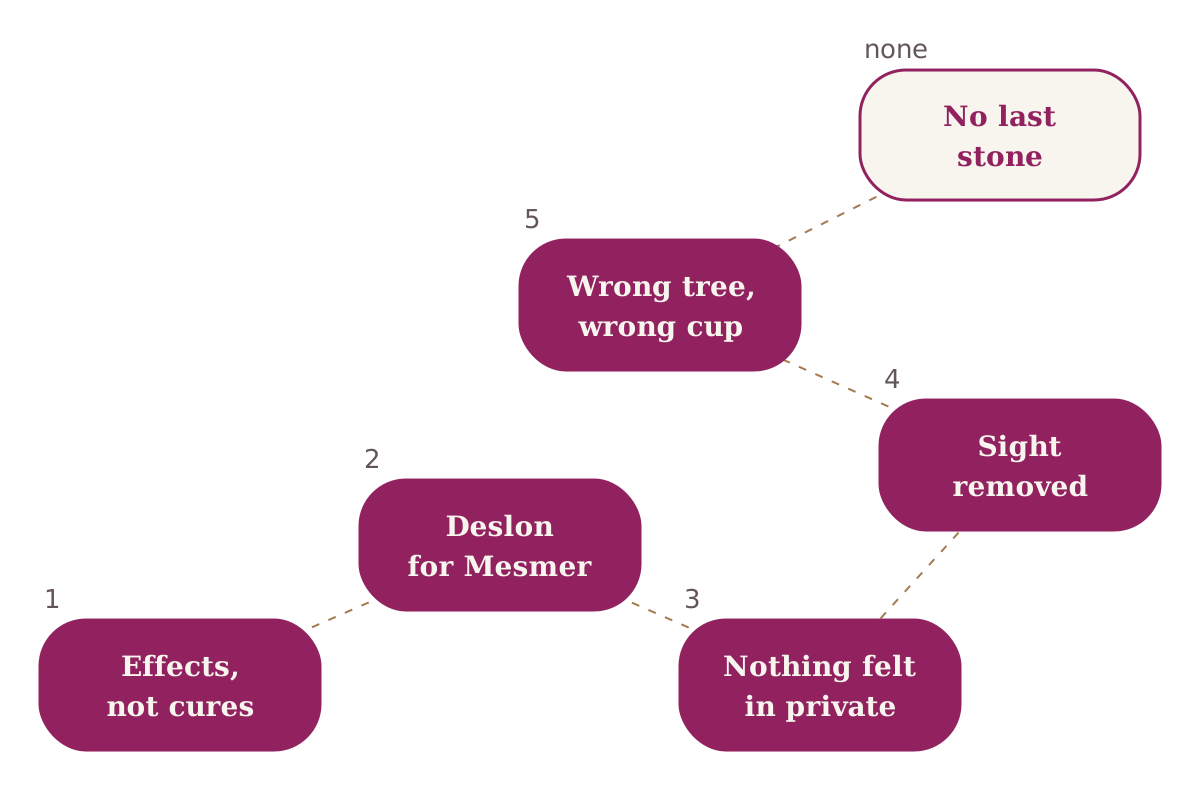
Crossing map of the commissioners’ report. No last stone is marked. 12 March to 11 August 1784.
"Crossing map of the 1784 report" by Persuasion Dissected — https://persuasiondissected.com/persuaders/animal-magnetism/ — licensed CC BY 4.0: https://creativecommons.org/licenses/by/4.0/
- Effects, not cures. The commissioners set recoveries aside and confine themselves to short-term effects on the body (p. 14) [1]; “always uncertain, often deceitful” [2]
- Deslon for Mesmer. The order names Deslon (p. 1); note (i) extends the finding to magnetism in general (pp. 62–64) [1]
- Nothing felt in private. Eight subjects at the private bucket; five of fourteen sick persons (pp. 17–18, 22) [1]
- Sight removed. The blindfold at M. Majault’s house and the paper door (pp. 27–28, 43–44) [1]
- Wrong tree, wrong cup. A crisis at an untreated tree and at untreated cups, calm at the treated cup (pp. 35–36, 39) [1]
- No last stone in this case. The report states its conclusion outright. « Vieille erreur » (p. 56) [1] against “old falshood” and “imposture” in the 1785 English [2] shows one reader going further, on a charge already in circulation.
Sources
- Rapport des commissaires chargés par le Roi de l’examen du magnétisme animal (Paris: Moutard, 1784). Signed B. Franklin, Majault, Le Roy, Sallin, Bailly, d’Arcet, de Bory, Guillotin, Lavoisier. French quotations here modernize long s. Cited pages: 1, 14–15, 17–19, 22, 26–28, 30–31, 34–37, 39, 42–45, 56–57, 62–64. archive.orgRead: full text; cited pages checked against the page images
- Report of Dr. Benjamin Franklin, and other commissioners, charged by the King of France, with the examination of the animal magnetism, as now practised at Paris. Translated from the French, with an historical introduction (London: J. Johnson, 1785). Translator not named. gutenberg.orgRead: full text of the report and its notes, with the introduction and postscript
Translations from the French are ours.
Next crossing
- The Four Minute Men — An official account of a persuasion campaign, told in its organizers’ own numbers.
- Subliminal advertising — A claim about unseen influence whose reputation traveled further than its record.
Cite this page
Persuasion Dissected. "Animal Magnetism: The 1784 Panel Would Not Judge It by Cures." Persuasion Dissected. Published 2026-11-11. https://persuasiondissected.com/persuaders/animal-magnetism/. Accessed: add the date you read it.
Corrections
No corrections yet.
How pieces are checked · All corrections · Contact · Report an error (contact@persuasiondissected.com)