Fiji Mermaid: By Barnum’s Account, the Letters Came First
In three lines
- Who persuaded whom: The Fiji Mermaid was what P. T. Barnum himself called “dried monkey and fish.” By his own 1855 report, in 1842 he persuaded New York reporters and editors to take it for a mermaid and drew paying visitors to see it, with his employee Lyman posing as a Dr. Griffin.
- Which stones: Barnum says three letters he wrote came first, mailed from Montgomery, Charleston and Washington. Griffin’s hotel showings, free engravings in three papers and 10,000 pamphlets followed.
- Outcome: He reports museum receipts of $1,272 in the four weeks before the show and $3,341.93 in its first four weeks. No 1842 newspaper could be read for this page, so the sequence rests on his book.
Route through this piece (8)
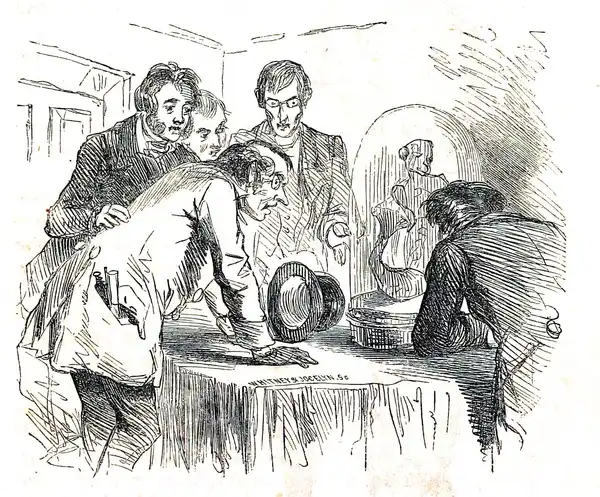
Men crowd around a glass case in an engraving printed beside Barnum’s account of editors viewing the specimen. 1855.
"Viewers around a glass case, engraving of 1855" by Whitney & Jocelyn, engravers. Public domain.
Full credit
"Viewers around a glass case, engraving of 1855" by Whitney & Jocelyn, engravers — https://commons.wikimedia.org/wiki/File:Mermaid_viewers_American_Museum.jpg — Public domain — Public domain in the US (published 1855) and in the EU (signed Whitney & Jocelyn Sc.; death dates not checked, treated as expired by inference from the 1855 publication, since protection would need an engraver working in 1855 to have died after 1955)
Case card
- Case
- The Fiji (Fejee) Mermaid promotion, by Barnum’s own accountBarnum, Life of P. T. Barnum (1855), pp. 231–242
- Date range
- Summer 1842, by Barnum’s account; Concert Hall show 8–13 August 1842 by the advertisement he reprints, then the American MuseumBarnum, Life of P. T. Barnum (1855), pp. 231, 237–238, 240
- Place
- New York and Philadelphia; letters mailed from Montgomery, Charleston and Washington, by Barnum’s accountBarnum, Life of P. T. Barnum (1855), pp. 232–234
- Persuader(s)
- P. T. Barnum; his employee Lyman, posing as Dr. Griffin, by Barnum’s accountBarnum, Life of P. T. Barnum (1855), pp. 232–233
- Audience
- New York and Philadelphia editors; newspaper readers; paying visitors, by Barnum’s accountBarnum, Life of P. T. Barnum (1855), pp. 233–238
- The ask
- Accept that a learned society’s representative was carrying a mermaid taken near the Fejee IslandsAdvertisement reprinted in Barnum, Life of P. T. Barnum (1855), p. 238
- Channel
- Letters; hotel showings; free engravings; pamphlets; advertisement; transparency; flag, by Barnum’s accountBarnum, Life of P. T. Barnum (1855), pp. 232–240
- Outcome
- By Barnum’s figures, receipts of $1,272 in the four weeks before and $3,341.93 in the first four weeksBarnum, Life of P. T. Barnum (1855), p. 242
- Primary record
- Barnum’s own 1855 book; the 1842 newspapers could not be readP. T. Barnum, The Life of P. T. Barnum, Written by Himself (New York: Redfield, 1855), pp. iv, 225, 231–242
In the summer of 1842, by Barnum’s own account, the New-York Herald printed a letter mailed from Montgomery, Alabama. It gave “the news of the day, trade, the crops, political gossip,” followed by “an incidental paragraph” about a Dr. Griffin and “a veritable mermaid taken among the Fejee Islands.” As Barnum describes it, that paragraph asks readers to accept that a distant correspondent had come across the curiosity by chance, in the ordinary course of sending the news. The Fiji Mermaid, as Barnum tells it, starts there.
By his own report, Barnum wrote that letter and two more like it, and he introduces the story by writing that he is “now in the confessional mood.” Almost everything here comes from his Life of P. T. Barnum, because the 1842 newspapers could not be read and neither the letters nor their dates have been checked against the papers. The book’s title page says 1855 and its preface is dated 1854, about twelve years after the show. On this site’s reading, Barnum had reason to make himself look clever.
What was the Fiji Mermaid, and was it real?
It was no mermaid. Barnum says so. His 1855 description is of an “ugly, dried-up, black-looking, and diminutive specimen,” with its mouth open and its arms thrown up, “giving it the appearance of having died in great agony.” Elsewhere he calls it “dried monkey and fish,” and he writes: “Assuming, what is no doubt true, that the mermaid was manufactured, it was a most remarkable specimen of ingenuity and untiring patience.”
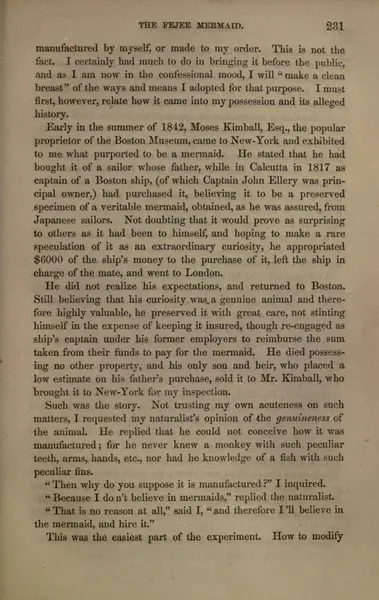
Page 231 of Barnum’s book, with the history Kimball gave and “Such was the story.” 1855.
"Life of P. T. Barnum (1855), p. 231" by P. T. Barnum. Public domain.
Full credit
"Life of P. T. Barnum (1855), p. 231" by P. T. Barnum — https://archive.org/details/lifeofptbarnum00barnuoft/page/231 — Public domain — Public domain in the US (published 1855) and in the EU (text by P. T. Barnum, died 1891, life+70); modified: re-saved at the 1096 px width of the page image; page not cropped
He denies making it, answering the rumor that it was made to his order with “This is not the fact.” The history he passes on came from its owner, Moses Kimball of the Boston Museum. A Boston ship captain, the story went, paid $6,000 of his ship’s money for it in Calcutta in 1817, “believing it to be a preserved specimen of a veritable mermaid,” obtained from Japanese sailors. Fiji does not come up in that history, and Barnum closes it with “Such was the story.”
His naturalist said he could not see how it had been made, but he did not believe in mermaids. “That is no reason at all,” Barnum says he replied, “and therefore I’ll believe in the mermaid, and hire it.” It was a hire, since Kimball is still the owner at the end of the chapter.
On the creature’s origin Barnum offers only a guess. He quotes a book on Japan about a fisherman who joined a monkey to a fish. That creature, “or another,” the book says, was shown around Europe in 1822 and 1823 by an American buyer, and Barnum asks whether a link to his own specimen is not “a plausible conjecture.” This page does not follow the specimen past 1855, so it cannot say where the object is now.
Why did the letters come first?
Barnum names his problem as “general incredulity in the existence of mermaids.” His answer was to “start the ball a-rolling” at “some distance from the centre of attraction,” which on his telling meant making the news arrive from somewhere other than New York, where the show would be.
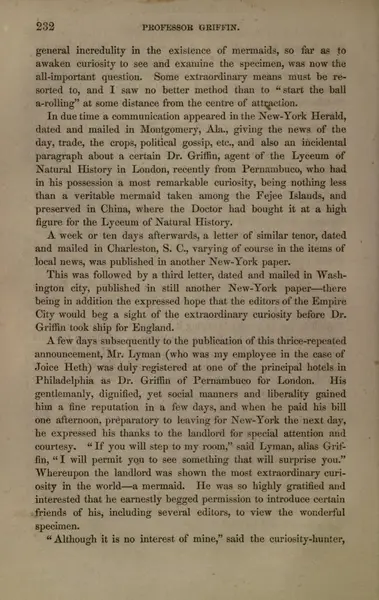
Page 232 of Barnum’s book, with the three letters and Lyman’s hotel registration. 1855.
"Life of P. T. Barnum (1855), p. 232" by P. T. Barnum — https://archive.org/details/lifeofptbarnum00barnuoft/page/232 — Public domain — Public domain in the US (published 1855) and in the EU (text by P. T. Barnum, died 1891, life+70); modified: reduced to 1400 px wide; page not cropped
He describes three letters to three New York papers. The first, in the Herald, came from Montgomery, and “a week or ten days afterwards” a second, from Charleston, reached another paper, “varying of course in the items of local news.” The third, from Washington, added “the expressed hope that the editors of the Empire City would beg a sight of the extraordinary curiosity.” That last line turns a passing item into a request aimed at the editors themselves.
Only after these letters does anyone check into a hotel, so in Barnum’s order the news reached New York readers before any showing he describes. Barnum gives no date for any letter and names only the Herald. This site’s sequence table (where this data comes from) therefore records each step as what Barnum wrote, with his page number. It is no check of the newspapers.
The confession comes a page later. “I may as well confess that those three communications from the South were written by myself,” he writes, “and forwarded to friends of mine, with instructions respectively to mail them, each on the day of its date.”
Where is the last stone in this case?
Barnum’s next sentence says what he thought the postmarks did: “This fact and the corresponding post-marks did much to prevent suspicion of a hoax.” The sentence names postmarks and suspicion, and it does not say what any reader concluded. As he describes the letters, none of them claims to be independent of the others. On this site’s reading, that step was left to the reader: three cities and three papers must mean three separate witnesses.
This site uses the last stone for a premise that no speaker states and the audience supplies for itself. The candidate here is three postmarks, three witnesses. The evidence that readers supplied it comes from one source, Barnum’s own account: that one sentence, written by the person with the most reason to say it worked, and the letters themselves were not read. The label stays provisional until the letters and any replies can be read in the 1842 papers.
Three letters from three cities, by Barnum’s account from one writer. 1842.
Illustration — not a historical depiction
Illustration: Persuasion Dissected. Generated schematic illustration — not a photograph or historical record. Reuse: CC BY 4.0 (https://creativecommons.org/licenses/by/4.0/), to the extent any rights exist.
Who was Dr. Griffin?
By Barnum’s report, Dr. Griffin was Lyman: “Mr. Lyman (who was my employee in the case of Joice Heth) was duly registered at one of the principal hotels in Philadelphia as Dr. Griffin of Pernambuco for London.” The name shifts as the story goes on, from Dr. Griffin in the letters to “Mr. J. Griffin” in the advertisement and “Professor Griffin” in Barnum’s own chapter. This chapter does not say whether the Lyceum of Natural History that Griffin claimed to serve existed.
As Barnum tells it, Lyman spent a few days earning a good name at the hotel, then offered the landlord a look while paying his bill: “I will permit you to see something that will surprise you.” It was the landlord, in this account, who asked to bring friends, “including several editors,” and Barnum says the Philadelphia press then joined New York’s in raising curiosity. Posing as a credentialed authority is a type of fraud that still exists, and anyone who suspects one today should contact the local authorities.
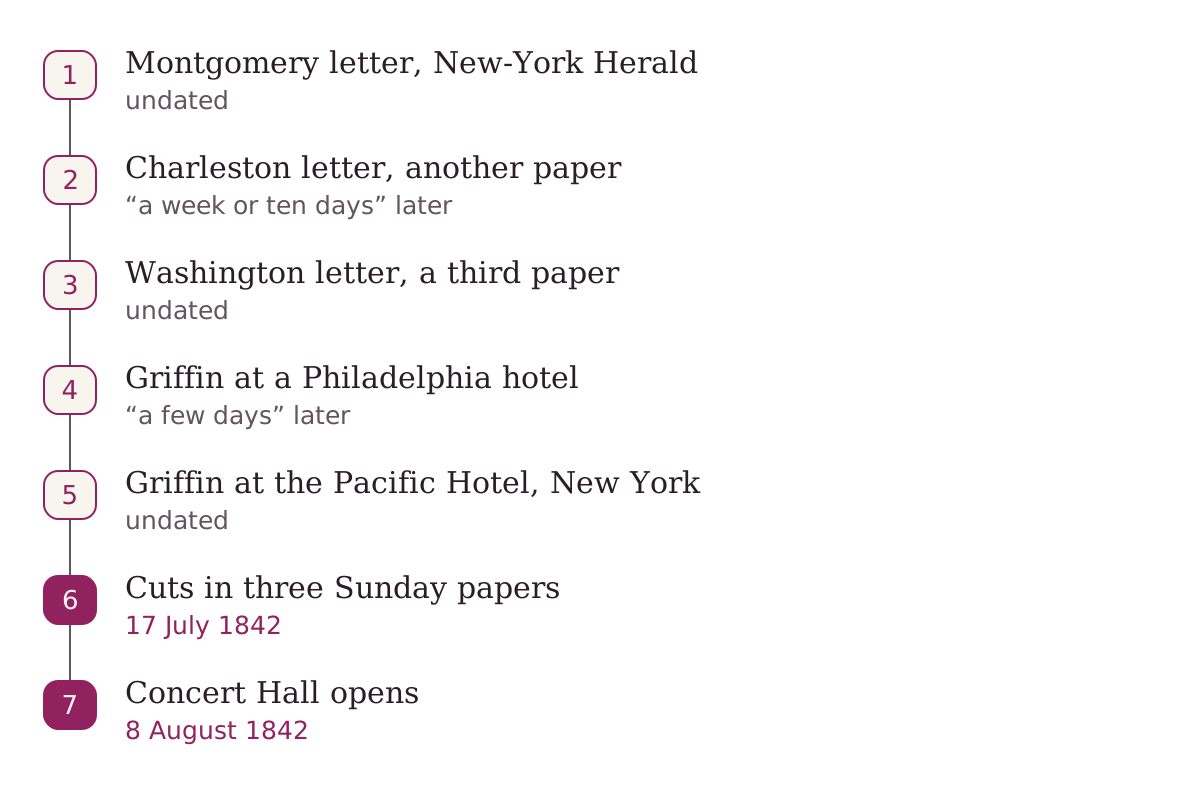
Seven steps of the promotion in the order Barnum gives them; the sequence table also lists the Philadelphia notices and the pamphlets. Only the last two shown carry calendar dates in his text. 1842.
"The Fiji Mermaid promotion in Barnum’s order" by Persuasion Dissected — https://persuasiondissected.com/cons/fiji-mermaid/ — licensed CC BY 4.0: https://creativecommons.org/licenses/by/4.0/
Back in New York, Lyman put up at the Pacific Hotel as Griffin. Reporters called. The papers carried “numerous reports of these examinations, all of which were quite satisfactory,” Barnum writes, adding, “I am confident that the reporters and editors who examined this animal were honestly persuaded that it was what it purported to be.” Those reports were not read for this page, so that sentence is only his view of what other people believed.
He also admits a worry about the disguise, “fearing that some of the Joice Heth victims would discover in Professor Griffin the exhibitor” of his earlier show, and he says that did not happen. By his account, then, a man who had fronted an earlier show worked under a second name, and no visitor recognized him.
How did three papers end up with three different mermaids?
Barnum says he called on the editors of the Herald and two Sunday papers and offered each “the free use of a mermaid cut,” an engraving with a description. He told each that he had hoped to use it in showing the creature, but that Griffin could not permit an American exhibition, so the picture might as well go to the paper.
“The three mermaids made their appearance in the three different papers on the morning of Sunday, July 17, 1842,” he writes. This site’s calendar check confirms that the date was a Sunday.
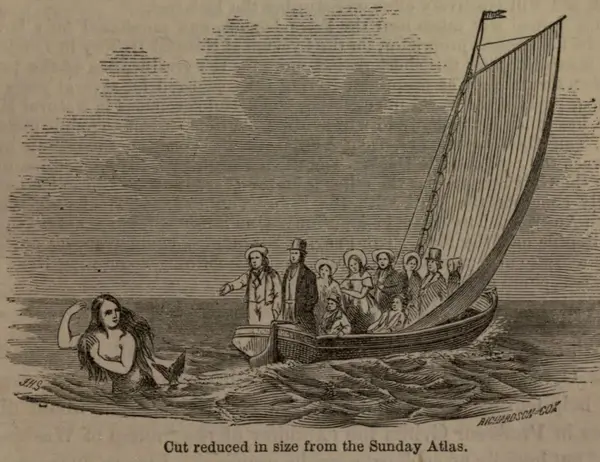
A boat party and a mermaid: the cut credited to the Sunday Atlas, as reprinted in Barnum’s book. 1855.
"Cut reduced in size from the Sunday Atlas, Life of P. T. Barnum (1855)" by Richardson-Cox, engravers. Public domain.
Full credit
"Cut reduced in size from the Sunday Atlas, Life of P. T. Barnum (1855)" by Richardson-Cox, engravers — https://archive.org/details/lifeofptbarnum00barnuoft/page/237 — Public domain — Public domain in the US (published 1855) and in the EU (signed Richardson-Cox; death dates not checked, treated as expired by inference from the 1855 publication, since protection would need an engraver working in 1855 to have died after 1955); modified: cropped to the engraving and its printed credit line, removing the surrounding text of the page
The book reprints three cuts, reduced in size and credited to the Sunday Atlas, the Sunday Mercury and the Sunday Herald. The Atlas and Mercury cuts show long-haired women with fish tails, while the Herald cut shows a shrunken creature with bared teeth and raised arms, titled “A correct likeness of the Fejee Mermaid.” The 1842 printings themselves remain unseen.
Each editor thought he had an exclusive, Barnum writes, and on finding out they “pronounced it a scaly trick.” Then boys sold his 10,000 pamphlets at “a penny each, (half the cost,)” in hotels and stores.
Set out in order, the table lists what, by Barnum’s account, a New York reader could hold by August 1842, beside what he later said lay behind each item. The focus belongs on that evidence, since the question this page can answer is what readers were shown, and it has no record of what any one of them concluded.
| What a reader could hold, per Barnum | What it appeared to be | What it was, per Barnum |
|---|---|---|
| Letter from Montgomery in the Herald | A correspondent’s news | Written by Barnum, mailed by a friend (p. 233) |
| Letters from Charleston and Washington | Two more correspondents | The same (p. 233) |
| Reports of examining the specimen | Editors’ own inspection | Real visits to a staged Griffin (p. 234) |
| A mermaid picture in the Sunday paper | The paper’s own illustration | Offered free by Barnum (pp. 236–237) |
| A penny pamphlet | A treatise on mermaids | Printed for Barnum, 10,000 copies (pp. 236–237) |
What did visitors see for 25 cents?
The newspaper advertisement Barnum reprints says Griffin had yielded to “numerous and urgent solicitations from scientific gentlemen,” whom it does not name. Griffin was to show the creature “positively for one week only,” at Concert Hall, 404 Broadway, from Monday, 8 August, to Saturday, 13 August 1842, “more for the gratification of the public than for gain.” Barnum’s name does not appear in the text as reprinted, and Griffin, who could not permit an exhibition when the editors were offered their pictures, had now consented.
The same advertisement lists real or real-sounding animals beside the mermaid: “The Ornithorhinchus, from New-Holland, being the connecting link between the Seal and the Duck,” flying fish, a snake and a siren, all “forming connecting links in the great chain of Animated Nature.” On this site’s reading, that list asks readers to file the mermaid as one more link in a respectable series. Lyman, Barnum writes, stood among these specimens delivering “scientific harangues.”
Outside hung a transparency of “a beautiful creature half woman and half fish, about eight feet in length.” Inside, Barnum writes, an occasional visitor would be “slightly surprised in finding that the reality was a black-looking specimen of dried monkey and fish that a boy a few years old could easily run away with under his arm.” When the show moved to his American Museum, “without extra charge,” he flew a flag with a mermaid “eighteen feet in length.”
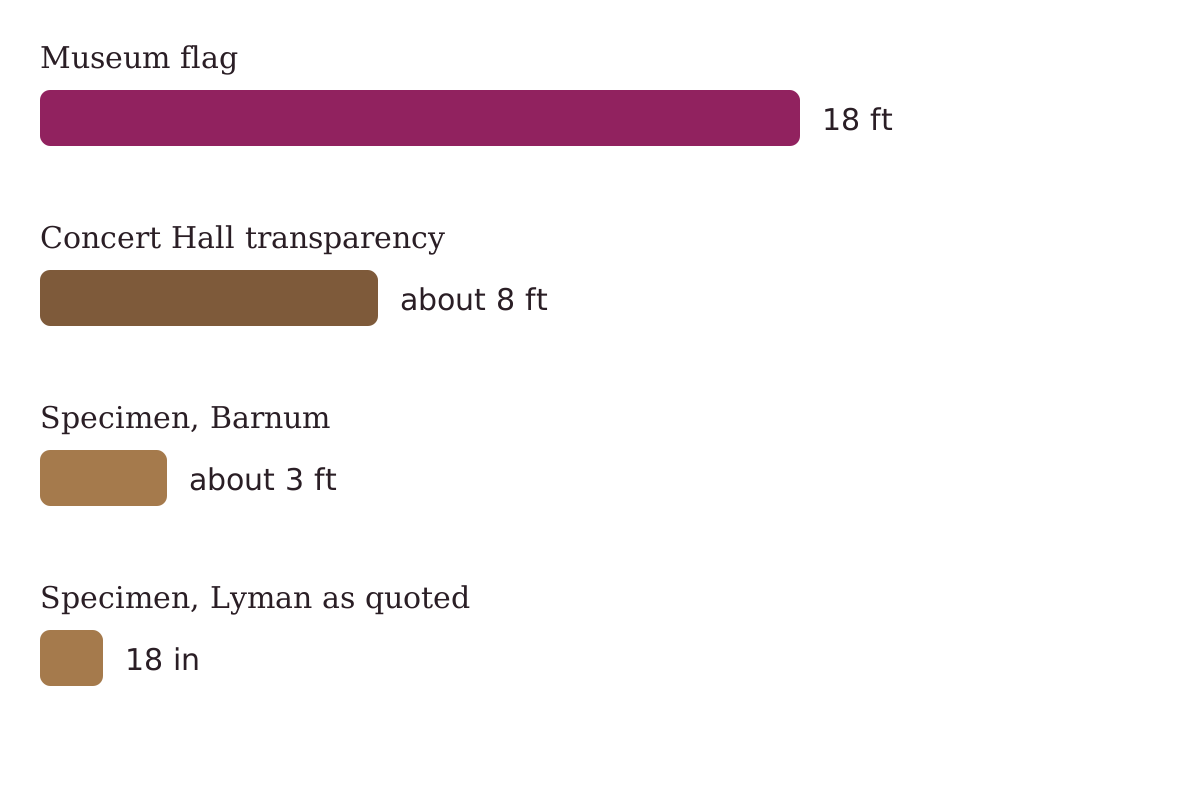
The mermaid as advertised and as described, all from Barnum’s book, which gives the specimen two different lengths. 1842 events; text of 1855.
"The mermaid as advertised and as described" by Persuasion Dissected — https://persuasiondissected.com/cons/fiji-mermaid/ — licensed CC BY 4.0: https://creativecommons.org/licenses/by/4.0/
Data: P. T. Barnum, Life of P. T. Barnum (1855)
Barnum’s text disagrees with itself on the creature, saying “about three feet long” on page 235 and quoting Lyman on page 241 about “our dried-up specimen eighteen inches long.” Lyman, by this report, refused to work under the flag, and it came down. At Concert Hall, Barnum recalls a visitor from New Jersey who paid, looked and said, “Well, that is the poorest show I ever did see.” Lyman’s patter, as Barnum reports it, held that the creature “lived upwards of three hours after its capture.”
This site pictures a con as a stone that sinks after the audience has crossed. Here the ticket was already bought when a visitor saw the size of the thing.
How much did the mermaid earn Barnum?
“The receipts of the American Museum for the four weeks immediately preceding the exhibition of the mermaid, amounted to $1272,” Barnum writes. “During the first four weeks of the mermaid’s exhibition, the receipts amounted to $3341.93.” This site’s arithmetic gives a rise of $2,069.93, to 2.63 times the earlier figure.
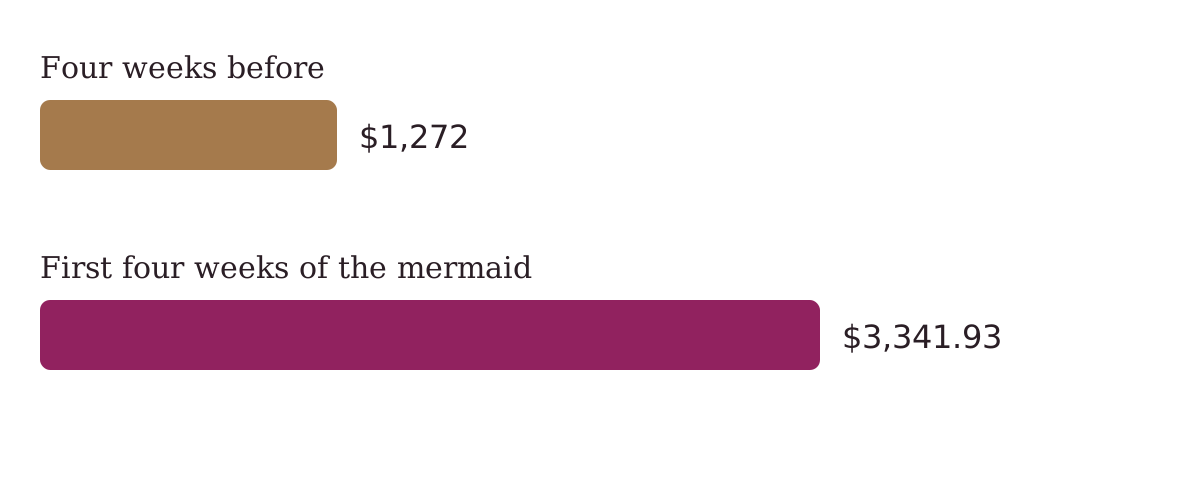
Museum receipts in the two four-week periods, by Barnum’s own figures. 1842.
"American Museum receipts in two four-week periods, by Barnum’s figures" by Persuasion Dissected — https://persuasiondissected.com/cons/fiji-mermaid/ — licensed CC BY 4.0: https://creativecommons.org/licenses/by/4.0/
Data: P. T. Barnum, Life of P. T. Barnum (1855)
Those are one narrator’s two numbers, offered as proof that the show drew crowds, and no ledger was read for this page. Barnum gives no calendar dates for either period, does not say whether the Concert Hall week counts, and does not say what else was on show at the Museum. The figures table (where this data comes from) carries those limits on each row. A claim about sales attached to a stunt also sits at the center of subliminal advertising.
Barnum records one parody. Henry Bennett, who ran a rival museum, “stuck a codfish and monkey together and advertised the Fudg-ee Mermaid,” and Barnum says this too drew attention to his Museum. After Bennett closed in January 1843, Barnum writes, he bought the collection and “secretly” engaged Bennett to work for him, adding, “I found profit in the arrangement.” The mermaid toured and went back to Kimball, Barnum writes, with a return to New York announced for 1 April 1855, “a most appropriate day.”
Earlier in the same book Barnum defends the whole method. He argues that “a little ‘clap-trap’ occasionally, in the way of transparencies, flags, exaggerated pictures, and puffing advertisements,” should be offset by the real animals in his collection, and he describes the mermaid there as “a questionable dead mermaid.” That is his own argument about his own business.
How far can Barnum’s own account be trusted?
Barnum is the only narrator of the sequence above. He told it differently later. This site compared the 1855 chapter with the 1872 printing of Struggles and Triumphs, the later autobiography, by reading its mermaid passages and searching its full text for the names. Earlier printings of that book were not read, so this page cannot date the change.
| Detail | Life of P. T. Barnum (1855) | Struggles and Triumphs (1872 printing) |
|---|---|---|
| Captain’s purchase | Calcutta, 1817 | Calcutta, 1822 |
| Three letters | Told and confessed | Not told |
| Griffin | Throughout | The name does not appear in the book |
| Lyman as Griffin | Yes | Not in the mermaid passages |
| Three Sunday cuts | 17 July 1842 | Not told |
| 10,000 pamphlets | Yes | Not told |
| Four-week receipts | $1,272 and $3,341.93 | Not given |
| Barnum’s verdict | “confessional mood” | “a special show of which, I confess, I am not proud” |
The comparison table (where this data comes from) gives the basis for each row. The later text adds a London exhibition of 1822, which Barnum says he confirmed from an old file of the Times and a copy of the Mirror, neither of which was read here. It keeps a general account, “a few paragraphs about the mermaid,” and says he “used it mainly to advertise the regular business of the Museum.” The machinery of letters and doctor is gone, and this page cannot say why.
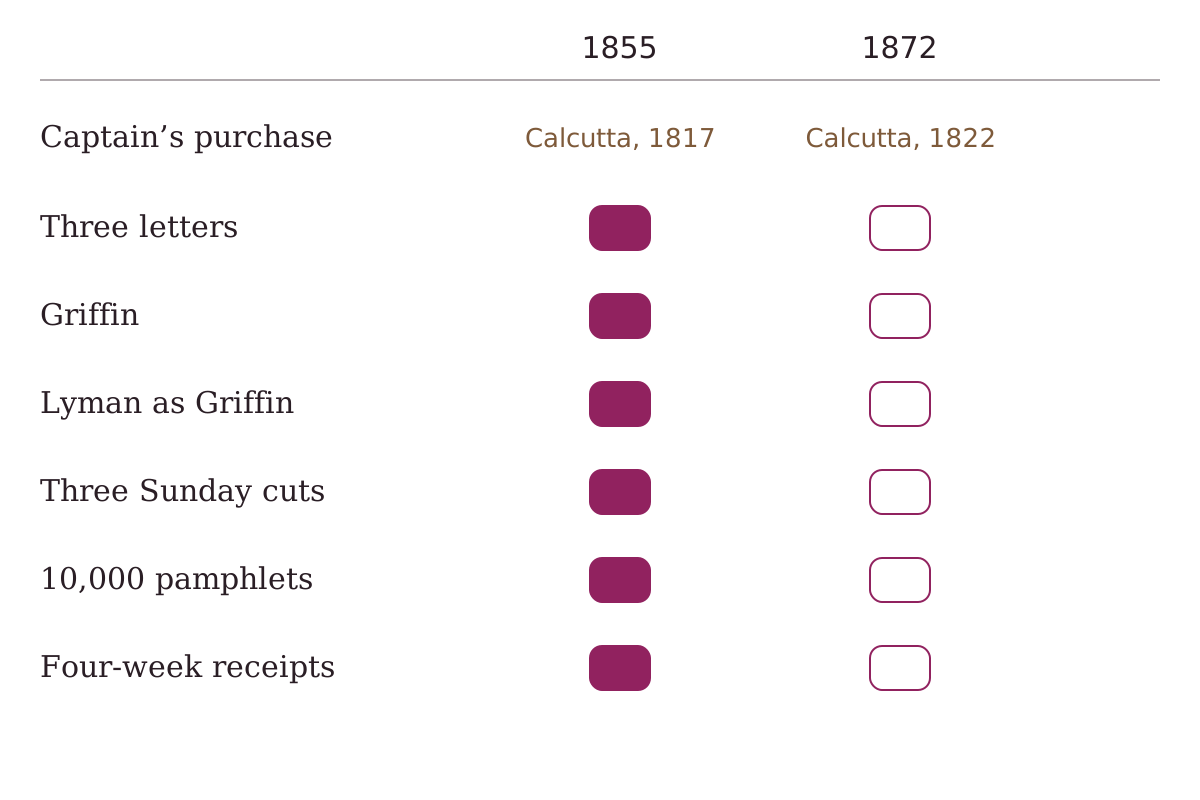
What each text tells about the promotion, on this site’s comparison of the 1855 chapter and the 1872 printing. A filled box means the text tells it.
"What the 1855 and 1872 texts tell" by Persuasion Dissected — https://persuasiondissected.com/cons/fiji-mermaid/ — licensed CC BY 4.0: https://creativecommons.org/licenses/by/4.0/
M. R. Werner’s 1923 biography retells the same order and appears to follow Barnum, so it does not count as a separate check. Steven C. Levi’s 1977 article is listed under Sources as bibliography only, and two book-length studies, Neil Harris’s Humbug (1973) and James W. Cook’s The Arts of Deception (2001), could not be read either. The same single-narrator limit applies to Talleyrand’s reports from the Congress of Vienna.
Crossing map
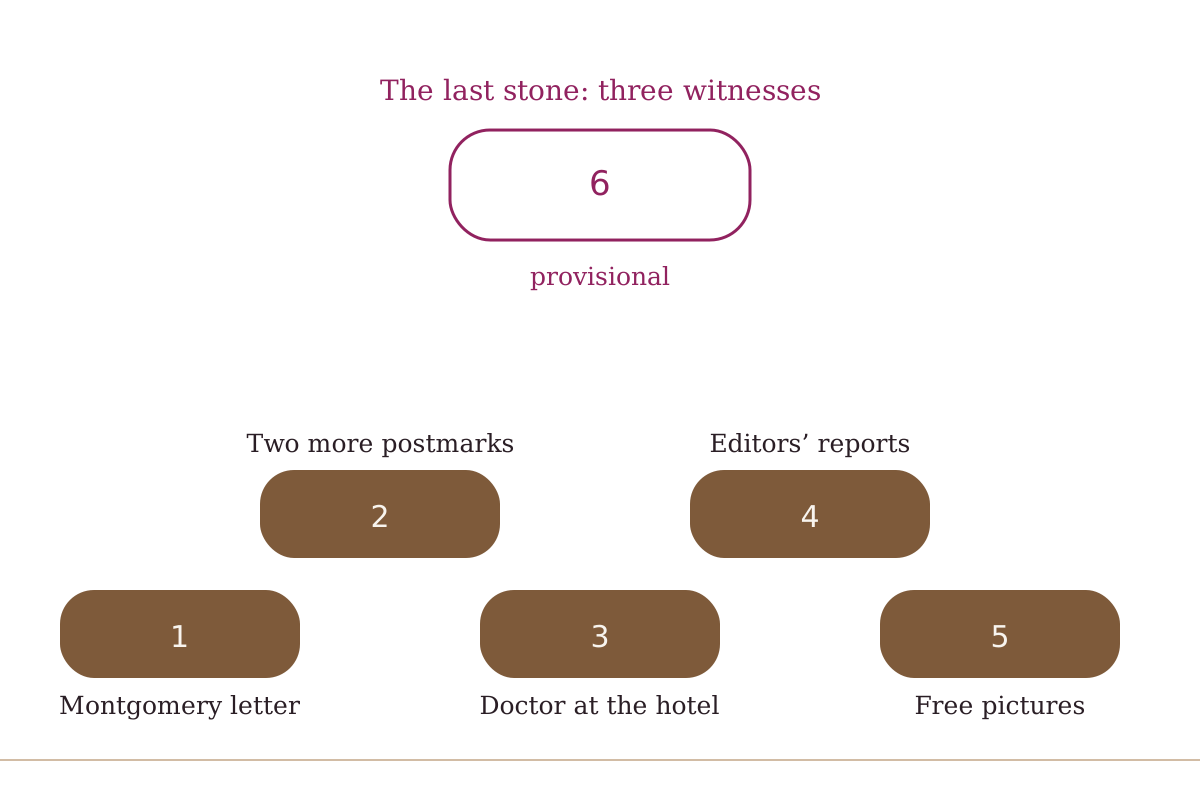
Crossing map of the promotion, every stone by Barnum’s account. Summer 1842.
"Crossing map of the Fiji Mermaid promotion" by Persuasion Dissected — https://persuasiondissected.com/cons/fiji-mermaid/ — licensed CC BY 4.0: https://creativecommons.org/licenses/by/4.0/
- Montgomery letter. A letter in the Herald mentions Griffin in passing among the news (p. 232) [1]
- Two more postmarks. Charleston and Washington letters reach two more New York papers (p. 232) [1]
- Doctor at the hotel. Lyman registers in Philadelphia as Dr. Griffin and shows the landlord (pp. 232–233) [1]
- Editors’ reports. Philadelphia and New York papers report on what Griffin showed them (pp. 233–234) [1]
- Free pictures. Three papers run mermaid cuts on 17 July 1842, and pamphlets follow (pp. 236–237) [1]
- The last stone: three witnesses. Provisional. No letter, as Barnum describes them, says its writer is independent. His claim that the postmarks “did much to prevent suspicion” is the only evidence (p. 233) [1]
Sources
- P. T. Barnum, The Life of P. T. Barnum, Written by Himself (New York: Redfield, 1855), pp. iv, 225, 231–242. archive.orgRead: chapter on the mermaid, pp. 231–242, p. 225 and the preface date on p. iv, each compared against the page images
- P. T. Barnum, Struggles and Triumphs: or, Forty Years’ Recollections of P. T. Barnum (Buffalo: Warren, Johnson & Co., 1872), chapter VIII. gutenberg.orgRead: chapter VIII mermaid passages, with the full text searched for names and figures; earlier printings not read
- M. R. Werner, Barnum (New York: Harcourt, Brace, 1923). gutenberg.orgRead: chapter on the mermaid only
- Steven C. Levi, “P. T. Barnum and the Feejee Mermaid,” Western Folklore 36, no. 2 (1977): 149–154. doi.orgRead: bibliography only
Next crossing
- The Great Moon Hoax — Another New York paper of the 1830s, another story with a distant source behind it.
- The sleeper effect — What research on discounted sources has and has not found.
Cite this page
Persuasion Dissected. "Fiji Mermaid: By Barnum’s Account, the Letters Came First." Persuasion Dissected. Published 2026-11-11. https://persuasiondissected.com/cons/fiji-mermaid/. Accessed: add the date you read it.
Corrections
No corrections yet.
How pieces are checked · All corrections · Contact · Report an error (contact@persuasiondissected.com)