Subliminal Advertising: A 1958 CIA Paper Wrote ‘Is Said’
In three lines
- Who persuaded whom: Two later papers say market researcher James Vicary claimed in 1957 that ads flashed too briefly to notice raised sales at the movies.
- Which stones: A theater test, an unnoticeable flash, a sales rise and partial laboratory support. A 1958 paper in a CIA journal wrote only that the rise “is said to have been stimulated.”
- Outcome: A 2013 paper calls the claim fictitious and a 2015 paper says he admitted fabricating the data, both without a citation. Lab effects read here are conditional, and none measured theater sales.
Route through this piece (4)
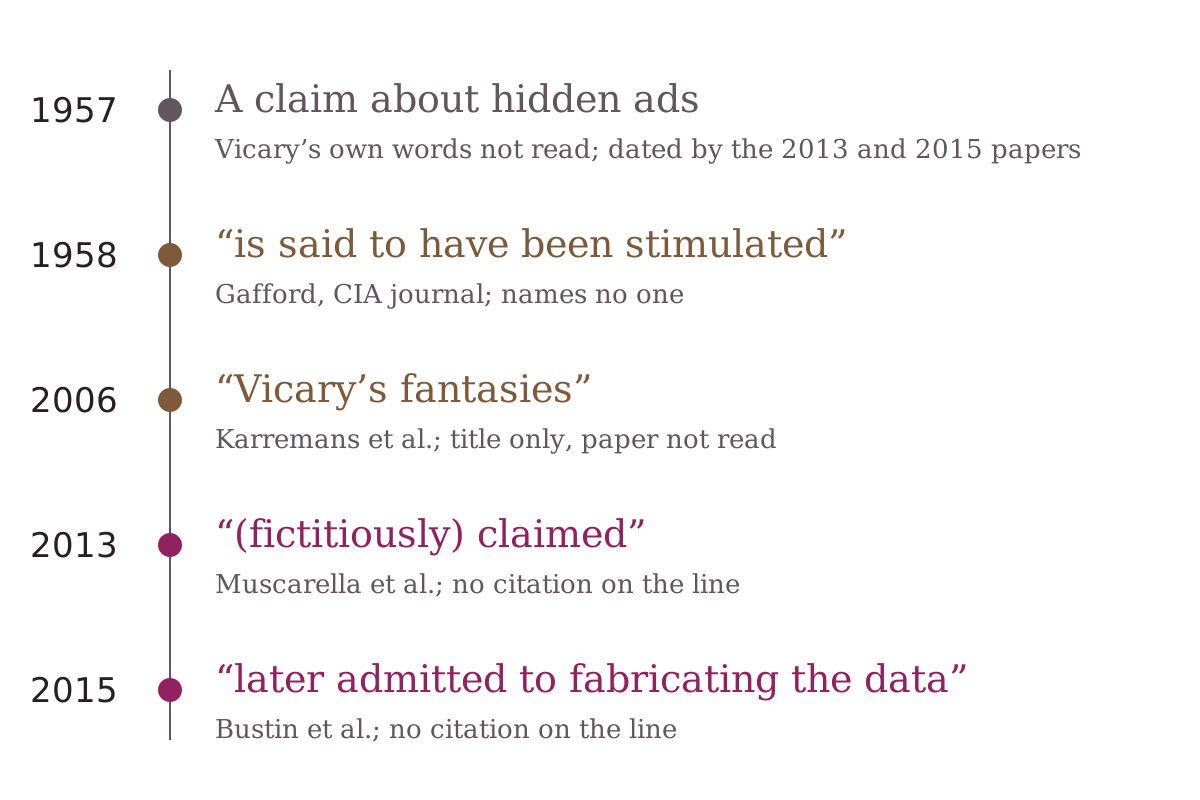
A popcorn story in the wording of four texts. The 1958 text names no one, so tying it to Vicary is this site’s reading, and the 2006 entry is a title only. 1957 to 2015.
"The popcorn story in the wording of four texts" by Persuasion Dissected — https://persuasiondissected.com/cons/subliminal-advertising/ — licensed CC BY 4.0: https://creativecommons.org/licenses/by/4.0/
Data: Richard Gafford, “The Operational Potential of Subliminal Perception,” Studies in Intelligence 2, no. 2 (1958); Karremans, Stroebe and Claus, Journal of Experimental Social Psychology 42 (2006), as reported in the 2013 and 2015 papers; Muscarella et al., PLoS ONE 8(5): e57738 (2013); Bustin et al., Frontiers in Psychology 6: 825 (2015)
In 1958, Richard Gafford wrote that a popcorn sales rise “is said to have been stimulated” by hidden film ads. His paper ran in Studies in Intelligence, the CIA’s journal. The passive asks a reader to accept that a test took place while leaving out who said so and who counted the popcorn. Gafford was describing subliminal advertising, here an ad interrupting a feature film for “a small fraction of a second,” and he called it “the most sensational” of the experiments then being popularized [1].
What did the 1958 CIA paper say about the popcorn test?
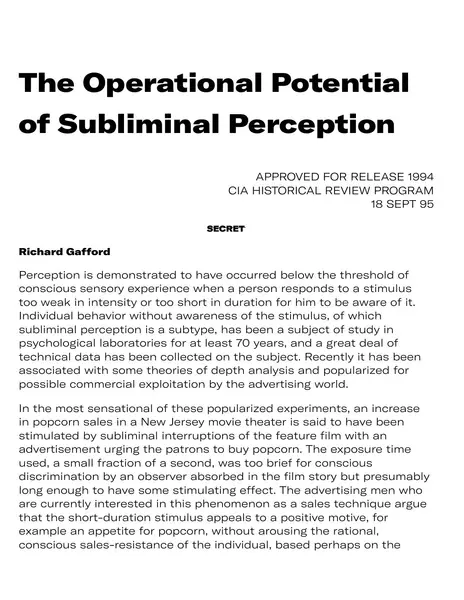
First page of Gafford’s paper in the copy the CIA now posts, with its release line. The popcorn sentence opens the second paragraph. 1958; release line dated 1994, above the date 18 September 1995.
"The Operational Potential of Subliminal Perception, first page" by Richard Gafford; Central Intelligence Agency. Public domain.
Full credit
"The Operational Potential of Subliminal Perception, first page" by Richard Gafford; Central Intelligence Agency — https://www.cia.gov/resources/csi/static/Potential-of-Subliminal-Perception.pdf — Public domain — Public domain in the US (US government publication, 1958; CIA site policy: unless a copyright is indicated, information on the website is in the public domain) and treated as public domain in the EU on the same policy, which allows it to be reproduced, published or otherwise used without permission; modified: first page of the PDF rendered to JPEG at 130 dpi; page not cropped
Subliminal, in Gafford’s definition, means a person responds to a stimulus “too weak in intensity or too short in duration for him to be aware of it.” His popcorn sentence gives no researcher, town, theater name or figure, and the next one adds a second hedge, that the flash was “presumably long enough to have some stimulating effect” [1].
James Vicary’s name appears nowhere in the paper, so linking the sentence to him is this site’s reading, based on the same product and the same kind of film test that later papers assign to him [2] [3].
Gafford’s doubt falls on the reasoning more than on the test. He finds “several mighty leaps in logic in the advertising man’s argument,” and he grants that lab support gives it “enough status to warrant serious attention” [1]. He also notes that “recognition thresholds vary tremendously,” so a message tuned for one viewer may miss another or reach awareness and arouse resistance.
His conclusion concerns intelligence work aimed at a target individual, where “operational feasibility is exceedingly limited.” Nowhere does he say that the popcorn test was faked, and the paper should not be read as an agency finding on it. [study stub: archival / review; N not applicable; preregistered: not applicable]
The posted copy prints SECRET with a line through it, and a release line reads “Approved for release 1994” above the date 18 September 1995 [1]. By this site’s reading, those marks suggest that the hedge was no public correction in 1958. They do not show who read it.
Who calls Vicary’s popcorn claim fictitious?
The firmer verbs arrive decades later, each in passing. A 2006 paper on brand choice by J. C. Karremans and colleagues carries the title “Beyond Vicary’s fantasies,” as listed in the references of the 2013 and 2015 papers [4].
Fifty-five years after Gafford, a 2013 paper on brand logos by Charlotte Muscarella and colleagues opens with “James Vicary (fictitiously) claimed in 1957” [2]. A 2015 paper on an energy-drink prime by Gaëlle M. Bustin and colleagues opens with “Although Vicary later admitted to fabricating the data” and closes with “Vicary’s claims were fabricated” [3].
Neither paper attaches a citation to those lines, though both cite freely elsewhere. This page read no statement by Vicary himself, so the admission rests here on one line of a 2015 introduction. The record read for this page cannot show that no test was ever run. It shows two recent papers saying that the claim was invented, and no one printing the test report.
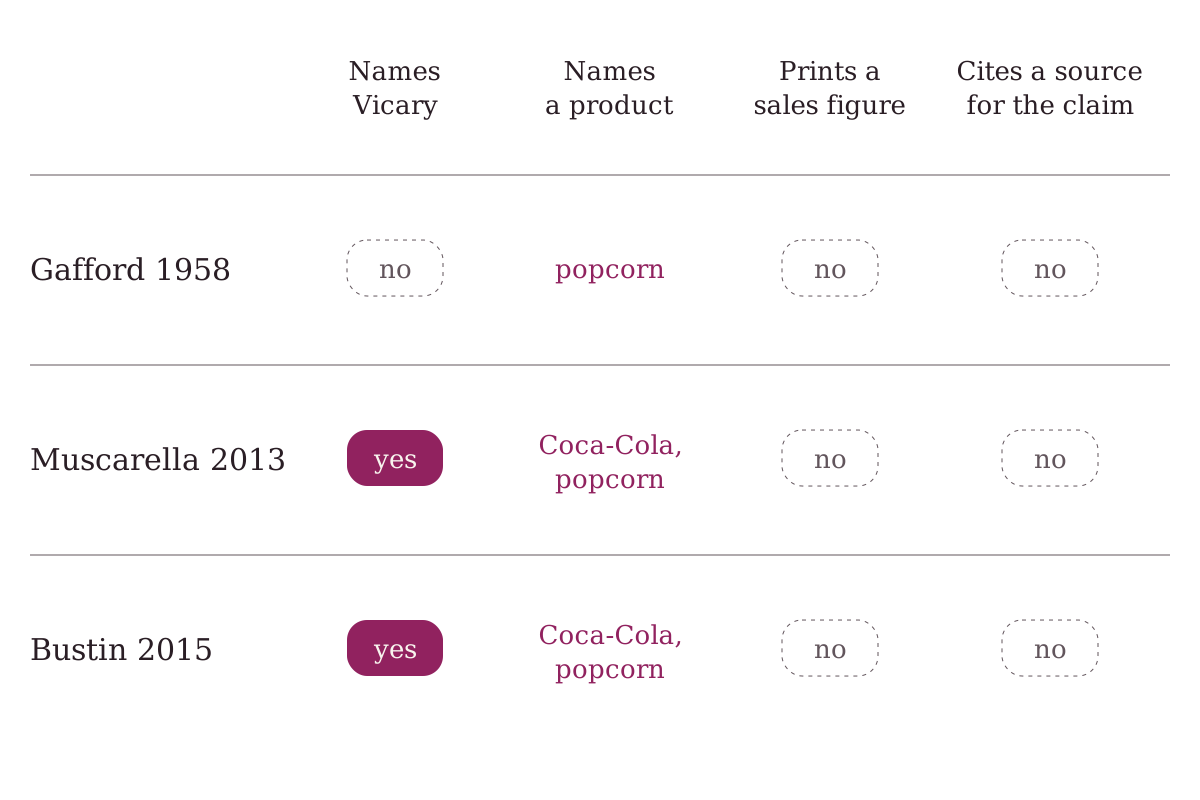
What each text supplies about the claim. Row by row in the wording table. 1958 to 2015.
"What each text supplies about the claim" by Persuasion Dissected — https://persuasiondissected.com/cons/subliminal-advertising/ — licensed CC BY 4.0: https://creativecommons.org/licenses/by/4.0/
Data: Richard Gafford, “The Operational Potential of Subliminal Perception,” Studies in Intelligence 2, no. 2 (1958); Muscarella et al., PLoS ONE 8(5): e57738 (2013); Bustin et al., Frontiers in Psychology 6: 825 (2015)
The details shift as well. Gafford has popcorn alone, the 2013 paper has “Drink Coca-Cola” and “Eat popcorn,” and the 2015 closing has Coca-Cola alone [1] [2] [3]. None of the three prints a sales figure, so this page repeats none. Every row is in the wording table (where this data comes from), with who wrote it and what it leaves out.
A film audience and a beam of light. The record read for this page holds no report of the test itself. Claim dated 1957.
Illustration — not a historical depiction
Illustration: Persuasion Dissected. Generated schematic illustration — not a photograph or historical record. Reuse: CC BY 4.0 (https://creativecommons.org/licenses/by/4.0/), to the extent any rights exist.
Other cases on this site left more to check. The Fiji Mermaid promotion has Barnum’s own account to distrust, and the Great Moon Hoax left its newspaper text. Here no first-person text was read. This site’s working hypothesis is that a claim’s reputation can outrun its record, a question it also puts to the sleeper effect.
Does subliminal advertising work?
The studies read here do not test the theater claim. Their answer depends on what counts as working. The 2013 authors write that it is “no longer questioned” that information below the threshold of awareness can influence behavior “in an experimental context,” and they add that several researchers have argued that Vicary’s claims “might contain some truth” [2].
Their own task had students sort letter strings as words or non-words after brand logos they could barely identify, or could not identify at all. The authors locate the effects in “an artificial laboratory context” and write that in everyday settings priming effects “need to be much stronger” to overcome competing stimuli. [study stub: experiment; Exp. 2, one group, N=34; preregistered: unknown]
Karremans and colleagues, as reported in the 2013 and 2015 papers, found that a hidden “Lipton Ice” raised intention to drink it, but only among thirsty participants [2] [3]. The 2013 authors add that methods of this kind have been criticized for underestimating how much participants noticed. The original was not read for this page. [study stub: experiment; n=unknown vs n=unknown, N=unknown; preregistered: unknown]
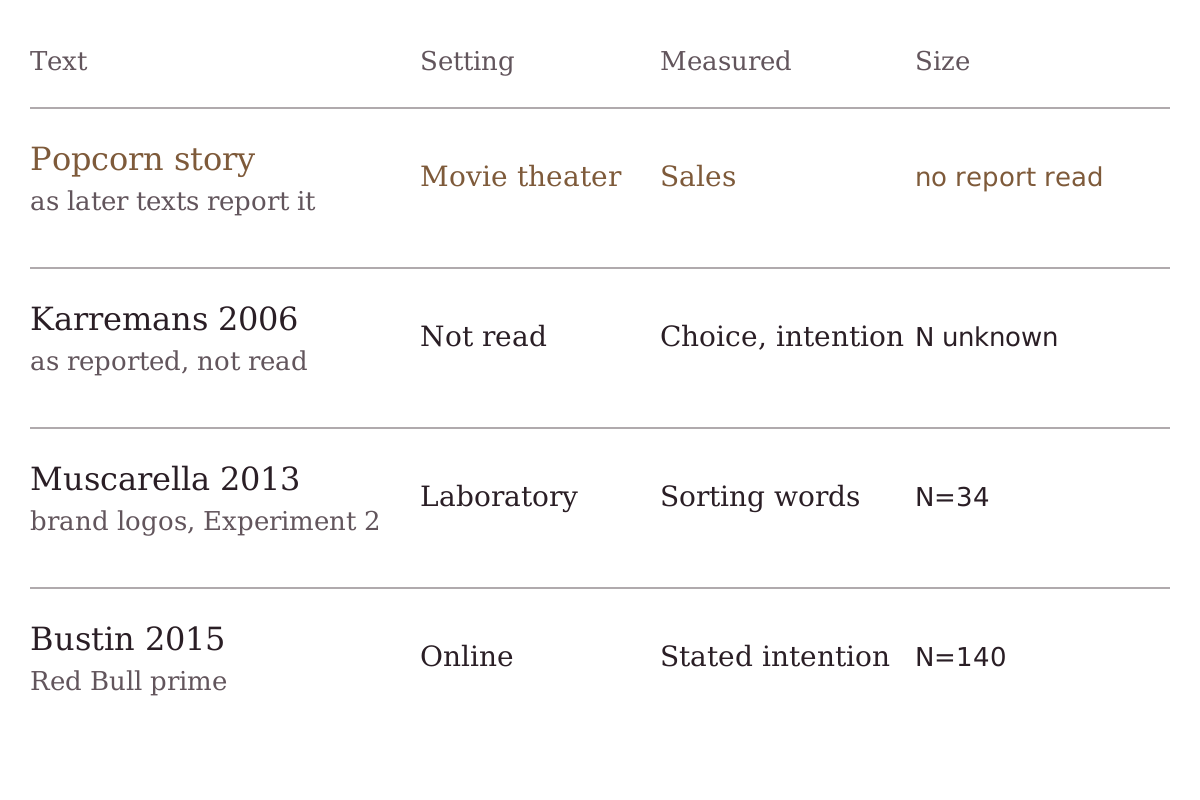
What was measured, and where. The first row is a claim, and the others are studies. 1957 to 2015.
"What the popcorn story and three studies measured" by Persuasion Dissected — https://persuasiondissected.com/cons/subliminal-advertising/ — licensed CC BY 4.0: https://creativecommons.org/licenses/by/4.0/
Data: Richard Gafford, “The Operational Potential of Subliminal Perception,” Studies in Intelligence 2, no. 2 (1958); Karremans, Stroebe and Claus, Journal of Experimental Social Psychology 42 (2006), as reported in the 2013 and 2015 papers; Muscarella et al., PLoS ONE 8(5): e57738 (2013); Bustin et al., Frontiers in Psychology 6: 825 (2015)
The 2015 study primed “Red Bull” online against a scrambled control word and asked 140 adults how likely they were to order it [3]. It reports “a small significant difference,” larger among people high in sensation seeking, though the authors call the results “preliminary” and say they could not control the flash’s exact timing.
The same authors describe average effects as weak, citing a 1996 meta-analysis by Trappey that was not read for this page. [study stub: meta-analysis; k=unknown studies; total N=unknown; preregistered: unknown] The 2015 paper reports stated intentions, with no purchases counted. [study stub: experiment; n=unknown vs n=unknown, N=140; preregistered: unknown]
That paper also says the claim “soon led to legislation” and that subliminal advertising “is illegal in many countries” [3]. Those are the paper’s words, since no statute was read for this page. The record read here lacks a report like the one the 1784 commission on animal magnetism left, with its trials set down in order so that a later reader could check the design.
Crossing map
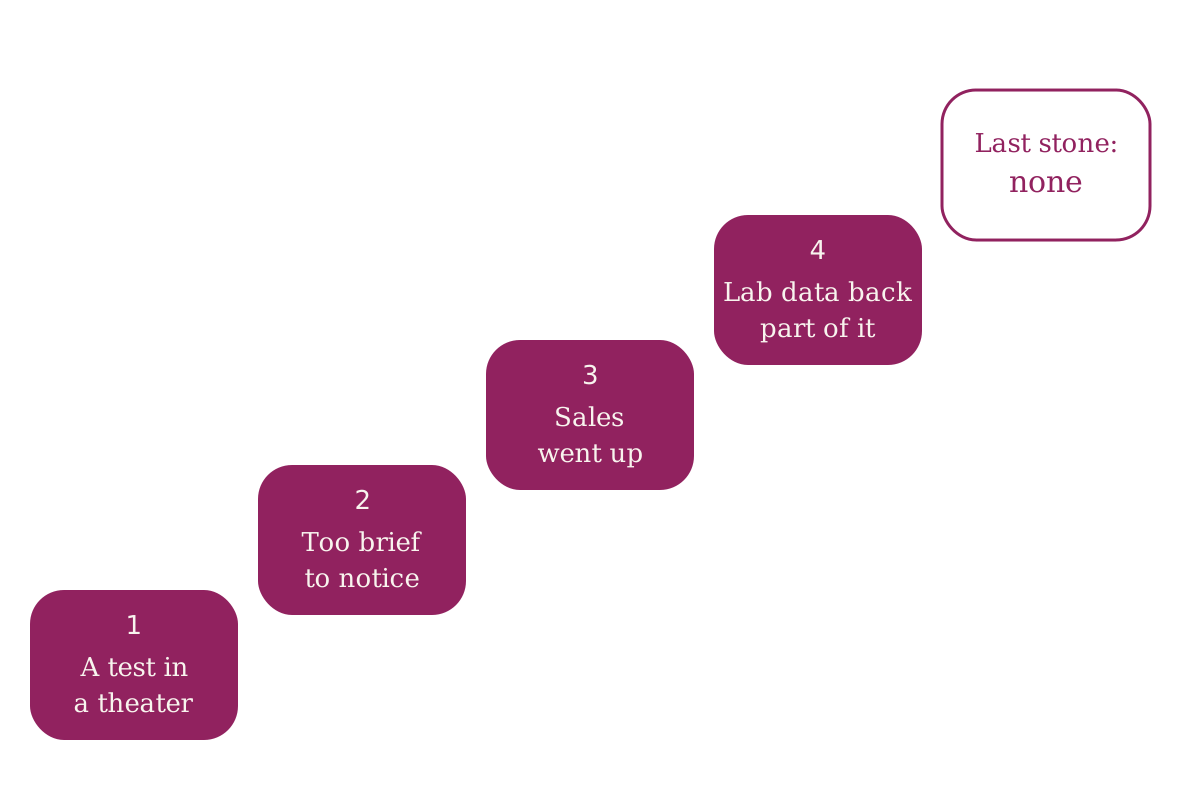
Crossing map of the popcorn story as later texts report it. Vicary’s own words were not read. 1957 to 1958.
"Crossing map of the popcorn story" by Persuasion Dissected — https://persuasiondissected.com/cons/subliminal-advertising/ — licensed CC BY 4.0: https://creativecommons.org/licenses/by/4.0/
- A test in a theater. Two later papers say Vicary claimed in 1957 to have shown moviegoers hidden ads [2] [3]
- Too brief to notice. The exposure was “too brief for conscious discrimination” (PDF p. 1) [1]
- Sales went up. An increase in popcorn sales “is said to have been stimulated” (PDF p. 1) [1]
- Lab data back part of it. Gafford grants that part of the pitch “is supported by laboratory data” (PDF p. 2) [1]
- No last stone in this case. This site uses the last stone for a premise the audience supplies unprompted. Readers may have assumed that someone checked the sales, but no audience reaction or text by Vicary was read that would show it.
Sources
- Richard Gafford, “The Operational Potential of Subliminal Perception,” Studies in Intelligence 2, no. 2 (1958). cia.govRead: full textText license: Public domain (CIA site policy) (terms)
- Charlotte Muscarella, Gigliola Brintazzoli, Sarah Gordts, Eric Soetens and Eva Van den Bussche, “Short- and Long-Term Effects of Conscious, Minimally Conscious and Unconscious Brand Logos,” PLoS ONE 8, no. 5 (2013): e57738. doi.orgRead: full textText license: CC BY (version not stated) (terms)
- Gaëlle M. Bustin, Daniel N. Jones, Michel Hansenne and Jordi Quoidbach, “Who does Red Bull give wings to? Sensation seeking moderates sensitivity to subliminal advertisement,” Frontiers in Psychology 6 (2015): 825. doi.orgRead: full textText license: CC BY (version not stated) (terms)
- J. C. Karremans, W. Stroebe and J. Claus, “Beyond Vicary’s fantasies: The impact of subliminal priming and brand choice,” Journal of Experimental Social Psychology 42 (2006): 792–798. doi.orgRead: bibliography only; results as reported in the 2013 and 2015 papers
Next crossing
- The Fiji Mermaid — A promotion known mainly from its promoter’s own later account.
- Animal magnetism — Another claim about unseen influence, and a commission that tested it trial by trial.
Cite this page
Persuasion Dissected. "Subliminal Advertising: A 1958 CIA Paper Wrote ‘Is Said’." Persuasion Dissected. Published 2026-11-11. https://persuasiondissected.com/cons/subliminal-advertising/. Accessed: add the date you read it.
Corrections
No corrections yet.
How pieces are checked · All corrections · Contact · Report an error (contact@persuasiondissected.com)