Four Minute Men: Creel Added 250,000 Estimated Speeches
In three lines
- Who persuaded whom: In 1917 and 1918 George Creel’s Committee on Public Information put volunteer Four Minute Men in front of movie audiences during intermissions; in 1920 his report and book told readers what those speakers had done.
- Which stones: A government slide, a bulletin that set the limits of each talk, then a total. By Creel’s own accounting, 250,000 of the 755,190 speeches (33.1%) were estimates added to incomplete reports.
- Outcome: Creel’s book prints 7,555,190 speeches on p. 85 and 755,190 on p. 94. No independent count was read for this page, so every total here is the organizers’ own.
Route through this piece (7)
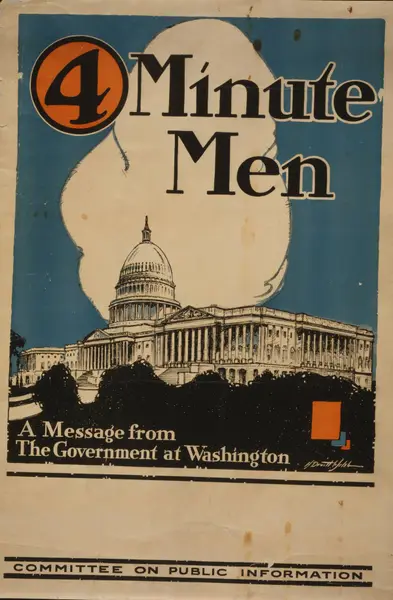
H. Devitt Welsh’s poster for the Four Minute Men, with a large blank space below the picture. 1917.
"4 minute men, a message from the government at Washington" by H. Devitt Welsh. Public domain.
Full credit
"4 minute men, a message from the government at Washington" by H. Devitt Welsh — https://commons.wikimedia.org/wiki/File:4_minute_men,_a_message_from_the_government_at_Washington_LCCN2003652827.jpg — Public domain — Public domain in the US (published 1917) and in the EU (H. Devitt Welsh died 1942, life+70); modified: cropped to the poster, removing the black backing and the color and gray scales of the photograph
Case card
- Case
- The Four Minute Men and the totals reported for them, by Creel’s own accountingCreel, “How We Advertised America” (1920), pp. 84–98
- Date range
- Trial speech 31 March 1917 and division’s end 24 December 1918, per the Chicago history; totals printed 1920History Committee, The Four Minute Men of Chicago (1919), pp. 7, 11; Creel, “How We Advertised America” (1920), pp. 93–94
- Place
- Motion-picture theaters across the United States, with national headquarters in WashingtonHistory Committee, The Four Minute Men of Chicago (1919), p. 7
- Persuader(s)
- George Creel and the Committee on Public Information; volunteer speakers under local chairmenCommittee on Public Information, Complete Report of the Chairman (1920), pp. 22–23
- Audience
- Theater audiences during intermissions; readers of the 1920 report and bookCommittee on Public Information, Complete Report of the Chairman (1920), pp. 22, 29
- The ask
- Accept that a fair estimate makes it certain 314,454,514 people were addressedCommittee on Public Information, Complete Report of the Chairman (1920), p. 22
- Channel
- Glass slide; lobby posters; bulletins; four-minute talks; 1920 report and bookCreel, “How We Advertised America” (1920), pp. 85–86; History Committee, The Four Minute Men of Chicago (1919), plate after p. 16
- Outcome
- Creel’s accounting: 505,190 speeches from exact reports plus 250,000 estimated gives 755,190Creel, “How We Advertised America” (1920), pp. 93–94
- Primary record
- The organizers’ own reports; the returns behind them and the bulletin run were not readGeorge Creel, “How We Advertised America” (New York: Harper & Brothers, 1920), pp. 7, 84–98; Committee on Public Information, Complete Report of the Chairman (Washington: Government Printing Office, 1920), pp. 17, 22–31; History Committee, The Four Minute Men of Chicago (Chicago, 1919), pp. 7–25
In 1920 George Creel printed a sum that added two estimates to an incomplete report: 755,190 speeches. The sum asks a reader to accept that the Four Minute Men, the volunteer speakers his committee sent into movie theaters, can be measured to the last speech. His own page says the exact reports covered about half of the activity.
The estimates are not hidden. Creel lists them himself, and this page takes its figures from him and his colleagues because no outside count was read. The question here is narrower than whether the speakers mattered: what each number in that accounting rests on, and where the qualifiers go when the total is repeated.
What were the Four Minute Men?
“The Four Minute Men were a nation-wide organization of public speakers under Government control,” says the 1919 history written by the Chicago branch. Its speakers talked “almost exclusively in the motion picture theatres” during intermissions. Donald M. Ryerson tried the idea at Chicago’s Strand Theatre on the evening of 31 March 1917, and the same history explains the name by the schedule of the houses, where four minutes “was the limit of available time” in most intermissions.
According to the same history, the work became a division of the Committee on Public Information, with national headquarters in Washington from 16 June 1917, and it ended on 24 December 1918. William McCormick Blair became national director when Ryerson left for the Navy, and William H. Ingersoll succeeded him in 1918. Creel gives a maximum membership of 75,000 speakers, and the first topic on his list is the selective draft, in May 1917.
Before each talk, a glass slide went up on the theater curtain. Its wording is short: the speaker “will speak four minutes on a subject of national importance. He speaks under the authority of The Committee on Public Information.” Creel’s name and “Washington, D. C.” came under that line.
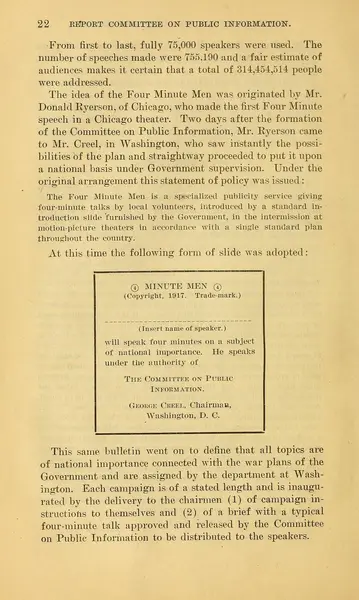
The slide as printed in the Committee’s report, p. 22, below the sentence on 314,454,514 people. 1920.
"Complete Report of the Chairman (1920), p. 22" by Committee on Public Information. Public domain.
Full credit
"Complete Report of the Chairman (1920), p. 22" by Committee on Public Information — https://archive.org/details/completereportof00unit/page/22 — Public domain — Public domain in the US (US government work, published 1920) and in the EU (published 1920 under the Committee’s name; George Creel died 1953, life+70); modified: reduced to 1000 px wide; page not cropped
The lobby made the same claim before the audience sat down. One poster in the Chicago history reads, “This Theater has been appointed by the Government to receive these official messages.” The report’s printing list on p. 17 counts 26,100 posters titled for the Capitol Building and 26,100 for Independence Hall, which may be these designs, although the report does not say so. Printed pictures as arguments come up again with the Boston Massacre.
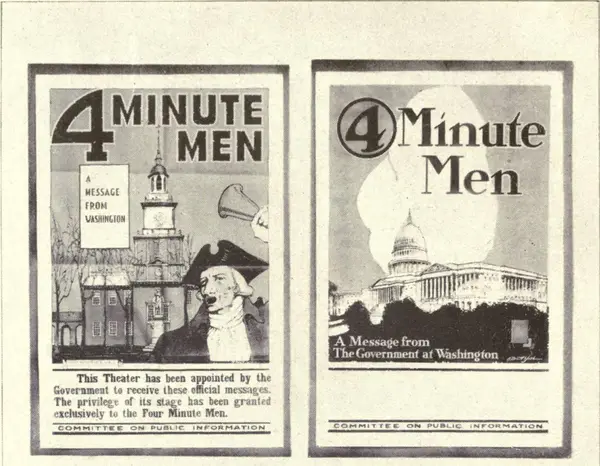
Two posters “used in theatre lobbies,” as reproduced in the Chicago branch’s history. 1919.
"Posters used in theatre lobbies, The Four Minute Men of Chicago (1919)" by History Committee of the Four Minute Men of Chicago. Public domain.
Full credit
"Posters used in theatre lobbies, The Four Minute Men of Chicago (1919)" by History Committee of the Four Minute Men of Chicago — https://archive.org/details/fourminutemenofc00unit/page/n25 — Public domain — Public domain in the US (published 1919) and in the EU (issued under a committee’s name with no named author, 70 years passed); modified: cropped to the two posters at the top of the plate, removing the trade-mark, button, identification card and caption
Who was allowed to speak?
Local branches needed sponsors. According to the report, nominating a local chairman required “the written indorsement of three prominent citizens,” bankers or professional or business men writing on their own stationery, and every chairman was registered in Washington. Speakers then received their authority and appointment from that chairman, so the person at the front of the theater stood at the end of a chain that began in the capital.
The program spread well beyond the theaters. Creel lists lodges, labor unions, granges, lumber camps, Indian reservations, churches and 153 colleges, along with a junior division in which schoolchildren wrote speeches from a bulletin. President Wilson’s letters, reprinted in the Chicago history, show the claimed size moving: one from November 1917 addresses “the Fifteen Thousand Four-Minute Men,” and a later one credits “seventy-five thousand speakers.”
How was a bulletin meant to keep 75,000 speakers on message?
The rule was written down at the start. “The aim is to preserve individuality and forcefulness of expression and yet confine the message absolutely to the four-minute limit and within the policy limits of the bulletin in order that the character of the original message formulated in Washington may not be lost in transmission through the speaker,” says the bulletin issued under the “original arrangement,” as the report quotes it.
That sentence makes its request of the speaker rather than the audience, who was to keep an individual voice while carrying Washington’s message. Creel describes the same difficulty from the other side. It was “delicate and dangerous business,” he wrote, to release “speakers impossible of exact control and yet vested in large degree with the authority of the government.” His next worry follows on the page: “We did not want stereotyped oratory, and yet it was imperative to guard against the dangers of unrestraint.”
His answer was a series of regular bulletins, each with “a budget of material” and “two or three illustrative four-minute speeches.” Waldo P. Warren wrote the first. The work then passed to E. T. Gundlach, “the patriotic head of an advertising agency,” and Creel says government departments were consulted and “Professor Ford and his scholars” reviewed the drafts.
The report adds that all topics “are assigned by the department at Washington.” Subjects ran from Liberty Loans and the Red Cross to food and income tax, and one, in the late summer of 1918, was titled “Where Did You Get Your Facts?”
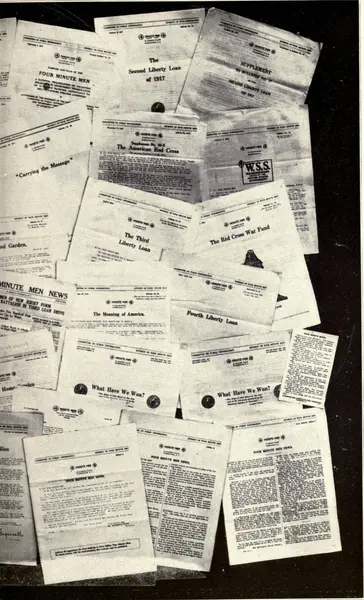
Bulletins and news sheets from national headquarters, in a plate from the Chicago history; the photograph runs off the left edge of this page. 1919.
"Speakers’ bulletins, The Four Minute Men of Chicago (1919)" by History Committee of the Four Minute Men of Chicago. Public domain.
Full credit
"Speakers’ bulletins, The Four Minute Men of Chicago (1919)" by History Committee of the Four Minute Men of Chicago — https://archive.org/details/fourminutemenofc00unit/page/n24 — Public domain — Public domain in the US (published 1919) and in the EU (issued under a committee’s name with no named author, 70 years passed); modified: cropped to the photograph, removing the caption and page margin; the photograph runs off the left edge of the page
The account of enforcement also comes from the organizers. Bertram G. Nelson, a University of Chicago professor of public speaking, traveled from city to city giving instruction in “putting talks across,” and by Creel’s account “the ax fell heavily whenever a speaker failed to hold his audiences, or injected the note of partizanship, or else proved himself lacking in restraint or good manners.” Chicago had a Speaking Committee that “Visited theatres and reported on the work of individual speakers.”
This page did not read the run of bulletins or the speeches as given, so it cannot say how closely any speaker kept to the limits. Even the count of bulletins differs, since Creel and the report give 46 bulletins and 36 campaigns while the Chicago history gives 37 of each. Reading a program through its own official report is also the problem with the 1784 inquiry into animal magnetism.
How did Creel get to 755,190?
Creel sets out the sum on pp. 93–94 of “How We Advertised America,” and the Committee’s report prints the same passage on p. 29. “Exact reports, covering approximately one-half of the full activities of the organization, give a total of 505,190 four-minute speeches made to audiences totaling 202,454,514 people.” Two estimates follow, and then: “Adding these conservative estimates to the above incomplete reports, the following results are shown.”
| Part of the total | Speeches | Audience | Creel’s words |
|---|---|---|---|
| Exact reports | 505,190 | 202,454,514 | “Exact reports” |
| First campaigns, 22 May to 27 Oct. 1917 | 70,000 | 40,000,000 | “a very reasonable estimate”; “not less than” |
| Final six campaigns, 27 Oct. to 24 Dec. 1918 | 180,000 | 72,000,000 | “certainly not less than” |
| Printed total | 755,190 | 314,454,514 | “conservative estimates” added to “incomplete reports” |
| Estimated share, this site’s arithmetic | 250,000 (33.1%) | 112,000,000 (35.6%) | |
| Estimate of final totals | 1,000,000 | 400,000,000 | “A very reasonable allowance” |
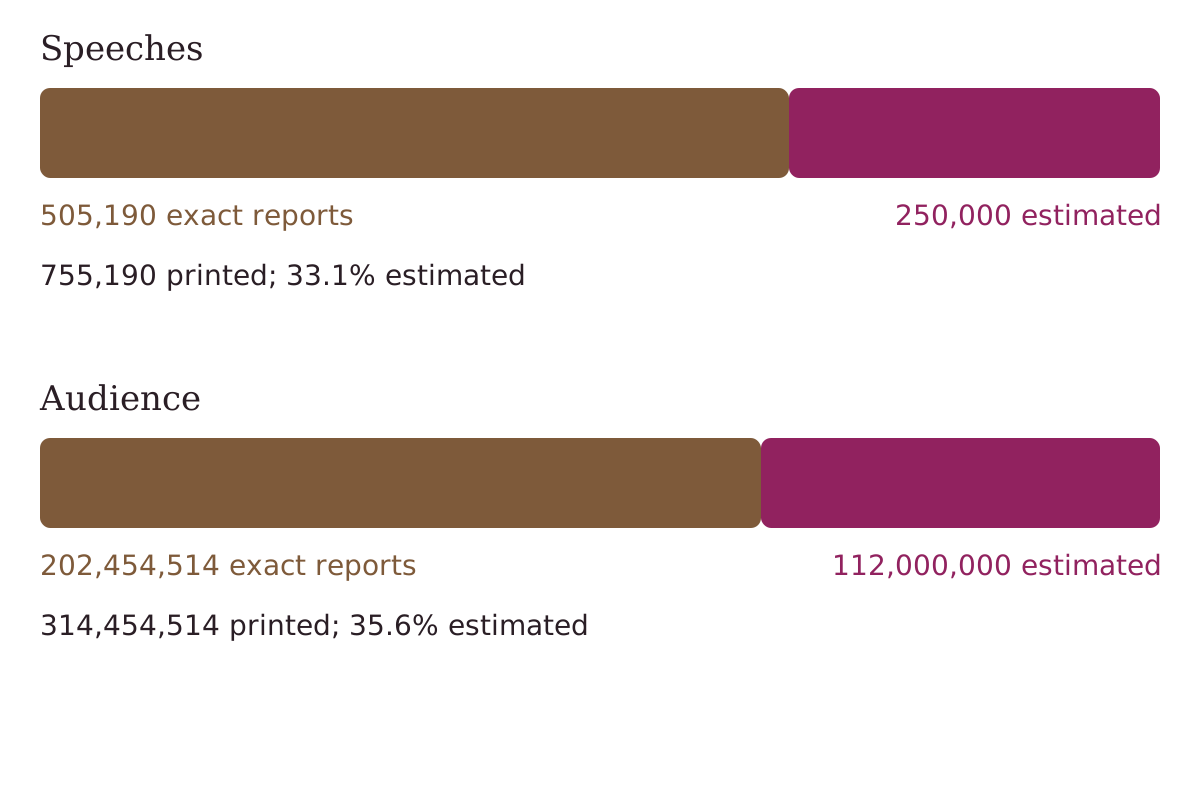
Exact reports and estimates inside each printed total, by Creel’s own accounting; shares are this site’s arithmetic. Printed 1920.
"Exact reports and estimates in the Four Minute Men totals" by Persuasion Dissected — https://persuasiondissected.com/persuaders/four-minute-men/ — licensed CC BY 4.0: https://creativecommons.org/licenses/by/4.0/
Data: George Creel, “How We Advertised America” (1920)
By Creel’s own accounting, then, 33.1% of the speeches and 35.6% of the audience in the printed total are estimates. “Exact” is his label, and the returns behind it were not read for this page. The full table, one claim to a row, is in the CSV (where this data comes from).
The phrase “approximately one-half” does not describe the printed total. The 505,190 reported speeches are 66.9% of 755,190 but 50.5% of 1,000,000, so by this site’s arithmetic the half fits only the larger estimate that Creel reaches a paragraph later. He justifies that figure by “the considerable number of communities from which incomplete or no reports were received,” and his averages of “about 28,000 speeches” and “more than 11,000,000 people” per campaign are that same estimate divided by 36.
Dividing audience by speeches shows how closely the estimates track the reports: about 401 people per speech in the exact reports, about 571 in the first estimate and exactly 400 in the final six campaigns. Those are this site’s divisions, and Creel does not explain how he reached his figures. His windows also begin on 22 May 1917, although his bulletin list gives 12–21 May for the first, on the draft. The Chicago history labels its local figure openly, with “Total of audiences reached, estimated” at 25,000,000 beside 50,000 speeches.
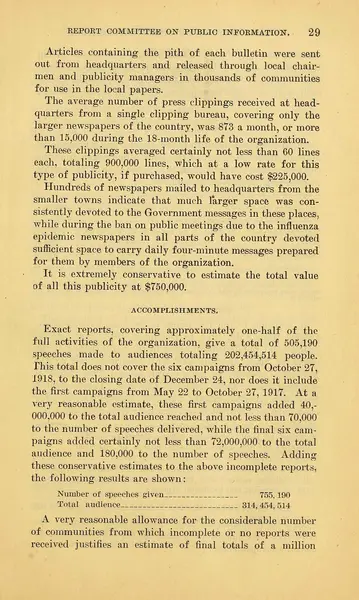
The same accounting in the Committee’s report, p. 29, under the heading “Accomplishments.” 1920.
"Complete Report of the Chairman (1920), p. 29" by Committee on Public Information. Public domain.
Full credit
"Complete Report of the Chairman (1920), p. 29" by Committee on Public Information — https://archive.org/details/completereportof00unit/page/29 — Public domain — Public domain in the US (US government work, published 1920) and in the EU (published 1920 under the Committee’s name; George Creel died 1953, life+70); modified: reduced to 1000 px wide; page not cropped
Why does Creel’s book also print 7,555,190?
The figure is in the print itself and is not a misreading of scanned text. Page 85 reads, “more than 7,555,190 speeches had been made, and a fair estimate of audiences makes it certain that a total of 134,454,514 people had been addressed.” Nine pages later the same book prints 755,190 and 314,454,514, and p. 7 also has 755,190.
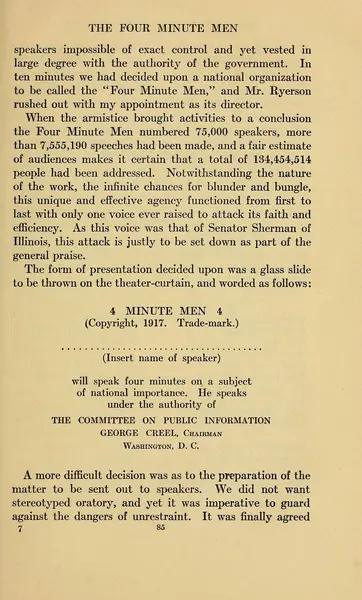
Creel’s chapter on the Four Minute Men, p. 85, with both figures that differ from p. 94. 1920.
"Creel, “How We Advertised America” (1920), p. 85" by George Creel — https://archive.org/details/howweadvertiseda01cree/page/85 — Public domain — Public domain in the US (published 1920) and in the EU (George Creel died 1953, life+70); modified: reduced to 1000 px wide; page not cropped
On this site’s reading, p. 85 is a typesetting error. The report’s nearly identical sentence reads 755,190 and 314,454,514, one digit has been added, and 134 looks like 314 transposed. The two p. 85 figures together would mean fewer than 18 people per speech, since the page says “more than” 7,555,190, against about 416 in the printed total. The chapter has another slip: p. 95 prints slides as $7,300 08 in one column and $7,300 68 in the total, and the column adds up only with 68.
That reading stays a reading. A text search of the scan finds no errata notice, and only this one copy was read. The Chicago history, a year earlier, rounds to “over 750,000 speeches to audiences totalling 315,000,000 persons,” and it also counts 7,448 cities and towns where Creel has 5,200 communities. Rival counts of another kind, of signatures, are at the center of the Chartist petition of 1848.
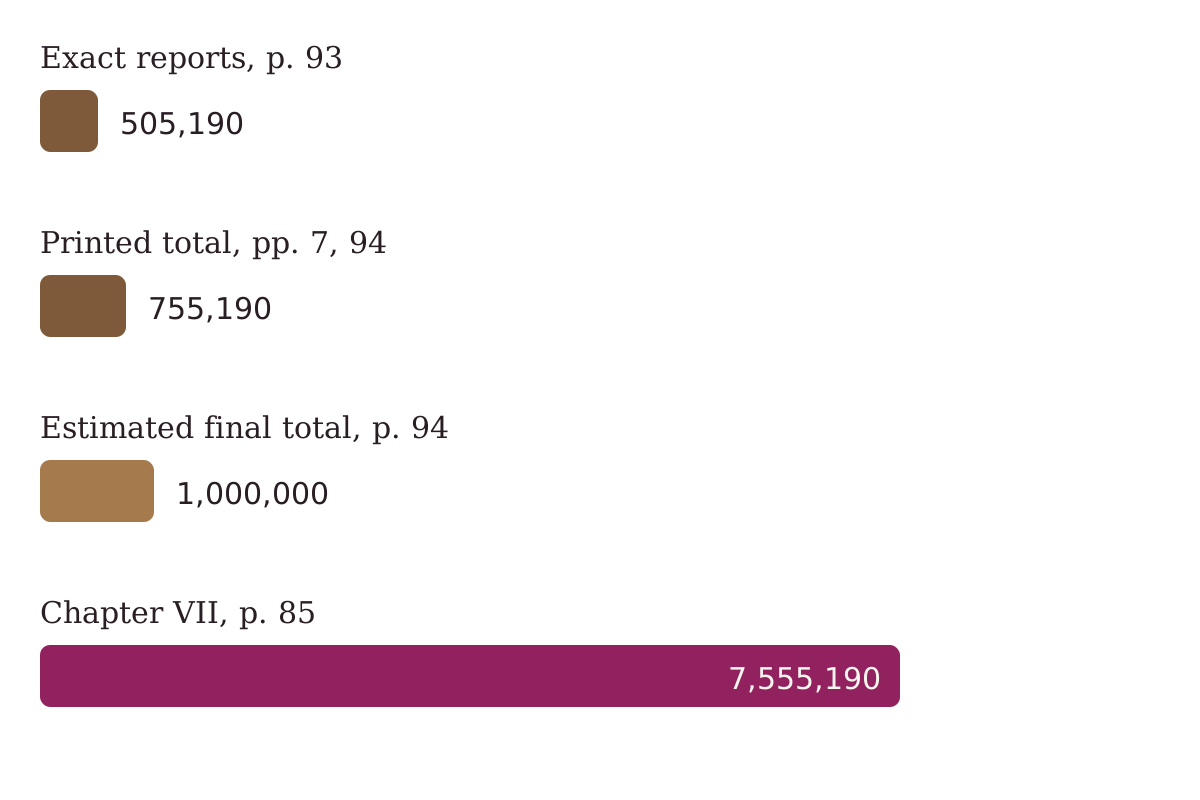
Speech figures as printed, on one scale, with page numbers from Creel’s book; 1,000,000 is his estimate of final totals. 1920.
"Speech totals printed for the Four Minute Men" by Persuasion Dissected — https://persuasiondissected.com/persuaders/four-minute-men/ — licensed CC BY 4.0: https://creativecommons.org/licenses/by/4.0/
Data: George Creel, “How We Advertised America” (1920)
What was a four-minute speech worth?
The organizers also put a dollar figure on the work. “It would not be reasonable to set a lower valuation than $4 on the delivery of a four-minute speech,” the report says. It then adds a sentence that Creel’s book does not repeat: “Indeed, this sum is ridiculously small, but because of its numerical appropriateness let it be taken as a basis of valuation,” on top of the speakers’ actual expenses.
The summary table on p. 31 then lists “One million speeches at $4 each.” That prices the estimate of final totals, not 755,190. Theater “rent” is set at half the speakers’ rate, so $6,000,000 of the report’s $9,424,800.10 total, or 63.7%, rests on the million. At 755,190 speeches, this site’s arithmetic gives $4,531,140 for those two lines.
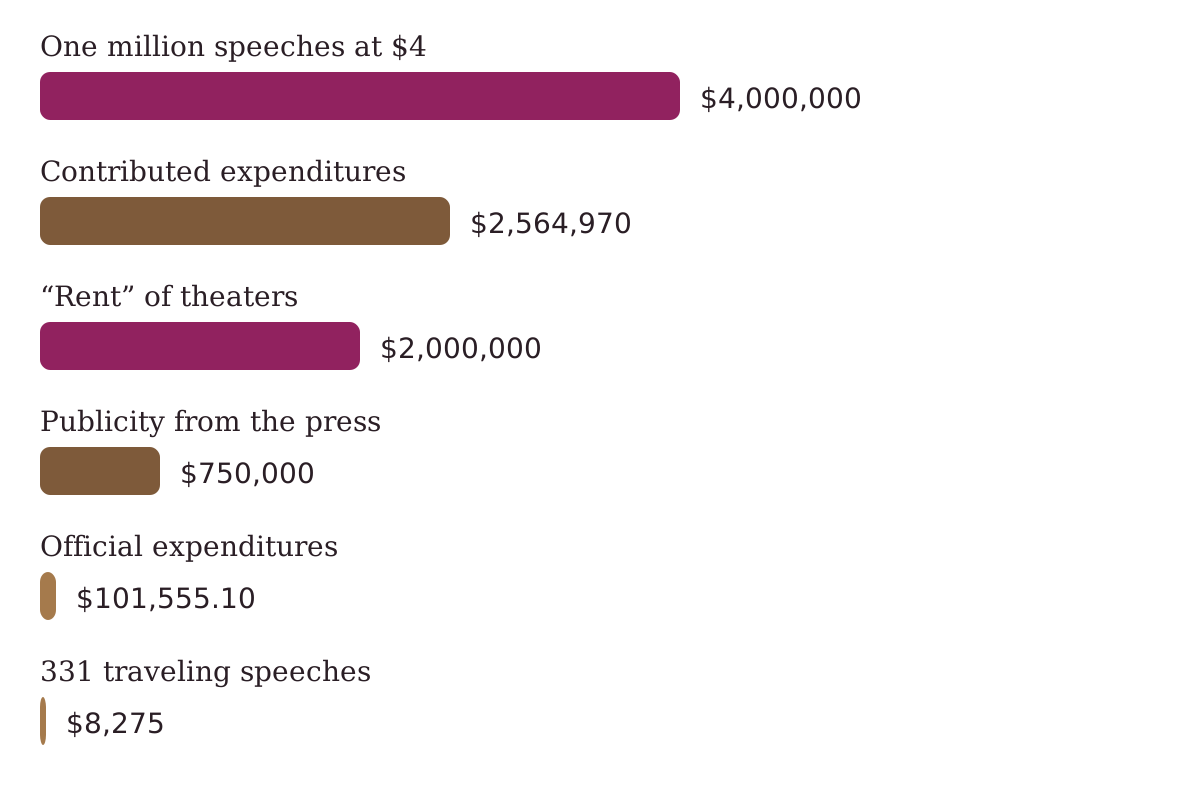
The six lines of the report’s “estimated valuation,” p. 31; the two marked in the accent color are priced on one million speeches. 1920.
"The Committee’s estimated valuation of the Four Minute Men" by Persuasion Dissected — https://persuasiondissected.com/persuaders/four-minute-men/ — licensed CC BY 4.0: https://creativecommons.org/licenses/by/4.0/
Data: Committee on Public Information, Complete Report of the Chairman (1920)
The two 1920 texts do not match here either. The report’s six lines add to its printed total. Creel’s book leaves out the $101,555.10 of official spending and prints $9,313,245, although this site’s addition of his five lines gives $9,323,245, which is $10,000 more. The report calls the result “nearly 95 times” the official cost, and this site’s division gives 92.8.
Where the book says “the established amounts expended from voluntary contributions,” the report says “the estimated amounts.” The contributed expenses show how those amounts were built: local chairmen at $10 a month for an average of 4,422 chairmen over eighteen months gives $795,960, and speakers at $2 a month, “averaging ten speakers to the chairman,” gives $1,591,920.
Both products check, yet ten speakers for each of 4,422 chairmen makes 44,220 people, well below the maximum of 75,000. The report calls 4,422 an average over the entire period, which could explain the gap, but it does not connect the two. The official $101,555.10 went mostly on salaries, $42,745, and printing, $36,451.88, and the report’s note warns that its figures for July to December 1918 were “partly estimated.” Wilson’s letter, as Creel prints it, turned that sum into “less than $1 yearly on an individual basis.”
Did the speeches change anyone’s mind?
The record read here cannot say. Creel asserts effect: when the Third Liberty Loan lagged, he writes, President Wilson bought a fifty-dollar bond, “fifty thousand Four Minute Men” delivered the challenge within days, and “the loan took a leap that carried it over the top.” He calls each speech “aimed as a rifle is aimed.” Those are claims from the man who ran the program, and no audience survey, outside tally or later historian was read for this page, so the readings below are this site’s alone.
Creel reports the opposition on his own terms too. Page 85 claims “only one voice ever raised to attack its faith and efficiency,” that of Senator Sherman of Illinois, and it adds that this attack “is justly to be set down as part of the general praise.” Sherman’s own words were not read for this page.
The totals sit inside an argument about money. On p. 94, two paragraphs after the totals, Creel claims that no other war organization but the Food Commission “paid such large returns on a small investment,” and he blames “the enmity of Congress” for his small budget.
On this site’s reading, the totals work as evidence in that case for the committee, though how much any reader in 1920 relied on them is not recorded. How a message and its source part ways in memory is a later research question, taken up in the sleeper effect.
Is there a last stone in this case?
This case has none on the record read here. The last stone is this site’s label for a premise the persuader leaves unsaid and the audience supplies, and naming one takes a record of the audience supplying it. No reader’s reaction was read for this page.
What the persuasion rests on is in the documents: the report’s p. 22 states “The number of speeches made were 755,190,” with the estimates seven pages off, and the audience figure keeps its final 514 after 112,000,000 in round estimates are added.
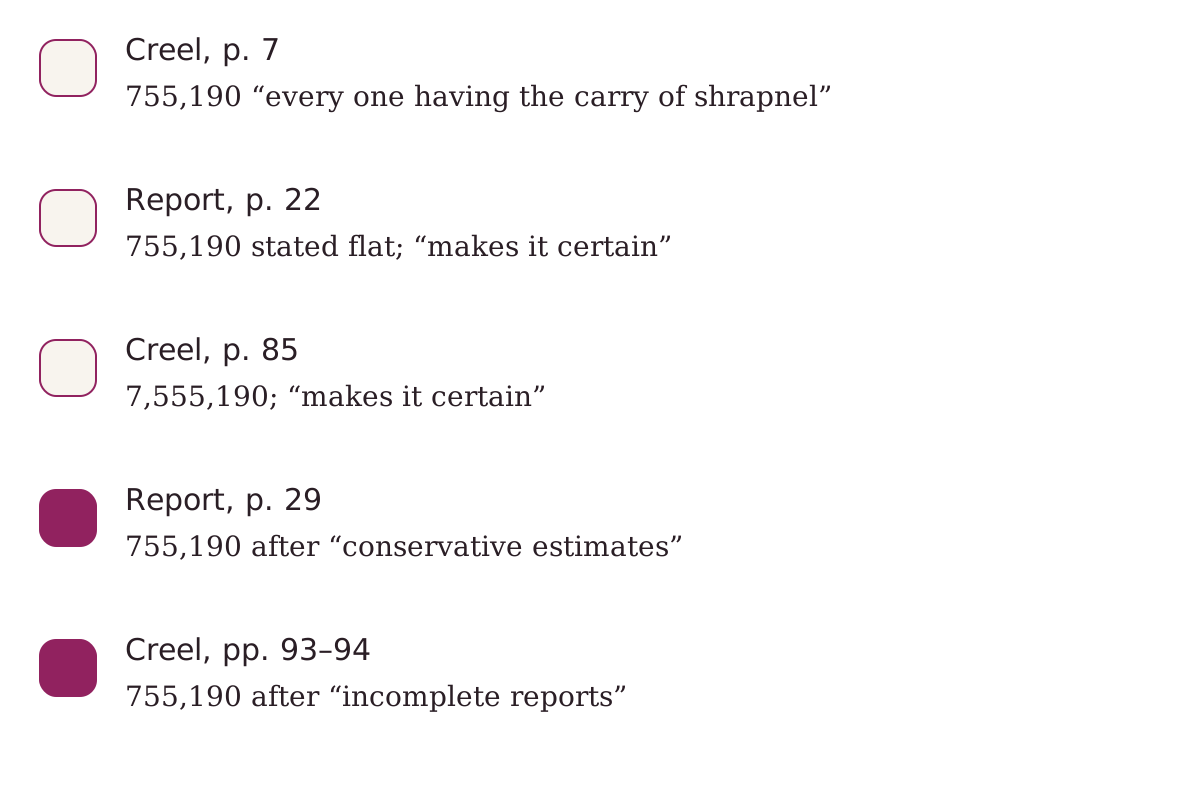
Five places where the total appears; a filled square marks a page that says the speech total includes estimates. Pages in the 1920 report and book.
"Where the Four Minute Men total appears" by Persuasion Dissected — https://persuasiondissected.com/persuaders/four-minute-men/ — licensed CC BY 4.0: https://creativecommons.org/licenses/by/4.0/
The word “certain” does similar work. On this site’s reading, a “fair estimate” that “makes it certain” turns one kind of claim into the other within a single sentence. The disclosure on p. 29 and pp. 93–94 is there for anyone who turned the page, and whether any reader in 1920 did is not recorded.
Crossing map
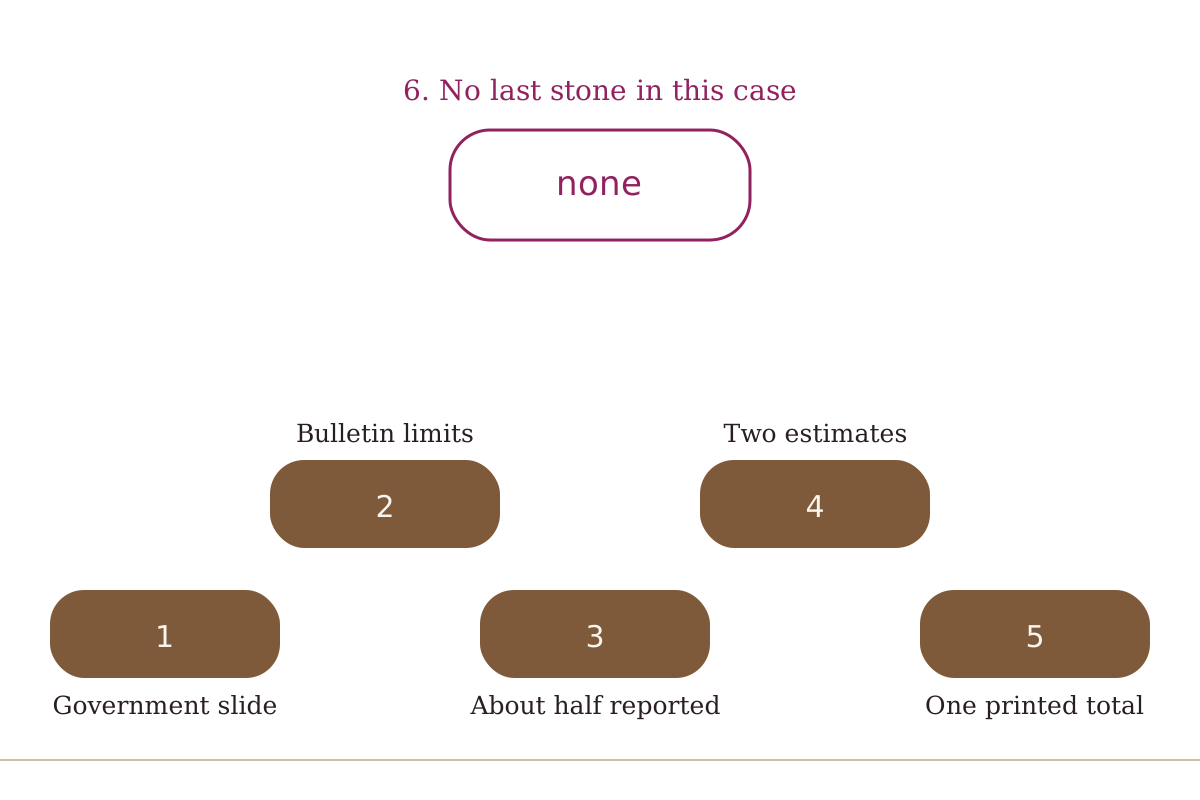
Crossing map of the Four Minute Men totals, from the slide to the printed sum. No last stone is marked. 1917 to 1920.
"Crossing map of the Four Minute Men totals" by Persuasion Dissected — https://persuasiondissected.com/persuaders/four-minute-men/ — licensed CC BY 4.0: https://creativecommons.org/licenses/by/4.0/
- Government slide. The slide says the speaker talks “under the authority of” the Committee (p. 22) [2]
- Bulletin limits. Talks were to stay “within the policy limits of the bulletin” (p. 23) [2]
- About half reported. Reports “covering approximately one-half” give 505,190 speeches (p. 93) [1]
- Two estimates. The first and last campaigns add 70,000 and 180,000 speeches (p. 93) [1]
- One printed total. The sum is printed as 755,190 speeches and 314,454,514 people (p. 94; report p. 22) [1] [2]
- No last stone in this case. The total rests on the unqualified sentence on p. 22 and “makes it certain”; no reader’s reaction was read [2]
Sources
- George Creel, “How We Advertised America” (New York and London: Harper & Brothers, 1920), pp. 7, 84–98. archive.orgRead: chapter VII, pp. 84–98, and p. 7; pp. 7, 84, 85, 89, 93, 94, 95, 97 compared against the page images
- Committee on Public Information, Complete Report of the Chairman of the Committee on Public Information, 1917, 1918, 1919 (Washington: Government Printing Office, 1920), pp. 17, 22–31. archive.orgRead: section on the Four Minute Men, pp. 22–31, and the printing list on p. 17; pp. 17, 22, 23, 29, 30, 31 compared against the page images
- History Committee of the Four Minute Men of Chicago, The Four Minute Men of Chicago (Chicago: 1919). archive.orgRead: chapters on the national and Chicago work, pp. 7–25, and plates; p. 7 and two plates compared against the page images
Next crossing
- The 1784 animal magnetism report — An official account of a test, where everything comes from the people who ran it.
- The Chartist petition of 1848 — A total of signatures that a House of Commons committee counted again.
Cite this page
Persuasion Dissected. "Four Minute Men: Creel Added 250,000 Estimated Speeches." Persuasion Dissected. Published 2026-11-11. https://persuasiondissected.com/persuaders/four-minute-men/. Accessed: add the date you read it.
Corrections
No corrections yet.
How pieces are checked · All corrections · Contact · Report an error (contact@persuasiondissected.com)