Boston Massacre: Witnesses Saw a Half Circle, Not a Line
In three lines
- Who persuaded whom: In December 1770 twelve jurors listed from towns outside Boston found six of eight British soldiers not guilty and two guilty of manslaughter, after John Adams and Josiah Quincy argued the defense, while Paul Revere’s print showed its buyers one version of the Boston Massacre.
- Which stones: The print offers a straight line, a raised sword and a quiet crowd. Witnesses described a half circle and guns going off one after another, disagreed on what was thrown, and did not agree on who said “fire.”
- Outcome: The six were discharged. The two found guilty, Killroy and Montgomery, were burnt in the hand and discharged. The jury gave no reasons.
Route through this piece (10)
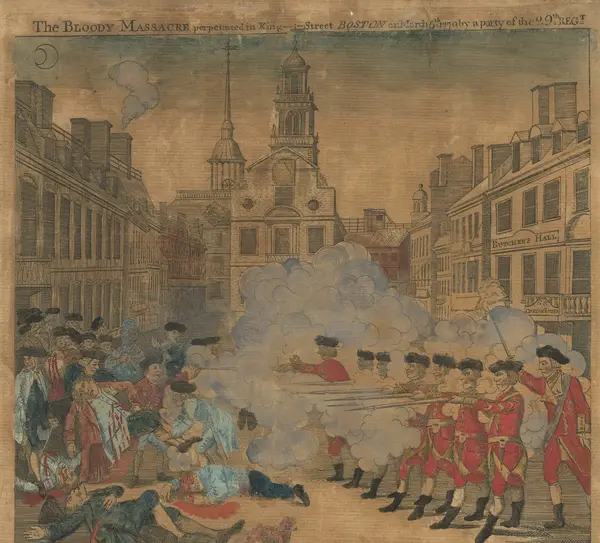
“The Bloody Massacre,” Paul Revere’s engraving after Henry Pelham, cropped to the picture. 1770.
"The Bloody Massacre, engraving, 1770" by Paul Revere, after Henry Pelham — https://commons.wikimedia.org/wiki/File:Paul_Revere,_after_Henry_Pelham,_The_Boston_Massacre,_1770,_NGA_11550.jpg — CC0 1.0 (https://creativecommons.org/publicdomain/zero/1.0/); modified: cropped to the engraving and its title, removing the printed verses and the list of names below; reduced to 1536 px wide
Case card
- Case
- Trial of eight soldiers of the 29th Regiment for the Boston Massacre killingsHodgson, The Trial of William Wemms (1770), title page
- Date range
- Firing 5 March 1770; trial from 27 November 1770; verdict 5 December 1770 by this site’s reckoning from the record’s day namesHodgson, The Trial of William Wemms (1770), pp. 5, 20, 178, 207
- Place
- Superior Court of Judicature, Boston, MassachusettsHodgson, The Trial of William Wemms (1770), title page
- Persuader(s)
- John Adams, Josiah Quincy and Sampson Salter Blowers for the prisoners; Samuel Quincy and Robert Treat Paine for the CrownHodgson, The Trial of William Wemms (1770), p. 9
- Audience
- Twelve jurors listed from Roxbury, Dorchester, Braintree, Dedham, Milton, Stoughton and HinghamHodgson, The Trial of William Wemms (1770), p. 8
- The ask
- Facts are stubborn thingsJohn Adams, in Hodgson, The Trial of William Wemms (1770), p. 177
- Channel
- Sworn testimony and closing argument, against the prints and published depositions Josiah Quincy warned the jury aboutHodgson, The Trial of William Wemms (1770), pp. 77, 177
- Outcome
- Six not guilty and discharged; Killroy and Montgomery guilty of manslaughter, burnt in the hand and dischargedHodgson, The Trial of William Wemms (1770), pp. 207–209
- Primary record
- Hodgson’s shorthand record, published by permission of the court; Paine’s closing was not taken downHodgson, The Trial of William Wemms (1770), title page and p. 178
On 4 December 1770, John Adams told the jury “facts are stubborn things” as he closed for eight soldiers. The line asks twelve men to judge the Boston Massacre by what witnesses had sworn to in that room, whatever their wishes or passions. The record prints only the day name, Tuesday. The date 4 December is this site’s reckoning from the court’s sittings.
Those jurors had a rival account to set aside. This page reads Revere’s picture against the town’s own pamphlet and the printed record of the soldiers’ trial, in which six of the eight went free and two were convicted of a lesser charge. The verdict does not make either side’s story of that night the true one, and the record leaves several of its central questions open.
What did Revere’s print tell its buyers?
Revere’s plate puts its verdict in the title: “The Bloody Massacre perpetrated in King-Street Boston on March 5th 1770 by a party of the 29th Regt.” The verses below the picture, left out of the crop above, supply a name with a gap in it: “While faithless P—n and his savage Bands, / With murd’rous Rancour stretch their bloody Hands.”
The picture adds what the words leave open. Seven soldiers, by this site’s count, stand in one straight rank with muskets level. An officer stands at the end of the rank with his sword up. In the crowd, nobody throws anything or lifts a club, and one man holds a cane at his side.
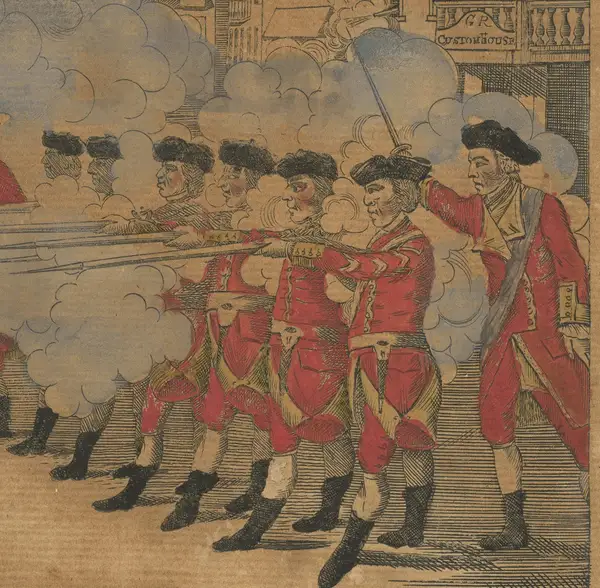
The rank and the officer, in a detail of Revere’s print. 1770.
"The Bloody Massacre, detail of the rank" by Paul Revere, after Henry Pelham — https://commons.wikimedia.org/wiki/File:Paul_Revere,_after_Henry_Pelham,_The_Boston_Massacre,_1770,_NGA_11550.jpg — CC0 1.0 (https://creativecommons.org/publicdomain/zero/1.0/); modified: cropped to the rank of soldiers and the officer; reduced to 1400 px wide
The plate is signed “Engrav’d Printed & Sold by Paul Revere Boston.” This site found no date of sale, so this page does not say how soon after March buyers had it. A printed picture sold alongside a printed story comes up again in the Great Moon Hoax.
What did Boston’s own pamphlet say?
The town put its account in print the same year. A Short Narrative of the Horrid Massacre in Boston says on its title page that it was “Printed by Order of the Town of Boston.” On the formation it does not match the print: “The said party was formed into a half circle.” On the firing it does not match either: “One gun was fired first: then others in succession, and with deliberation.”
On the order, the pamphlet chooses its verb with care: “Capt. Preston is said to have ordered them to fire, and to have repeated that order.” One deposition in its appendix goes further and then hedges. Robert Goddard swore that a man who “appear’d to be the commanding officer” gave the word, and that at the jail he pointed to Preston and told a grand juror he “verily believed he was the man that order’d the soldiers to Fire.”
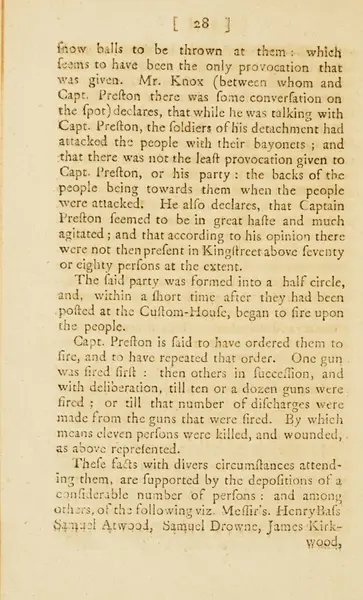
A Short Narrative, printed by order of the town, p. 28. 1770.
"A Short Narrative of the Horrid Massacre in Boston (1770), p. 28" by Unknown author. Public domain.
Full credit
"A Short Narrative of the Horrid Massacre in Boston (1770), p. 28" by Unknown author — https://archive.org/details/shortnarrativeof00unkn — Public domain — Public domain in the US (published 1770) and in the EU (issued by the Town of Boston, no named author; published 1770, 70 years passed); modified: cropped to the printed page, removing the book edge and the scan background
Goddard also swore the snow lay “near a foot deep”; the print’s street is bare. A public body printing its own account has a later parallel in the Four Minute Men. Josiah Quincy later warned the jury about depositions of this kind: “we were not present to cross examine.” He did not name the pamphlet, so linking the two is this site’s reading.
How did the case get from March to December?
A grand jury indicted Captain Thomas Preston and the eight soldiers for five killings. Each indictment names one soldier as the shooter and the others as present and aiding: William Warren for Crispus Attucks, James Hartegan for Samuel Gray, Matthew Killroy for Samuel Maverick, John Carrol for James Caldwell, and Hugh White for Patrick Carr.
The night itself comes through in pieces, because witnesses saw different parts of it. Bells rang after nine o’clock, and people ran out expecting a fire. A sentry at the Custom House door was surrounded by boys, and James Bailey says they were “throwing pieces of ice at him.” William Whitington heard Preston tell another officer to “take out six or seven of the men, and let them go down to the assistance of the Sentry.” The firing followed soon after.
Preston was tried first and separately. The National Park Service reports that his jury found him not guilty on 30 October 1770. This site did not read a record of that trial.
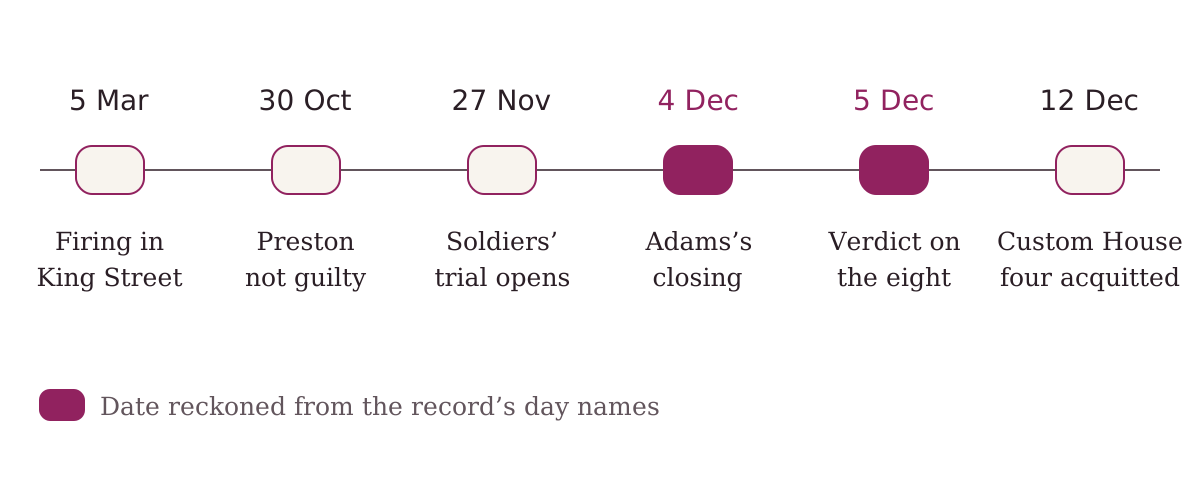
From the firing to the last of the trials. 5 March to 12 December 1770.
"The Boston Massacre trials, March to December 1770" by Persuasion Dissected — https://persuasiondissected.com/on-trial/boston-massacre-trial/ — licensed CC BY 4.0: https://creativecommons.org/licenses/by/4.0/
The soldiers’ trial opened on 27 November, and the record slips on the day. It prints “On Saturday, the 27th November,” but that date fell on a Tuesday, and the first sitting adjourned to “next morning, Wednesday.” Counting forward by the day names gives Tuesday 4 December for Adams’s close and Wednesday 5 December for the verdict, since the record prints no adjournment after the court met on Wednesday morning.
The whole account comes through one reporter: its title page says it was “Taken in short-hand by John Hodgson” and “Published by permission of the court,” and it marks several places where arguments were summarized or cut.
Who sat on the jury?
The clerk’s list holds 33 names by this site’s count: 25 on the panel and 8 talesmen, the extra men a sheriff returns when a panel runs short. The prisoners agreed that Wemms “should make challenges for them all.” The list marks 11 men challenged for cause, 10 challenged peremptorily, meaning with no reason given, and 12 sworn.
All four men listed from Boston were challenged for cause. The twelve sworn are listed from Roxbury, Dorchester, Braintree, Dedham, Milton, Stoughton and Hingham, and three of the Hingham men came in as talesmen. The list gives no causes.
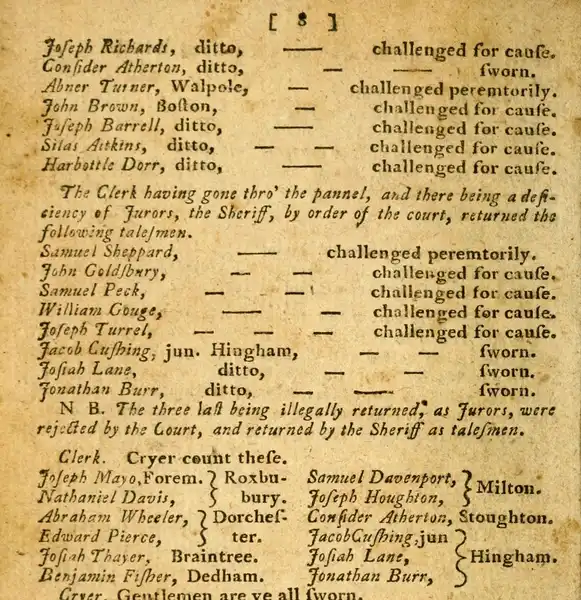
The end of the jury list, with the twelve sworn and their towns, in the trial record, p. 8. 1770.
"The Trial of William Wemms (1770), p. 8" by John Hodgson. Public domain.
Full credit
"The Trial of William Wemms (1770), p. 8" by John Hodgson — https://archive.org/details/trialofwilliamwe00wemm — Public domain — Public domain in the US (published 1770) and in the EU (John Hodgson, reporter; published 1770, well over 70 years passed); modified: cropped to the upper part of the page, ending at the list of twelve jurors
Adams gave one clue to what a challenge might be for. He mentioned a man nominated as a juror who “had said, he believed Capt. Preston was innocent, but innocent blood had been shed, and therefore somebody ought to be hanged for it.” Who gets to count as the jury, and how its votes are counted, also matters in the trial of Socrates.
Who said “fire”?
The raised sword poses a plain question. This record does not settle it. This site searched the testimony and found ten witnesses who speak to the word, a floor rather than a tally. Only James Dodge names Preston, and he hedges: “I think it was Capt. Preston that gave the word to fire.”
Richard Palmes, who had just stepped between Preston and another man, said: “I heard the word fire, who gave it I do not know.” James Brewer, asked whether it came from the people or the soldiers, answered: “From the people.” Dodge himself had heard “several among the people” shouting it. The full list, with page numbers, is in the CSV (where this data comes from).
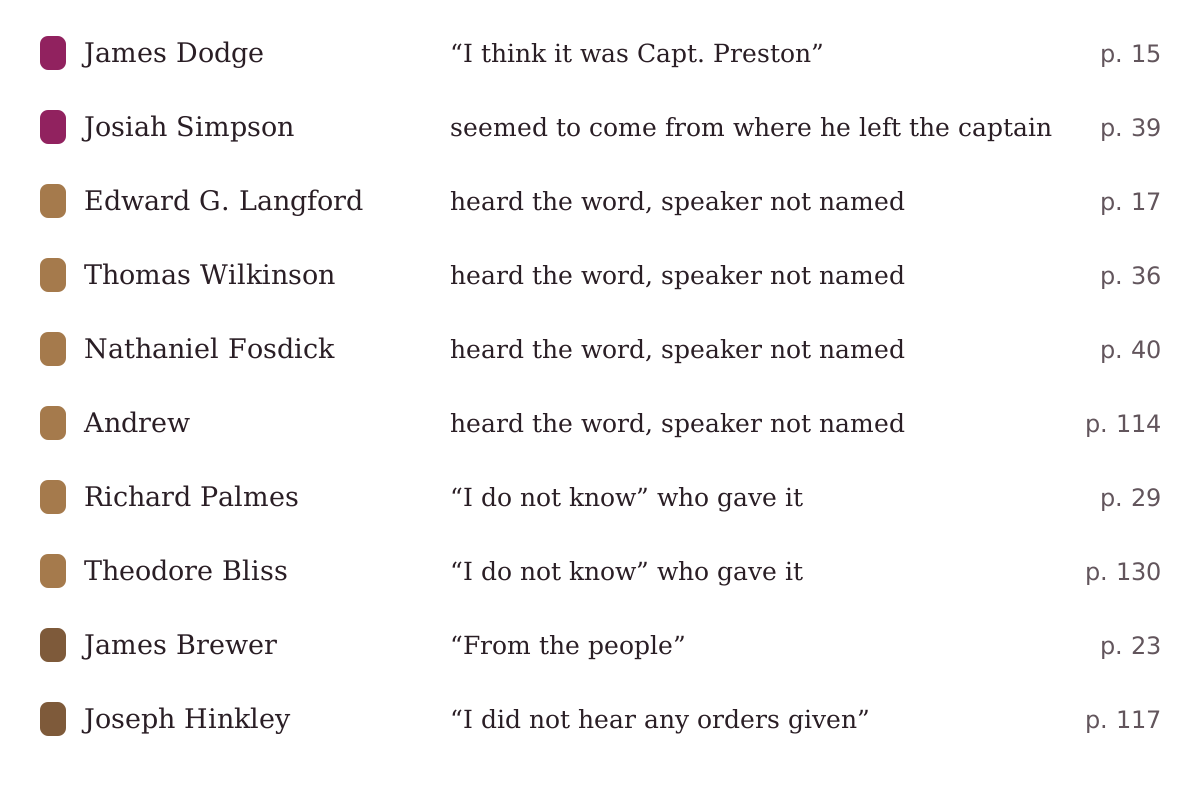
Ten witnesses on the word “fire,” from this site’s search of the record, which is a floor. Testimony of November and December 1770.
"Ten witnesses on the word fire" by Persuasion Dissected — https://persuasiondissected.com/on-trial/boston-massacre-trial/ — licensed CC BY 4.0: https://creativecommons.org/licenses/by/4.0/
Data: John Hodgson, The Trial of William Wemms (Boston, 1770)
Other testimony sets Preston against the picture. Palmes asked if he meant to fire on the inhabitants and reports the reply “by no means.” Theodore Bliss says Preston told him “they could not fire without his orders.” Benjamin Burdick saw him afterward push up the guns and say “stop firing, do not fire.”
This site uses the last stone for a premise that no speaker states and the audience supplies, with a record of the audience supplying it. The raised sword comes close: the plate’s words stop at “faithless P—n,” and the town’s pamphlet says only “is said.” Nothing this site read records what a buyer took from the sword, so this page marks no last stone. The print relied on its picture. This site could not date the print against the town’s pamphlet, so this page does not say which came first.
How does the print compare with the testimony?
The table sets each detail against one or two witnesses. It does not imply that the print’s buyers read any of this. The National Park Service, writing about Preston’s separate trial, says testimony there suggests he may have stood in front of his soldiers, “unlike what is depicted in this engraving.”
| In the print | In the record |
|---|---|
| One straight rank | “in a circle, or half moon” (Brewer, p. 22) |
| Muskets level together | “one after another, like the clock striking” (Wilkinson, p. 36) |
| Officer behind the rank | “I saw Preston fall in betwixt the fourth and fifth man” (Fosdick, p. 40) |
| Nothing thrown | 25 witnesses to ice, snow-balls and sticks, ten for the Crown, by Justice Oliver’s count (p. 204); “I saw nothing thrown” (Langford, p. 19) |
| A gun at a Custom House window | Four men acquitted on that claim (appendix, p. 217) |
The window has its own short trial in the appendix, drawn from the minutes of an attendee the record does not name. On 12 December four men, Edward Manwarring among them, stood accused of aiding the killing of Attucks. Charles Bourgat, Manwarring’s young French servant, swore he had been forced to fire from a Custom House window. Witnesses contradicted him, and the record ends: “The Jury acquitted all the Prisoners, without going from their Seats.”
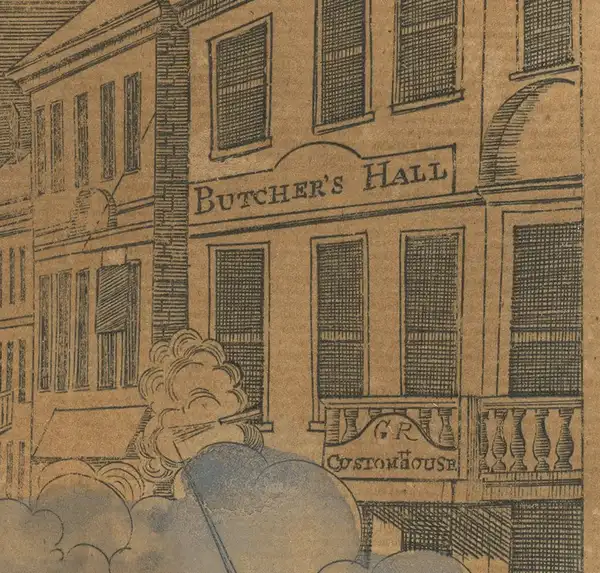
The window under the sign “Butcher’s Hall,” beside the balcony marked Custom House, in a detail of Revere’s print. 1770.
"The Bloody Massacre, detail of the Custom House" by Paul Revere, after Henry Pelham — https://commons.wikimedia.org/wiki/File:Paul_Revere,_after_Henry_Pelham,_The_Boston_Massacre,_1770,_NGA_11550.jpg — CC0 1.0 (https://creativecommons.org/publicdomain/zero/1.0/); modified: cropped to the Custom House front, with the sign and the window; 880 px wide
What did the Crown ask the jury to accept?
Five lawyers appear on the record. Robert Treat Paine and Samuel Quincy spoke for the Crown, and John Adams, Josiah Quincy and Sampson Salter Blowers appeared for the prisoners, so two men named Quincy faced each other. Samuel Quincy opened by calling the case one that decided “whether eight of your fellow subjects shall live or die!”
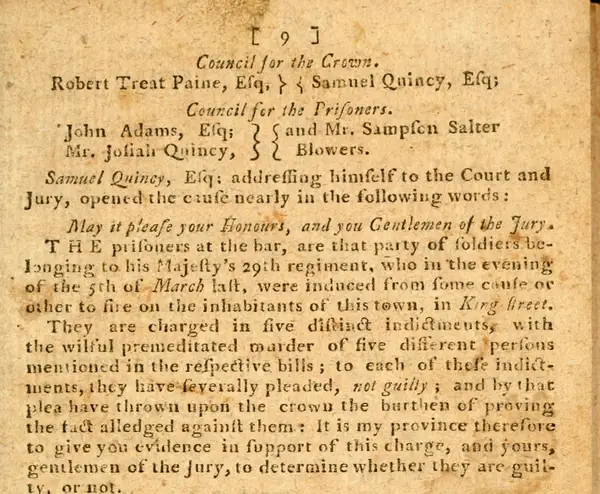
Counsel on both sides, and the start of the Crown’s opening, in the trial record, p. 9. 1770.
"The Trial of William Wemms (1770), p. 9" by John Hodgson. Public domain.
Full credit
"The Trial of William Wemms (1770), p. 9" by John Hodgson — https://archive.org/details/trialofwilliamwe00wemm — Public domain — Public domain in the US (published 1770) and in the EU (John Hodgson, reporter; published 1770, well over 70 years passed); modified: cropped to the upper part of the page, ending after the fourth paragraph of the opening
His case rested on three claims. The first was identity, that all eight stood in that party, which he said witnesses had sworn to. The second was a rule that made it “imaterial,” where several men act together, “who gave the mortal blow,” because all present count as principals. The third answered self-defense in advance: “A person cannot justify killing, if he can by any means make his escape.”
He also gave the jury a motive for the crowd’s gathering, and it runs opposite to Adams’s. Soldiers with cutlasses had been out earlier that evening, and in his account the town’s people “had reason to be apprehensive they were in danger of their lives.” On that telling, the bells and the numbers in King Street were fear, with no plot behind them. He pressed hardest on one man, saying the shooters could not be fixed “except in the case of Killroy, against whom I think you have certain evidence.”
What did Quincy and Adams ask the jury to accept?
Josiah Quincy, opening for the defense, named the rival account directly: “The prints exhibited in our houses have added wings to fancy.” He does not say which prints, so Revere’s is not certain to be among them. His ask came just before: “the prisoners are to be condemned by the evidence here in Court produced against them, and by nothing else.”
Adams then took the Crown’s own witnesses. Of Ebenezer Bridgham he said: “This is a witness for the crown, and his testimony is of great weight for the prisoners.” The defense also brought in Patrick Carr, one of the dead, through his surgeon, who reported that Carr “did not blame the man whoever he was, that shot him.” Justice Oliver told the jury “This Carr was not upon oath, it is true,” then left it to them “whether a man, just stepping into eternity, is not to be believed.”
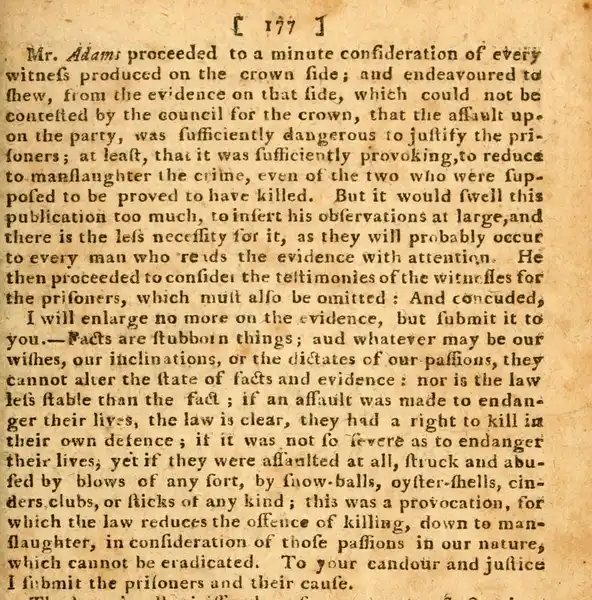
Adams’s close in the trial record, p. 177, after the reporter’s summary of what he left out. 1770.
"The Trial of William Wemms (1770), p. 177" by John Hodgson. Public domain.
Full credit
"The Trial of William Wemms (1770), p. 177" by John Hodgson — https://archive.org/details/trialofwilliamwe00wemm — Public domain — Public domain in the US (published 1770) and in the EU (John Hodgson, reporter; published 1770, well over 70 years passed); modified: cropped to the upper part of the page, ending after the closing submission
The crowd, Adams also told the jurors, was most probably “a motley rabble,” which he went on to describe in racial and ethnic slurs. He singled out “a Carr from Ireland, and an Attucks from Framingham,” and complained of those who “ascribe all their doings to the good people of the town.” On this site’s reading, the wording set the crowd apart from the town. He did concede that Maverick “had no concern in the riotous proceedings.”
Then came the ask. After “facts are stubborn things,” the sentence turns to a rule of law with two branches: an assault that endangered life gave “a right to kill in their own defence,” and blows “of any sort, by snow-balls, oyster-shells, cinders clubs, or sticks” made the killing manslaughter.
The record of this argument is uneven. The reporter cut part of Adams’s review of witnesses as too long, and Paine’s closing for the Crown is missing because the shorthand writer “was so fatigued, that he could not take down what Mr. Paine said.”
Why were two soldiers found guilty of manslaughter?
The jury gave no reasons. It “withdrew for about two hours and an half.” On this site’s reading, its verdicts fall where the argument forked. The reporter had described Adams aiming to reduce to manslaughter the crime “even of the two who were supposed to be proved to have killed.” Justice Peter Oliver told the jurors that “as to two of the prisoners, there is no great doubt of their firing, namely, Montgomery and Killroy.”
The evidence on those two differs in kind. Palmes and Bailey put a blow on Montgomery or his gun before he fired, and Bailey says he “was knocked down with a stick.” Against Killroy the Crown had Langford, who stood beside Samuel Gray, and Hemmingway’s report of what Killroy said before that night. Oliver gave Hemmingway little weight, since Killroy’s “being at the Custom House was not voluntary, but by order of his officer.”
The other six were acquitted, including four men the indictments name as shooters.
Oliver pointed to Justice Trowbridge’s account of the difficulty of fixing any one killing on any one man, and offered the maxim “That it is better that ten guilty persons escape, than one innocent person suffer.” He then spoke of “a violent presumption” that they had fired in their own defense. The other justices, the record says, “differed in no material point.” The record does not say whether the charge moved the jury. A later Massachusetts jury and its short deliberation come up in the Lizzie Borden trial.
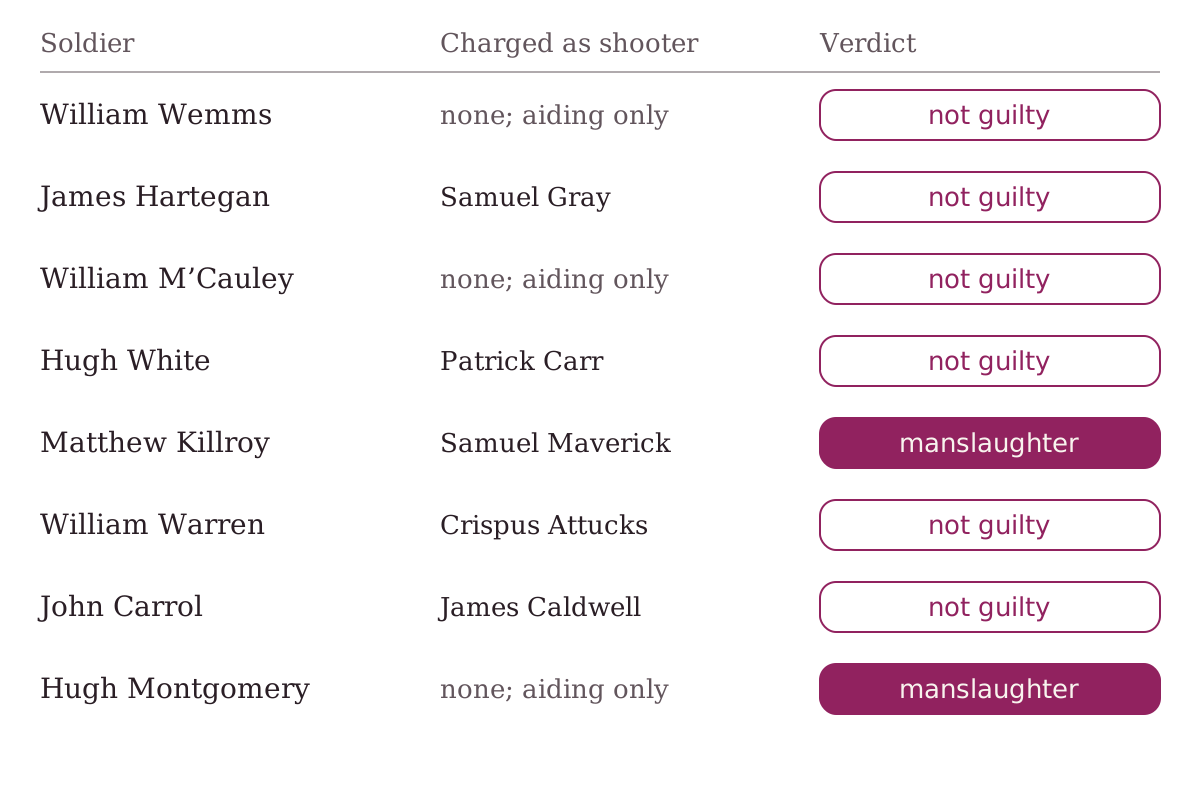
The eight verdicts, with the killing each named shooter was charged with. Verdicts of December 1770.
"Eight soldiers and their verdicts" by Persuasion Dissected — https://persuasiondissected.com/on-trial/boston-massacre-trial/ — licensed CC BY 4.0: https://creativecommons.org/licenses/by/4.0/
Data: John Hodgson, The Trial of William Wemms (Boston, 1770)
The reporter closes in one sentence: “Wemms, Hartegan, M’Cauley, White, Warren and Carrol were immediately discharged; Killroy and Montgomery, prayed the Benefit of Clergy, which was allowed them, and thereupon they were each of them burnt in the hand, in open Court, and discharged.”
Benefit of Clergy was an old English plea that, as the National Park Service describes it, reduced sentences for first offenders. Each verdict, with page numbers, is in the CSV (where this data comes from).
Crossing map
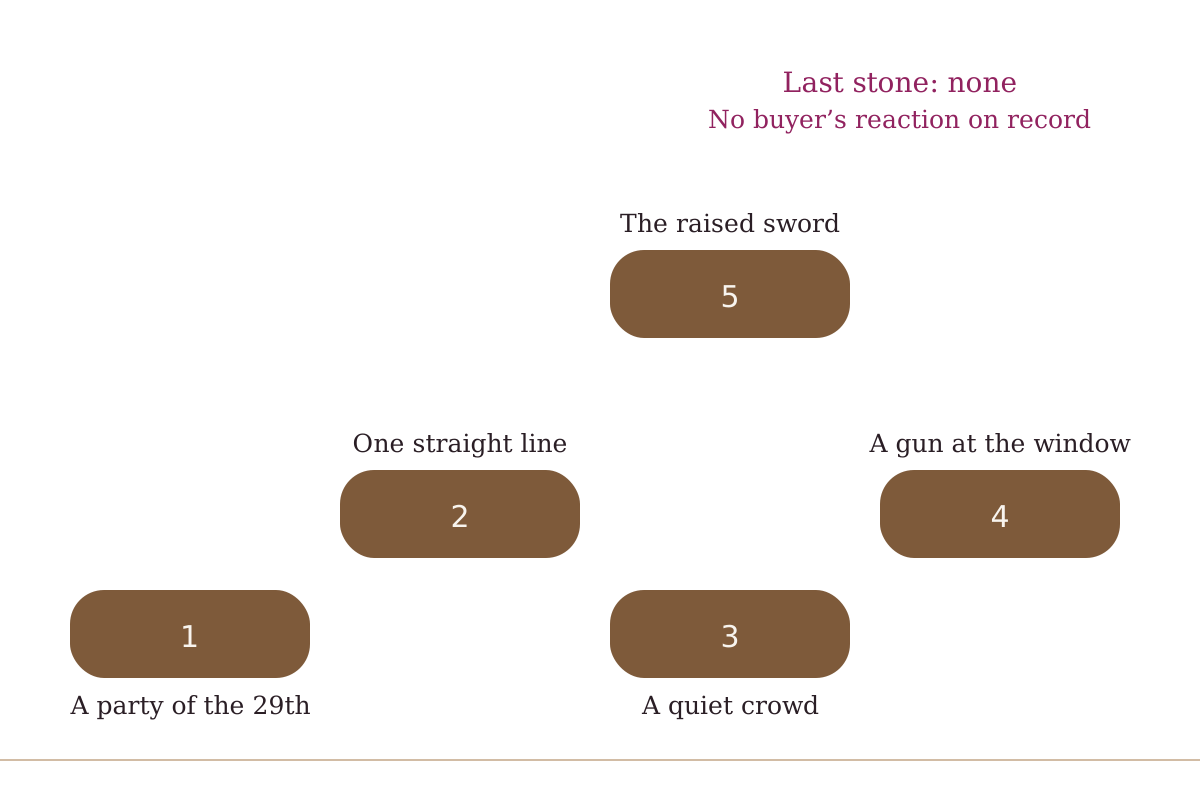
Crossing map of Revere’s print. The stones are what the plate offers a buyer. 1770.
"Crossing map of Revere’s print" by Persuasion Dissected — https://persuasiondissected.com/on-trial/boston-massacre-trial/ — licensed CC BY 4.0: https://creativecommons.org/licenses/by/4.0/
- A party of the 29th. The title names the regiment, and the verses name “P—n” with a gap [2]
- One straight line. The plate shows one rank; the pamphlet says “a half circle” (p. 28) [2] [3]
- A quiet crowd. The plate shows nothing thrown; witnesses disagree (pp. 19, 204) [1] [2]
- A gun at the window. The plate shows a muzzle at a window; four men were acquitted on that claim (p. 217) [1] [2]
- The raised sword. No words on the plate say he gave the order. The pamphlet says “is said” (p. 28), and one of ten witnesses found names him, with “I think” (p. 15) [1] [2] [3]
- No last stone in this case. Nothing read records a buyer taking the sword for an order. The print relied on its picture [2]
Sources
- John Hodgson (shorthand reporter), The Trial of William Wemms, James Hartegan, William M’Cauley, Hugh White, Matthew Killroy, William Warren, John Carrol, and Hugh Montgomery (Boston, 1770). archive.orgRead: chapters of the record: indictments, jury list, counsel’s arguments, the testimony on the order to fire, summing up, verdicts and appendix; witness testimony read in part, by searchText license: CC0 (transcription) (terms)
- Paul Revere, after Henry Pelham, The Bloody Massacre perpetrated in King-Street Boston on March 5th 1770 (Boston, 1770), hand-colored engraving, National Gallery of Art copy. commons.wikimedia.orgRead: full page: the whole print, title and versesText license: CC0 (terms)
- A Short Narrative of the Horrid Massacre in Boston (Boston: printed by order of the Town of Boston, 1770). archive.orgRead: single value via title page, p. 28 and deposition No. 72 (appendix p. 58); the rest searched only
- National Park Service, “Boston Massacre Trial.” nps.govRead: full article

Next crossing
- The trial of Socrates — A trial where the sources disagree on the count, read from the words said to be spoken at it.
- The Four Minute Men — Wartime speakers and the numbers their own organizers reported about them.
Cite this page
Persuasion Dissected. "Boston Massacre: Witnesses Saw a Half Circle, Not a Line." Persuasion Dissected. Published 2026-11-11. https://persuasiondissected.com/on-trial/boston-massacre-trial/. Accessed: add the date you read it.
Corrections
No corrections yet.
How pieces are checked · All corrections · Contact · Report an error (contact@persuasiondissected.com)