Chartist Movement: 5.7M Signatures Claimed, 1.98M Reported
In three lines
- Who persuaded whom: On 13 April 1848 a Commons committee told the House that the petition of the Chartist movement, Britain’s campaign for the six-point People’s Charter, held 1,975,496 signatures, against the 5,706,000 Feargus O’Connor had announced.
- Which stones: Thirteen clerks and the usual counter working “upwards of seventeen hours,” and a list of false names. O’Connor rejected the count on the spot: thirteen clerks could not have done it, he said, and five million legitimate names would remain without the false ones.
- Outcome: O’Connor abandoned his motion on the petition that night. Why Chartism faded is interpretation, and T. F. Tout (1918) and Julius West (1920) read it differently.
Route through this piece (8)
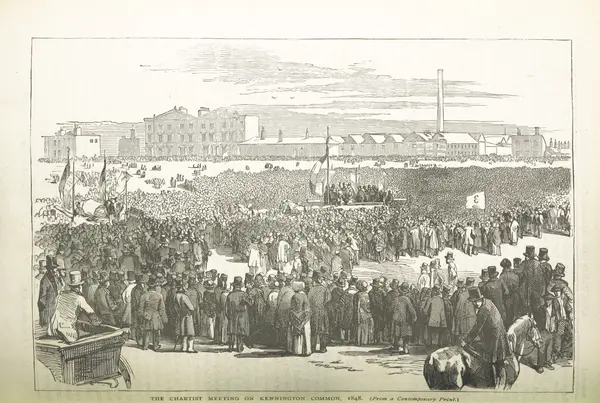
The meeting on Kennington Common as printed in Old and New London, “from a contemporary print.” The meeting took place on 10 April 1848.
"The Chartist meeting on Kennington Common, 1848" by Unknown author. Public domain.
Full credit
"The Chartist meeting on Kennington Common, 1848" by Unknown author — https://commons.wikimedia.org/wiki/File:Image_taken_from_page_944_of_%27Old_and_New_London,_etc%27_(11192221776).jpg — Public domain — Public domain in the US (published before 1931) and in the EU (unsigned illustration published 1873 to 1878, 70 years passed)
Case card
- Case
- The 1848 Chartist petition and the Commons countHC Deb 13 April 1848, vol. 98, cc. 284–301
- Date range
- 10 April 1848 (presented) to 13 April 1848 (report and reply); Convention sequel to 19 AprilHC Deb vol. 98, c. 285; Gammage (1894), pp. 319–321
- Place
- Kennington Common and the House of Commons, LondonHC Deb vol. 98, cc. 287, 292–293
- Persuader(s)
- Feargus O’Connor, MP for Nottingham; Thomas Thornely and the Select Committee on Public Petitions; Lord John Russell, Sir R. H. Inglis, Mr. CrippsHC Deb vol. 98, cc. 284–292
- Audience
- Members of the House of Commons; beyond them, the petition’s signers and the Chartist ConventionHC Deb vol. 98, cc. 284–301; Gammage (1894), p. 319
- The ask
- Committee: accept 1,975,496 and “a gross abuse of the privilege”. O’Connor: reject the count, as five million legitimate signatures would remainHC Deb vol. 98, cc. 285–286
- Channel
- Petition; committee report read at the table; debate; Convention sittingsHC Deb vol. 98, cc. 284–301; Gammage (1894), pp. 319–321
- Outcome
- O’Connor abandoned his motion on the petition. Why Chartism faded remains a matter of interpretationHC Deb vol. 98, cc. 300–301; Tout (1918), pp. 292, 300; West (1920), pp. 294–295
- Primary record
- HC Deb 13 April 1848, vol. 98, cc. 284–301UK Parliament historic Hansard
On 13 April 1848, the clerk at the Commons table read out a committee’s count of one Chartist petition. The report asked the House to accept that 1,975,496 was the real number, against 5,706,000 announced three days earlier. It also asked the House to accept a description, “a gross abuse of the privilege,” of what the sheets contained.
Feargus O’Connor, the Member for Nottingham who had presented the petition, stood up in the same debate and refused the number. By this site’s arithmetic the two figures stand 3,730,504 apart. They are two parties’ claims, each denied by the other party while the House listened. What was counted and what the count was then taken to mean are separate questions in the printed record, and only the first has a number attached.
What was the Chartist movement?
The Chartist movement was a British campaign for the People’s Charter, a draft law with six demands. The movement’s best-known method was the mass petition to the House of Commons. Mark Hovell’s history (1918, p. 2) lists the demands: a vote for every adult man, voting by ballot, 300 equally divided constituencies, Parliaments elected every year, no property qualification for members, and pay for members.
There were three national petitions. For 1839 speakers in the debate of 12 July mostly give 1,200,000 signatures (HC Deb vol. 49, cc. 222–274), as does Hovell (p. 134), while one speaker says 1,280,000 (c. 252) and Julius West has Thomas Attwood giving that figure when he presented it in June (p. 114). The House voted down the motion with 46 for and 235 against (vol. 49, c. 274).
For 1842 Thomas Duncombe told the House 3,315,752 (vol. 62, c. 1375), and the next day “very nearly 3,500,000” (vol. 63, c. 14). The Northern Star, the Chartist paper, gave 3,317,702, a figure also painted on the frame that carried the petition (Hovell, p. 254). The vote was 49 to 287 (vol. 63, c. 88).
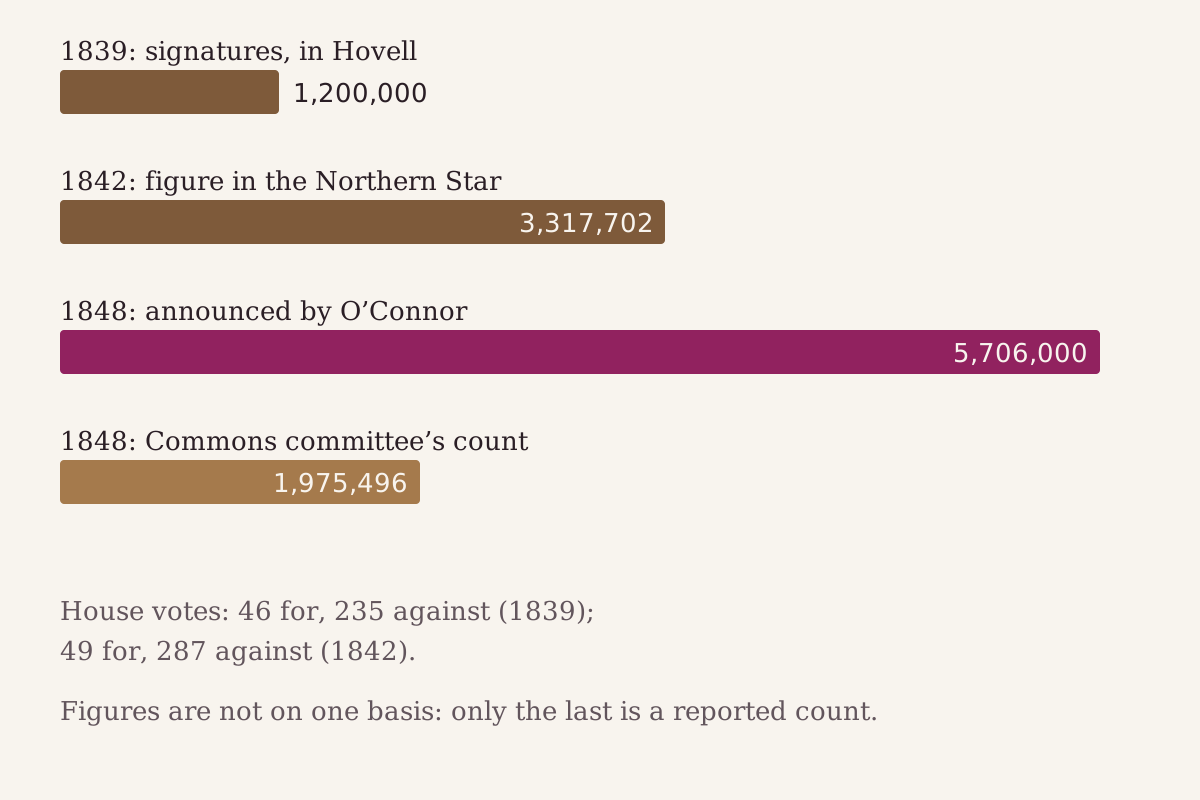
The figures attached to the three national petitions. They are not on one basis: only the 1848 committee figure is a count reported in the House. 1839 to 1848.
"Figures attached to the three national petitions" by Persuasion Dissected — https://persuasiondissected.com/movements/chartist-movement/ — licensed CC BY 4.0: https://creativecommons.org/licenses/by/4.0/
Data: Hovell and Tout, The Chartist Movement (1918), pp. 134, 254; HC Deb 12 July 1839, vol. 49, c. 274; HC Deb 3 May 1842, vol. 63, c. 88; HC Deb 13 April 1848, vol. 98, cc. 284–301
The 1848 petition may not have asked for all six points. Tout, who finished Hovell’s book, writes that O’Connor’s dislike of the ballot prevailed and that the ballot “was quietly dropped” (p. 287). Yet the committee’s chairman, Thomas Thornely, named “the ballot” among the points the petitioners urged (c. 286). This page has not read the petition’s own text, so the conflict stays open.
What happened on Kennington Common on 10 April 1848?
A printed handbill called the working men of London to a “peaceful procession” on “Monday Next, April 10,” under the motto “Peace and Order.” The procession was to end on Kennington Common, south of the Thames. Tout writes that the police commissioner, Richard Mayne, told O’Connor the meeting could go ahead but that no procession would cross the bridges (p. 291).
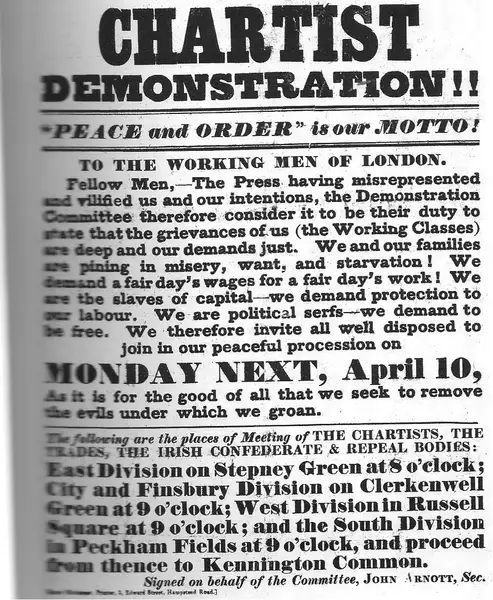
The handbill for the demonstration, signed on behalf of the committee by John Arnott. April 1848.
"Chartist Demonstration handbill" by John Arnott — https://commons.wikimedia.org/wiki/File:Chartist_Demonstration.jpg — Public domain — Public domain in the US (published 1848) and in the EU (signed by John Arnott, who died 1868, life+70)
The government’s preparations were already large before any signature was counted. Tout puts the special constables at nearly 170,000 and has the Duke of Wellington directing the defense (p. 290). Gammage, a Chartist writing later, gives 70,000 sworn in the City (p. 313).
The law moved too. Tout says government lawyers found a Restoration statute against more than ten people presenting a petition, and that an Act hurried through Parliament made certain seditious deeds a felony (p. 290). On 10 April that measure was still a bill, and the Commons debated its second reading that evening (vol. 98, c. 73). Lord John Russell’s report to the Queen at 2 p.m. that day, as West quotes it, already called the meeting “a complete failure” (p. 249).
The petition went to Parliament without the procession. Tout has it arriving “in three cabs” amid “shouts of laughter” (p. 291), and a committee member, Mr. Cripps, later spoke of “three crazy cabs” (c. 291). The crowd itself became a second fight over numbers. Every figure in that fight belongs to someone:
| Crowd on Kennington Common | Who said so | Where |
|---|---|---|
| Exceeding half a million | O’Connor, as reported by Mr. Smyth | c. 293 |
| 400,000 to 500,000 | O’Connor to Convention delegates | Gammage, p. 317; West, p. 251 |
| A quarter of a million | A Chartist proclamation, as reported by the Earl of Arundel | c. 287 |
| At most 25,000, and he believed not more than 15,000 | Earl of Arundel, “from the highest” sources | c. 287 |
| At most 15,000 | Mr. J. G. Smyth, who said he was there | cc. 292–293 |
| About 20,000 | “More impartial observers,” in Tout’s summary | p. 291 |
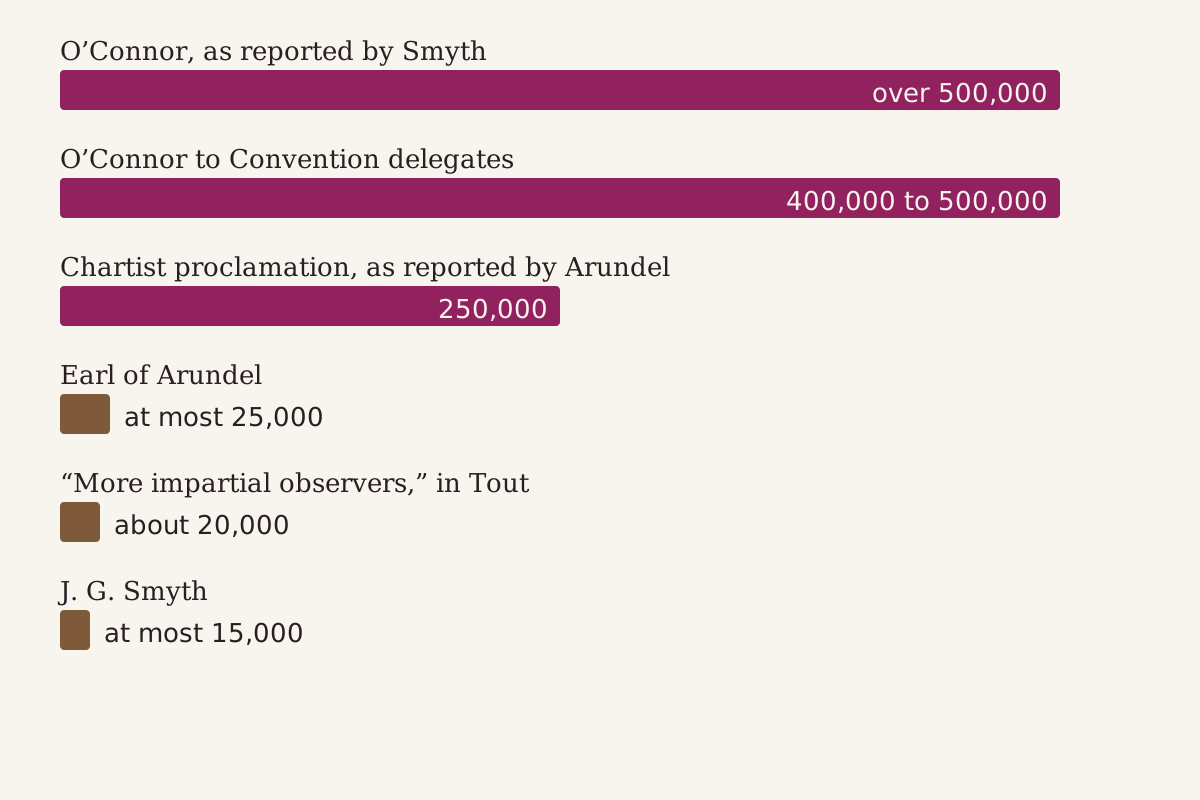
The crowd figures in the table on one scale, each labelled with whoever gave it, using the upper figure where a range is given. O’Connor’s and the proclamation’s figures reach the record only as others relayed them. Claims from April 1848, with Tout’s summary from 1918.
"Crowd figures for Kennington Common" by Persuasion Dissected — https://persuasiondissected.com/movements/chartist-movement/ — licensed CC BY 4.0: https://creativecommons.org/licenses/by/4.0/
Data: HC Deb 13 April 1848, vol. 98, cc. 284–301; Gammage, History of the Chartist Movement (1894), p. 317; West, A History of the Chartist Movement (1920), p. 251; Hovell and Tout, The Chartist Movement (1918), p. 291
What did the committee report on 13 April 1848?
The Select Committee on Public Petitions was under instruction to report the signatures on “each and every petition,” as Thornely reminded O’Connor (cc. 286–287). West reads it differently, writing that the Government “worked on the line suggested” by doubters and that the sheets went to the clerks “immediately on its arrival” (p. 250).
The report itself says thirteen law-stationers’ clerks worked “upwards of seventeen hours,” with the usual counter, under the committee’s clerk, and its result is the sentence at the top of this page.
The report then moves from number to character. On “numerous consecutive sheets” it found signatures in “one and the same handwriting,” and it listed the names of people unlikely to agree, “Victoria Rex, April 1st” and the Duke of Wellington among them. It also listed names “obviously fictitious,” such as “No Cheese,” “Pug Nose” and “Flat Nose,” and added that it would not repeat others out of regard for the dignity of the House.
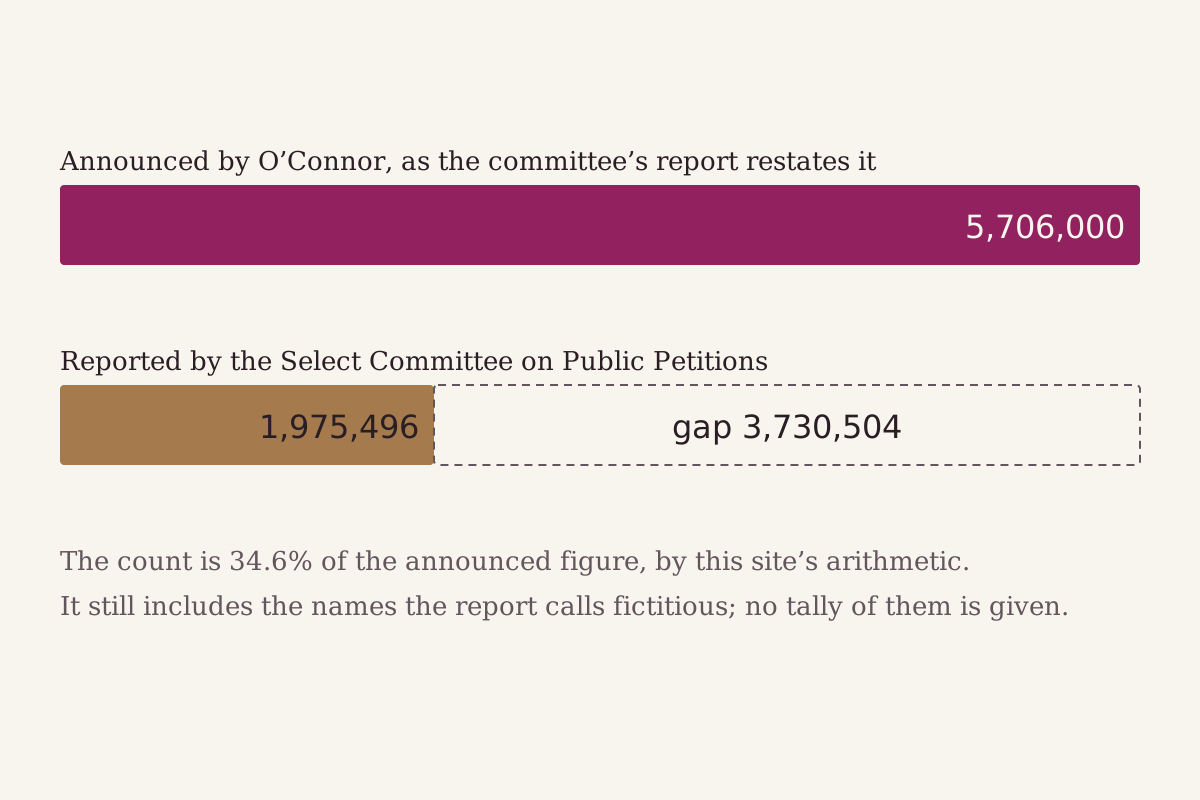
The announced figure and the reported count, with the gap by this site’s arithmetic. 13 April 1848.
"The announced figure and the reported count" by Persuasion Dissected — https://persuasiondissected.com/movements/chartist-movement/ — licensed CC BY 4.0: https://creativecommons.org/licenses/by/4.0/
Data: HC Deb 13 April 1848, vol. 98, cc. 284–301
Two limits are easy to miss. The report gives no tally of false names, so 1,975,496 includes them and does not measure real supporters. And Sir Robert Inglis, among the petition’s sharpest critics that night, conceded “an enormous and perhaps unprecedented mass of signatures,” with “hundreds of thousands of real signatures” among them (cc. 288–289). In the Hansard text read here, his speech gives the total as 1,974,496, a thousand below the report, and this site uses the report’s figure.
The main figures in the dispute, each with its speaker and its column or page, are in the 1848 count CSV (where this data comes from). Other numbers in the record include the weight, 5¾ hundredweight by Thornely (c. 287), and five tons, which Cripps said O’Connor had claimed and O’Connor denied (c. 291).
Was 5,706,000 possible at all?
Before the count, doubters had already tested the figure against the population. West reports an anonymous letter to The Times pointing out that the adult men of Great Britain numbered just 300,000 fewer than the signatures (p. 250). Cripps told the House that, on hearing 5,000,000 claimed, he had spent two and a half hours with the Population Abstract for 1841 and concluded that the petition “could not be signed by half that number” (c. 290).
Those benchmarks are not on one basis. The letter, on West’s account and this site’s arithmetic, implies about 5.4 million adult men in Great Britain, while Cripps put the males above 15 in England alone at no more than 7,000,000 (c. 292). Cripps also said that sheets taken at random held 8,200 women in every 100,000 names (c. 290), which Gammage prints as 8,200 out of 10,000 (p. 318), so the record cannot even fix that ratio.
The later comparison has a similar weakness. Tout says that even with the false names there were “fewer signatures to the Petition of 1848 than to the Petition of 1842” (p. 292). That sets a committee’s count beside figures from the petition’s own side, and the 1842 debates read for this page contain no committee count to put on the same basis.
How did O’Connor answer the count?
O’Connor did not defend every name. He said it would not be possible for him to deny “some of the practices” the committee described, and he suggested that “something like the spy system” had planted them (cc. 285–286). Then he attacked the arithmetic: “thirteen clerks could not have counted 1,900,000 signatures in seventeen hours, nor could twenty have done it.” Later in the sitting he said they could not have finished “in double the time” (c. 292).
He also offered numbers of his own, though not the one he had presented. Statements from organisers showed “upwards of 4,800,000 signatures,” with 175,000 from Manchester and 75,000 from Birmingham, and without the absurd entries, he had “no doubt” there would be “five million of legitimate signatures” (c. 286). He gave no count behind either figure, and the organisers’ statements are not printed in the debate.
The figure had moved before it reached the House. Gammage has O’Connor promising 5,000,000 while the signing went on (p. 286) and Ernest Jones predicting six million (p. 316), and West calls 5,706,000 “O’Connor’s most frequent estimate” (p. 250). The printed Hansard for 10 April does not carry the figure or O’Connor’s words on presenting the petition. Its minutes list petitions for universal suffrage “By Mr. Bright, and other Hon. Members” without naming his (c. 73), and his one recorded speech that evening does not mention it (from c. 83).
The nearest line that night is William Smith O’Brien’s, about the Chartists “from five millions of whom there has been a petition presented this evening” (c. 76). So 5,706,000 reaches the record through the report (c. 285) and through Inglis, who said he heard it (c. 288).
Cripps recalled the claim as 5,000,000 (c. 290), and Gammage has O’Connor stating five million seven hundred thousand on presenting it (p. 316). O’Connor’s replies in Hansard do not deny having given the figure, and Gammage’s summary has him believing “the number of signatures he had stated was correct” (p. 318).
One promise of O’Connor’s shows how far reports of that night vary. Hansard has him offering a future petition with “two or three times the amount” (c. 286). West notes that the Northern Star printed 10,000,000 “or double or treble that number,” and that Hansard “reports no such statement” (p. 251), while Gammage prints fifteen million (p. 318).
Could thirteen clerks count 1.98 million names in 17 hours?
The record allows a rough test. Thirteen clerks for seventeen hours is 221 clerk-hours, so by this site’s arithmetic 1,975,496 names means about 8,939 names per clerk per hour, or about 2.5 a second without a pause. That rate leaves O’Connor’s doubt far from absurd on its face. Thornely answered only that he had “no doubt” the number had been “fairly ascertained” (c. 287).
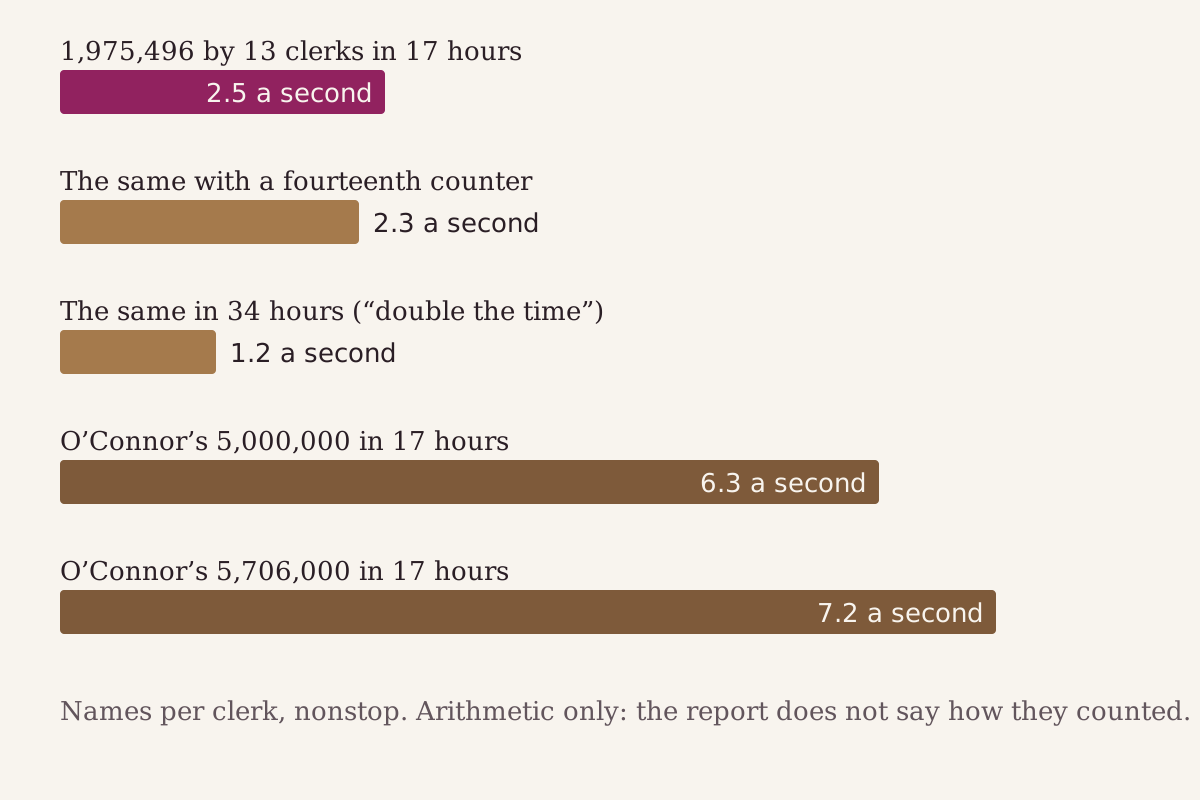
Names per clerk per second under each figure, by this site’s arithmetic, assuming names were counted one at a time and taking the report’s “upwards of seventeen hours” as exactly 17. Inputs from the debate of 13 April 1848.
"Names per clerk per second under each figure" by Persuasion Dissected — https://persuasiondissected.com/movements/chartist-movement/ — licensed CC BY 4.0: https://creativecommons.org/licenses/by/4.0/
Data: HC Deb 13 April 1848, vol. 98, cc. 284–301
The test does not settle the matter, because “upwards of” makes seventeen a floor, a fourteenth counter worked with them, and the report does not say whether the clerks read each name or totalled sheets.
The same arithmetic gives about 6.3 names a second for O’Connor’s five million, though nobody claimed the clerks had counted that many. He also said that a member of the Government had told him “about twelve o’clock” the day before that there were “not above 1,900,000” (c. 285), so by his own account a rough result was circulating before the report was read.
What did the House argue about after the count?
The debate that followed ran from column 284 to column 301. It turned quickly from the sheets to the man. Russell gave the report “the most implicit credit” (c. 287), and Inglis called the petition “hardly worth the paper on which it was written” (c. 289). Cripps told the House he “could never believe the hon. Member again” and quoted sheets reading “We could not get paid for any more to-day” (c. 291).
O’Connor left the chamber, saying he would explain the personal charge elsewhere. One member warned of “fatal consequences” (c. 295), so O’Connor was ordered to attend, then taken into custody and discharged (cc. 297–299), and when he returned Cripps repeated his regret and O’Connor said he would “entirely forget the whole matter” (c. 300). O’Connor then gave up the procedural route: “I shall not found any Motion upon that petition” (c. 301).
Who answered for the names on the sheets?
O’Connor’s defense was that nobody could read such a petition: “I never saw one of them till I saw them rolled up here” (c. 292). He later added that T. S. Duncombe had presented the 1842 petition, which he recalled as 3,370,000 signatures, in the same way (c. 301), though Duncombe had told the House in 1842, “I believe these to be every one of them bonâ fide signatures” (vol. 62, c. 1375).
The Speaker took the other view, saying a member is responsible “for the genuineness and propriety of the signatures,” though he allowed that a member might be imposed upon as to names (c. 297).
Mr. Hume, who said no man respected the right of petition more, called it “the grossest imposition” while also rebuking Cripps for his language (cc. 293–294). Inglis offered the only proposal for checking future petitions, that signers should add their “designations and the residences” (c. 289), and no member took it up during this debate.
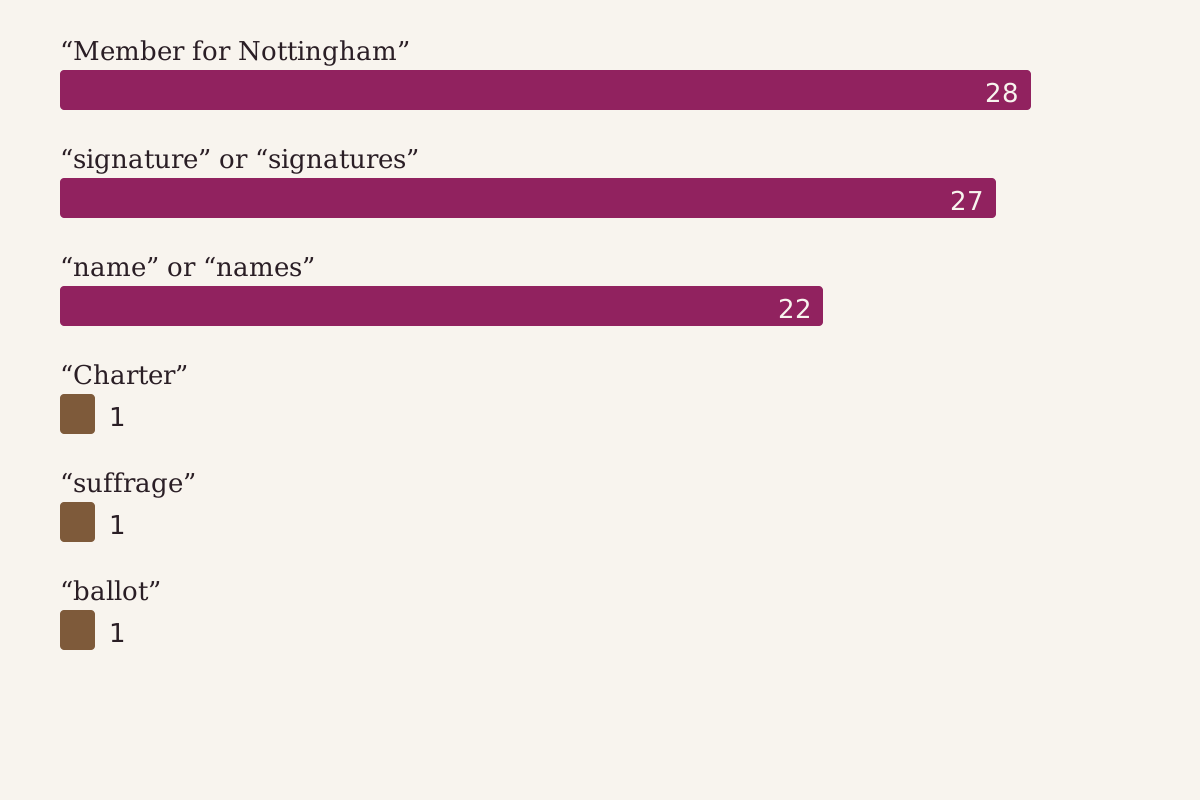
Word counts across the report and all speeches, by this site’s count, in about 7,200 words of debate. 13 April 1848.
"Word counts in the debate of 13 April 1848" by Persuasion Dissected — https://persuasiondissected.com/movements/chartist-movement/ — licensed CC BY 4.0: https://creativecommons.org/licenses/by/4.0/
Data: HC Deb 13 April 1848, vol. 98, cc. 284–301
This site’s count of the printed debate shows the shift: “signature” or “signatures” appears 27 times and “Member for Nottingham” 28 times, while “Charter,” “suffrage” and “ballot” appear once each. Thornely supplied the ballot, saying he “entirely agreed” with the petitioners on it (c. 286). Russell supplied the Charter, in a remark that passers-by might have signed “without having any wish for the Charter” (c. 287).
Each case here is checked for the last stone, a premise no speaker states and the audience supplies, and this one names none. A tempting candidate is that a discredited count also answers what the petition asked, since no speaker argued that the demands were wrong because the sheets were bad. But the question before the House was whether the report should lie on the table (c. 285), so its silence on the demands shows little, and no record shows members supplying that step.
How did the Chartists check their own number?
The dispute continued in the Chartist Convention, the movement’s delegate meeting. Robert Gammage’s history is the fullest account read here. Gammage had joined the movement around 1842 and, in Hovell’s words, “later developed into a thoroughgoing opponent to O’Connor” (Hovell, p. 176), so his summary carries that slant.
By Gammage’s account, O’Connor told the delegates on 14 April that he would not bring the Charter before the House for now and recommended more petitioning. Samuel Kydd moved that every delegate return his district’s number, and Ernest Jones believed the signatures had been underestimated, citing 200,000 still lying at the office. A motion to gather more genuine names, if the Government would accept that as an argument, was set aside (p. 319).
Another delegate, Harney, believed the signatures from his own district were genuine but proposed a different proof. He suggested that the men of Nottingham form a National Guard as “the most convincing answer” to those who denied their numbers (p. 319).
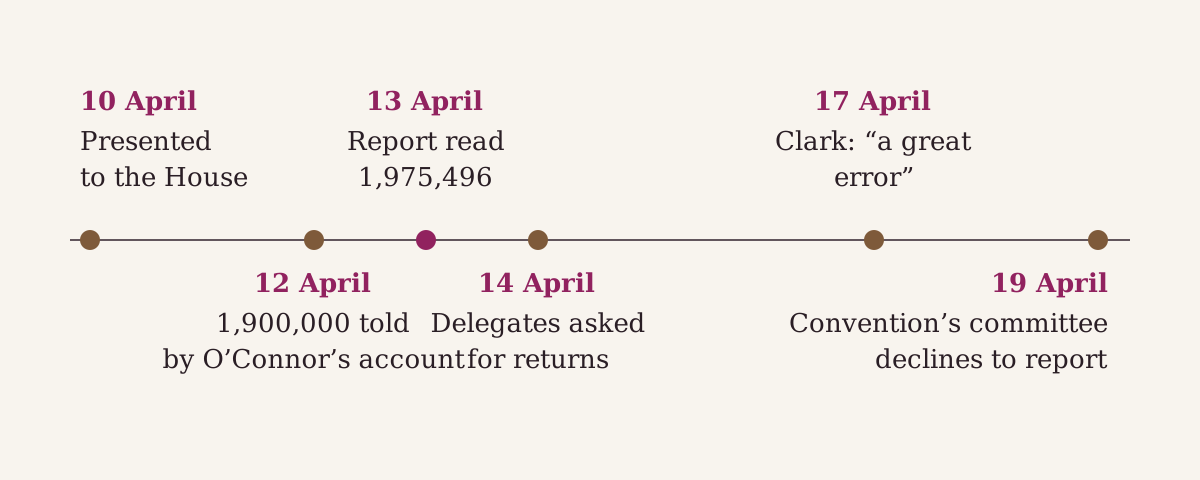
Ten calendar days, counting 10 and 19 April both, in Parliament and the Chartist Convention, with the Convention’s sittings as Gammage summarises them. 10 to 19 April 1848.
"Ten days in April 1848" by Persuasion Dissected — https://persuasiondissected.com/movements/chartist-movement/ — licensed CC BY 4.0: https://creativecommons.org/licenses/by/4.0/
On 17 April a delegate named Clark reported fresh sheets from Leeds and Manchester and said he had “no doubt a great error had been made in the number of signatures,” and that “they ought not to be ashamed to acknowledge it” (p. 321). Gammage’s summary does not say who made the error. A committee was appointed. Two days later Clark reported that it “could not ascertain” whether the Commons figures or the organisers’ figures were correct, and that its members “declined to make any report.”
That leaves the record with an unusual ending. The organisers’ own committee, in the only account read here, did not defend 5,706,000 and did not accept 1,975,496. Reported and audited totals also part ways in the Four Minute Men, and a House vote is asked to carry more than it measured in Seward’s Folly.
Did the count end the Chartist movement?
The count is a fact in the record. Its effect is interpretation, and the two historians read here do not put it first. Tout writes: “Chartism never recovered from the tragic fiasco of April 10, 1848” (p. 292). He takes the scrutiny of the signatures as the next blow, then says “The Petition was dead.” His later summary of how contemporaries judged the failure lists “unending faction” and “the great fiasco on Kennington Common,” and does not list the count (p. 300).
West gives the petition more weight within the same week: “The fate of the Petition was even more ignominious than that of the projected procession” (p. 249). But he rejects the question of failure as framed. “Judged by its crop of statutes and statues, Chartism was a failure,” he writes, and by its purpose of stirring class consciousness a success: “It achieved, not the Six Points, but a state of mind” (pp. 294–295).
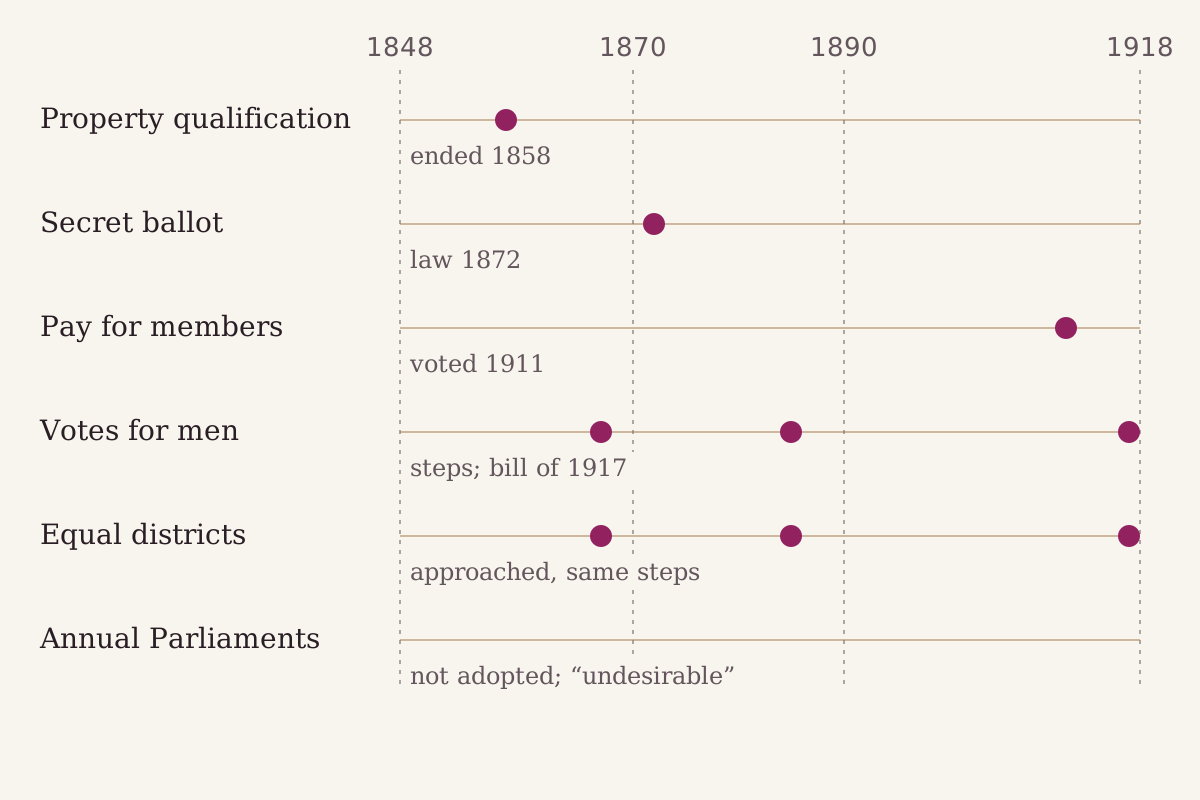
The six points after 1848, as Tout listed them in a book published in 1918. Dates are his.
"The six points after 1848" by Persuasion Dissected — https://persuasiondissected.com/movements/chartist-movement/ — licensed CC BY 4.0: https://creativecommons.org/licenses/by/4.0/
Tout agrees on the long view: “A wider survey suggests that in the long run Chartism by no means failed” (p. 300). He dates the end of the property qualification to 1858, the ballot to 1872 and members’ pay to 1911, and he treats annual Parliaments as the one point “regarded as undesirable” (pp. 301–302). The Luddites raise a similar problem of reading pressure from outside Parliament, a generation earlier.
Both books are about a century old. Later studies, such as John Saville’s 1848: The British State and the Chartist Movement (1987) and Malcolm Chase’s Chartism: A New History, were not read for this page, only their bibliographic records.
On this site’s working hypothesis, the distance between a movement’s own number and a checked one is part of the contest for an audience, an editorial reading offered with the caveat that neither Tout nor West rests the movement’s end on the count. A later movement’s number needs its own arithmetic in the Montgomery bus boycott.
Crossing map
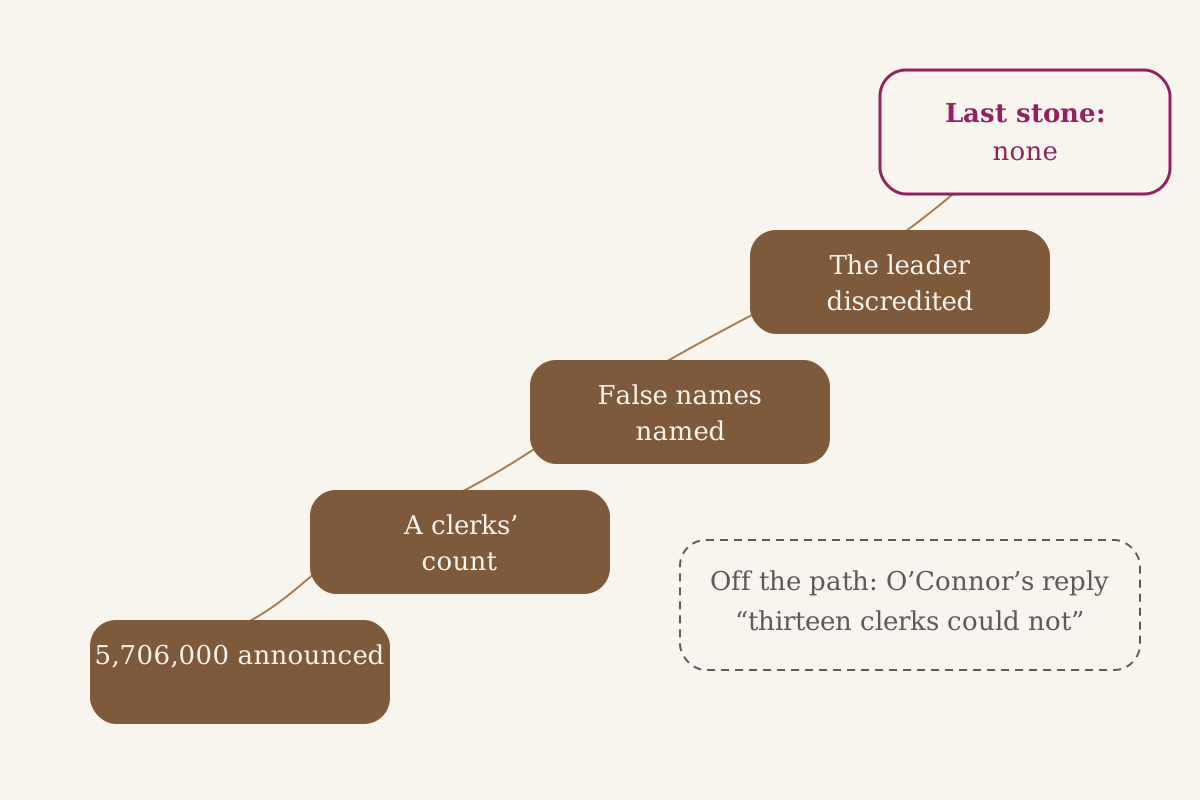
Crossing map of the case against the petition. The dashed stone off the path is O’Connor’s reply on the clerks. 13 April 1848.
"Crossing map of the 1848 petition" by Persuasion Dissected — https://persuasiondissected.com/movements/chartist-movement/ — licensed CC BY 4.0: https://creativecommons.org/licenses/by/4.0/
- 5,706,000 announced. The report restates the figure O’Connor gave on presenting the petition (c. 285) [1]
- A clerks’ count. Thirteen clerks, upwards of seventeen hours, 1,975,496 (c. 285) [1]
- False names named. The same handwriting, Victoria Rex, No Cheese, and “a gross abuse of the privilege” (c. 285) [1]
- The leader discredited. Cripps says he cannot believe O’Connor again; O’Connor leaves, returns in custody and gives up his motion (cc. 291–301) [1]
- No last stone in this case. The attack relied on what speakers said outright: the report’s “gross abuse” and Inglis’s “hardly worth the paper.” The debate was on whether the report should lie on the table, and no record shows members concluding that the count answered the Charter (cc. 285–289) [1]
Sources
- The Chartist Petition—Messrs. O’Connor and Cripps, House of Commons debate, 13 April 1848, Hansard, 3rd series, vol. 98, cc. 284–301. api.parliament.ukRead: full text of the report and debate
- Mark Hovell, The Chartist Movement, edited and completed by T. F. Tout (Manchester: University Press, 1918). Cited pages: 2, 134, 164, 176, 254; Tout’s chapter: 287, 290–292, 300–302. archive.orgRead: pages cited; preface for who wrote which part
- Julius West, A History of the Chartist Movement (London: Constable, 1920). Cited pages: 114, 185, 249–252, 294–295. archive.orgRead: pages cited
- R. G. Gammage, History of the Chartist Movement, 1837–1854 (Newcastle-on-Tyne: Browne & Browne, 1894). Cited pages: 286, 313, 316–319, 321. archive.orgRead: pages cited
- John Saville, 1848: The British State and the Chartist Movement (Cambridge: Cambridge University Press, 1987). doi.orgRead: bibliography only
- Malcolm Chase, Chartism: A New History. Reviewed 2008. doi.orgRead: bibliography only
- House of Commons, 10 April 1848: Minutes, and Crown and Government Security Bill debate, Hansard, 3rd series, vol. 98, cc. 73–135. api.parliament.ukRead: full text of the minutes and debate
- The National Petition, House of Commons debate, 12 July 1839, Hansard, 3rd series, vol. 49, cc. 220–274. api.parliament.ukRead: single value via the debate text: figures and the division
- The People’s Charter—Petition, House of Commons, 2 May 1842, Hansard, 3rd series, vol. 62, cc. 1373–81. api.parliament.ukRead: single value via the debate text: figures and the passage quoted
- The National Petition—The Charter, House of Commons debate, 3 May 1842, Hansard, 3rd series, vol. 63, cc. 13–88. api.parliament.ukRead: single value via the debate text: figures and the division
Next crossing
- The Luddites — Frame-breaking in Nottingham, read from the letters and the Lords debate of its own years.
- The Four Minute Men — A wartime speaking program whose totals rest on its director’s own accounting.
Cite this page
Persuasion Dissected. "Chartist Movement: 5.7M Signatures Claimed, 1.98M Reported." Persuasion Dissected. Published 2026-11-11. https://persuasiondissected.com/movements/chartist-movement/. Accessed: add the date you read it.
Corrections
No corrections yet.
How pieces are checked · All corrections · Contact · Report an error (contact@persuasiondissected.com)