Lizzie Borden: The Court Kept Out Her Inquest Testimony
In three lines
- Who persuaded whom: In June 1893 George D. Robinson and the defense asked a New Bedford jury to acquit Lizzie Borden of killing her father and stepmother, and the prosecution asked it to convict.
- Which stones: The court excluded her inquest testimony and the drug-store evidence. Robinson told jurors to leave both out, pointed to the lack of any trace on her, and warned against convicting because no one else was in view.
- Outcome: Not guilty on 20 June 1893, after one hour and ten minutes by Edwin Porter’s account. The record read here cannot say who committed the killings, or whether the rulings decided the verdict.
Route through this piece (10)
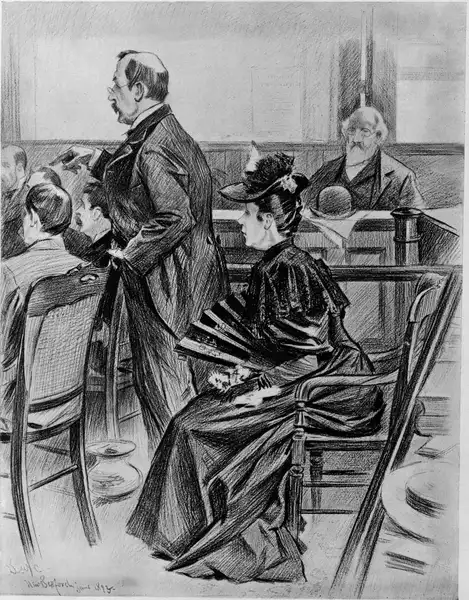
George D. Robinson and Lizzie Borden “before the acquittal,” in a sketch drawn at New Bedford for the front page of Frank Leslie’s weekly. June 1893.
"The Borden murder trial: a scene in the court-room before the acquittal" by Benjamin West Clinedinst. Public domain.
Full credit
"The Borden murder trial: a scene in the court-room before the acquittal" by Benjamin West Clinedinst — https://commons.wikimedia.org/wiki/File:BW_Clinedinst,_the_Borden_murder_trial_cph.3c23237.jpg — Public domain — Public domain in the US (published 1893) and in the EU (Benjamin West Clinedinst died 12 September 1931, life+70); modified: cropped to the drawing, removing the magazine masthead and the printed caption below, resized to 1,600 px on the long side
Case card
- Case
- Commonwealth of Massachusetts v. Lizzie Andrew BordenWigmore 1893, p. 826; Porter 1893, ch. XXII
- Date range
- Killings 4 August 1892; inquest 9–11 August 1892; trial 5–20 June 1893Wigmore 1893, pp. 819, 826, 835, 840
- Place
- Superior Court of Bristol County, New Bedford Court House, MassachusettsWigmore 1893, p. 826
- Persuader(s)
- Defense: George D. Robinson, Melvin O. Adams, Andrew J. Jennings. Prosecution: Hosea M. Knowlton, William H. MoodyWigmore 1893, p. 826
- Audience
- Twelve jurors, and three judges on the admissibility of evidencePorter 1893, ch. XXII; Wigmore 1893, p. 826
- The ask
- Robinson: do not return a verdict simply because you do not see how anybody else could do itWigmore 1893, p. 836
- Channel
- Arguments on evidence; witness testimony; closing arguments; the judge’s chargePorter 1893, chs. XXVI, XXX–XXXII
- Outcome
- Not guilty on 20 June 1893 at 4:32 p.m.; one hour and ten minutes out, by Porter’s account; the record does not settle who did itWigmore 1893, p. 835; Porter 1893, ch. XXXII
- Primary record
- Court’s ruling and speeches as printed in Wigmore and Porter; stenographic and inquest transcripts not readWigmore 1893; Porter 1893
On 12 June 1893, three judges at New Bedford ruled that jurors would not hear Lizzie Borden’s inquest testimony. An inquest is a sworn inquiry into a death, and she had answered questions at this one over three days in August 1892. The ruling asked prosecutors to go on without the one sworn account of hers in the sources read here.
Seven days later her lawyer, George D. Robinson, stood up to tell the jury what to do with that gap. Porter’s book dates the ruling only as the seventh day, a Monday, so 12 June is this site’s reckoning from the 5 June opening. The same reckoning gives the other trial dates below, though it cannot pin the tenth day to one date.
What happened before the Lizzie Borden trial?
Andrew Borden, a 70-year-old retired merchant, and his second wife, Abby, were killed in their house in Fall River, Massachusetts, on the morning of 4 August 1892. His daughter Lizzie, 32, was at home, and so was the servant, Bridget Sullivan. John H. Wigmore, of Northwestern University Law School, wrote in 1893 that the evidence was “purely circumstantial.”
The inquest ran on 9, 10 and 11 August, and she was arrested on the evening of the 11th. Judge Josiah C. Blaisdell, who had presided at the inquest, also heard the preliminary hearing from 25 August to 1 September, which ended with a finding that she was probably guilty. The trial opened on Monday, 5 June 1893, before Chief Justice Albert Mason and Justices Caleb Blodgett and Justin Dewey, and the first day went to choosing twelve jurors from a panel of 150.
Hosea M. Knowlton and William H. Moody prosecuted. Robinson, a former governor, led the defense with Melvin O. Adams and Andrew J. Jennings. A conviction carried death, as both Robinson and Wigmore say.
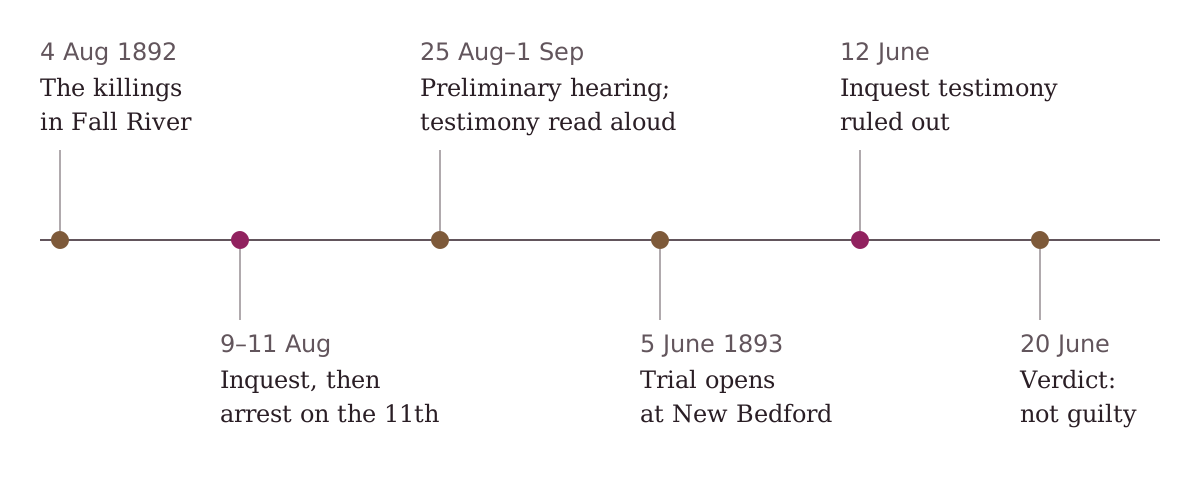
From the killings to the verdict; the 12 June date is this site’s reckoning. August 1892 to June 1893.
"From the killings to the verdict" by Persuasion Dissected — https://persuasiondissected.com/on-trial/lizzie-borden/ — licensed CC BY 4.0: https://creativecommons.org/licenses/by/4.0/
Two accounts from 1893 carry this page, and both have limits. Wigmore’s is a law-review sketch, and he warns that he used “his own discretion” in stating the effect of testimony. Porter’s book, The Fall River Tragedy, prints speeches and a running story, and its preface says its facts came from official sources. The full stenographic transcript and the inquest transcript were not read for this page.
What did the jury hear against her?
Wigmore sorts the prosecution’s case into motive, design, opportunity, means and what he calls consciousness of guilt, and much of it reached the jury. Of that last heading he adds, “Much that was here offered was excluded.” Witnesses described bad feeling over property between Lizzie Borden and her stepmother, and a police officer reported that when he asked about her mother that noon she answered, “She is not my mother. My mother is dead.”
The state also leaned on two things she said or did, starting with what she told Bridget Sullivan and her father, that Abby Borden had gone out: “she had a note from somebody.” No note was found, and although the defense advertised for its sender or carrier, “nothing appeared.” Then, on the Sunday after the killings, her friend Alice Russell saw her at the stove with a dress and heard her say: “I am going to burn this old thing up; it is covered with paint.”
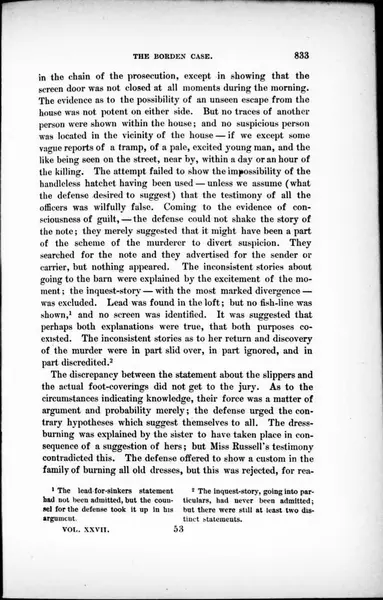
Wigmore on how the defense answered each point, and on what did not reach the jury, 27 American Law Review 833. 1893.
"The Borden Case, 27 American Law Review 833" by John H. Wigmore. Public domain.
Full credit
"The Borden Case, 27 American Law Review 833" by John H. Wigmore — https://archive.org/details/sim_american-law-review-1866_the-american-law-review_november-december-1893_27 — Public domain — Public domain in the US (published 1893) and in the EU (John Henry Wigmore died 1943, life+70); modified: trimmed the black microfilm surround, resized to 1,600 px on the long side
The defense answered with her character and with gaps in the police work. Wigmore, who defends the officers against charges of persecution, still lists what they failed to do: one lost a list of the dresses in her closet, and two disagreed over whether a broken hatchet’s handle had been found. “More care and more method,” he wrote, was the lesson for police. He also faults Robinson’s side for claiming that the note story began with Bridget Sullivan, which he calls, “in effect, a false quotation of the testimony.”
Why did the court keep out her inquest testimony?
Annie M. White, the county’s court stenographer, was called to tell what took place at the inquest, and Robinson rose to stop her. Moody argued for admission on the Monday morning, Robinson replied, and that afternoon the judges ruled, by Porter’s account.
The two sides had agreed on the facts, and Wigmore prints them. Police had watched her from 5 August, and a warrant issued on 8 August was neither served nor mentioned to her. Her lawyer could talk with her beforehand but could not attend, and the court gave her no caution about incriminating herself. When she finished on 11 August she was arrested on a new warrant.
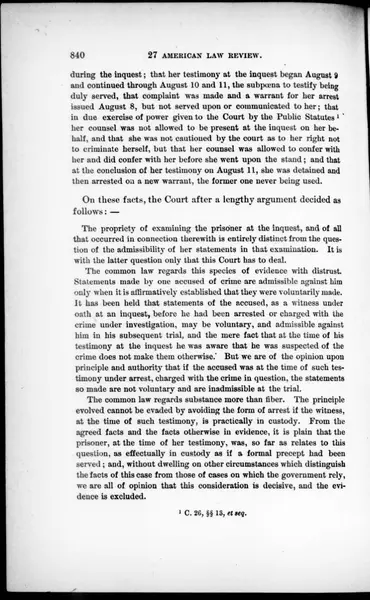
The agreed facts and the court’s ruling as Wigmore printed them, 27 American Law Review 840. 1893.
"The Borden Case, 27 American Law Review 840" by John H. Wigmore. Public domain.
Full credit
"The Borden Case, 27 American Law Review 840" by John H. Wigmore — https://archive.org/details/sim_american-law-review-1866_the-american-law-review_november-december-1893_27 — Public domain — Public domain in the US (published 1893) and in the EU (John Henry Wigmore died 1943, life+70); modified: trimmed the black microfilm surround, resized to 1,600 px on the long side
The court held that an accused who testifies while under arrest for the crime does not testify voluntarily, and that skipping the formal arrest changed nothing. “The common law regards substance more than fiber,” it said. She had been “as effectually in custody as if a formal precept had been served,” and “we are all of opinion that this consideration is decisive, and the evidence is excluded.”
The argument had started ten months earlier. When she was arraigned in August 1892, Jennings said the police had “settled on the guilty party and held an inquest to examine her, without anybody to defend her,” and that Blaisdell was “sitting in a double capacity.” Knowlton replied that “the inquest was against no one,” and Blaisdell overruled the objection. The 1893 court left that dispute alone, saying the propriety of examining her “is entirely distinct from the question of the admissibility of her statements.”
Moody argued the opposite: she spoke with counsel first and testified “as a voluntary witness in every possible sense of the word.” Wigmore sided with him, writing that the ruling let the defense “blow hot and cold,” going on the stand when it helped and staying silent when the words proved dangerous.
That is one writer’s legal opinion, printed the same year, in a review that also calls the trial “a model of what trials should be.” A ruling on what a jury may weigh also sits at the center of the Zola libel trial.
What was in the testimony the jury missed?
Wigmore says the testimony “contained several damaging contradictions.” Two of them appear in his summary. First, she told several people how she found her father, and the inquest version differs from the others. On the barn stories, he calls the inquest account the one “with the most marked divergence.”
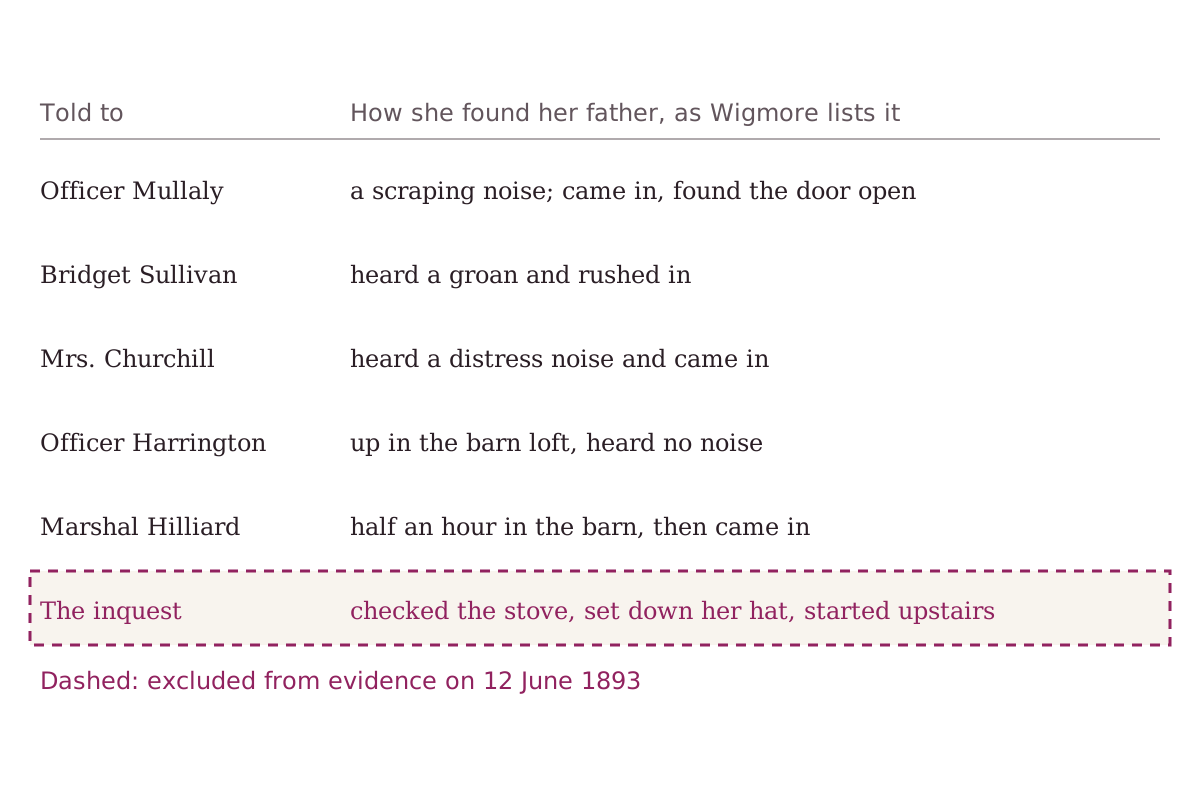
Six accounts of how she found her father, in Wigmore’s summary, with the inquest version moved to the last row. Told August 1892; listed in 1893; the 12 June date is this site’s reckoning.
"Six accounts of finding her father" by Persuasion Dissected — https://persuasiondissected.com/on-trial/lizzie-borden/ — licensed CC BY 4.0: https://creativecommons.org/licenses/by/4.0/
Second, she testified that when her father came home she helped him lie down, took off his boots and put on his slippers. He was found wearing boots. Wigmore states that this discrepancy “did not get to the jury.”
The ruling did not remove every inconsistency. Wigmore’s note says the inquest story “had never been admitted; but there were still at least two distinct statements” before the jury. Prosecutors could still argue about what she told people on the day. They could not use what she swore to.
She did not testify at the trial either. Justice Dewey told the jury that any thought unfavorable to her “based on her failure to testify, is unwarranted in law.” Porter records her only words to them, just before the charge: “I am innocent. I leave it to my counsel to speak for me.”
Had the jurors already read it?
The inquest itself was held behind closed doors, Porter writes, but the testimony did not stay there. At the preliminary hearing, District Attorney Knowlton read the shorthand report aloud in court. Adams objected to at least one answer as harmful to her, and Blaisdell let it in, so one judge heard what three later excluded.
Porter reports about forty newspaper representatives on the hearing’s opening day. The words the trial jury did not hear in evidence had been spoken in open court the summer before.
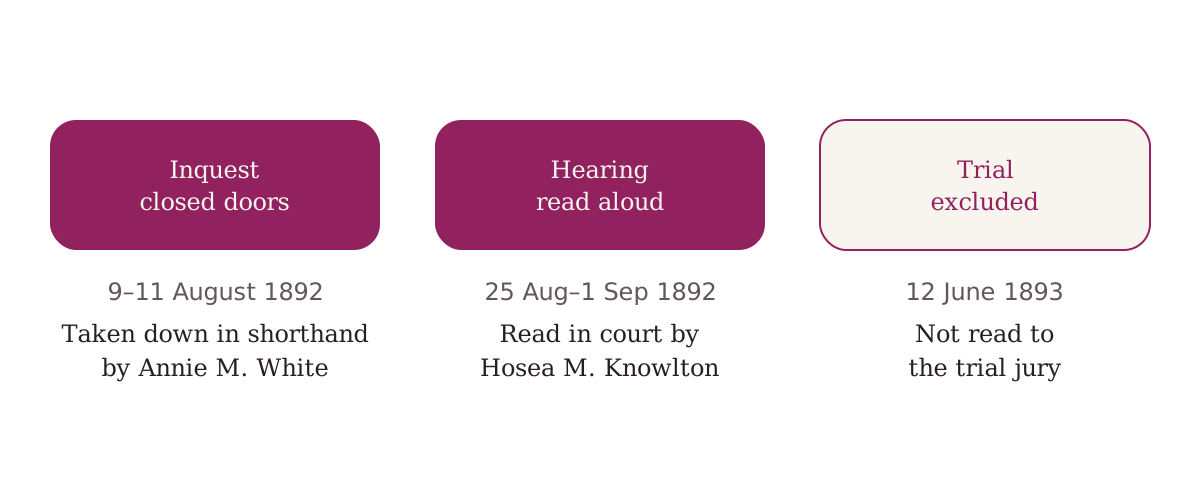
Where the inquest testimony went, from Porter’s account and the ruling Wigmore prints; the 12 June date is this site’s reckoning. August 1892 to June 1893.
"Where the inquest testimony went" by Persuasion Dissected — https://persuasiondissected.com/on-trial/lizzie-borden/ — licensed CC BY 4.0: https://creativecommons.org/licenses/by/4.0/
Robinson knew jurors might have seen coverage of the case. He told them that some had said they might have read about it and even formed an opinion, and that he believed their promise to judge on the evidence. On what they should set aside he added: “I do not care what you have read.”
Justice Dewey gave the same warning. The press, he said, had published “rumors and reports of all kinds,” and jurors must guard against impressions from newspapers. Neither source shows which juror read what, so this page cannot say whether any of them knew what she had said at the inquest. The headline claim is narrower than that: her testimony was never put to the jury as evidence.
What else did the rulings remove from the case?
Moody told the jury on the second day that the prisoner had gone to a drug store the day before the killings and asked for ten cents’ worth of prussic acid, a poison, to clean a sealskin cape. On the tenth day, 15 or 16 June by this site’s reckoning, the clerk, Eli Bence, was called, and after Robinson objected the jury was sent out and the judges ruled the evidence out.
Porter gives the ground as incompetence; Wigmore says the evidence “did not come up to the offer.” Porter’s print of the hearing has her denying the errand at the inquest: “I did not go to Smith’s drug store to buy prussic acid.” The jury heard neither the clerk nor her answer to him.
Wigmore thought the steps behind that ruling absurd. A furrier was held unqualified to say whether the acid was used on furs, and the county medical examiner was not allowed to say either. “What a wonderful web of obscurity the legal mind can contrive to weave over the simplest matters!” he wrote.
The defense lost rulings too. Wigmore lists four chief ones, two against each side.
| Evidence | Offered by | Ruling | Where |
|---|---|---|---|
| Her inquest testimony | Prosecution | Excluded, as not voluntary | Wigmore pp. 839–840; Porter ch. XXVI |
| Alleged attempt to buy prussic acid | Prosecution | Excluded, as not meeting the offer | Wigmore pp. 828, 838–839; Porter ch. XXVIII |
| A family custom of burning old dresses | Defense | “Excluded,” by Chief Justice Mason | Wigmore p. 842, note 2 |
| A man seen in the woods on 16 August | Defense | Excluded after the prosecution called it too remote | Wigmore p. 843 |
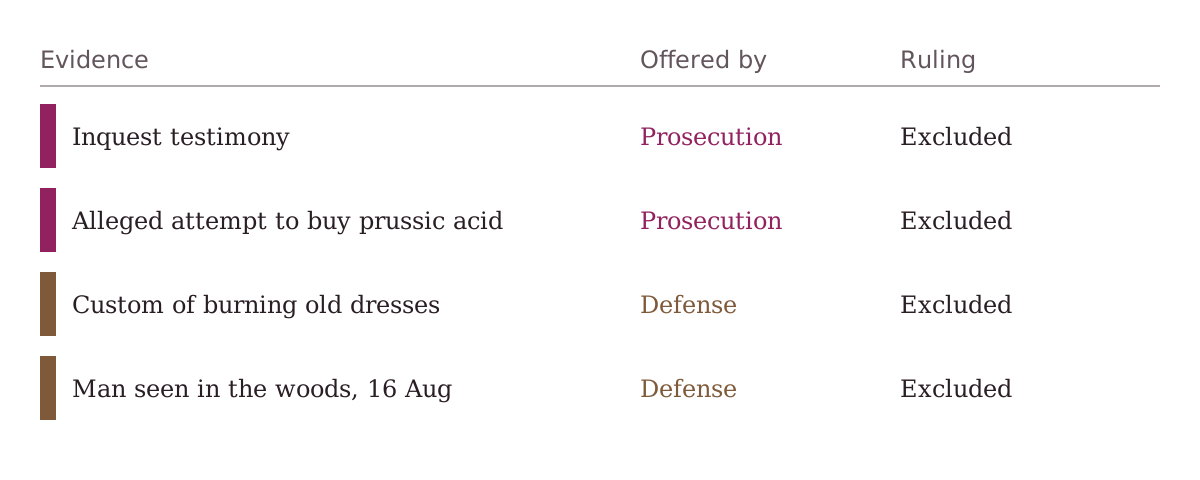
The four chief rulings on evidence in Wigmore’s review, by the side that offered the evidence. June 1893.
"Four chief rulings on evidence" by Persuasion Dissected — https://persuasiondissected.com/on-trial/lizzie-borden/ — licensed CC BY 4.0: https://creativecommons.org/licenses/by/4.0/
Each ruling, with its coordinates and the people named, is in the CSV (where this data comes from). An equal count does not mean equal weight, and Wigmore argues that “most of what was excluded seems admissible.” He also writes that, had she been convicted, it “would seem” that the defense’s exception to the dress ruling “must certainly have overturned the verdict.”
How did each side use what the jury could not hear?
Moody had promised more than the jury got. Besides the drug store, he said the state would prove she “made contradictory statements about her whereabouts.” Robinson used that gap in his closing on the twelfth day, by this site’s reckoning 19 June. Of the poison he said: “It is not proved: the court did not allow it to be proved, and it is not in the case.”
He then told them the state had promised to show she “had contradicted herself under oath,” and that the court had refused: “And so there is nothing of the kind.” By his own telling, jurors knew a sworn statement existed. They did not hear what it said.
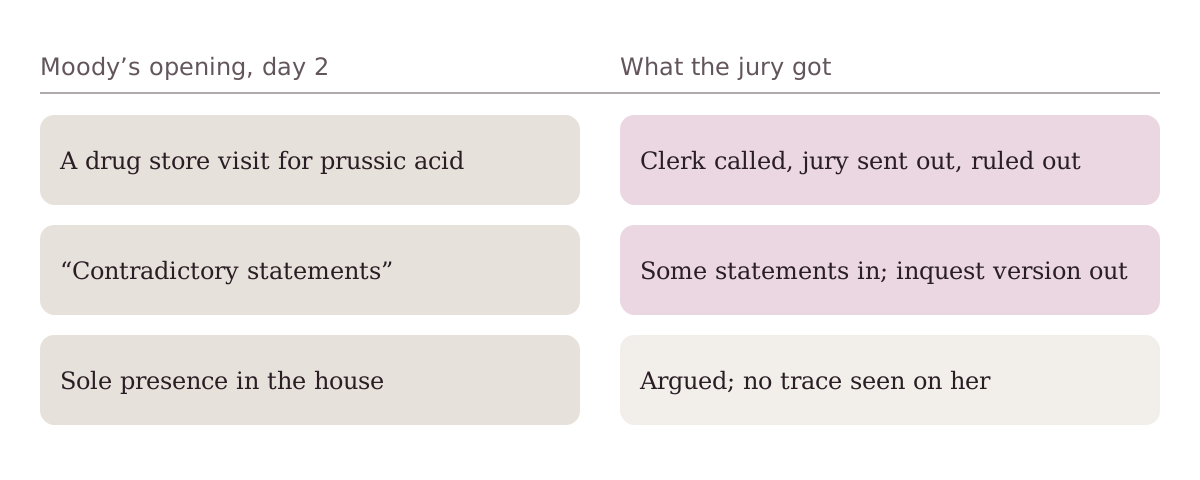
What the prosecution’s opening promised and where it ended up, from Porter and Wigmore. June 1893.
"The prosecution’s opening against the record" by Persuasion Dissected — https://persuasiondissected.com/on-trial/lizzie-borden/ — licensed CC BY 4.0: https://creativecommons.org/licenses/by/4.0/
Robinson named the thought he feared, that prosecutors “would not have offered it unless there is something behind it,” and answered it: “That is not the way to try cases.” Then came the instruction: “So you will leave those things out, gentlemen.” His list was “No prussic acid, no preparation of a weapon by this woman, no statement made by her under oath.” Wigmore reports that some criticized this “dangerous frankness,” though “the event seemed to justify his judgment.”
To suspicious facts, such as her being in the house that morning, Robinson offered plain answers: “But it is her home.”
The ask at the top of this page comes from the excerpts Wigmore prints; Porter’s text of the speech does not carry that sentence. In it he warned against a verdict reached “simply for the reason that you do not see how anybody else could do it,” and described an innocent man who comes home to a death and finds suspicion fastening on him.
Wigmore adds what he calls “the stronghold of the defense”: “the utter absence of all such traces or marks as would presumably be found upon the murderer.” None of the five or six people who came in within ten minutes, he writes, saw any on her. Defense counsel also took up in argument, he notes, one point that had not been admitted: the lead she said she went to the barn to find.
Knowlton answered with a different question. “It is not a question of circumstantial evidence, Mr. Foreman; it is a question of the sufficiency of circumstantial evidence,” he said. A chip on a river is only a circumstance, he went on, yet a hundred moving one way show the current.
Closing speeches that ask jurors to read a disputed scene are also the record of the Boston Massacre trials.
How long did the jury take to acquit Lizzie Borden?
Justice Dewey’s charge came on the last day, and it spoke to the same line Robinson had drawn. If the evidence raised “a suspicion of guilt, or even a strong probability of guilt” and fell short of proof, he said, their duty was to acquit. Porter then writes that the jury “remained one hour and ten minutes.”
Wigmore gives the verdict as Tuesday, 20 June, at 4:32 in the afternoon, “after less than an hour and a half of deliberation.” The two statements fit together: seventy minutes is less than an hour and a half. He also passes on, marked “It was reported,” a story that the jurors agreed on the first ballot and waited an hour so that counsel for the commonwealth would not think his argument had been ignored. No juror’s account of this is in the sources read here.
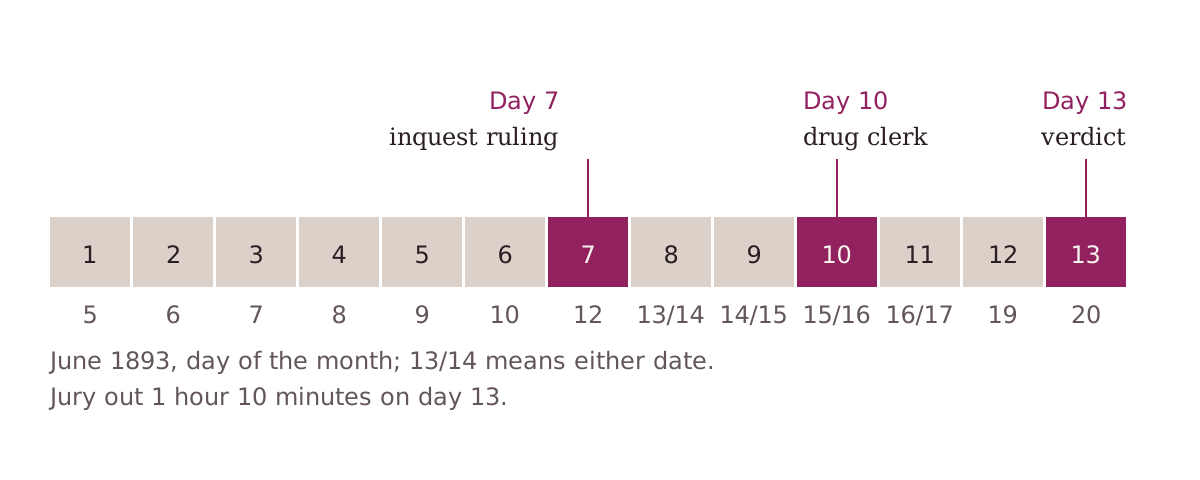
The thirteen days of the trial, with dates reckoned by this site from Porter’s day count and Wigmore’s fixed dates; days 8 to 11 each fall on one of two dates. June 1893.
"The thirteen days of the trial" by Persuasion Dissected — https://persuasiondissected.com/on-trial/lizzie-borden/ — licensed CC BY 4.0: https://creativecommons.org/licenses/by/4.0/
The foreman’s “not guilty” drew applause that officers checked at once, Porter writes. Knowlton then asked for the two other pending indictments to be dropped, and the court discharged her. Porter ends with her going home to Fall River, and Wigmore stops at the trial.
For what came after, the one account read here is a popular book, Edmund Pearson’s Studies in Murder of 1924. Pearson says she then lived about a mile and a half from her old home, in a large house called Maplecroft, and that the telephone directory listed her as Lizbeth A. Borden. He adds that her sister Emma had moved away, and that newspapers in May 1923 recorded a dispute in probate court over a building the two owned.
He also records a jingle beginning “Lizzie Borden took an axe,” in which, “however unjustly,” the event was celebrated. Pearson was writing while she was alive, so her death is outside this page.
Did Lizzie Borden do it?
The record read here cannot answer that. The jury returned not guilty, the verdict Justice Dewey had told them was their duty if the proof fell short, and no juror’s reasoning appears in the sources read. No one was convicted in those sources, and they disagree about what the evidence meant.
- Wigmore, 1893. He leans toward guilt because of her statements and her silence: “one side of the balance sinks heavily.” He then adds: “This is not saying that the evidence justified a conviction.” The missing traces, he says, are “difficulties of ignorance,” a problem for any other suspect as well. Weighing her silence is a step Justice Dewey had told the jury it could not take.
- Porter, 1893. His preface says the acquittal “settled beyond question the probability of her guilt,” which this site reads as saying the verdict closed the matter. His chapter on the ruling calls the inquest testimony “the strongest prop of the State’s case.”
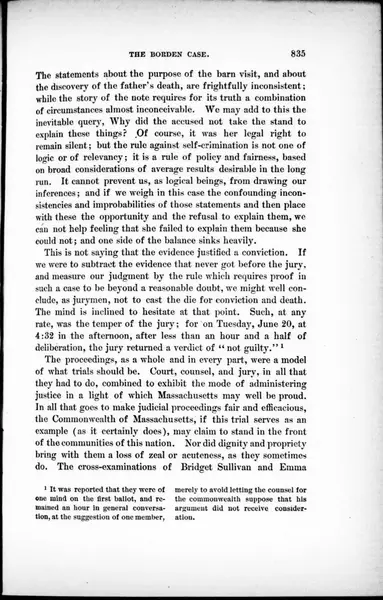
Wigmore’s judgment on the evidence, the verdict and the first-ballot report, 27 American Law Review 835. 1893.
"The Borden Case, 27 American Law Review 835" by John H. Wigmore. Public domain.
Full credit
"The Borden Case, 27 American Law Review 835" by John H. Wigmore — https://archive.org/details/sim_american-law-review-1866_the-american-law-review_november-december-1893_27 — Public domain — Public domain in the US (published 1893) and in the EU (John Henry Wigmore died 1943, life+70); modified: trimmed the black microfilm surround, resized to 1,600 px on the long side
The two also weigh the rulings differently. Porter’s “strongest prop” points to the exclusion, while Wigmore writes only that it “possibly affected the result.” He calls the absence of traces on her “the decisive fact of the case,” and that was a matter the jury did hear about.
This site’s working idea, that limiting what may be asked often shapes a trial more than the arguing does, therefore gets only partial support here. The limits ran against both sides, and the law-review writer who studied the rulings named something else as decisive. Asking what an audience was actually shown is also the way this site reads the Fiji Mermaid and the 1784 inquiry into animal magnetism.
A second check on every case is for the last stone, a premise the persuader leaves for the audience to supply. Robinson left none on this point. He said out loud what jurors might be tempted to assume, and he told them not to assume it, which leaves no unstated step for this page to point at.
Crossing map
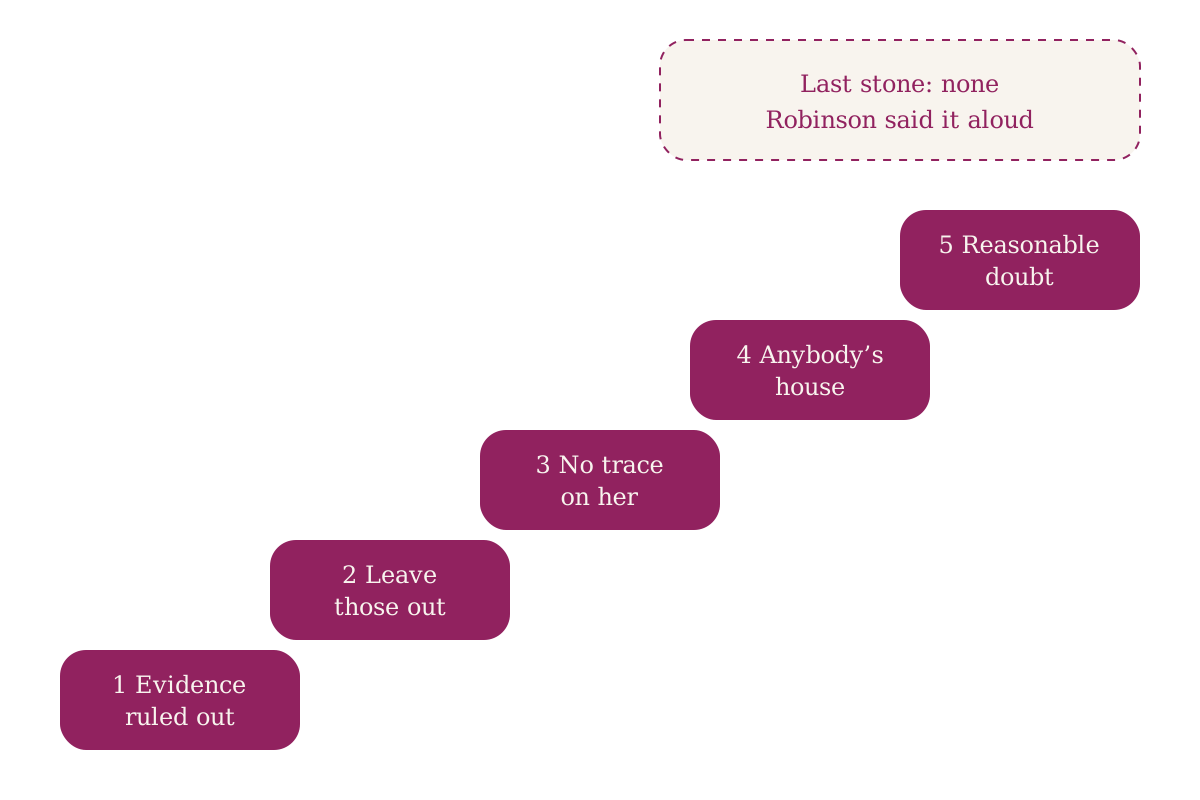
Crossing map of the defense’s case to the jury; no juror’s reasoning appears in the sources read. June 1893.
"Crossing map of the defense’s case to the jury" by Persuasion Dissected — https://persuasiondissected.com/on-trial/lizzie-borden/ — licensed CC BY 4.0: https://creativecommons.org/licenses/by/4.0/
- Evidence ruled out. The court excludes the inquest testimony and the drug-store evidence (Wigmore pp. 833, 838–840; Porter chs. XXVI, XXVIII) [1] [2]
- Leave those out. Robinson names the prussic acid and her sworn statement and tells jurors to set them aside (Porter ch. XXX; Wigmore p. 836) [1] [2]
- No trace on her. None seen on her by the first arrivals, and no garment or weapon found bearing traces, with one small exception Wigmore notes (p. 834) [1]
- Anybody’s house. A verdict should not rest on failing to see who else could have done it (Wigmore pp. 836–837) [1]
- Reasonable doubt. Suspicion, or even strong probability, is not enough (Justice Dewey, Porter ch. XXXII) [2]
- No last stone in this case. Robinson stated his premises aloud, including the one about the excluded evidence. The persuasion relied on the rulings, the missing physical traces and the standard of proof, and no source read here shows what jurors supplied for themselves [1] [2]
Sources
- John H. Wigmore, “The Borden Case,” American Law Review 27 (November–December 1893): 819–845. archive.orgRead: full article; pages 826, 829–831, 833–836, 839, 840, 842, 843 and 845 compared with page images
- Edwin H. Porter, The Fall River Tragedy: A History of the Borden Murders (Fall River, 1893). Cited by chapter. gutenberg.orgRead: chapters on the inquest, the preliminary hearing and the trial, with the closing speeches and the charge
- Edmund Lester Pearson, Studies in Murder (Garden City, N.Y.: Garden City Publishing reprint; copyright 1924 by Macmillan), “The Borden Case,” pp. 69, 117–118. archive.orgRead: pages 69, 117 and 118 only, compared with page images; a popular account, used for her later life and the rhyme
Next crossing
- The Zola libel trial — Another court decides what a jury may have proved to it, and a one-word question is left standing.
- The 1784 inquiry into animal magnetism — Commissioners decide what the people being tested can see, and write down what happens next.
Cite this page
Persuasion Dissected. "Lizzie Borden: The Court Kept Out Her Inquest Testimony." Persuasion Dissected. Published 2026-11-11. https://persuasiondissected.com/on-trial/lizzie-borden/. Accessed: add the date you read it.
Corrections
No corrections yet.
How pieces are checked · All corrections · Contact · Report an error (contact@persuasiondissected.com)