Trial of Socrates: In Plato, 30 Votes Would Have Freed Him
In three lines
- Who persuaded whom: In 399 BC Meletus, Anytus and Lycon persuaded an Athenian jury to convict Socrates and then to sentence him to death. Plato’s Apology later argued his side to readers.
- Which stones: In Plato, the defense asks jurors to set aside old rumor, test the charge, reject pleading, see a narrow vote and weigh a reward against a fine. The prosecution’s speeches are not in the accounts read here.
- Outcome: Death. Plato’s Socrates implies a margin of about 60 votes, and Diogenes Laertius, in Hicks’s translation, says 281. Neither cites a court tally, so the record cannot settle it.
Route through this piece (9)
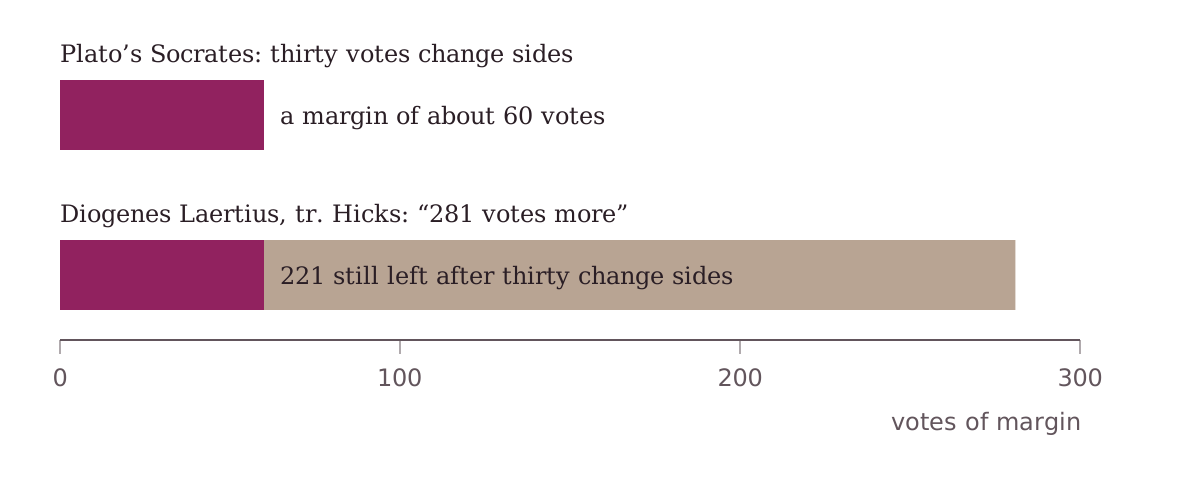
The two ancient statements about the first vote, set on one scale by this site’s arithmetic. Trial of 399 BC; Diogenes wrote probably in the third century AD, on Hicks’s provisional dating.
"The first vote in Plato and in Diogenes Laertius" by Persuasion Dissected — https://persuasiondissected.com/on-trial/trial-of-socrates/ — licensed CC BY 4.0: https://creativecommons.org/licenses/by/4.0/
Case card
- Case
- Trial of SocratesPlato, Apology, tr. Jowett; Diogenes Laertius II.40–42, tr. Hicks
- Date range
- Spring of 399 BC, as dated by Louis Dyer’s 1908 edition; the verdict and sentence came on one dayDyer and Seymour 1908, Introduction §15; Plato, Apology 37a
- Place
- A jury court at AthensPlato, Apology, tr. Jowett
- Persuader(s)
- Meletus, Anytus and Lycon (prosecution; speeches not in the accounts read); Socrates (defense, as written by Plato and Xenophon)Plato, Apology 36a–b; Xenophon, Apology, tr. Dakyns
- Audience
- The Athenian jurors; size not given in Plato, Xenophon or Diogenes (500 or 501 is the editors’ figure); later readers of PlatoBurnet 1924, p. 63; Riddell 1867, pp. xiii–xiv
- The ask
- Socrates, in Plato: judge by being informed and convinced, and take the first vote as nearly equalPlato, Apology 35c, 36a, tr. Jowett
- Channel
- Sworn charge; speeches in court; two votesDiogenes Laertius II.40–42, tr. Hicks; Riddell 1867, pp. xiv–xv
- Outcome
- Convicted, then sentenced to death; in Plato, 30 switched votes would have acquitted him, while in Diogenes he was condemned by 281 votes more than those to acquit, and neither cites a court tallyPlato, Apology 36a; Diogenes Laertius II.41–42, tr. Hicks
- Primary record
- No court record read; Plato’s Apology, Xenophon’s Apology and Diogenes Laertius are later written accountsPlato, Apology, tr. Jowett; Xenophon, Apology, tr. Dakyns; Diogenes Laertius II.40–42, tr. Hicks (1925)
In 399 BC, just convicted, Socrates told his jurors that thirty votes would have freed him, in Plato’s account. The sentence asks them to accept that the verdict was thin. It also asks later readers of the trial of Socrates to accept a figure from Plato’s own pen.
A second ancient figure will not sit beside it. Diogenes Laertius, in R. D. Hicks’s 1925 translation, says Socrates was “condemned by 281 votes more than those given for acquittal.” Thirty votes changing sides shrink a margin by 60, so a margin of 281 would still stand at 221 after they moved. This page keeps the two statements apart, because the accounts read here cite no count from the court.
What were the charges against Socrates?
Diogenes reports the sworn charge through an earlier writer, Favorinus, who said it was still preserved in the Metroön. Meletus swore it: “Socrates is guilty of refusing to recognize the gods recognized by the state, and of introducing other new divinities. He is also guilty of corrupting the youth. The penalty demanded is death.”
Plato’s Socrates gives a looser version at 24b, introduced as “something of this kind”: he “corrupts the youth” and “does not believe in the gods of the state, but has other new divinities of his own.” The order of the counts differs between the two. Both name the same three things.
Plato names three accusers, Meletus, Anytus and Lycon, and no speech by any of them appears in the accounts read for this page. What remains of their case is what the defense says it was, so the persuasion that won the verdict cannot be read in its own words. John Burnet, in his 1924 edition of the Apology, thought “Anytus was the moving spirit.” That is his reading, and the sources offer no way to test it.
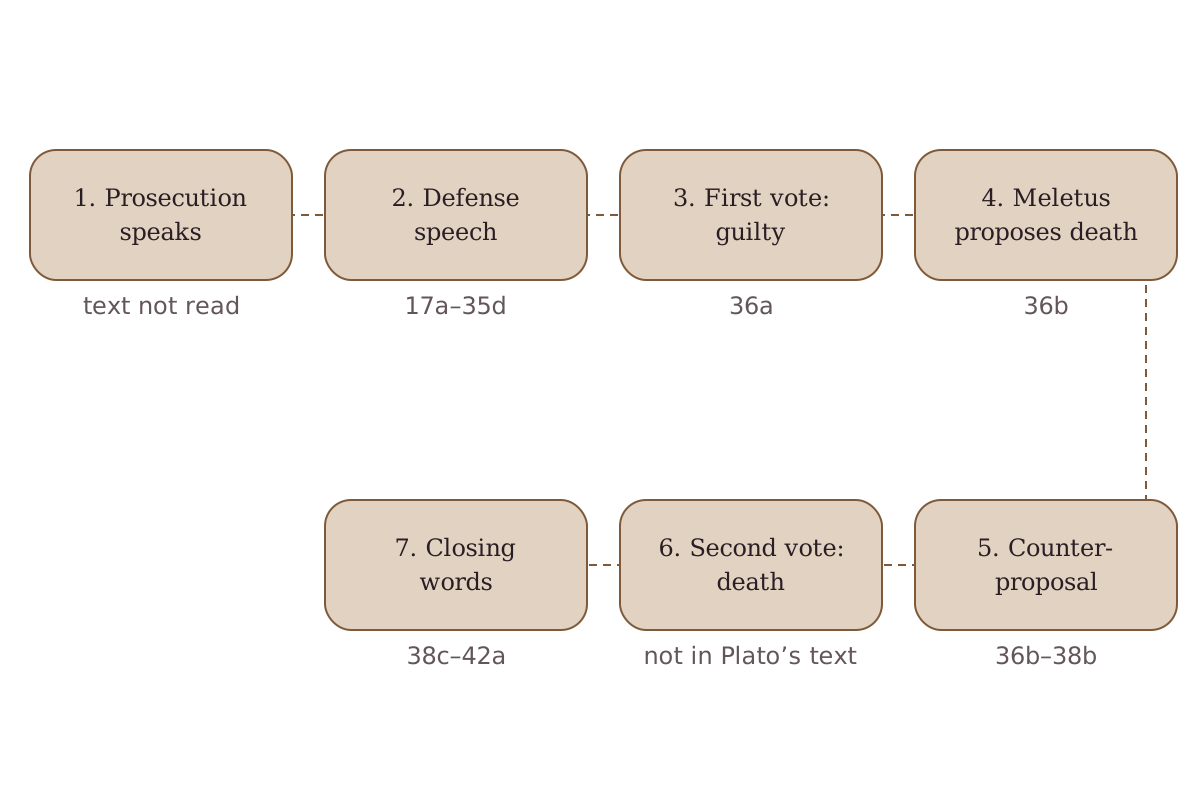
The order of the day as James Riddell reconstructed it in 1867 from the orator Aeschines, with the Apology’s section numbers. 399 BC.
"Order of the day at the trial of Socrates" by Persuasion Dissected — https://persuasiondissected.com/on-trial/trial-of-socrates/ — licensed CC BY 4.0: https://creativecommons.org/licenses/by/4.0/
Diogenes adds two stories about the trial, and no witness stands behind either in the accounts read here. The orator Lysias is said to have written Socrates a speech, which he read through and declined with the remark, “A fine speech, Lysias; it is not, however, suitable to me.” Justus of Tiberias, Diogenes says, had the young Plato climb the platform until the jurors shouted, “Get down! Get down!”
Riddell’s edition, working from what the orator Aeschines says of another kind of suit, describes time split into three equal lengths: the prosecution, the defense, and a third for the penalty.
Plato’s Socrates complains about the clock. If Athens had a law “that a capital cause should not be decided in one day,” he says at 37a, “then I believe that I should have convinced you.” Limits on what a jury gets to hear shape Zola’s libel trial as well, and speeches to a jury are read the same way for the Boston Massacre trials.
How did Socrates answer the old rumors and Meletus?
He starts with a warning his accusers gave, that the jurors might be “deceived by the force of my eloquence.” He denies being a great speaker, “unless by the force of eloquence they mean the force of truth,” and says that at “more than seventy years of age” this is his “first time in a court of law.”
Then he moves the danger away from the indictment. Far more dangerous than Anytus, he says at 18b, “are the others, who began when you were children,” the old rumors about a man who studied the sky and made the worse case look better.
Those rumors get a source the jurors could check for themselves. The accusation, he says at 19c, “is just what you have yourselves seen in the comedy of Aristophanes,” where a stage Socrates claims to walk in air, and he asks those present to tell their neighbors whether they ever heard him talk that way. The appeal turns the jury into its own witnesses, although the text records no answer from them.
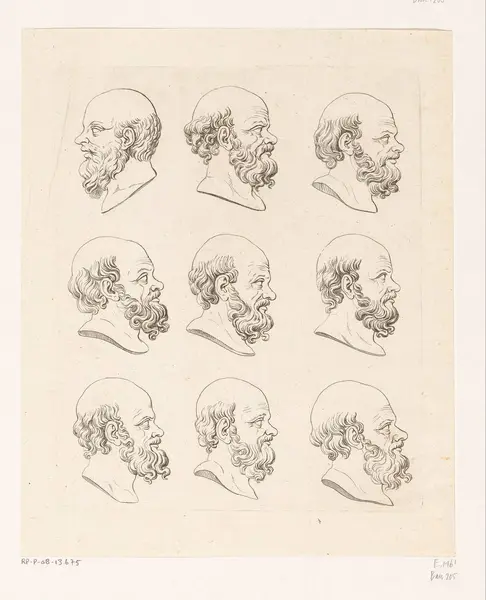
Nine heads of Socrates, etched by Daniel Chodowiecki for a book on reading character from faces. 1775.
"Negen koppen van Socrates" by Daniel Nikolaus Chodowiecki. Public domain.
Full credit
"Negen koppen van Socrates" by Daniel Nikolaus Chodowiecki — https://commons.wikimedia.org/wiki/File:Negen_koppen_van_Socrates,_RP-P-OB-13.675.jpg — Public domain — Public domain in the US (published 1775) and in the EU (print of 1775, so far more than 70 years after any possible author’s death); modified: resized to 1,600 px on the long side
To explain where his reputation came from, he calls “the God of Delphi” as a witness (20e–21a). His friend Chaerephon asked the oracle whether anyone was wiser, and “the Pythian prophetess answered, that there was no man wiser.” Xenophon’s version differs: Apollo says that no one is “more liberal, or more upright, or more temperate,” and the jurors respond with “a fiercer murmur of dissent.” Jowett found the Delphi story suspect, “of a kind which is very likely to have been invented.”
Next he cross-examines Meletus. “Tell the judges, then, who is their improver,” he asks, on the theory that a man who has found the corrupter of the young must know who improves them. Burnet’s notes treat the reply to Meletus as running from 24b to 28a. When Meletus insists that Socrates “says that the sun is stone, and the moon earth,” Socrates answers at 26d that the claim comes from the books of Anaxagoras, and he calls the indictment “a riddle.”
Why did Socrates refuse to plead for his life?
Anytus, he reports, told the jurors that Socrates must die or else their sons “will all be utterly ruined.” Socrates then answers an offer that no one in the text has made. If they freed him on condition that he stop, he says at 29d, “I shall obey God rather than you.” On this site’s reading, that line closes off the quiet way out before the first vote has been taken.
He follows it with an image of himself: “I am that gadfly which God has attached to the state.” Here, for once, he comes close to a request, since “You will not easily find another like me, and therefore I would advise you to spare me” (31a). Later he dares the families of his supposed victims to come forward, saying “Now is their time,” and points to Crito and others in the room who have not done so (33d).
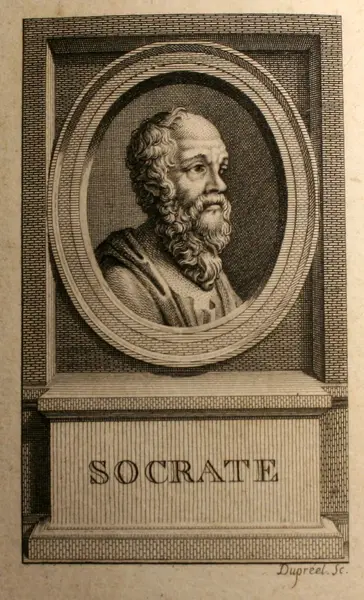
Socrates as engraved by Jean-Baptiste-Michel Dupréel, from a French book of lives of the philosophers published in 1825, long after the trial. 1825.
"Sócrates, from Abrégé de la vie des plus illustres philosophes de l’antiquité" by Jean-Baptiste-Michel Dupréel. Public domain.
Full credit
"Sócrates, from Abrégé de la vie des plus illustres philosophes de l’antiquité" by Jean-Baptiste-Michel Dupréel — https://commons.wikimedia.org/wiki/File:Jean-Baptiste-Michel_Dupr%C3%A9el_S%C3%B3crates.jpg — Public domain — Public domain in the US (published 1825) and in the EU (published 1825, so far more than 70 years after any possible author’s death); modified: resized to fit the delivery size
Near the end he refuses the usual appeal. He has “sons, O Athenians, three in number,” he says, “and yet I will not bring any of them hither in order to petition you for an acquittal.” He claims his reputation forbids it, since “the world has decided that Socrates is in some way superior to other men.”
At 35c he gives the other reason, and it is the closest thing in the speech to a theory of persuasion: “there seems to be something wrong in asking a favour of a judge, and thus procuring an acquittal, instead of informing and convincing him.”
Three readers explain the result differently, and the record supports none of them over the rest:
- Xenophon: Socrates “by his self-laudation” drew jealousy and “caused his judges all the more to record their votes against him.”
- Benjamin Jowett: “As he expected, and probably intended, he is convicted.”
- John Burnet: he “would no doubt have been acquitted but for the special position of Anytus,” whom ordinary jurors found it hard to picture bringing a baseless charge.
How many votes convicted Socrates?
Plato’s Socrates puts it this way at 36a: “I expected it, and am only surprised that the votes are so nearly equal; for I had thought that the majority against me would have been far larger; but now, had thirty votes gone over to the other side, I should have been acquitted.”
Equal votes meant acquittal, and Burnet cites the orator Aeschines for “a clear case of acquittal following equality of votes.” If thirty is exactly the number needed and the jurors were even in number, so that a tie could occur, the majority was 60. Plato gives no totals, and he gives one more hint only as a joke: without Anytus and Lycon, Meletus “would not have had a fifth part of the votes,” which would have cost him “a fine of a thousand drachmae.”
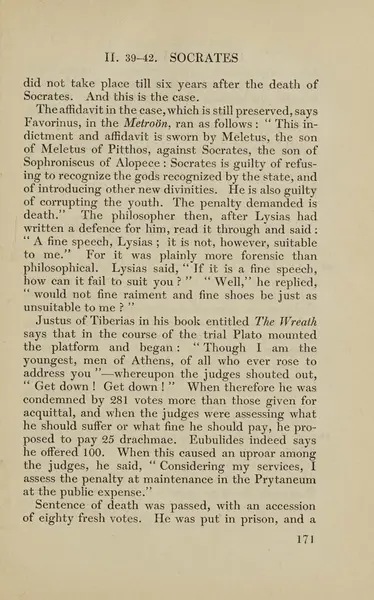
Hicks’s English of Diogenes Laertius, Lives II.41–42, as printed in 1925, with the 281 and the eighty fresh votes.
"Diogenes Laertius, Lives of Eminent Philosophers, vol. I, p. 171" by R. D. Hicks. Public domain.
Full credit
"Diogenes Laertius, Lives of Eminent Philosophers, vol. I, p. 171" by R. D. Hicks — https://archive.org/details/livesofeminentph01diog — Public domain — Public domain in the US (published 1925) and in the EU (Robert Drew Hicks died 1929, life+70; Diogenes Laertius ancient); modified: resized to 1,600 px on the long side
Diogenes Laertius wrote far later. Hicks provisionally dates the work to “the earlier decades of the third century A.D.,” about six centuries after the trial, and his own introduction names “the trial of Socrates” among the typical cases of “extraneous matter which disturbs the context.”
The Greek he translates says 281 more votes than those to acquit. Taken literally, it also breaks the fifth-of-the-votes joke. On Burnet’s reading that Socrates credits each accuser with a third of the convicting votes, this site’s arithmetic needs at least 1,407 votes cast before Meletus falls short.
Plato, Xenophon and Diogenes do not say how many jurors sat. The usual answer comes from editors: Burnet writes of “the 500 (or 501) dicasts,” dicasts being the jurors, and Louis Dyer’s 1908 school edition says a court was “Generally” five hundred, with even numbers “habitually increased by one.” Burnet adds that odd-numbered courts appear in the fourth century, but that “we do not know when this practice was introduced.”
Each statement above, with who made it and whether it is stated or inferred, is in the CSV (where this data comes from).
Can the thirty and the 281 both be right?
Not as written. Burnet calls the Diogenes figure “wholly inconsistent with the text.” The editions read here set out three ways out, and each one changes something in the sources.
| The repair | Who | What it changes | What it costs |
|---|---|---|---|
| Plato wrote “three,” not “thirty” | Wiggers and Matthiä, repeated by Grote, per Riddell | Plato’s word | A jury of 556 or 557, unlike other recorded courts, per Riddell; Burnet says “three” has “no authority at all” |
| 281 is the convicting total, not the margin | Riddell, 1867; Burnet notes the fit | What Diogenes’ Greek means | Needs a court of 501, with “220 for his acquittal,” and thirty becomes a round number for “31 exactly” |
| Diogenes or his source erred | Burnet, 1924 | Diogenes’ reliability | Assumes a court of 500 and a split of 280 to 220, which no ancient account read here states |
Riddell and Burnet disagree on the point that decides between the last two. Riddell saw “no reason” to mistrust Diogenes and read thirty as “in round numbers.” Burnet answered, “I do not think it possible that τριάκοντα is a ‘round number’,” because “Accuracy would be essential here.”
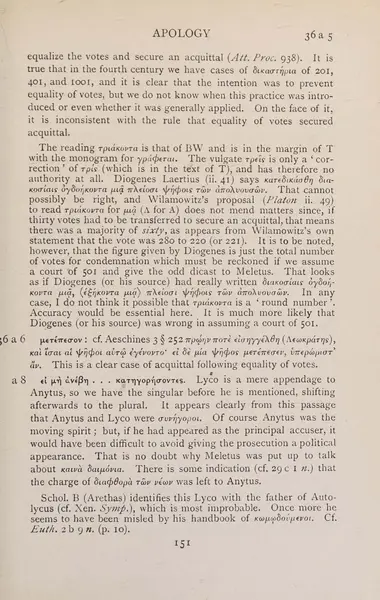
Burnet’s note on Apology 36a, setting out why Diogenes’ figure cannot stand as written. 1924.
"Plato’s Euthyphro, Apology of Socrates and Crito, notes, p. 151" by John Burnet. Public domain.
Full credit
"Plato’s Euthyphro, Apology of Socrates and Crito, notes, p. 151" by John Burnet — https://archive.org/details/platoseuthyphroa0000john — Public domain — Public domain in the US (published 1924) and in the EU (John Burnet died 1928, life+70; Oxford, Clarendon Press); modified: resized to 1,600 px on the long side
Burnet also notes that 281 is exactly the convicting total in a court of 501, and suggests a dropped phrase might explain it. He still thinks the likelier error is the assumed court.
Dyer’s school edition, by contrast, prints the Riddell reading as fact: 281 votes to convict and 220 to acquit, a majority of “sixty-one votes,” with no note that the count is a reconstruction. Hicks’s English says something else, 281 more than those to acquit. The two do not agree, and neither one settles the count.
Each repair is an argument from the text, and none of them is a new source. The same care over two sides’ counts applies to the Chartist petition of 1848, where the claim and the check have named authors. On the first vote, the only witnesses are a defender’s speech and a late compiler.
Is Plato’s Apology a record of what Socrates said?
Editors split on this too. Jowett opened his introduction with “there are no means of determining” how the Apology stands to “the real defence of Socrates.” Burnet argued that “Plato’s aim is obviously to defend the memory of Socrates,” and that because “most of those present must have been still living” at publication, a fictitious account would have defeated that aim, an argument about plausibility that cannot show how close any single sentence stands to what was said in court.
Plato also places himself in the room. Socrates points out “Adeimantus the son of Ariston, whose brother Plato is present,” and later names Plato among the friends who will stand surety. So the author, by his own account, is a witness and an advocate at once, which is why the thirty votes cannot simply be read as a minute of the proceedings.
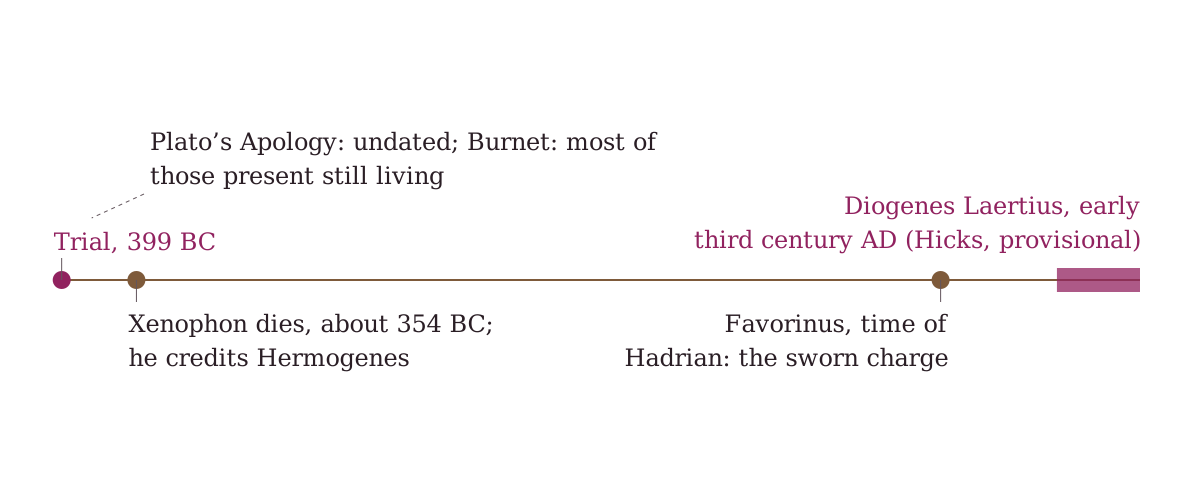
How far each account stands from the trial; Plato’s date of writing is not fixed by the sources read. 399 BC to the third century AD.
"How far each account stands from the trial" by Persuasion Dissected — https://persuasiondissected.com/on-trial/trial-of-socrates/ — licensed CC BY 4.0: https://creativecommons.org/licenses/by/4.0/
Xenophon’s short Apology is the other early account, and it credits what he knows to “Hermogenes, the son of Hipponicus.” It has Socrates claim that death suited him better than old age, and it has friends speaking for him. Riddell observed that Plato “manifestly would have us think of Socrates defending himself alone.” Xenophon gives no vote figures at all.
This site checks every case for the last stone, a premise the speaker leaves unsaid and the audience supplies. This case has none to name. Socrates, as written, says his premises aloud, the prosecution’s wording is missing, and the jurors’ response survives only as votes and, in Xenophon, murmurs.
What penalty did Socrates propose?
The law left this penalty to the court, and Burnet explains the bind: the court “had to choose between the alternative penalties” from each side and “could not itself propose a different one.” He adds his own reading, that Anytus wanted death demanded so that Socrates would offer exile, and “Socrates, however, refused to play the game of Anytus.” The ancient accounts then give three versions of what Socrates did.
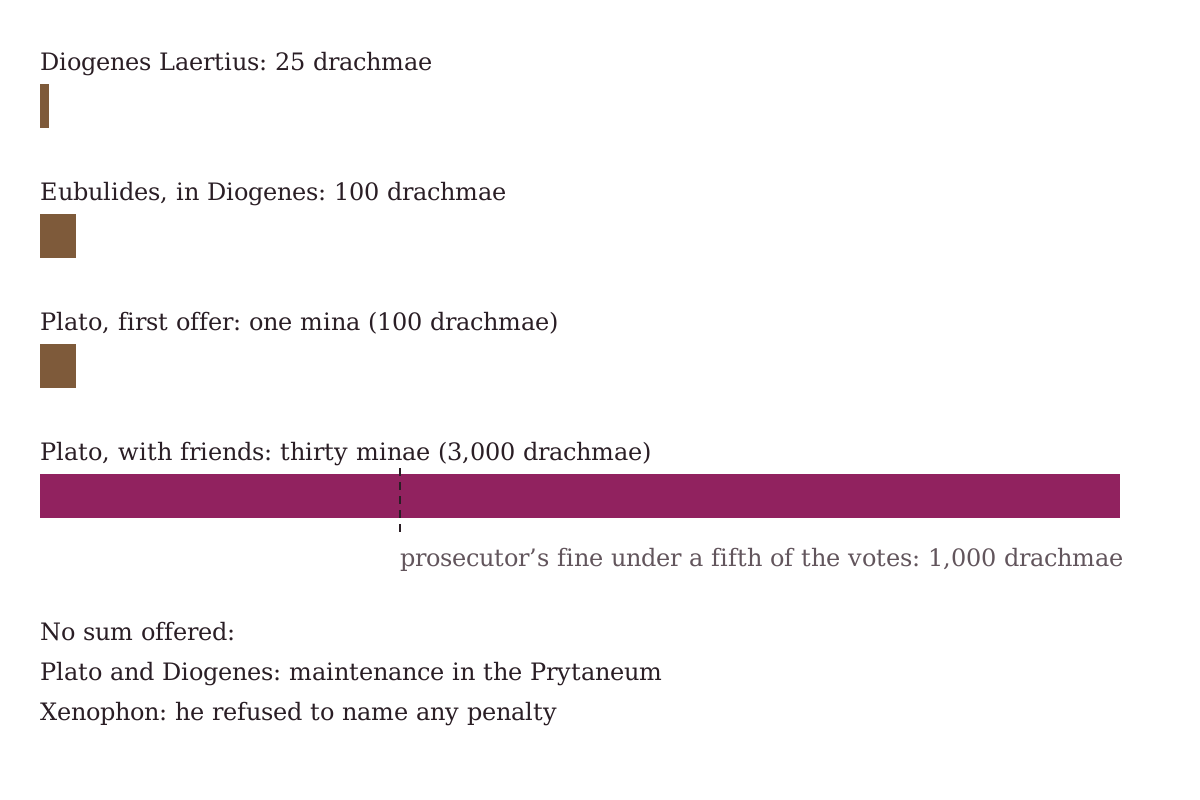
The offers in each account, in drachmae, at Burnet’s 100 drachmas to the mina. Plato, Xenophon and Diogenes on the penalty stage of 399 BC.
"Counter-penalties in Plato, Xenophon and Diogenes" by Persuasion Dissected — https://persuasiondissected.com/on-trial/trial-of-socrates/ — licensed CC BY 4.0: https://creativecommons.org/licenses/by/4.0/
In Plato he opens with a reward: “maintenance in the Prytaneum,” a place at the city’s table, which he says he deserves more than an Olympic victor (36d). He then rejects prison and exile, and says that “the unexamined life is not worth living” (38a).
Only then does money appear. He has said that “money I have none,” yet “perhaps I could afford a mina.” Burnet sizes that sum against ransoms: one mina was a fair price for a prisoner of war in Aristotle’s time, and two was the figure Herodotus gives for the Peloponnese.
Finally “Plato, Crito, Critobulus, and Apollodorus, my friends here, bid me say thirty minæ” (38b).
Xenophon flatly contradicts that. Asked for a counter-penalty, “he would neither do so himself nor suffer his friends to do so for him,” on the ground that it “was like a confession of guilt.” Diogenes reverses Plato’s order: an offer of 25 drachmae first, or 100 according to Eubulides, then uproar, then the Prytaneum.
H. G. Dakyns, translating Xenophon, noted of Plato and Diogenes: “These authorities tell a different story.”
Thirty minae, or 3,000 drachmae by this site’s arithmetic, was three times the fine Meletus had risked. Burnet, working from the orator Lysias, infers “a handsome sum” for a man of moderate means to give as a dowry.
What happened after the second vote?
Among the accounts read, only Diogenes gives a figure: “Sentence of death was passed, with an accession of eighty fresh votes.” Burnet turns that into “a division of 300 to 200” in a court of 500, and immediately adds, “We have no means of checking this.”
Eighty added to his own 280 comes to 360 by this site’s arithmetic, so the printed 300 does not follow from that split. Dyer’s edition hedges the same way, “It is said.” Plato gives no number for the second vote.
In Plato the condemned man then speaks again. “I would rather die having spoken after my manner, than speak in your manner and live,” he says, and tells those who voted against him that “the deficiency which led to my conviction was not of words.” Burnet reports that Wilamowitz and Schanz thought this last speech pure fiction, and he calls that contention “groundless.”
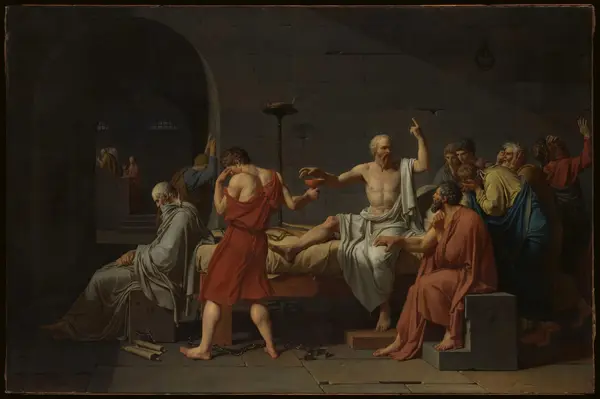
Jacques-Louis David’s The Death of Socrates shows the prison before the poison, painted long after the trial and not a scene from it. 1787.
"The Death of Socrates" by Jacques-Louis David. Public domain.
Full credit
"The Death of Socrates" by Jacques-Louis David — https://commons.wikimedia.org/wiki/File:The_Death_of_Socrates_MET_DP-13139-001.jpg — Public domain — Public domain in the US (painted 1787) and in the EU (Jacques-Louis David died 1825, life+70); photograph released CC0 on the file page; modified: resized to 1,600 px wide; the card frame may trim a few pixels
How long he waited depends on the source. Diogenes writes that a “few days afterwards” he “drank the hemlock,” while Dyer, citing Plato’s Phaedo, says the sentence was delayed “for thirty days.” Diogenes adds that “the Athenians felt such remorse” that they punished his accusers, a tale Dyer says “rests on such slender authority that it must not be taken as history.”
Plato’s speech ends without any of that: “The hour of departure has arrived, and we go our ways—I to die, and you to live. Which is better God only knows.” Athens speaks from the other side of a very different argument in the Melian Dialogue.
Crossing map
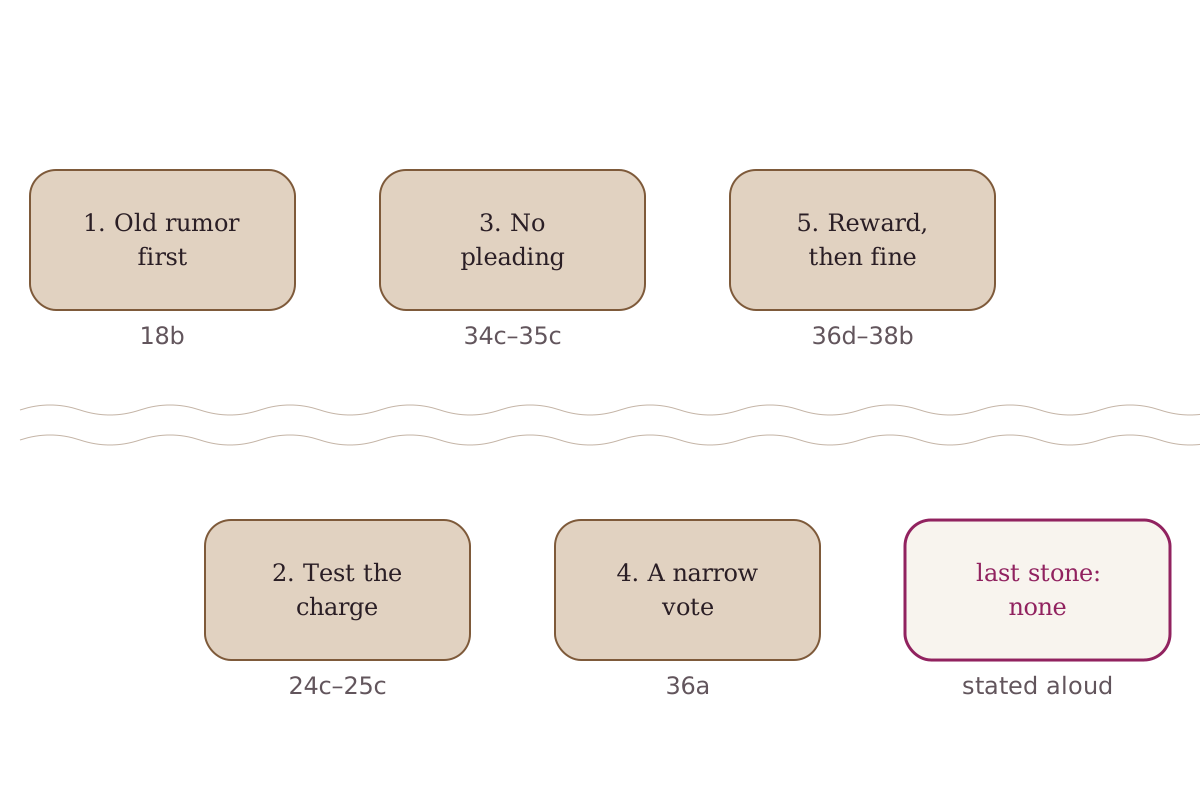
Crossing map of the defense as Plato wrote it; the prosecution’s stones are not in the accounts read. 399 BC.
"Crossing map of the defense in Plato’s Apology" by Persuasion Dissected — https://persuasiondissected.com/on-trial/trial-of-socrates/ — licensed CC BY 4.0: https://creativecommons.org/licenses/by/4.0/
- Old rumor first. The speech ranks the old tale above the indictment: “the others, who began when you were children” (Apology 18b) [1]
- Test the charge. Socrates questions Meletus on who improves the young (24c–25c; range per Burnet) [1] [4]
- No pleading. He will not bring his sons forward to plead, and a judge should be informed and convinced (34c–35c) [1]
- A narrow vote. “Had thirty votes gone over” (36a). Diogenes’ 281 does not fit it (II.41) [1] [2]
- Reward, then fine. The Prytaneum, one mina, then thirty minae with sureties (36d–38b). Xenophon says he refused to offer anything [1] [3]
- No last stone in this case. Socrates states each premise aloud, and the prosecution’s words, where a gap could be seen, are not in these accounts. The defense, as written, rests on claims stated aloud and on appeals to his reputation [1] [3]
Sources
- Plato, Apology, translated by Benjamin Jowett, with Jowett’s introduction. Section numbers cited here follow the notes of Burnet, Dyer and Riddell. gutenberg.orgRead: full text and introduction
- Diogenes Laertius, Lives of Eminent Philosophers, vol. I, translated by R. D. Hicks (London: Heinemann, 1925), pp. xii, xvi, 171–173 (II.40–43). archive.orgRead: pages cited; pages xii, xvi, 171 and 173 compared with page images
- Xenophon, The Apology of Socrates, translated by H. G. Dakyns, in The Works of Xenophon. en.wikisource.orgRead: full text and notes
- John Burnet, Plato’s Euthyphro, Apology of Socrates and Crito, edited with notes (Oxford: Clarendon Press, 1924), pp. 63–64, 149–152, 160–161. archive.orgRead: pages cited; pages 63, 149–152 and 160–161 compared with page images
- James Riddell, The Apology of Plato, with a revised text and English notes (Oxford: Clarendon Press, 1867), pp. xii–xv. archive.orgRead: pages cited; pages xii–xiv compared with page images
- Louis Dyer and Thomas Day Seymour, Apology of Socrates and Crito, with extracts from the Phaedo and Symposium (Boston: Ginn, 1908), Introduction §§15, 40–41, 48 and notes to Apology XXV–XXVIII (pp. 97–98). archive.orgRead: sections and notes cited; pages 12, 26, 31, 97 and 98 compared with page images
Next crossing
- The Dreyfus affair and Zola’s libel trial — Another trial read from the words spoken at it, where the fight is over what the jury may ask.
- The Melian Dialogue — Athens again, in a debate Thucydides wrote as a dialogue.
Cite this page
Persuasion Dissected. "Trial of Socrates: In Plato, 30 Votes Would Have Freed Him." Persuasion Dissected. Published 2026-11-11. https://persuasiondissected.com/on-trial/trial-of-socrates/. Accessed: add the date you read it.
Corrections
No corrections yet.
How pieces are checked · All corrections · Contact · Report an error (contact@persuasiondissected.com)