Melian Dialogue: In Thucydides, Melos Chose Closed Doors
In three lines
- Who persuaded whom: In Thucydides’ account, Athenian envoys tried in 416 BC to talk “the magistrates and the few” of Melos into submitting. Melos had kept them from “the people,” and the exchange is Thucydides’ written version, not minutes.
- Which stones: The envoys ask Melos to talk only of safety, set right aside, give up neutrality and discount hope, on the way to accepting tribute. Melos accepts the format and the topic, sets right aside only under protest, then refuses the rest.
- Outcome: Melos refused. After a siege and “some treachery taking place inside,” it surrendered. Athens killed the grown men it captured, enslaved the women and children and settled the island (5.116).
Route through this piece (7)
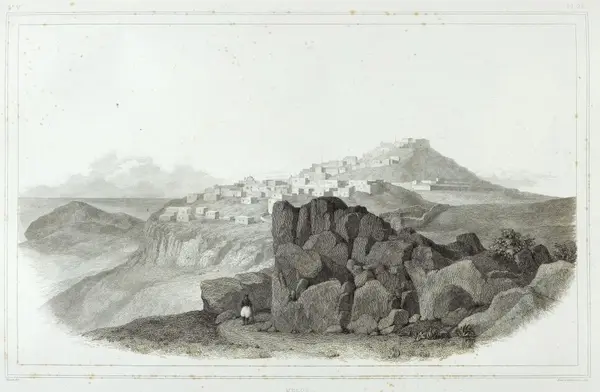
Melos as a French survey engraved it, with the later town on its hill and not the city of 416 BC. Published 1838.
"Melos, plate 25" by Abel Blouet. Public domain.
Full credit
"Melos, plate 25" by Abel Blouet — https://commons.wikimedia.org/wiki/File:Milos1829.jpg — Public domain — Public domain in the US (published 1838) and in the EU (published 188 years ago; Abel Blouet, named as draftsman, working by 1829; engravers’ dates not traced); modified: recompressed JPEG at the same pixel size; plate kept whole
Case card
- Case
- The Melian Dialogue, the talks at Melos as Thucydides wrote themThucydides 5.84–116, tr. Crawley
- Date range
- Summer 416 BC to the following winter; Thucydides gives seasons and no datesThucydides 5.84, 5.116; year as given by Grote, History of Greece, vol. 7, ch. LVI
- Place
- Melos, an island colony of Lacedaemon; the text does not describe the place of the talksThucydides 5.84
- Persuader(s)
- Athenian envoys sent by the generals Cleomedes and Tisias; their words are Thucydides’ written versionThucydides 1.22, 5.84
- Audience
- “the magistrates and the few”; the Melians did not bring the envoys before the peopleThucydides 5.84
- The ask
- “the strong do what they can and the weak suffer what they must”Thucydides 5.89, tr. Crawley
- Channel
- Closed talks in short exchanges, as Thucydides wrote them, with an army encamped on the islandThucydides 5.84–85
- Outcome
- Melos refused; after a siege and “some treachery taking place inside” it surrendered; Athens killed the grown men it captured, enslaved the women and children and settled the islandThucydides 5.112, 5.116
- Primary record
- Thucydides, History, Book 5, the only account of the talks read for this page; no minutes known to this pageThucydides, tr. Crawley; Project Gutenberg 7142
In summer 416 BC, Melos sent Athenian envoys to “the magistrates and the few” instead of to the people. That choice asks the people of Melos to accept that others will hear the terms for them. The Melian Dialogue, as the exchange is now called, is not a transcript: Thucydides wrote it, and he names no witness to it.
Crawley’s translation heads the chapter “The Melian Conference,” and this page reads that chapter from its first sentence to its last, citing the book and section numbers readers use to locate a passage. The envoys’ argument has become the famous part of the episode. The arrangement that produced the argument gets a single clause.
Who kept the envoys from the people of Melos?
The clause runs: “These the Melians did not bring before the people, but bade them state the object of their mission to the magistrates and the few” (5.84). Its grammatical subject is “the Melians,” which leaves open which Melians made the decision. Thucydides describes no vote, debate or consultation behind it.
Thucydides offers no explanation in his own voice, so the only one in the text comes from the other side of the negotiation. The envoys open by announcing that the talks are closed so that Athens may not “deceive the ears of the multitude by seductive arguments which would pass without refutation (for we know that this is the meaning of our being brought before the few)” (5.85).
The talks were held before the few, and the people were not there. Summer 416 BC.
Illustration — not a historical depiction
Illustration: Persuasion Dissected. Generated schematic illustration — not a photograph or historical record. Reuse: CC BY 4.0 (https://creativecommons.org/licenses/by/4.0/), to the extent any rights exist.
That statement is a claim about motive from an interested party, composed by a third. It also works as an opening move, because the envoys immediately extend the arrangement into a procedural rule: “Make no set speech yourselves, but take us up at whatever you do not like, and settle that before going any farther.”
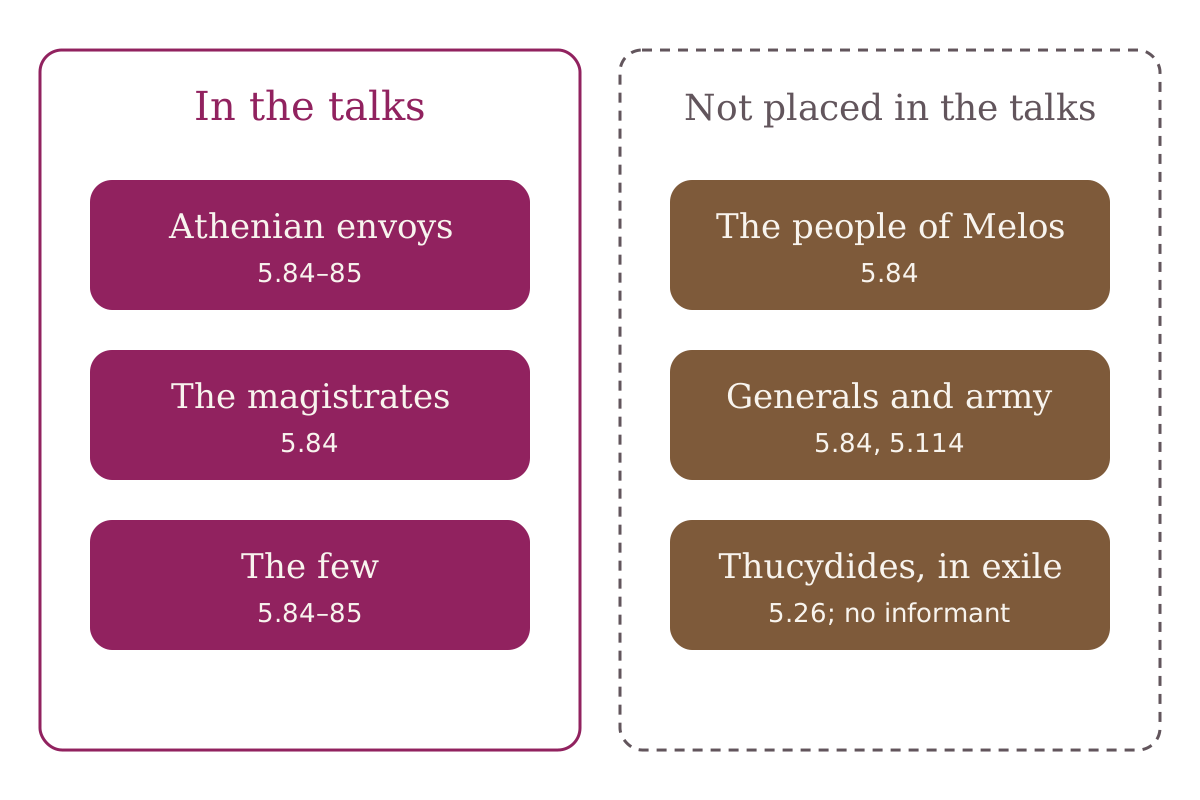
Who the text places in the talks and who it does not place there, on this site’s reading of 5.26 and 5.84–85. Summer 416 BC.
"Who the text places in the talks, and who it does not place there" by Persuasion Dissected — https://persuasiondissected.com/bargaining/melian-dialogue/ — licensed CC BY 4.0: https://creativecommons.org/licenses/by/4.0/
George Grote, the nineteenth-century historian of Greece, interpreted the clause as a departure from custom. Discussing peace or war before the assembly was “a practice, frequent, if not universal,” he wrote, and on this occasion “the Melian leaders departed from this practice.” He described the body as an “executive council,” an interpretive label that goes beyond Crawley’s wording.
Nothing in the chapter says whether the people were ever told the proposed terms. When the talks ended, “the Melians, left to themselves, came to a decision” (5.112), again with no vote described, so the record cannot establish what the people would have preferred, or whether anyone consulted them.
Is the Melian Dialogue a record of what was said?
Thucydides explains his treatment of speech early in the history. “It was in all cases difficult to carry them word for word in one’s memory,” he writes, “so my habit has been to make the speakers say what was in my opinion demanded of them by the various occasions” (1.22). He adds that he stayed “as closely as possible to the general sense of what they really said,” a qualification that concerns speeches. It does not settle how he obtained the contents of a closed conversation.
His own circumstances introduce a second difficulty: “It was also my fate to be an exile from my country for twenty years after my command at Amphipolis” (5.26). The translation’s chapter heading places Amphipolis in the eighth and ninth years of the war, so those twenty years include the sixteenth, the year of the Melos expedition. He says that exile left him “present with both parties,” and the Melos chapter identifies no informant.
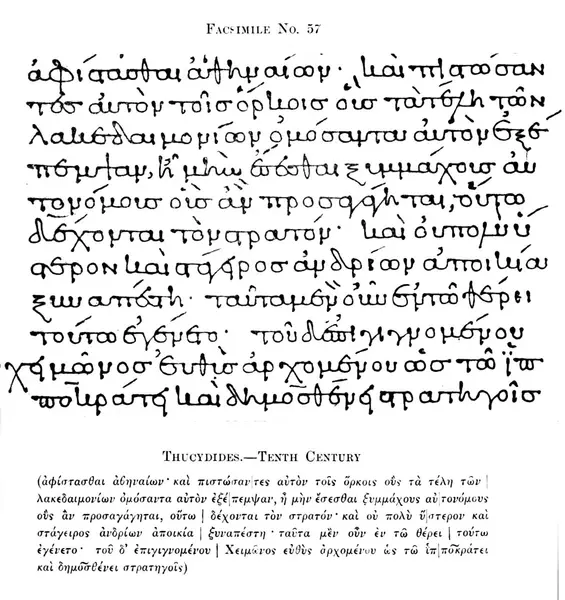
A tenth-century copy of Thucydides, as a 1912 handbook reproduced it. The lines shown come from another part of the History and name Stagirus, not Melos.
"Thucydides, tenth century, Facsimile No. 57" by Edward Maunde Thompson. Public domain.
Full credit
"Thucydides, tenth century, Facsimile No. 57" by Edward Maunde Thompson — https://commons.wikimedia.org/wiki/File:Thucydides_Manuscript.jpg — Public domain — Public domain in the US (published 1912) and in the EU (Edward Maunde Thompson died 1929, life+70); the manuscript is tenth-century; modified: resized to 1200 px and converted to grayscale JPEG; page kept whole; original kept
Grote reached the sharpest conclusion in the sources read here. He judged that this passage “is in far larger proportion his own and in smaller proportion authentic report, than any of the other speeches,” because the participants were few: “three or four Athenians, and perhaps ten or a dozen Melians,” an estimate of his own, since the chapter supplies no number.
Even so, he accepted a core of authentic report, saying that Thucydides heard “the general character of what passed” through the Athenian envoys: “I make no doubt.” He also argued that the envoys were the only possible informants because the whole Melian population had been killed, although his own footnote concedes that some “must have escaped or must have been spared.” Both statements stand here because neither can be tested against a second account of the conversation.
Throughout this page, therefore, “the Athenians” and “the Melians” mean the speakers Thucydides composed. A comparable caution applies to Plato’s version of the defense speech in the trial of Socrates, held in Athens 17 years later.
Where does “the strong do what they can” come in the talks?
The sentence arrives early, as a rule for the debate and before any concrete offer. At 5.89 the envoys announce that they will not argue “how we have a right to our empire because we overthrew the Mede,” and they ask Melos in return not to plead “that you have done us no wrong.” The sentence quoted in the ask then follows as the justification for abandoning both arguments.
Lifted out of that context, the sentence can read like a general law of politics. In place, it is a proposal about the agenda, spoken by characters. Thucydides does not endorse it in his narrator’s voice within this chapter. The Melians treat it as an instruction: “we speak as we are obliged, since you enjoin us to let right alone and talk only of interest” (5.90).
A later turn extends the claim from politics to religion. “Of the gods we believe, and of men we know, that by a necessary law of their nature they rule wherever they can,” the envoys say at 5.105, in the second longest turn of the exchange, and they add that “all we do is to make use of it.”
The terms themselves come out slowly. At 5.93 the envoys supply their reason for sparing the island: “we should gain by not destroying you.” Only the last turn before the envoys withdraw specifies the proposal, “the moderate offer of becoming its tributary ally, without ceasing to enjoy the country that belongs to you” (5.111). It joins a payment to a promise about territory.
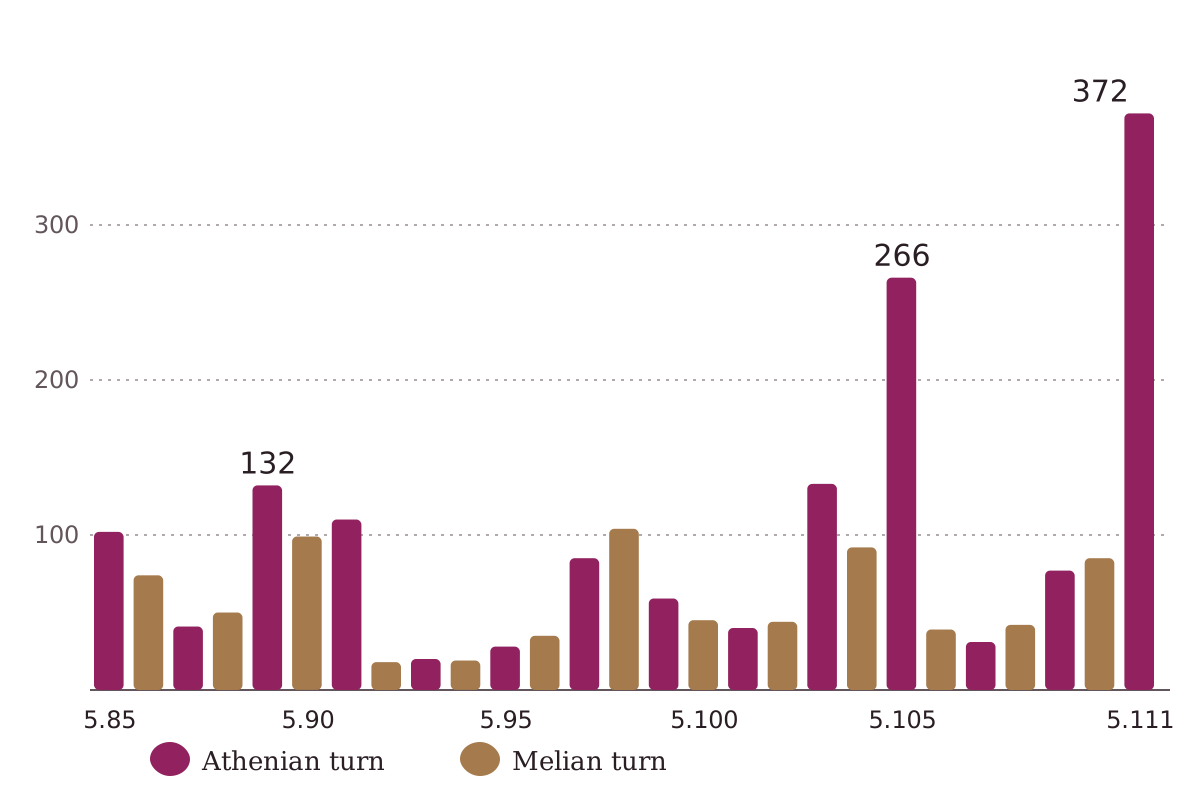
Words per speaking turn in Crawley’s English, by this site’s count. Athenian turns are dark and Melian turns are light. Book 5, sections 85–111.
"Words per speaking turn in Crawley’s English" by Persuasion Dissected — https://persuasiondissected.com/bargaining/melian-dialogue/ — licensed CC BY 4.0: https://creativecommons.org/licenses/by/4.0/
Data: Thucydides, History, Book 5, tr. Richard Crawley, 5.85–111, this site’s count
This site’s count of Crawley’s English assigns the envoys 1,496 words in 14 turns and the Melians 746 in 13, before the closing exchange. Grote describes “thirteen distinct observations, with as many replies,” which comes to 26 turns, one fewer than this count. The figures measure one English translation and not the Greek, so they offer only a rough guide to proportion. The turn-by-turn count is available as a CSV (where this data comes from).
The envoys told the Melians “Make no set speech yourselves” and promised that they themselves would not “make a long speech which would not be believed.” Yet the longest turn in the exchange is one of their own: 372 words at 5.111, their last before they withdraw.
What did Melos concede, and what did it refuse?
Melos conceded the format first, with a warning. “To the fairness of quietly instructing each other as you propose there is nothing to object,” the commissioners reply, but “all we can reasonably expect from this negotiation is war, if we prove to have right on our side and refuse to submit, and in the contrary case, slavery” (5.86). Next it accepted the subject of the conference: “the question in this conference is, as you say, the safety of our country” (5.88).
The Melians accepted the exclusion of justice only under protest. Then they contested the argument on the ground Athens had chosen. Their first argument from interest warned that Athens itself would need fairness one day, since its “fall would be a signal for the heaviest vengeance” (5.90). Their second asked how Athens could avoid “making enemies of all existing neutrals” (5.98), prefaced by a complaint: “if you debar us from talking about justice and invite us to obey your interest, we also must explain ours.”
The envoys answered each argument on the same terms. A rival empire “is not so terrible to the vanquished as subjects who by themselves attack and overpower their rulers” (5.91), they replied, and mainland neutrals gave them “but little alarm” (5.99). Whether those replies were sound is a separate question. The chapter records no independent judgment of them.
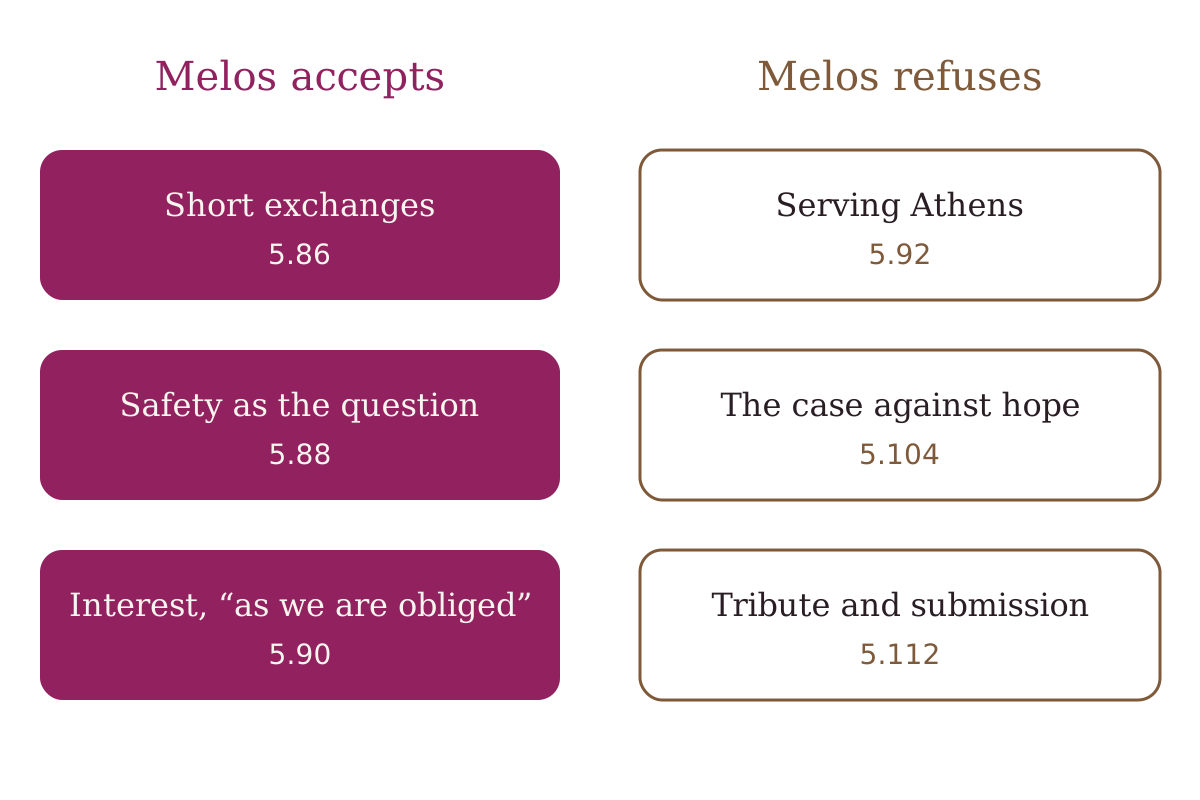
What the Melians accept in the talks and what they refuse, on this site’s reading. Book 5, sections 86–112. Summer 416 BC.
"What the Melians accept and what they refuse" by Persuasion Dissected — https://persuasiondissected.com/bargaining/melian-dialogue/ — licensed CC BY 4.0: https://creativecommons.org/licenses/by/4.0/
Beyond that point the concessions stop. Melos asks “how, pray, could it turn out as good for us to serve as for you to rule?” (5.92) and proposes neutrality (5.94). When the envoys call hope “danger’s comforter” (5.103), the Melians invoke the gods and “the alliance of the Lacedaemonians” (5.104), and their final answer remains “the same as it was at first” (5.112).
This site examines every case for the last stone, a premise that no speaker states and the audience supplies independently. The Melian Dialogue offers none that the text can demonstrate, because the envoys voice their premises, including the reason the offer should hold, and the Melians answer and refuse. No oath or guarantee appears in the chapter, and the only assurance the envoys offer is Athens’s own gain (5.93).
Documentary evidence is thin as well. The dispute in the Yalta Conference runs through drafts printed word for word and notetakers’ minutes, whereas the terms here survive as one sentence in a speech that Thucydides composed.
What was the exit cost, for Melos and for Athens?
This site’s label for a barrier to leaving that a source supports is the exit cost: money already invested, a public statement, social ties, or legal or reputational consequences. Melos and Athens each identify such barriers during the talks, and the table lists only exits that have words behind them.
| Exit in the text | Barrier in the text | Who says it | When the text shows it |
|---|---|---|---|
| Submit as a “tributary ally” (5.111) | Freedom of “a city that has been inhabited these seven hundred years” (5.112); “great baseness and cowardice” (5.100) | Melians, in Thucydides’ wording | Summer 416 BC, during the talks |
| Neutrality, “friends instead of enemies” (5.94) | “your friendship will be an argument to our subjects of our weakness” (5.95) | Athenian envoys, in Thucydides’ wording | Summer 416 BC, during the talks |
| Rescue by Lacedaemon, of which Melos is a colony (5.84, 5.104) | “while we are masters of the sea” (5.109) | Athenian envoys, in Thucydides’ wording | During the talks; no Lacedaemonian force appears in the siege account |
| Athens sails home after “such a treaty as shall seem fit to us both” (5.112) | “the fact that you are islanders and weaker than others” (5.97) | Athenian envoys, in Thucydides’ wording | During the talks |
| Terms once the siege began | Cannot be dated from the record | Thucydides does not say | 5.114 to 5.116 |
The barriers on the Athenian side are claims. In the envoys’ telling, Athens could not withdraw because its subjects were watching. This chapter provides no independent way to test that statement. The neutrality proposal also has a history, since Thucydides says that Melos “at first remained neutral” and later, after Athenian plundering, took “an attitude of open hostility” (5.84), and an earlier devastation of the island had failed to produce submission (3.91).
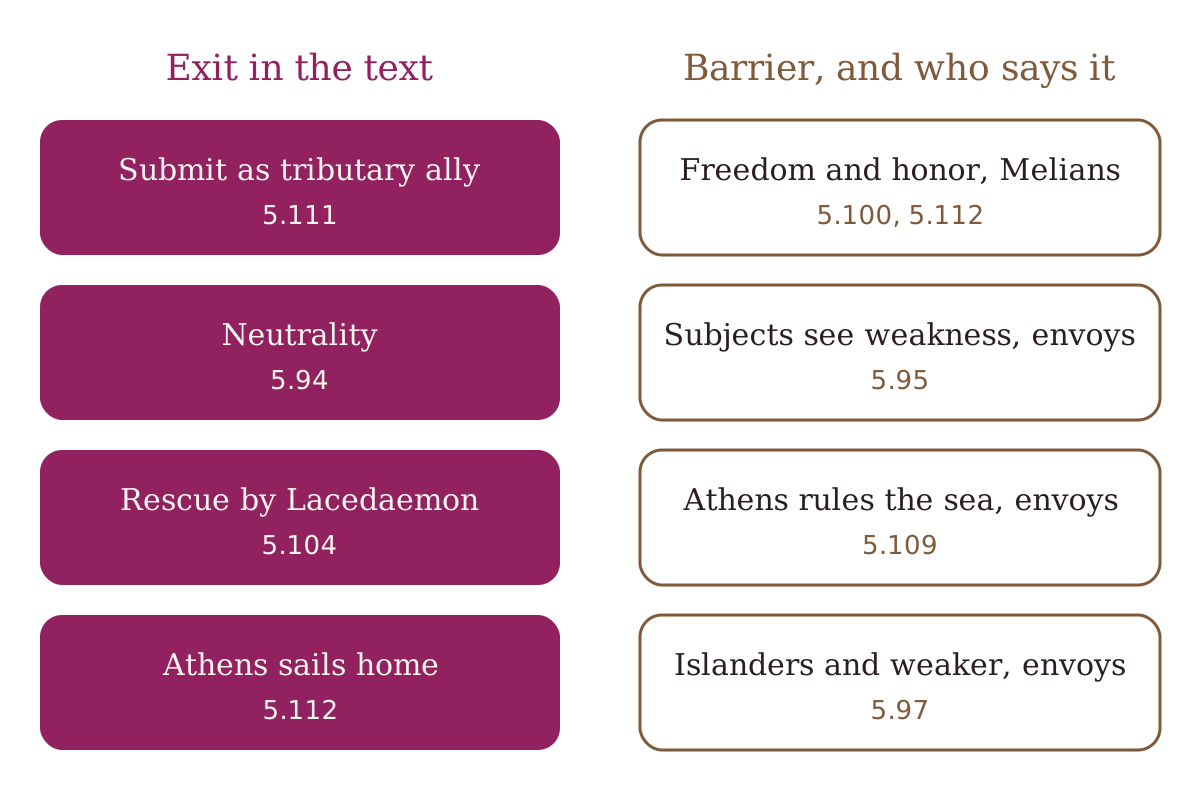
Exits the talks name and the barrier the text gives each, on this site’s reading of 5.94–112. Summer 416 BC.
"Exits named in the talks and the barrier the text gives each" by Persuasion Dissected — https://persuasiondissected.com/bargaining/melian-dialogue/ — licensed CC BY 4.0: https://creativecommons.org/licenses/by/4.0/
Reputation is the barrier that the envoys attack most directly. The Melians call surrender without a fight “great baseness and cowardice” (5.100), and the last Athenian turn before the withdrawal replies that men can be led by “the mere influence of a seductive name” into “hopeless disaster” (5.111), then describes submission to “the greatest city in Hellas” as no dishonor.
Position mattered as well: the magistrates and the few weighed these barriers with the terms before them, while the chapter does not place the people in the conversation. This site’s working hypothesis, for the historical negotiations it covers, is that deadlines and exit costs often explain the outcome better than opening tactics do. Melos supports that only partly, because the barriers appear in the text and no deadline does. The envoys say only “Think over the matter, therefore, after our withdrawal” (5.111).
In the papers of the Luddites, a Nottinghamshire hosier likewise has to estimate what another side’s terms are worth, although the documentary record there is considerably different.
How did the siege of Melos end?
Thucydides narrates the aftermath briefly. “The Athenian envoys now returned to the army; and the Melians showing no signs of yielding, the generals at once betook themselves to hostilities” (5.114). A surrounding wall was constructed, most of the army returned home, and a smaller force remained to continue the siege by land and sea.
The size of the original expedition depends on the text consulted. Crawley prints “sixteen hundred heavy infantry” from Athens and Grote gives twelve hundred, each with about fifteen hundred additional men from the allies (5.84). The CSV (where this data comes from) preserves both figures with their sources.
The Melians counterattacked twice. They “attacked by night and took the part of the Athenian lines over against the market” (5.115), and the following winter they captured “another part” (5.116), after which reinforcements arrived from Athens under Philocrates.
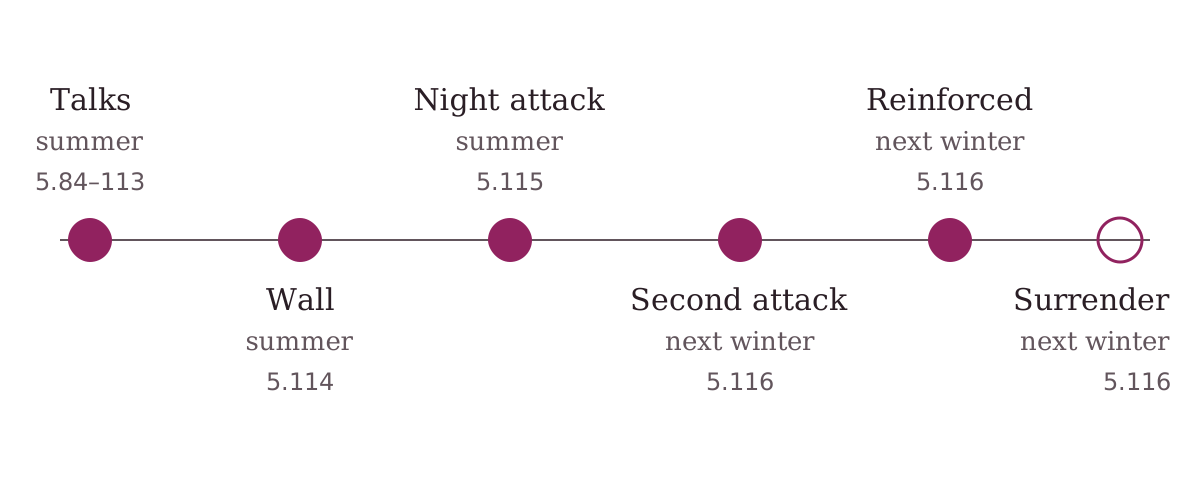
The order of events in Thucydides, who gives seasons and no dates. Summer 416 BC to the following winter.
"Order of events from the talks to the surrender" by Persuasion Dissected — https://persuasiondissected.com/bargaining/melian-dialogue/ — licensed CC BY 4.0: https://creativecommons.org/licenses/by/4.0/
The conclusion occupies one sentence: “the siege was now pressed vigorously; and some treachery taking place inside, the Melians surrendered at discretion to the Athenians, who put to death all the grown men whom they took, and sold the women and children for slaves, and subsequently sent out five hundred colonists and inhabited the place themselves” (5.116).
The phrase “some treachery” names no traitor, number or motive. It does not say whether the betrayal began among the few or among the people. Grote’s note, citing Xenophon (not read for this page), adds that Lysander restored some Melians to the island after the battle of Aegospotami.
Book 6 begins immediately afterward: “The same winter the Athenians resolved to sail again to Sicily.” Grote interpreted that placement as deliberate, writing that Thucydides “makes a halt, to illustrate the sentiment of Athenian power” before the Sicilian catastrophe, an interpretation that Thucydides himself does not state.
Crossing map
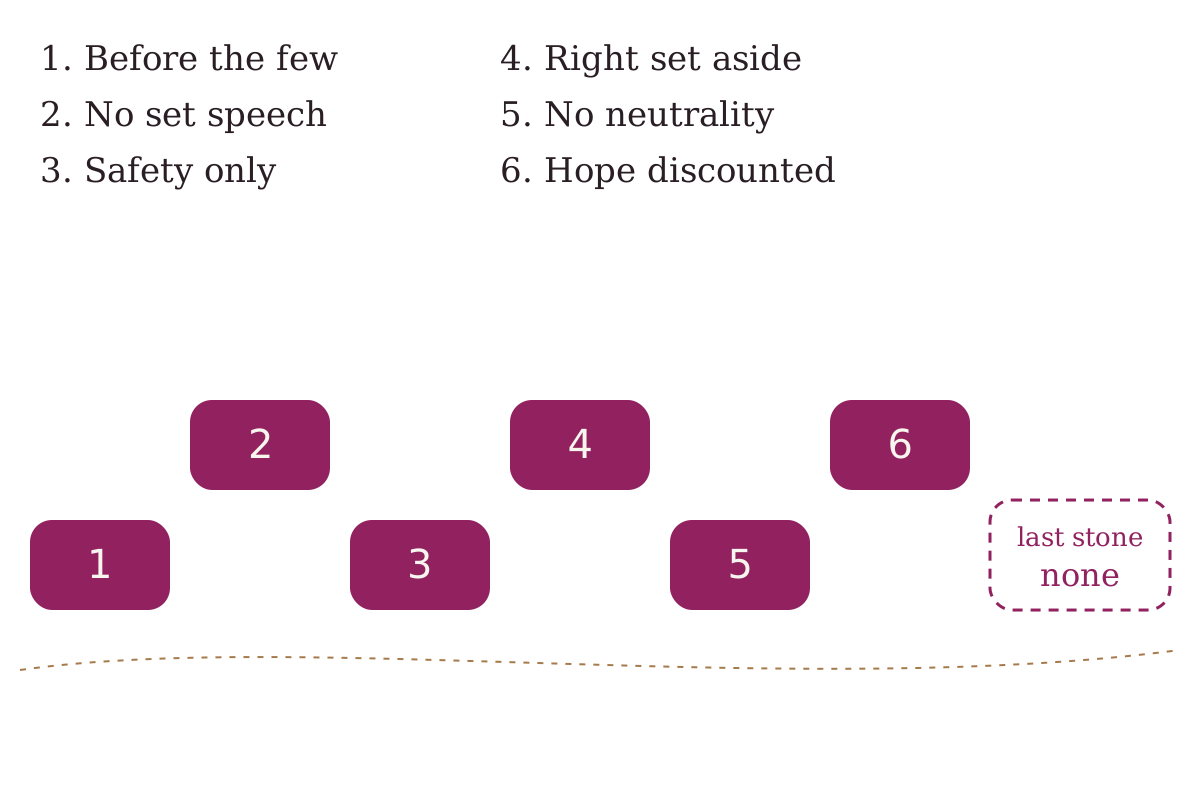
Crossing map of the envoys’ case, as Thucydides wrote it. The last place on the path is empty. Summer 416 BC.
"Crossing map of the envoys’ case" by Persuasion Dissected — https://persuasiondissected.com/bargaining/melian-dialogue/ — licensed CC BY 4.0: https://creativecommons.org/licenses/by/4.0/
- Before the few. The Melians keep the envoys from the people, and the envoys state what they take that arrangement to mean (5.84–85) [1]
- No set speech. The envoys propose short exchanges, and the Melians have “nothing to object” (5.85–86) [1]
- Safety only. The envoys limit the conversation to the facts in view, and the Melians accept “the safety of our country” as the question (5.87–88) [1]
- Right set aside. “The strong do what they can,” and the Melians continue “as we are obliged” (5.89–90) [1]
- No neutrality. The Melians ask to be “friends instead of enemies,” and the envoys refuse (5.94–95) [1]
- Hope discounted. The envoys answer fortune, the gods and Lacedaemon in succession (5.103–109) [1]
- No last stone in this case. The envoys state each premise, the Melians answer and refuse (5.111–112), and the record ends with the siege and “some treachery” (5.116) [1]
Sources
- Thucydides, The History of the Peloponnesian War, translated by Richard Crawley (first complete edition 1874). Book 1, section 22; Book 3, section 91; Book 5, sections 26 and 84–116; Book 6, opening. gutenberg.orgRead: chapter: Book 5 sections 84–116 in full; other sections cited
- George Grote, History of Greece, vol. 7, ch. LVI (New York: Harper & Brothers, reprinted from the London edition). gutenberg.orgRead: chapter section on Melos, with notes
- “Crawley, Richard,” Dictionary of National Biography, 1901 supplement, vol. 2. en.wikisource.orgRead: full entry
Next crossing
- The Congress of Vienna — Another closed negotiation, known largely through what one participant wrote about it.
- The trial of Socrates — Athens again, this time with a jury, and with Plato composing the words that survive.
Cite this page
Persuasion Dissected. "Melian Dialogue: In Thucydides, Melos Chose Closed Doors." Persuasion Dissected. Published 2026-11-11. https://persuasiondissected.com/bargaining/melian-dialogue/. Accessed: add the date you read it.
Corrections
No corrections yet.
How pieces are checked · All corrections · Contact · Report an error (contact@persuasiondissected.com)