Dreyfus Affair: Zola’s Court Barred Secret-Document Proof
In three lines
- Who persuaded whom: In early 1898 the French war minister and the Paris prosecutors persuaded a jury to convict Émile Zola of libel over “J’accuse…!”
- Which stones: By this site’s count the charge used 106 of the letter’s 4,494 words, a ruling barred proof of anything else, and the judge refused question after question about a secret document.
- Outcome: Guilty “à la majorité” on 23 February 1898. The Cour de cassation then quashed the verdict because the minister had filed the complaint in the court-martial’s place.
Route through this piece (9)
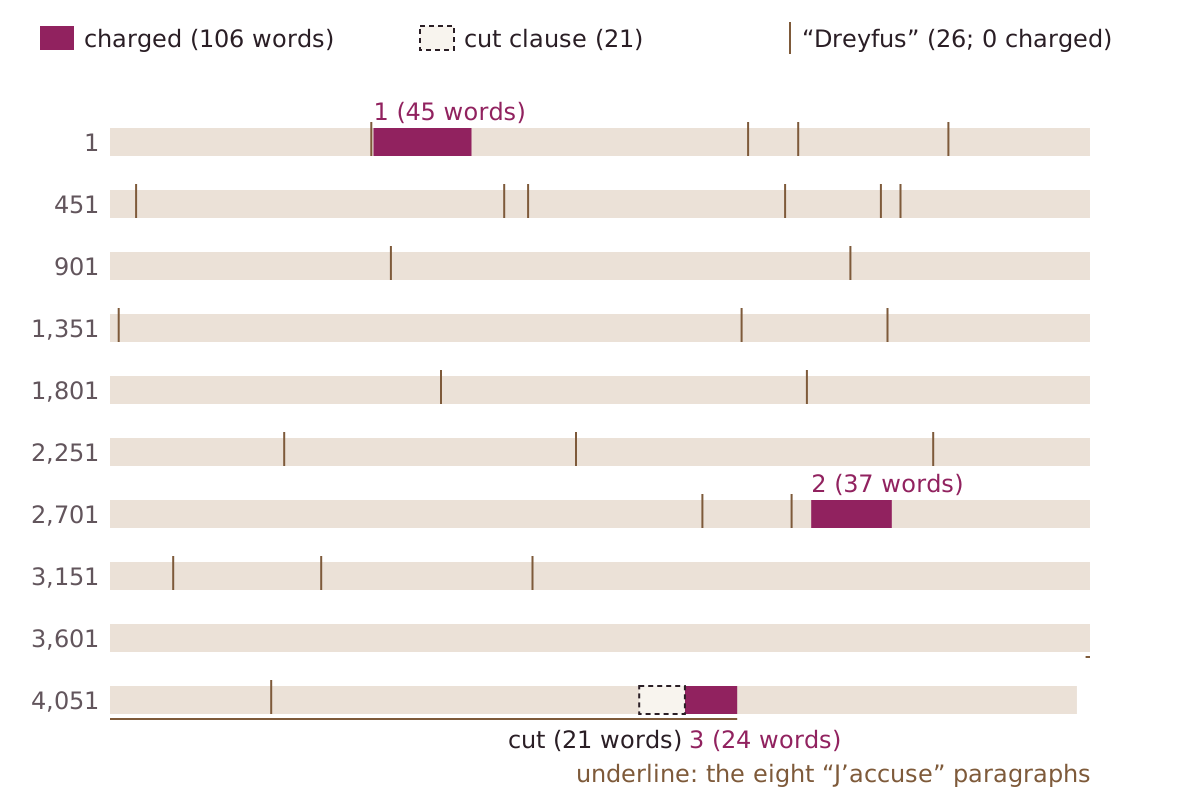
“J’accuse…!” in reading order, with the three passages named in the summons and the clause the summons left out. Letter of 13 January 1898; summons of 20 January 1898.
"J'accuse…! in reading order: the 106 words that were charged" by Persuasion Dissected — https://persuasiondissected.com/on-trial/dreyfus-affair-zola-trial/ — licensed CC BY 4.0: https://creativecommons.org/licenses/by/4.0/
Case card
- Case
- Zola’s libel trial over “J’accuse…!” (Dreyfus affair)Le procès Zola (1898), vol. I, pp. 15–16, 35–38
- Date range
- 13 January 1898 (letter) to 23 February 1898 (verdict); quashed after appeal hearings of 31 March to 2 April 1898Le procès Zola (1898), vol. II, pp. 431–433, 509
- Place
- Paris: L’Aurore; Cour d’assises de la Seine; Cour de cassationLe procès Zola (1898), vol. I, p. 30; Le procès Zola (1898), vol. II, p. 509
- Persuader(s)
- Zola (the dare); General Billot, war minister (the complaint); Avocat général Van Cassel (the prosecution)Le procès Zola (1898), vol. I, pp. 14, 35–38
- Audience
- Readers of L’Aurore, then the twelve jurors of the Seine assize courtLe procès Zola (1898), vol. I, p. 30
- The ask
- Zola: try me and hold the inquiry in public. The prosecution: judge three passages about the Esterhazy court-martial, and nothing about the 1894 verdictLe procès Zola (1898), vol. I, pp. 14–16, 35–38
- Channel
- Open letter; complaint; summons; court rulings; trialLe procès Zola (1898), vol. I, pp. 3–16, 35–38, 56–57
- Outcome
- Zola: one year in prison and a 3,000-franc fine; Perrenx, the paper’s manager: four months and 3,000 francs; verdict later quashedLe procès Zola (1898), vol. II, pp. 431–433, 509
- Primary record
- Le procès Zola… Compte-rendu sténographique « in-extenso » (Paris, 1898), 2 vols.Le procès Zola devant la Cour d’assises de la Seine et la Cour de cassation, compte-rendu sténographique (Paris: Bureaux du Siècle and P.-V. Stock, 1898), vol. I, pp. 3–22, 30, 35–38, 56–57, 84–86, 117–120, 126, 169, 197–260, 305, 378–382, 503; vol. II, pp. 127, 155–156, 411–412, 431–433, 509
On 13 January 1898, L’Aurore printed Émile Zola’s open letter to President Félix Faure, and it ended with a dare. He asked to be put before a jury, and he asked for “l’enquête,” the inquiry, to happen in daylight. The sentence asks readers to accept that a libel trial would also be an inquiry into the Dreyfus affair.
The government gave him the trial. Its complaint, its summons and a ruling on the first day kept the inquiry out. By this site’s count the summons charged 106 of the letter’s 4,494 words, and its third quotation opened with an ellipsis that removed the clause about a secret document. Over the following days, by this site’s ledger, the presiding judge met questions about that document with one sentence more than any other, “La question ne sera pas posée,” meaning the question would not be put to the witness.
What did “J’accuse…!” accuse, and whom?
Near its end, by this site’s count, the letter has eight paragraphs that begin “J’accuse.” They name ten men: Lieutenant-Colonel du Paty de Clam; Generals Mercier, Billot, de Boisdeffre, Gonse and de Pellieux; Major Ravary; and the handwriting experts Belhomme, Varinard and Couard. They also accuse the War Office bureaus of a press campaign, and they accuse two courts-martial.
The last of the eight is the one that matters here. It reads: “J’accuse enfin le premier conseil de guerre d’avoir violé le droit, en condamnant un accusé sur une pièce restée secrète, et j’accuse le second conseil de guerre d’avoir couvert cette illégalité, par ordre, en commettant à son tour le crime juridique d’acquitter sciemment un coupable.”
In English: the first court-martial broke the law by convicting a man on a document that stayed secret, and the second covered up “this illegality,” on orders, by knowingly acquitting a guilty man. The first was the 1894 court that convicted Alfred Dreyfus. The second, sitting on 10 and 11 January 1898, had acquitted Major Esterhazy on the 11th. This page reads only the 1898 trial, from the words spoken at it, the same way the site reads the trial of Socrates.
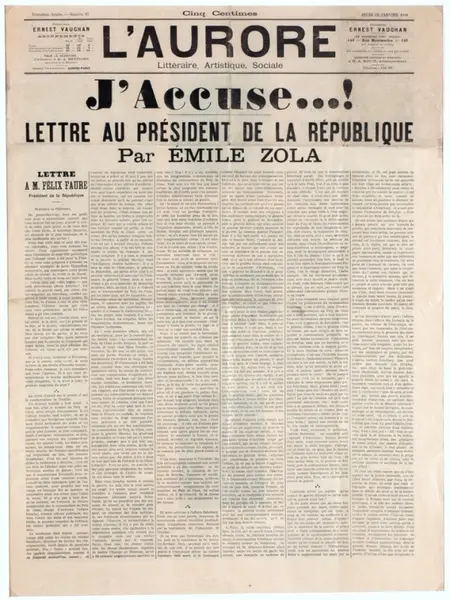
Front page of L’Aurore carrying “J’accuse…!”. 13 January 1898.
""J'accuse...!", front page of L'Aurore" by Émile Zola, L'Aurore — https://commons.wikimedia.org/wiki/File:%22J%27accuse...!%22,_page_de_couverture_du_journal_l%E2%80%99Aurore,_publiant_la_lettre_d%E2%80%99Emile_Zola_au_Pr%C3%A9sident_de_la_R%C3%A9publique,_M._F%C3%A9lix_Faure_%C3%A0_propos_de_l%E2%80%99Affaire_Dreyfus.jpg — Public domain — Public domain in the US (published 1898) and in the EU (Émile Zola died 1902, life+70; newspaper published 1898)
Zola wrote that he knew what he was inviting. “En portant ces accusations, je n’ignore pas que je me mets sous le coup des articles 30 et 31 de la loi sur la presse du 29 juillet 1881,” he wrote, naming the press law’s libel articles. “Et c’est volontairement que je m’expose.” He was exposing himself to them on purpose.
What did the government charge Zola with?
General Billot, the war minister and one of the ten men named, filed the complaint on 18 January 1898. The editor’s narrative in the trial record (vol. I, p. 14) says 20 January, but the complaint letter and the summons both give the 18th, and this site follows the documents. The letter, read aloud when the trial opened, says the article insults “deux Ministres de la guerre, les bureaux de la guerre, des officiers généraux et des officiers de tous grades.”
It then declines to sue for any of them, “non plus que pour le jugement de 1894 dont l’autorité doit rester entière.” Nor would it sue over the 1894 judgment, “whose authority must remain whole.” The complaint covered one body: the court-martial that had acquitted Esterhazy.
The summons of 20 January quoted three passages. This site’s count sets them against the whole letter.
| What the summons quoted | Where, per the summons | Words (this site’s count) | “Dreyfus” (this site’s count) |
|---|---|---|---|
| 1. “Un conseil de guerre vient, par ordre, d’oser acquitter un Esterhazy…” | page 1, column 1 | 45 | 0 |
| 2. “Ils ont rendu cette sentence inique… le second est forcément criminel.” | page 1, column 6 | 37 | 0 |
| 3. “… J’accuse le second Conseil de guerre d’avoir couvert cette illégalité par ordre…” | page 2, column 2 | 24 | 0 |
| All three passages | 106 (2.4% of the letter) | 0 | |
| The whole letter | 4,494 | 26 |
Method: this site’s count, on Wikisource’s validated transcription of the L’Aurore text, from the salutation to the closing formula, compared with the reprint in Le procès Zola, vol. I, pp. 3–14. A word is a run of letters or digits joined by apostrophes or hyphens, so “d’oser” counts once. In passage 2 the summons reads “cette” where the letter reads “une,” which does not change the count. Full text, glosses and word positions: CSV (where this data comes from).
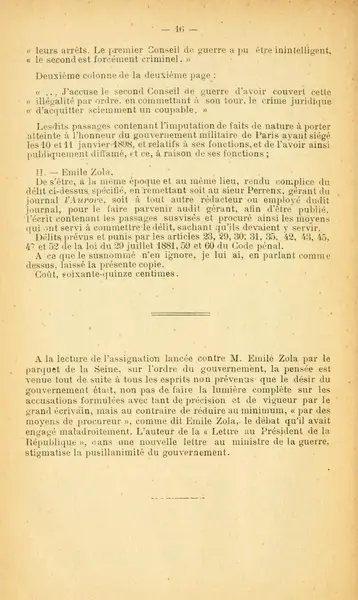
The summons as printed in the trial record, vol. I, p. 16, with the third passage opening on an ellipsis. 1898.
"L'assignation, Le procès Zola, vol. I, p. 16" by Unknown author — https://archive.org/details/leprocszoladev01zola — Public domain — Public domain in the US (published 1898) and in the EU (anonymous court record published 1898, 70 years passed)
The first quotation starts on the word after “Dreyfus.” The letter reads “que cette abominable affaire Dreyfus ! Un conseil de guerre vient…”, and the summons begins at “Un.” The third quotation starts at the second half of a sentence. The 21 words before it, the clause about the secret document, appear in no charge.
The defense made the same point in court with a rougher count. On 8 February Albert Clemenceau, one of the defense lawyers, told the jurors that the letter filled “seize pages de la brochure que voici,” sixteen pages of the pamphlet he was holding, and that the prosecution “n’en a poursuivi que quinze lignes environ,” about fifteen lines of them. Counting a document in order to answer it comes up again with the Chartist petition of 1848.
Why did a narrow charge keep the Dreyfus verdict out of court?
The 1881 press law let Zola try to prove his accusations true. Article 52 limited that proof to the facts “articulés et qualifiés dans la citation,” the facts set out in the summons. In a second letter, addressed to the war minister, Zola complained that “on vous a découvert, dans la loi du 29 juillet 1881, un article 52.” He called it a resort to “moyens de procureur,” lawyers’ tricks.
Before the trial, Zola and Perrenx served notice that they would prove the three charged facts and eight more, which they called “connexes” and “indivisibles.” The eighth was the secret document: “Le premier Conseil de guerre a violé le droit en condamnant un accusé sur une pièce restée secrète.”
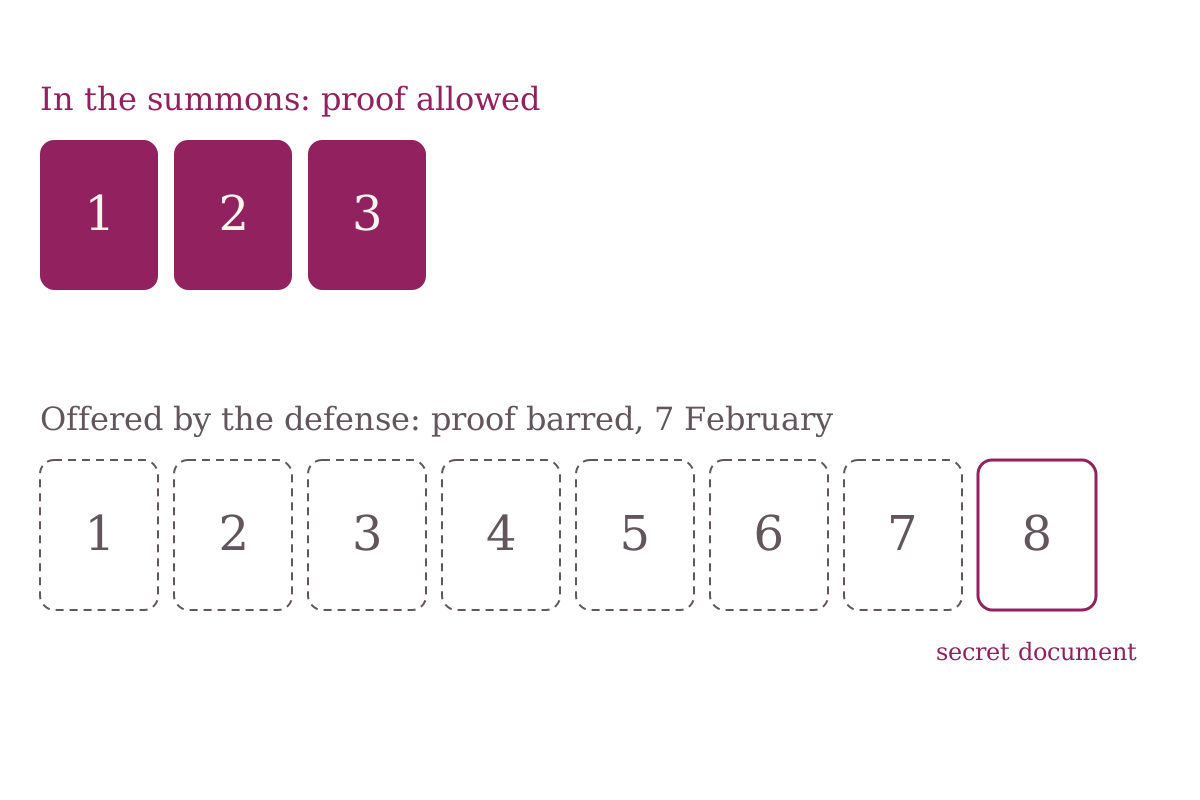
The three facts in the summons and the eight more the defense offered. Notice before the trial; ruling of 7 February 1898.
"Three facts charged, eight barred" by Persuasion Dissected — https://persuasiondissected.com/on-trial/dreyfus-affair-zola-trial/ — licensed CC BY 4.0: https://creativecommons.org/licenses/by/4.0/
On 7 February, the first day, the court ruled against them. It held that proof “est limitée aux faits qualifiés et articulés dans la citation” and that the eight facts had no link to the charged ones. It added that the request aimed “de détruire par tous les moyens l’autorité de la chose jugée.” Then it barred all eight: “dit que la preuve leur en sera interdite.” Rulings on what a jury may hear also shape the Lizzie Borden trial.
The prosecutor had already explained the narrow charge. Avocat général Van Cassel told the court that “en ne retenant qu’une prévention très nette, on avait voulu empêcher le débat de dévier.” The charge had been kept to one sharp count to stop the debate from drifting. The defense’s plan, he said, was to reopen “deux décisions judiciaires rendues dans les affaires Dreyfus et Esterhazy.”
The idea of untouchable judgments was already in the letter. “J’accuse…!” says the Esterhazy judges’ excuse was that their supreme chief had declared “la chose jugée inattaquable, sainte et supérieure aux hommes.”
Where is the last stone in this case?
The third passage still carried a word that pointed back to the missing clause: “cette illégalité,” this illegality. The jury would be asked whether accusing a court of covering up “this illegality” was libel. The court had already ruled that the illegality itself could not be proved.
Zola raised it himself on 8 February. He asked why the word was in the summons at all if the court would not consider it: “Il est entendu alors qu’on ne tient pas compte du mot « illégalité ». Vous n’en tenez pas compte. Mais pourquoi l’a-t-on mis... ?”
Zola’s lead counsel, Fernand Labori, pressed the point. When he read the cut clause aloud to show what “cette illégalité” meant, the judge said the question would not be put and that Labori was struggling in vain: “La question ne sera pas posée, vous vous débattez inutilement.”
This site uses the last stone for a premise that no speaker states and the audience supplies for itself. Here it is the premise that “this illegality” could be weighed without the illegality itself being proved. Neither the complaint, the summons nor the prosecutor said so.
The record shows only that the jury answered the question put to it, after the court had barred proof of the clause that defined the word. So the stone is marked provisional. Its evidence comes from one source, the trial record, at three points: where the summons stops (vol. I, p. 16), the refused reading of the cut clause (vol. I, p. 119) and the jury’s answer (vol. II, pp. 432–433). How much one word can carry is also the question in the text of the Yalta Conference.
How did Zola answer the narrow charge?
He answered before the trial began, in his second letter to the war minister, which quotes his uncharged accusations one by one and follows each with nearly the same clause. Of du Paty de Clam, he wrote, “je puis le dire, et on n’ose pas, pour l’avoir écrit, me poursuivre.” To the minister himself: “Et vous n’osez pas, vous, Ministre de la guerre, pour l’avoir écrit, me poursuivre.” By this site’s count the refrain runs seven times.
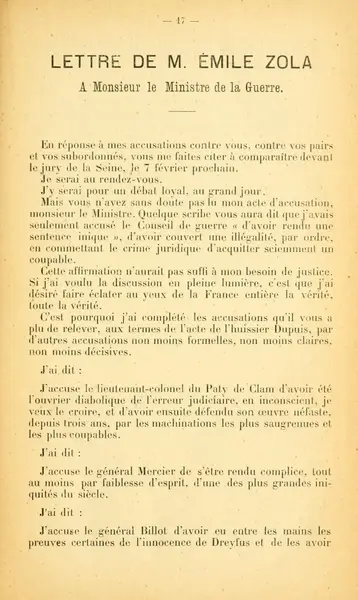
Zola’s letter to the war minister as printed in the trial record, vol. I, p. 17. 1898.
"Lettre de M. Émile Zola à Monsieur le Ministre de la Guerre, Le procès Zola, vol. I, p. 17" by Émile Zola. Public domain.
Full credit
"Lettre de M. Émile Zola à Monsieur le Ministre de la Guerre, Le procès Zola, vol. I, p. 17" by Émile Zola — https://archive.org/details/leprocszoladev01zola — Public domain — Public domain in the US (published 1898) and in the EU (Émile Zola died 1902, life+70)
The handwriting experts were the one variation. For them, Zola wrote, “on m’assigne en police correctionnelle”: he was being summoned before the lower correctional court instead. There, Labori told the assize court on 7 February, “la preuve n’est pas permise,” proof is not allowed. Then Zola closed the list by saying that he stood by every word: “J’ai dit ces choses, et je les maintiens.”
On this site’s reading, the refrain asks its readers to treat each missing charge as a quiet concession, since the state had left it uncharged. Zola also told the minister whom he had expected to face in court: du Paty de Clam, Mercier, de Boisdeffre, Gonse, de Pellieux and Ravary, “avec les trois experts en écritures.” He put his remaining hope in the jury: “Vous avez oublié que je vais avoir pour juges douze citoyens français, dans leur indépendance.”
His legal argument fit in one sentence. “Cette preuve, la loi m’ordonne de la faire, et la loi serait menteuse si, m’imposant ce devoir, elle m’en refusait le moyen.” The law ordered him to prove his charge, he wrote, and it would be lying if it denied him the means.
How often did the judge say “La question ne sera pas posée”?
This site’s count of the judge’s refusal formulas in both volumes of the trial record gives 34 refusals between 8 and 18 February, 15 of them containing the words “La question ne sera pas posée.” A text search of the scanned volumes misses words and the judge varied his wording, so 34 is a floor. Rulings that only told a witness not to answer are not counted.
Twelve concerned the secret document, nine of them asking whether one had reached the 1894 judges or whether the witness had heard of it; one more was refused in part, and four touched it indirectly. The ledger, with page numbers, is in the CSV (where this data comes from).
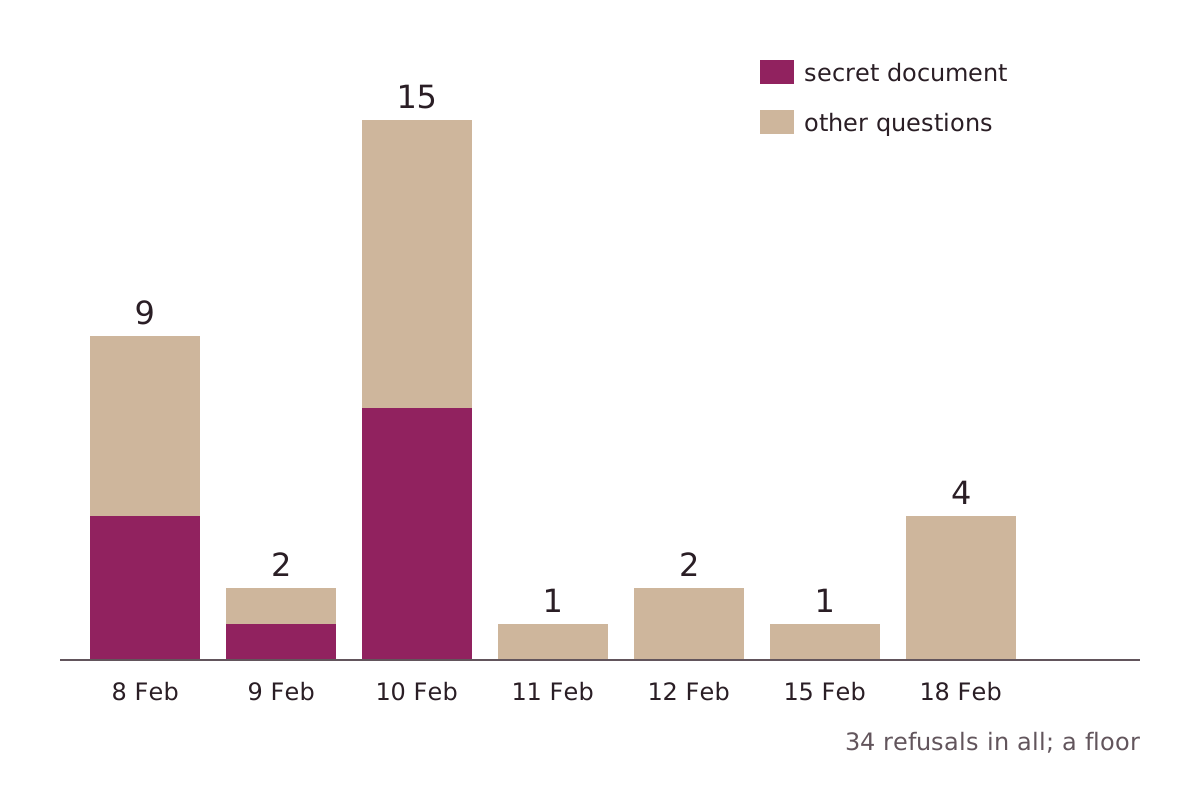
Refusals by hearing day in this site’s ledger, a floor rather than a total. 8 to 18 February 1898.
"Refusals by hearing day" by Persuasion Dissected — https://persuasiondissected.com/on-trial/dreyfus-affair-zola-trial/ — licensed CC BY 4.0: https://creativecommons.org/licenses/by/4.0/
The densest run came on 10 February. With Vallecalle, recorded as clerk of the court-martial, on the stand, Labori asked the judge to put one question: whether a secret document had been produced to the 1894 court “sans avoir été communiquée à la défense.” The judge replied: “La question ne sera pas posée.”
Labori put the same question for Colonel Maurel, whom he described as the president of the 1894 court, and for Colonel Echemann and Major Patron, whom he described as two of its judges. Each time the record shows the same sentence. Two more members, Gallet and Roche, “ne répondent pas,” and the defense gave up on them.
Later that day the question was refused again for Dupuy, recorded as a former prime minister, and for Guérin, a former minister of justice. Two days earlier, Casimir-Perier, a former president of the Republic, had paused before his oath to say that his duty was not to tell the whole truth: “Je ne puis dire toute la vérité, mon devoir est de ne pas la dire.”
On 9 February the bench framed the trial in one exchange. Labori began, “L’affaire Zola ne se rattache…” The judge cut in: “Il n’y a pas d’affaire Zola.” After the noise and laughter noted in the record, and a word from Labori to the jurors, the judge added: “Il y a l’affaire Dreyfus et l’affaire Esterhazy.”
Why did the defense keep asking questions it knew would be refused?
Labori gave his reason on 8 February, right after “vous vous débattez inutilement.” He replied: “Inutilement, non; peut-être inutilement, pour obtenir un arrêt favorable, mais pas au point de vue de ma cause, car le monde nous juge, et MM. les jurés aussi suivent ces débats avec intérêt.” Perhaps in vain for a ruling, he said, but not for his cause, because the world was judging, and the jurors were following.
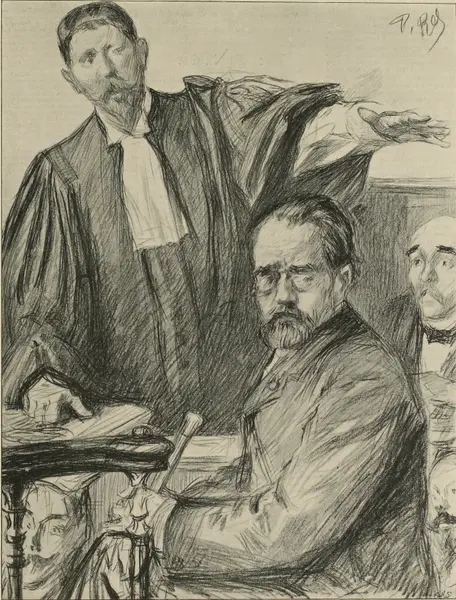
Labori addressing the court beside Zola, in a sketch by Paul Renouard from the front page of The Graphic, 12 February 1898.
"The Dreyfus Affair: The Trial of M. Zola in the Assize Court, Paris" by Paul Renouard. Public domain.
Full credit
"The Dreyfus Affair: The Trial of M. Zola in the Assize Court, Paris" by Paul Renouard — https://commons.wikimedia.org/wiki/File:The_Dreyfus_affair_the_trial_of_M._Zola_in_the_assize_court,_Paris._Paris_Mus%C3%A9es_20230515145657.jpg — Public domain — Public domain in the US (published 1898) and in the EU (Paul Renouard died 1924, life+70; engraver anonymous, published 1898, 70 years passed); modified: cropped to the drawing, removing the masthead, date line and printed captions
On 10 February he made the method explicit. After the judge refused a question to Major Besson d’Ormescheville, he said he had “un certain nombre de questions à poser, qui ne seront pas posées,” and would list them anyway. When the judge objected that “c’est toujours la même chose,” Labori answered that he would hear the witnesses one by one: “pour chacun d’eux, nous demanderons acte de votre refus de poser nos questions !” Each question was still spoken in open court, and each refusal went into the record.
Did any witness answer anyway?
A ruling on questions did not stop every answer. On 12 February Albert Clemenceau noted that earlier exchanges that day, one with Colonel Henry, had already touched the Dreyfus case and “la pièce secrète.” He then asked whether Demange, who told the court he had defended Dreyfus, based his certainty that the 1894 judgment was unlawful on what a court-martial judge had told another lawyer, Salles.
Demange answered before the judge could rule, with a cry of “Mais oui, parbleu !”, roughly “why yes, of course.” The record adds “(Mouvements divers.)” The judge told Demange he did not have the floor and refused the question. Earlier in the same testimony, Demange had said he learned “par M. Salles, qu’il y avait eu une violation de la loi.”
On 18 February Albert Clemenceau tried to ask about Esterhazy and Colonel de Schwarzkoppen, and the judge refused before the question was finished: “Non, je ne la poserai pas.” When Clemenceau protested that the judge did not even know the question (“Mais vous ne la connaissez pas !”), the judge replied that he did, because Clemenceau had just said it: “Si, vous venez de la dire.”
Georges Clemenceau, pleading on the last day, told the jurors he had heard “toutes les fois que la vraie question se posait, ce mot tragique : « La question ne sera pas posée ».” In English: every time the real question came up, he heard that tragic phrase.
What did the jury decide, and why didn’t the verdict stand?
On 23 February the jury received two written questions. The first asked whether Perrenx, the paper’s manager, had defamed the court-martial by publishing the three passages, which were quoted again. The third still began at “J’accuse le deuxième Conseil de guerre.” The second asked whether Zola had knowingly supplied the text.
The jury deliberated for thirty-five minutes and answered “Oui, à la majorité” to both. Zola was sentenced to one year in prison and a 3,000-franc fine; Perrenx to four months and the same fine. When cheers rose at the back of the room, the record has Zola calling out, “Ce sont des cannibales !”
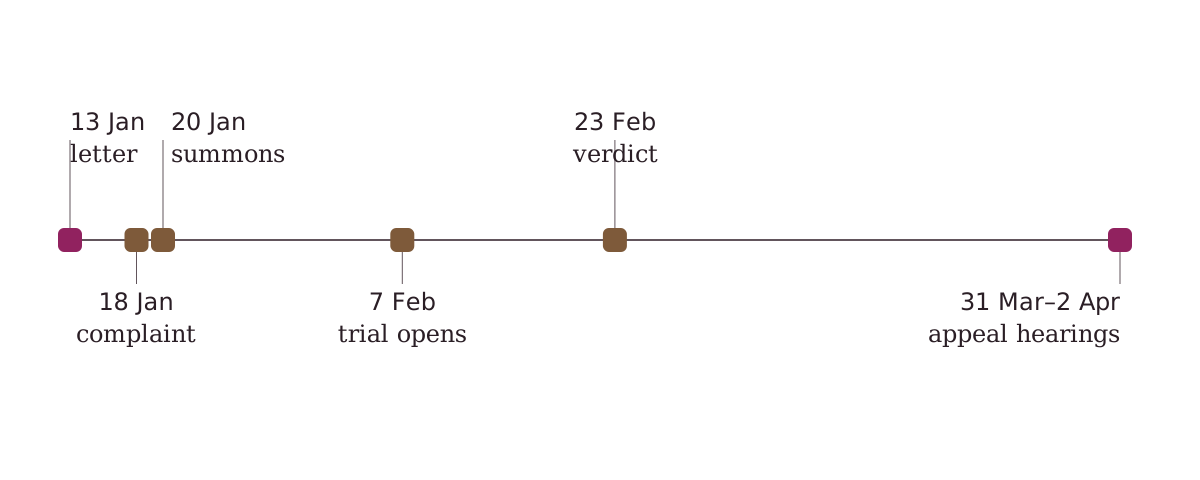
From the letter to the appeal hearings. 13 January to 2 April 1898.
"From the letter to the appeal hearings" by Persuasion Dissected — https://persuasiondissected.com/on-trial/dreyfus-affair-zola-trial/ — licensed CC BY 4.0: https://creativecommons.org/licenses/by/4.0/
The verdict did not stand. The criminal chamber of the Cour de cassation held that a court-martial counts among the “Cours et Tribunaux” that, under the press law, may prosecute only after their own deliberation. “Le Ministre de la guerre n’a pu se substituer au premier Conseil de guerre,” it ruled, meaning the Paris court-martial that had tried Esterhazy, in whose name the minister had complained. It quashed the verdict and the procedure.
The minister’s complaint had set the narrow limits of the trial, and the same complaint was the defect that voided it. The case was not over. By Ernest Vizetelly’s 1899 account, judgment went against Zola by default at Versailles on 18 July 1898, and he left Paris for England that night.
J’accuse as printed vs. J’accuse as charged
| In L’Aurore, 13 January 1898 | In the summons, 20 January 1898 |
|---|---|
| Ten named men, the War Office bureaus and two courts-martial | One court-martial: the one that acquitted Esterhazy |
| 4,494 words, by this site’s count | 106 words, by this site’s count |
| “Dreyfus” 26 times, by this site’s count | “Dreyfus” 0 times |
| The secret-document sentence in full | The same sentence from its second half, opened with “…” |
| “Qu’on ose donc me traduire en cour d’assises” | A summons to the Cour d’assises for 7 February 1898 |
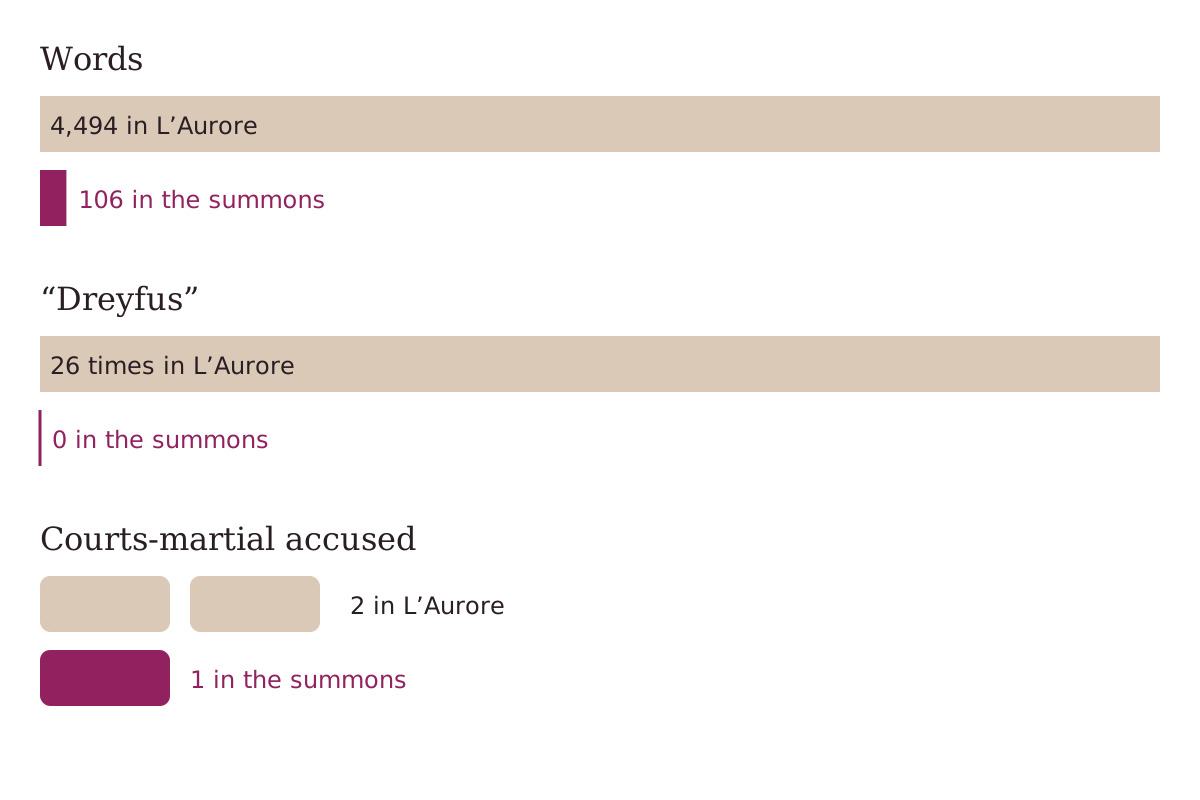
The letter as printed and the letter as charged, on this site’s count. January 1898.
"The letter as printed and as charged" by Persuasion Dissected — https://persuasiondissected.com/on-trial/dreyfus-affair-zola-trial/ — licensed CC BY 4.0: https://creativecommons.org/licenses/by/4.0/
Crossing map
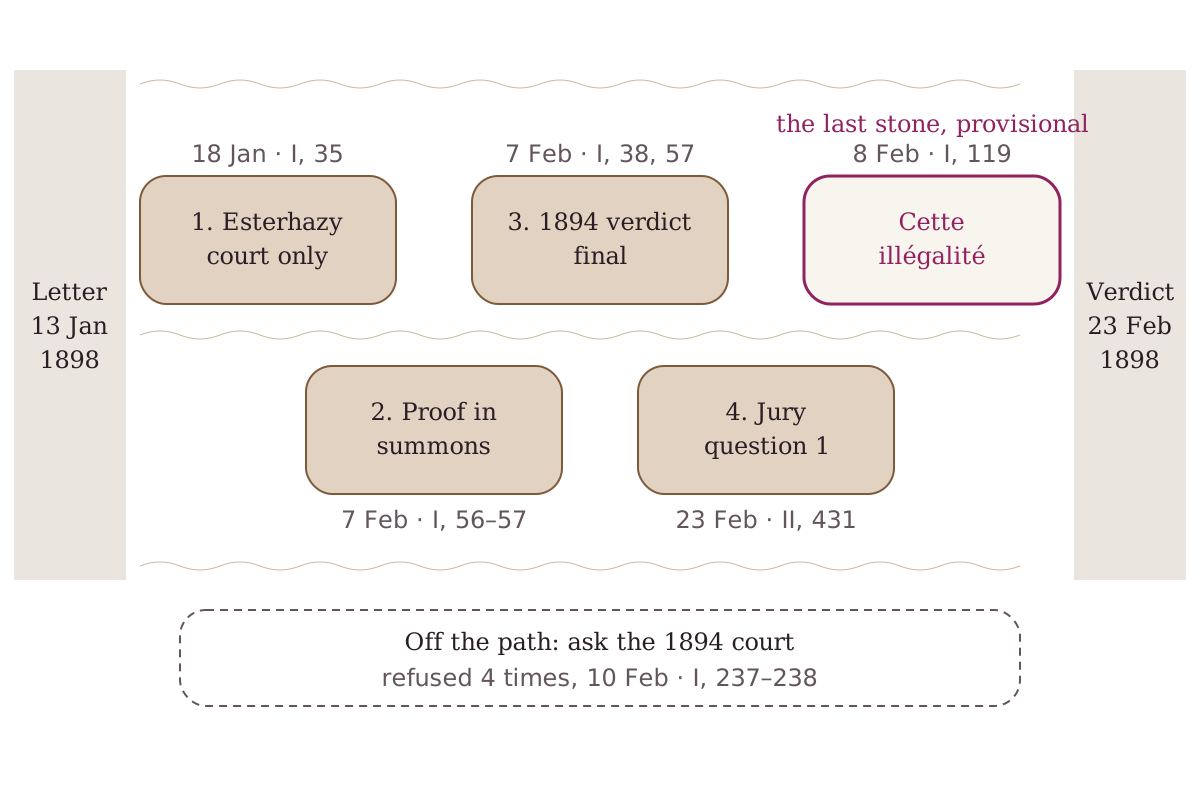
Crossing map of the prosecution’s case. The dashed stone off the path is the question to the 1894 court’s clerk and judges, refused four times on 10 February. 18 January to 23 February 1898.
"Crossing map: from J’accuse…! to Oui, à la majorité" by Persuasion Dissected — https://persuasiondissected.com/on-trial/dreyfus-affair-zola-trial/ — licensed CC BY 4.0: https://creativecommons.org/licenses/by/4.0/
- Esterhazy court only. The war minister’s complaint of 18 January treats only the court-martial that acquitted Esterhazy as defamed (vol. I, p. 35) [2]
- Proof in summons. The ruling of 7 February limits proof to the facts in the summons (vol. I, pp. 56–57) [2]
- 1894 verdict final. The prosecutor and the ruling treat the 1894 judgment as chose jugée, a matter already decided (vol. I, pp. 38, 57) [2]
- Jury question 1. The first of two written questions asks the jury about the three passages; the second asks whether Zola knowingly supplied the text (vol. II, pp. 431–432) [3]
- The last stone: cette illégalité. Provisional. Nobody stated that the jury could weigh “this illegality” without the illegality itself being proved. The evidence, all from the trial record, is where the summons stops, and Labori’s reading of the cut clause, refused by the judge (vol. I, p. 119) [2]
Sources
- Émile Zola, “J’accuse…!” (Lettre à M. Félix Faure, Président de la République), L’Aurore, 13 January 1898. Transcription marked as validated on French Wikisource; used for the word counts. fr.wikisource.orgRead: full text of the letter
- Le procès Zola devant la Cour d'assises de la Seine et la Cour de cassation (7 février–23 février, 31 mars–2 avril 1898). Compte-rendu sténographique « in-extenso » et documents annexes, vol. I (Paris: Bureaux du « Siècle » / P.-V. Stock, 1898). Cited pages: 3–14 (the letter as reprinted); 15–22 (summons, Zola's letter to the war minister, defense notice); 30 (court and jury); 35–38 (complaint, summons, prosecutor); 56–57 (ruling of 7 February); 84–86, 117–120 (8 February); 126, 169 (9 February); 197–260 (10 February); 305 (11 February); 378–382 (12 February); 503 (15 February). archive.orgRead: pages cited
- Le procès Zola, vol. II (Paris, 1898). Cited pages: 127, 155–156 (18 February); 411–412 (Georges Clemenceau's plea); 431–433 (questions to the jury, verdict, sentence); 509 (Cour de cassation ruling). archive.orgRead: pages cited
- Ernest Alfred Vizetelly, With Zola in England (London: Chatto & Windus, 1899), pp. 8–9, 13. archive.orgRead: pages 8–9 and 13
Translations from the French are ours.
Next crossing
- The trial of Socrates — Another trial read line by line from the words spoken at it.
- The Yalta Conference — A negotiation where the fight is over what one word in the text commits anyone to do.
Cite this page
Persuasion Dissected. "Dreyfus Affair: Zola’s Court Barred Secret-Document Proof." Persuasion Dissected. Published 2026-11-11. https://persuasiondissected.com/on-trial/dreyfus-affair-zola-trial/. Accessed: add the date you read it.
Corrections
No corrections yet.
How pieces are checked · All corrections · Contact · Report an error (contact@persuasiondissected.com)