Yalta Conference: Poland’s Government, to Be ‘Reorganised’
In three lines
- Who persuaded whom: At the Yalta Conference in February 1945, Molotov, Stettinius and Eden moved one another to a single text on Poland’s government. Eden read it to Stalin, Roosevelt and Churchill on 10 February, and the communiqué they signed carries it.
- Which stones: The text says the government in Poland should be “reorganised on a broader democratic basis,” then calls the result “This new Government.” It names no one to rule on when that government is “properly formed.”
- Outcome: By 22 March 1945 Molotov was calling any other reading a violation, in Harriman’s paraphrase, and on 7 April Stalin wrote of “a dead end.” The United States recognized the new government on 5 July 1945.
Route through this piece (9)
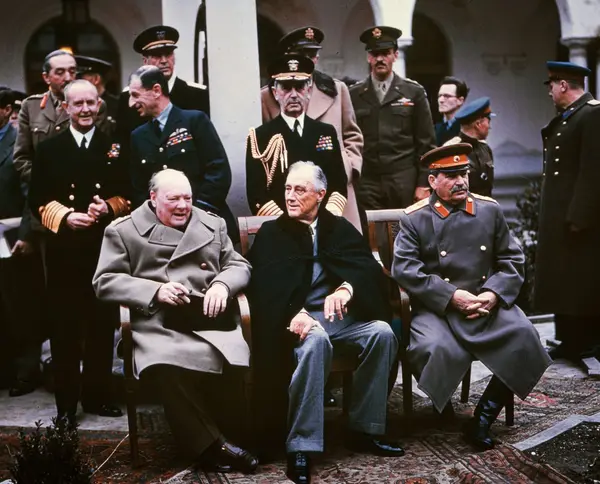
Churchill, Roosevelt and Stalin at the Yalta Conference, with officers standing behind them. February 1945.
"Yalta summit 1945 with Churchill, Roosevelt, Stalin (USA C-543)" by Unknown author. Public domain.
Full credit
"Yalta summit 1945 with Churchill, Roosevelt, Stalin (USA C-543)" by Unknown author — https://commons.wikimedia.org/wiki/File:Yalta_summit_1945_with_Churchill,_Roosevelt,_Stalin.jpg — Public domain — Public domain in the US (work of the US Army Signal Corps, 1945) and in the EU (photographer not named; a like scene is plate 7 of the US government volume published 1955, 70 years passed); modified: resized to 1600 px wide; the 3:2 card frame crops the top and bottom edges
On 11 February 1945, three foreign secretaries at the Yalta Conference signed “reorganised” into the text on Poland. This site reads that word as asking its readers to accept one event, a government that goes on existing while it changes. The next sentence calls the result “This new Government,” and the text does not say who decides whether the result counts.
The conference met from 4 to 11 February, and its protocol also covers the world organization, Germany, reparation and Yugoslavia, while this page reads only the sentences on Poland’s government. The record here is mostly American: Foreign Relations of the United States, or FRUS, whose 1955 volume prints the drafts and the minutes. Those minutes are notetakers’ accounts rather than transcripts. Soviet and British files were not read, so Molotov and Stalin reach this page through American notes and printed translations.
What does the Yalta text on Poland say?
The Declaration on Poland opens with its reason: “A new situation has been created in Poland as a result of her complete liberation by the Red Army.” Then comes the government. “The Provisional Government which is now functioning in Poland should therefore be reorganised on a broader democratic basis with the inclusion of democratic leaders from Poland itself and from Poles abroad,” it says. “This new Government should then be called the Polish Provisional Government of National Unity” (p. 980).
The body “now functioning” was the one the Soviet Union already dealt with, called the Lublin or Warsaw government in the minutes. The United States and Britain still recognized a Polish government in London. On this site’s reading, the two sentences pull in different directions: a government that is reorganised already exists, and a new one does not.
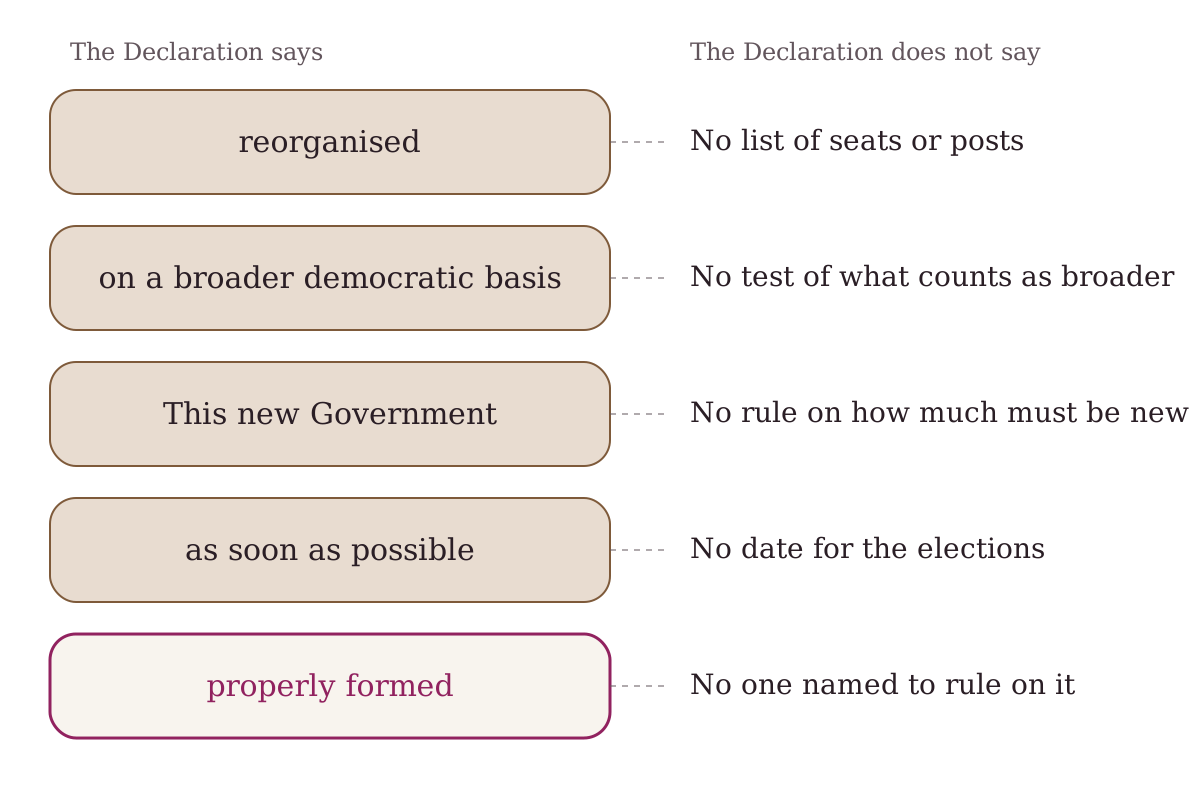
Five phrases from the Declaration on Poland and what the text leaves unstated, on this site’s reading. 11 February 1945.
"Five phrases of the Declaration on Poland" by Persuasion Dissected — https://persuasiondissected.com/bargaining/yalta-conference/ — licensed CC BY 4.0: https://creativecommons.org/licenses/by/4.0/
The rest is procedure. Molotov, Harriman and Clark Kerr are “authorised as a commission to consult in the first instance in Moscow,” and the new government is pledged to “free and unfettered elections as soon as possible.” Then the condition: “When a Polish Provisional Government of National Unity has been properly formed in conformity with the above,” the three governments will have diplomatic relations with it.
The spelling varies too. The protocol prints “reorganised,” and the communiqué of the same day prints “reorganized” (pp. 980, 973). The communiqué also speaks of a government formed “in such a manner as to command recognition by the three major powers.” The weight one word can carry is also the problem in the Zola libel trial, where a summons kept “cette illégalité” (this illegality, in this site’s translation) and cut the clause that defined it.
What did each side want before and at Yalta?
The quarrel over recognition was already open before anyone reached the Crimea. In late December 1944 Stalin told Roosevelt that if the Lublin committee made itself a provisional government, the Soviet Government “will not have any serious ground for postponement of the question of its recognition” (p. 222). Roosevelt replied on 30 December that he saw “no prospect of this Government’s following suit” (p. 224).
An American briefing paper set the aim for the meeting as “a truly democratic government of their own choice,” and it warned against any interim regime that might “crystallize into a permanent government” (p. 230).
The Polish question then reached the third plenary meeting on 6 February. Roosevelt asked for “a representative government which could have the support of all the great powers.” Churchill wanted Poland to be “mistress in her own house and captain of her soul.” Stalin, in Bohlen’s minutes, said of Poland: “It is not only a question of honor for Russia, but one of life and death” (pp. 667–669).
The next day Molotov read a paper with a modest verb: “to add to the Provisional Polish Government some democratic leaders from Polish émigré circles.” The result would be “the enlarged Provisional Polish Government.” Roosevelt objected to one word, “émigré,” and Churchill offered “Poles temporarily abroad.” Stalin agreed to add “and from inside Poland” (pp. 716–717). They were already bargaining at the level of single words.
On 8 February the American paper proposed something larger. Named Poles would come to Moscow “to form a Polish Government of National Unity,” under a three-man Presidential Committee (pp. 792–793). A British paper asked for “a fully representative provisional Polish Government” (p. 870).
Molotov answered, in Bohlen’s minutes, that it was “impossible to ignore the existence of the present Polish government” (p. 776). Stalin’s position appears in two sets of notes. Matthews has him say, “It is better to reconstruct than to create a new government” (p. 790), and Bohlen gives the same point as “the reconstruction of the Provisional Government” (pp. 780–781). The matter went to the foreign ministers.
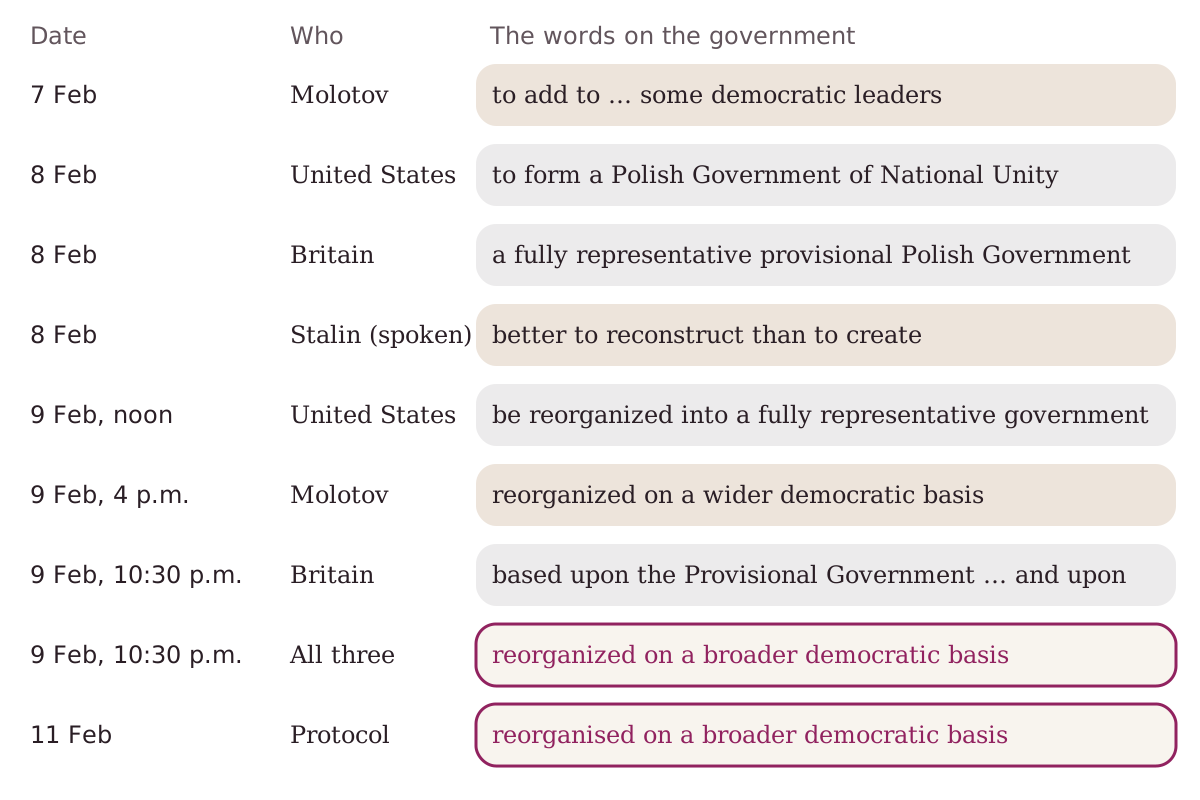
The words on the government, draft by draft, as printed in FRUS. Stalin’s line is a spoken remark in Matthews’ minutes. 7 to 11 February 1945.
"The words on the government, draft by draft" by Persuasion Dissected — https://persuasiondissected.com/bargaining/yalta-conference/ — licensed CC BY 4.0: https://creativecommons.org/licenses/by/4.0/
How did “reorganized” get into the draft?
At noon on 9 February, Stettinius read a new American paper to the foreign ministers. “Mr. Molotov spoke of the reorganization of the Polish Government,” it says, before offering its formula: “That the present Polish Provisional Government be reorganized into a fully representative government” (pp. 803–804, 815–816). FRUS could not settle who wrote it. One copy credits Matthews, who wrote in 1954 that he thought Bohlen was the author.
The American paper had written down a noun it credited to Molotov, and the discussion that followed shows what each side took from it. Molotov insisted that the new government be formed “on the basis of the Lublin Government.” Stettinius said that unless the ministers could “get away from the words ‘existing Polish Government’,” no agreement could be reached (pp. 806–807). Harriman tried “based on the old and also on other democratic elements,” and the minutes call Molotov’s reaction negative.
At 4 p.m. Molotov brought an amendment to the plenary: “The present Provisional Government of Poland should be reorganized on a wider democratic basis” (p. 842). The words “fully representative” were gone from his sentence.
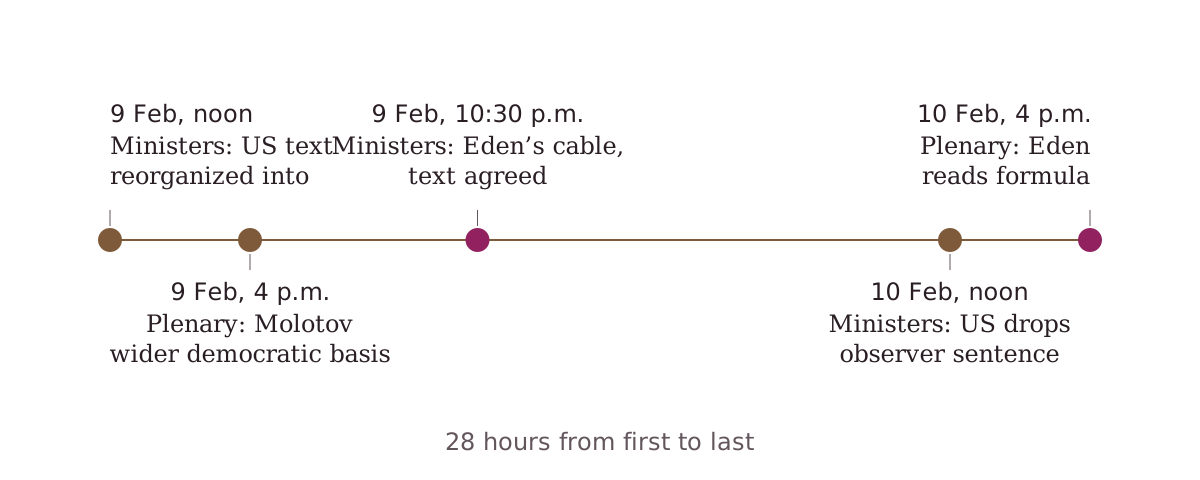
Five sittings on the Polish formula, 28 hours from the first to the last by this site’s count. 9 and 10 February 1945.
"Five sittings on the Polish formula" by Persuasion Dissected — https://persuasiondissected.com/bargaining/yalta-conference/ — licensed CC BY 4.0: https://creativecommons.org/licenses/by/4.0/
Late that night, at 10:30, Eden reported a strong cable from the War Cabinet and handed over a revised British formula. Its verb was different: the government “should be based upon the Provisional Government now functioning in Poland and upon other democratic Polish leaders.” Its next line read, “This new Government should be called the Polish Provisional Government of National Unity” (pp. 867, 870).
The text agreed that night kept Molotov’s verb with a different adjective, “reorganized on a broader democratic basis,” and it kept Eden’s “This new government” (p. 867). In the drafts read for this page, neither word replaces the other. Both stay.
Which words did the drafts drop?
This site compared five full texts dated 9 to 11 February, phrase by phrase. The result is below, with the key wording of each draft and remark in the draft-by-draft CSV (where this data comes from) and the grid in the phrase CSV (where this data comes from).
| Phrase in the text | US text, 9 Feb noon | Eden, 9 Feb night | Agreed, 9 Feb night | Eden read, 10 Feb | Protocol, 11 Feb |
|---|---|---|---|---|---|
| be reorganized / reorganised (main verb) | yes | no | yes | yes | yes |
| fully representative | yes | yes | no | no | no |
| This new Government | no | yes | yes | yes | yes |
| satisfactorily formed | yes | no | no | no | no |
| which the three Governments can regard as | no | yes | no | no | no |
| properly formed | no | no | yes | yes | yes |
| ambassadors observing and reporting | yes | yes | no | no | no |
| exchange Ambassadors by whose reports | no | no | no | yes | yes |
| as soon as possible | no | no | no | yes | yes |
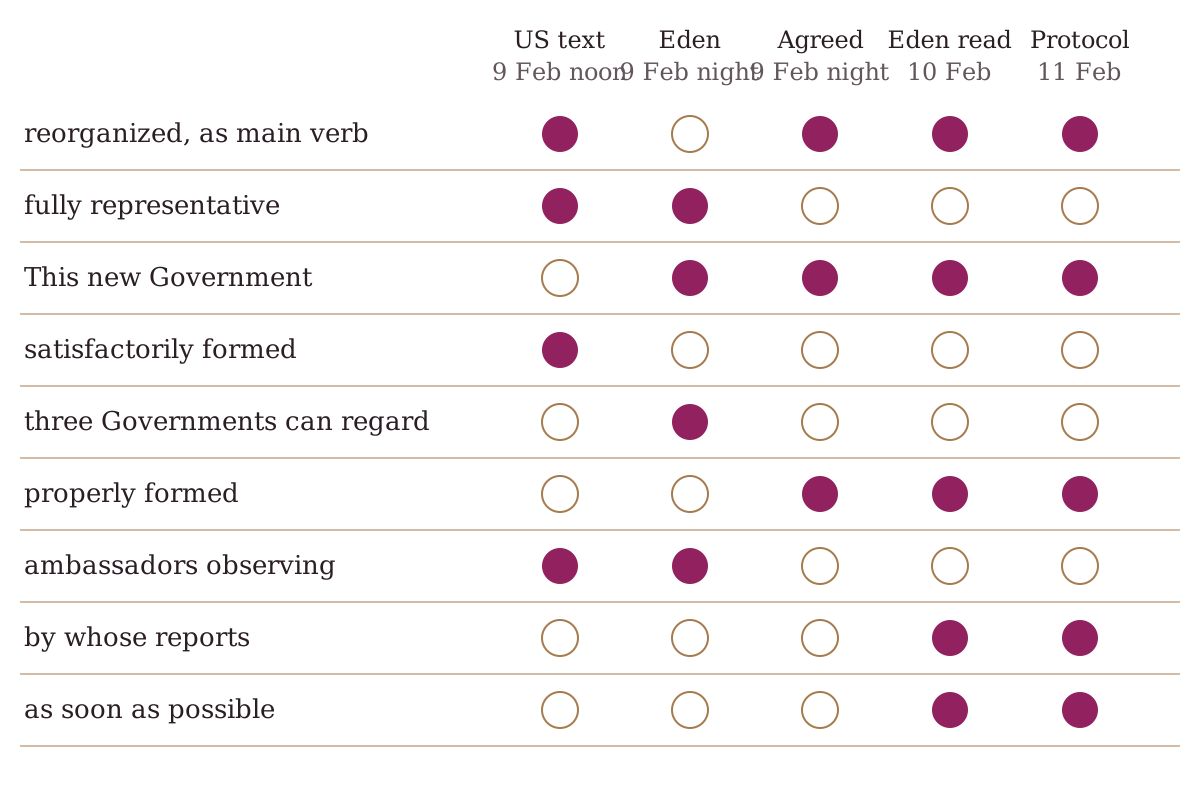
Nine phrases in five texts, on this site’s comparison of the printed wording. 9 to 11 February 1945.
"Nine phrases in five texts" by Persuasion Dissected — https://persuasiondissected.com/bargaining/yalta-conference/ — licensed CC BY 4.0: https://creativecommons.org/licenses/by/4.0/
The test for recognition changed most. The American paper said “satisfactorily formed,” and Eden’s said a government “which the three Governments can regard as fully representative of the Polish people,” a version that names the judges. The agreed text has “properly formed in conformity with the above,” which names none (pp. 816, 871, 867).
The observers went next. Both Western texts had ambassadors in Warsaw “observing and reporting” on the elections, and Molotov replied that this would offend the Poles and that ambassadors report anyway (pp. 842–843). Stettinius’s softer variant met “the same objections” (p. 868).
On 10 February at noon, Stettinius offered to withdraw the sentence, on the understanding that Roosevelt stayed free to make any statement he felt necessary about what his ambassador told him. “The President, however, was so anxious to reach agreement that he was willing to make this concession,” the minutes say. Eden made clear that he had not agreed to drop it (p. 872).
Molotov then proposed “as soon as possible” in place of “as soon as practicable,” and Stettinius refused the new recognition clause he also proposed (p. 872). Stalin had said on 8 February that elections “might be possible in a month,” barring trouble at the front (p. 781). The text sets no date. What survived of the observers is a subordinate phrase: Ambassadors “by whose reports the respective Governments will be kept informed about the situation in Poland” (p. 898).
What did the negotiators say about the wording?
The minutes of 9 February show Roosevelt and Molotov speaking of it lightly while it was changing. After the 4 p.m. recess on 9 February, Roosevelt said “it was only a matter of drafting,” and he later repeated that “it was only a matter of words and details” (p. 846). At noon Molotov had taken a similar line in Page’s minutes: “In the last analysis the question of a formula was not important” (p. 806), and he added that the fundamental issues mattered more.
There was a record of what a failure would cost. On 8 February Churchill said that parting while recognizing different Polish governments would be “stamping this conference with a seal of failure” (p. 778). On 9 February he said he “definitely did not want to leave this conference without an agreement.” He also warned against haste, saying “it was a great mistake to take hurried decisions” (p. 843). On 10 February Roosevelt said he “would have to leave Yalta tomorrow at three o’clock” (p. 906).
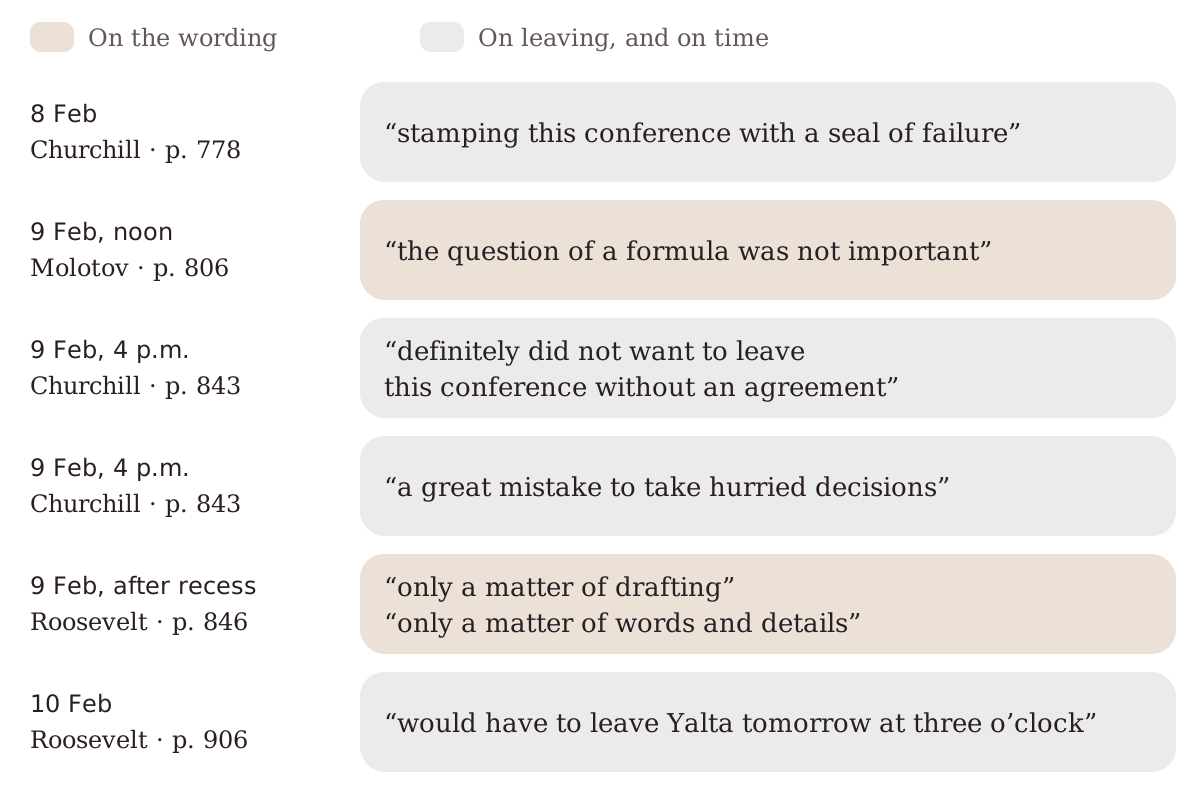
Six remarks from the minutes, sorted by this site into remarks on the wording and on leaving. 8 to 10 February 1945.
"Six remarks on the wording and on leaving" by Persuasion Dissected — https://persuasiondissected.com/bargaining/yalta-conference/ — licensed CC BY 4.0: https://creativecommons.org/licenses/by/4.0/
This site’s label for such a barrier to leaving is the exit cost, and its working hypothesis is that deadlines and exit costs often explain more about a negotiation than opening tactics do. The Yalta record bears on only part of it. Churchill’s statement and Roosevelt’s departure time are in the minutes, but the minutes read here do not say that the clock chose the wording, and they give no way to weigh it against opening tactics.
A very different kind of record survives from the Congress of Vienna, where one man’s reports carry most of the account. A signed paper carried home from a conference is also the subject of the Munich Agreement.
How did each government read the word after Yalta?
The readings came apart fast. On 27 February Churchill told the Commons the procedure was “set forth in unmistakable terms,” that the agreement provides for “a new Polish Provisional Government of National Unity,” and that Britain would keep recognizing the London government until “His Majesty’s Government consider that a new Provisional Government has been properly formed.” Lord Dunglass interrupted him to say, “So much depends upon the interpretation of the words” (HC Deb 27 February 1945, cc. 1280–1281).
In Moscow the commission met over the same text. On 6 March Harriman reported that “Every argument Clark Kerr and I advanced was brushed aside,” and that Molotov called the communiqué the “anchor” for its work, with no other Yalta conversations bearing on it (doc. 506). In Molotov’s account, as Harriman reported it, a text Roosevelt had called a matter of drafting was now the only authority.
On 22 March a Soviet aide-mémoire, 39 days after the protocol by this site’s count from 11 February, stated its reading in Harriman’s paraphrase: “a new reorganized Polish government” was to “be formed on the basis of the present provisional government existing in Poland.” It continued: “Any other interpretation of the decisions of the Crimea Conference would be a violation of these decisions” (FRUS 1945, vol. V, p. 176). The paraphrase uses both words at once and settles the question in favor of one.
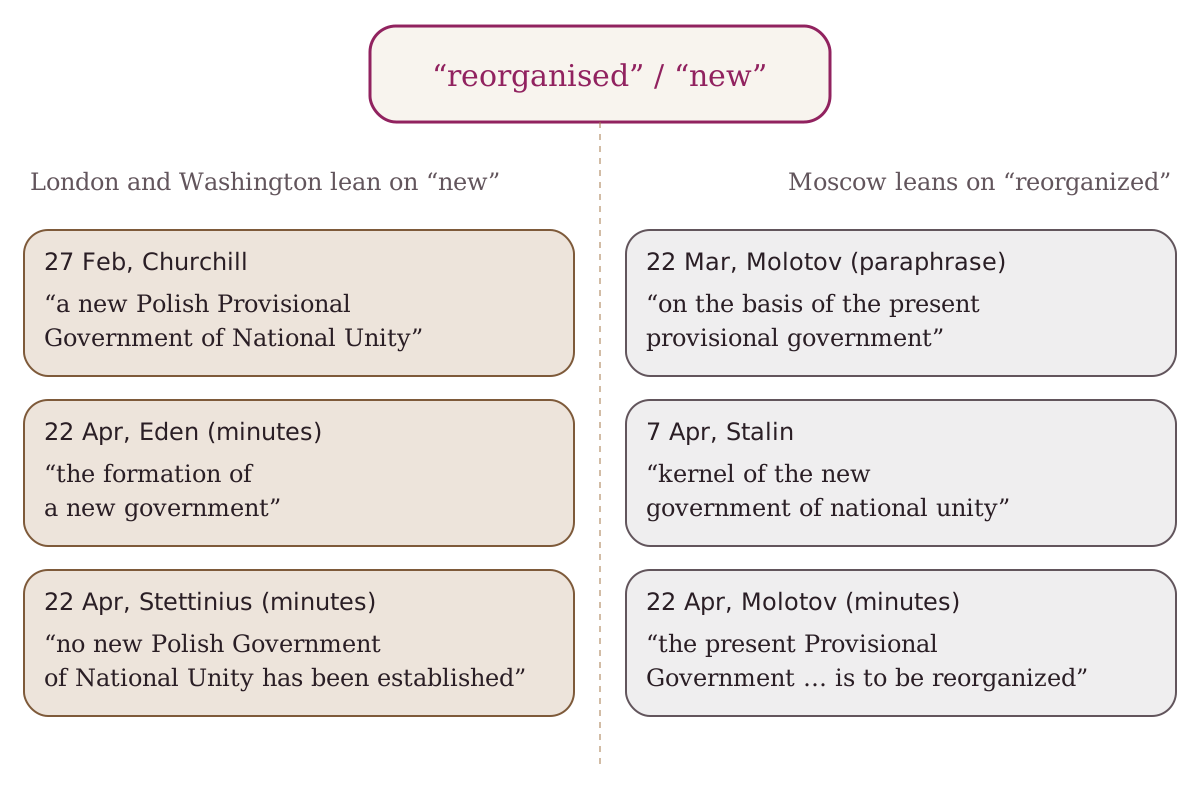
The same text read two ways, sorted by this site, in the words of each speaker or the minutes. February to April 1945.
"The same text read two ways" by Persuasion Dissected — https://persuasiondissected.com/bargaining/yalta-conference/ — licensed CC BY 4.0: https://creativecommons.org/licenses/by/4.0/
Stalin wrote to Roosevelt on 7 April that matters “have really reached a dead end.” In his reading, all three had treated the Provisional Government as one “which is subject to reconstruction and which should serve as kernel of the new government of national unity” (doc. 510).
On 22 April Molotov said the decision “stipulates that the present Provisional Government in Poland is to be reorganized.” Eden answered that the aim had been “the formation of a new government” (FRUS 1945, vol. V, p. 237). Rival figures for one fact mark the Chartist petition of 1848; here the dispute is over one sentence.
Who counted as “democratic” in that sentence?
Of all the words, “democratic” came with the fewest limits. Stalin had told the conference on 6 February that “the Warsaw government has a democratic base equal at least to that of de Gaulle” (p. 670). On 9 February Molotov proposed “non-Fascist and anti-Fascist” before “democratic parties,” and the signed text settled on “all democratic and anti-Nazi parties” (pp. 842, 980).
One name tested the phrase. On 9 February Churchill asked whether Mikolajczyk, the former London prime minister, would be allowed to take part in the elections. Bohlen records Stalin’s answer: Mikolajczyk belonged to the Peasant Party “which wasn’t a Fascist party and therefore he could take part in the elections” (p. 848). Molotov had said at noon that “it might be a mistake to say that he was unacceptable” (p. 805).
Earlier remarks went both ways: on 6 February Roosevelt said Mikolajczyk had struck him as “a sincere and an honest man” (p. 668), and on 8 February Molotov was “not a bit sure about Mikolajczyk” (p. 777).
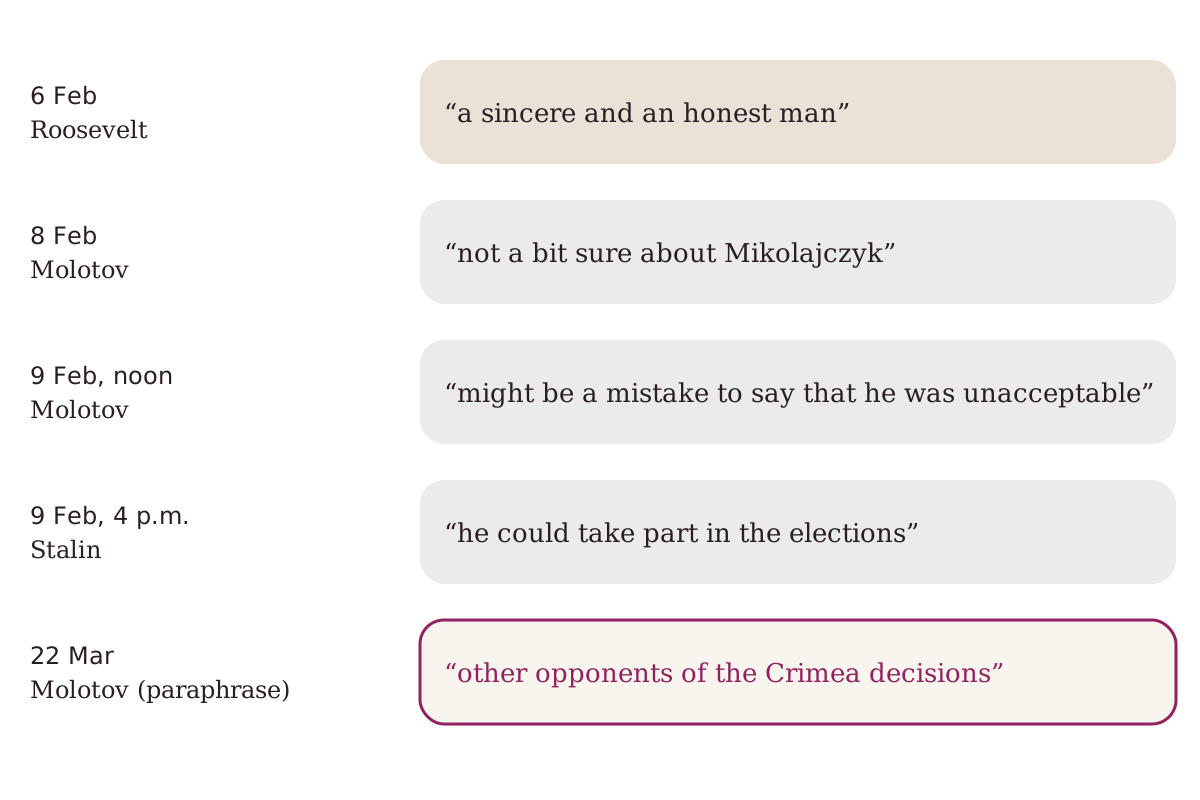
One name under the word “democratic,” in the minutes and in Harriman’s paraphrase. 6 February to 22 March 1945.
"One name under the word democratic" by Persuasion Dissected — https://persuasiondissected.com/bargaining/yalta-conference/ — licensed CC BY 4.0: https://creativecommons.org/licenses/by/4.0/
By 22 March the same name stood among “other opponents of the Crimea decisions, such as for instance Mikolajczyk,” who in Molotov’s paper, as Harriman paraphrased it, did not qualify for consultation (FRUS 1945, vol. V, p. 177). Stalin’s letter of 7 April added its own test: those invited should “recognize the decisions of the Crimea Conference, including the decision on the Curzon Line” (doc. 510). Neither test appears in the signed text, and Stalin offered his as “the meaning of the decisions.”
The objection then lapsed. An American memorandum of Stalin’s talk with Harry Hopkins, an adviser to President Truman, on 31 May has him saying the Soviet Government “had strongly objected” to Mikolajczyk and three others “but that now they were prepared to accept them” (FRUS 1945, vol. V, p. 311).
How did the dispute over the word end?
The commission’s talks ended first. On 21 June Harriman reported that the Poles had reached a settlement among themselves: Osubka-Morawski stayed as prime minister, Mikolajczyk became a vice prime minister and minister of agriculture, and there would be “six new Ministers out of a total of twenty” (FRUS 1945, vol. V, pp. 352–353). Harriman reported two days later that one of the six had declined to serve (p. 357).
Harriman wrote that, unless told otherwise, he would accept the settlement “as complying with the Yalta formula,” and that he and Clark Kerr had said the Yalta decision “would not be fulfilled until the holding of a truly free election.” He also wrote that the non-Lublin Poles were “ready to accept any compromise which gives some hope for Polish independence and individual freedom” (pp. 353–354).
“Properly formed” was tested at the commission’s last meeting on 22 June, in Harriman’s account. Clark Kerr said Britain was not committed to recognize the new government until satisfied that it had been “properly formed,” which to Britain included a formal pledge of free elections. After an argument in which Bierut showed irritation, Clark Kerr “backed down” and asked only whether Bierut accepted the Crimea decision on this point (pp. 358–359).
For the United States, the question closed with a note 144 days after the protocol, by this site’s count from 11 February. The United States decided to recognize “the new Polish Provisional Government of National Unity,” effective at 7:00 p.m. Eastern War Time on 5 July 1945, “in conformity with the decisions of the Crimea Conference.” The same note closed the American mission to the London government (Conference of Berlin volume, doc. 503, p. 737).
The American chargé delivered it to the London government’s foreign minister, Adam Tarnowski. He reported Tarnowski as saying that what hurt the Poles most was “the claim that the arrangements arrived at at Yalta and at Moscow were fair and just” (p. 736). That is one interested party’s view, reported by the other side of the conversation.
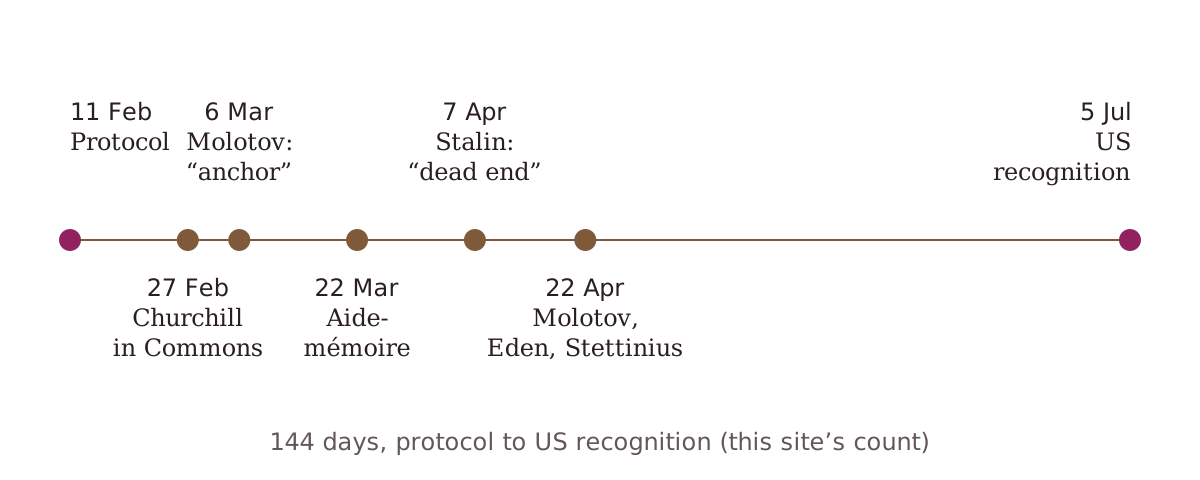
From the protocol to American recognition. 11 February to 5 July 1945.
"From the protocol to American recognition" by Persuasion Dissected — https://persuasiondissected.com/bargaining/yalta-conference/ — licensed CC BY 4.0: https://creativecommons.org/licenses/by/4.0/
Without covering the later Polish elections, this page stops at the recognition note, and it does not judge whether another wording would have changed events. Harriman’s telegram of 21 June calls the result “the reorganized govt,” and the American note of 5 July calls it “the new Polish Provisional Government” (pp. 353, 737). The note records an American decision that the condition had been met. Nothing in the Declaration said who should make that call, and Churchill had told the Commons it would be his government’s.
Crossing map
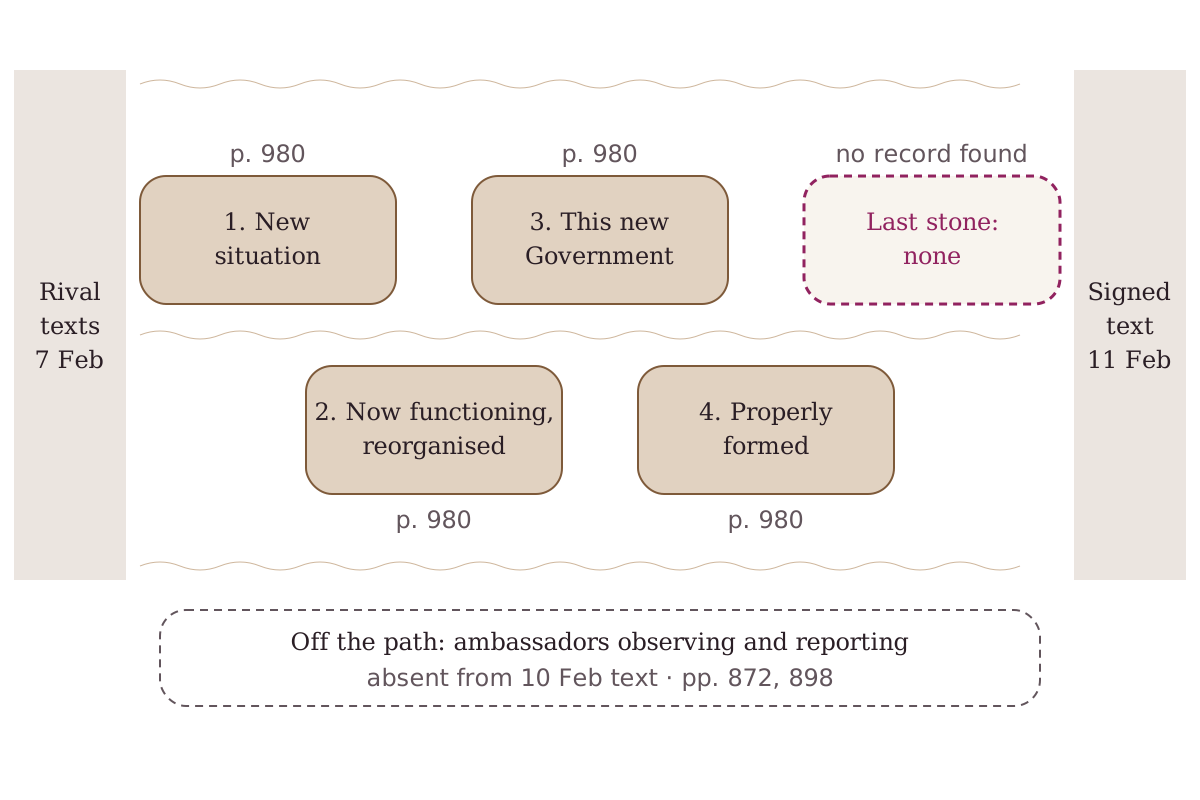
Crossing map of the sentence on Poland’s government. No last stone is marked. The dashed stone off the path is the observer sentence, absent from the text read on 10 February. 7 to 11 February 1945.
"Crossing map of the sentence on Poland’s government" by Persuasion Dissected — https://persuasiondissected.com/bargaining/yalta-conference/ — licensed CC BY 4.0: https://creativecommons.org/licenses/by/4.0/
- New situation. The text opens on the Red Army’s complete liberation of Poland, which calls for a more broadly based government (p. 980) [1]
- Now functioning, reorganised. The government “now functioning” is the thing to be reorganised, the verb Molotov’s amendment carried (pp. 842, 867, 980) [1] [2]
- This new Government. The next sentence calls the result new, a line from Eden’s formula (pp. 870, 980) [1] [2]
- Properly formed. Relations follow when the government is “properly formed,” with no judge named (pp. 867, 980) [1] [2]
- No last stone in this case. The candidate, that the word would mean the same to all three, is one no minute read for this page shows anyone supplying. The text was settled by trading words across five sittings, Roosevelt called what remained “only a matter of drafting,” and by March the readings differed (p. 846; FRUS 1945, vol. V, p. 176; HC Deb cc. 1280–1281) [2] [4] [6]
This site uses the last stone for a premise no speaker states and the audience supplies, with a record of the audience supplying it. The minutes show the sequence only, not what any delegate privately believed, so some may have seen the gap and accepted it. This page marks none.
Sources
- Foreign Relations of the United States: Conferences at Malta and Yalta, 1945 (Washington: GPO, 1955), doc. 501, Protocol of Proceedings, section VII, p. 980; doc. 500, Communiqué, pp. 973 ff. history.state.govRead: full text of the Poland sections
- FRUS, Conferences at Malta and Yalta, 1945. Pre-conference: docs. 158 (pp. 221–222), 160 (pp. 224–225), 165 (pp. 230 ff.). Minutes and papers: doc. 352 (6 February, pp. 667–671); 373 (7 February, pp. 716–718); 394, 396, 399 (8 February, pp. 776–781, 786–790, 792–793); 405, 409 (9 February noon, pp. 803–807, 815–816); 423 (9 February 4 p.m., pp. 842–848); 432, 434, 435 (9 February 10:30 p.m., pp. 867–871); 436, 439, 440 (10 February noon, pp. 872, 883–884); 451 (10 February 4 p.m., pp. 898, 905–906). history.state.govRead: sections on Poland in the minutes; full text of the Polish papers; pre-conference Polish documents 158, 160, 163, 165, 166
- FRUS, Conferences at Malta and Yalta, 1945, post-conference documents: doc. 506, Harriman to the Secretary of State, 6 March 1945 (excerpts); doc. 510, Stalin to Roosevelt, 7 April 1945 (translation, excerpts). history.state.govRead: sections printed as excerpts; printed page not shown in the online text
- FRUS, 1945, vol. V: doc. 150, Harriman to the Secretary of State, 23 March 1945, pp. 176–178 (paraphrase of a Soviet aide-mémoire of 22 March); doc. 193, minutes, 22 April 1945, pp. 237–240; doc. 226, memorandum of the Hopkins–Stalin conversation, 31 May 1945, pp. 309–313; doc. 264, Harriman, 21 June 1945, pp. 352–354; doc. 266, Harriman, 23 June 1945, pp. 357–361. history.state.govRead: full text of docs. 150, 193, 264 and 266; Polish lists and Stalin’s remarks in doc. 226
- FRUS, Conference of Berlin (Potsdam), 1945, vol. I, doc. 503, Schoenfeld to the Secretary of State, 5 July 1945, pp. 736–737. history.state.govRead: full text
- House of Commons debate, Crimea Conference, 27 February 1945, Hansard, vol. 408, cc. 1267 ff. api.parliament.ukRead: sections: Churchill’s Poland passage, cc. 1279–1282
Next crossing
- The Munich Agreement — Another conference paper, read for what it commits anyone to do.
- The Zola libel trial — A trial where one word, “cette” (this), stood in for a clause the jury could not weigh.
Cite this page
Persuasion Dissected. "Yalta Conference: Poland’s Government, to Be ‘Reorganised’." Persuasion Dissected. Published 2026-11-11. https://persuasiondissected.com/bargaining/yalta-conference/. Accessed: add the date you read it.
Corrections
No corrections yet.
How pieces are checked · All corrections · Contact · Report an error (contact@persuasiondissected.com)