Great Moon Hoax: The New York Sun Cited a Scottish Journal
In three lines
- Who persuaded whom: In August 1835 the New York Sun ran a story crediting Sir John Herschel with finding life on the moon, and the Sun printed praise from several other papers.
- Which stones: A notice from Edinburgh, a journal supplement no outside reader is on record as seeing, a Dr. Grant and an unnamed medical gentleman stood between New York and Herschel.
- Outcome: Rivals called it a hoax. On 16 September, in the text reprinted in 1917, the Sun still would not confess until British papers testified, and the sources read here do not show what it said later.
Route through this piece (9)
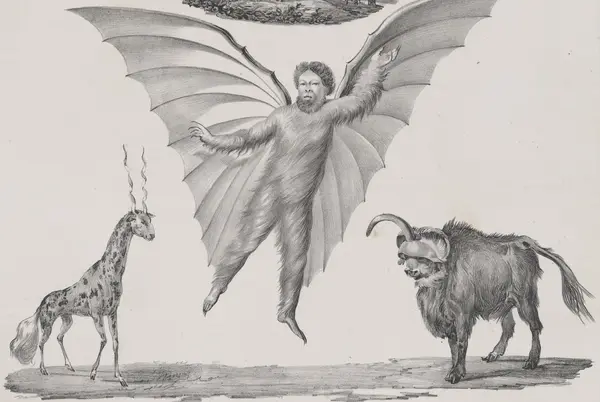
Lunar creatures in a lithograph printed in Naples, titled for Herschel’s discoveries in the moon. 1835.
"Scoperte fatte nella luna dal Sigr. Herschell" by Salvatore Fergola. Public domain.
Full credit
"Scoperte fatte nella luna dal Sigr. Herschell" by Salvatore Fergola — https://commons.wikimedia.org/wiki/File:Scoperte_fatte_nella_luna_dal_Sigr._Herschell_LCCN2012646034.jpg — Public domain — Public domain in the US (published 1835) and in the EU (Salvatore Fergola died 1874, life+70); modified: cropped to the winged figure and two animals, removing the title, the paper edge and nearly all of the moon scene above (a strip of its lower edge remains at the top)
Case card
- Case
- The Great Moon Hoax: “Great Astronomical Discoveries” in the New York SunF. M. O’Brien, “The Story of the Sun,” Munsey’s Magazine, June 1917, pp. 101–108
- Date range
- 21 August to 16 September 1835, as far as the texts read here goF. M. O’Brien, “The Story of the Sun,” Munsey’s Magazine, June 1917, pp. 101, 109
- Place
- New YorkF. M. O’Brien, “The Story of the Sun,” Munsey’s Magazine, June 1917, pp. 101–110
- Persuader(s)
- The New York Sun under Benjamin H. Day; Richard Adams Locke as writer, per O’Brien and PoeF. M. O’Brien, “The Story of the Sun,” Munsey’s Magazine, June 1917, pp. 100–101, 112; Poe, “Richard Adams Locke” (1848 manuscript)
- Audience
- Readers of the Sun and the editors of other papersF. M. O’Brien, “The Story of the Sun,” Munsey’s Magazine, June 1917, pp. 104–107; The Moon Hoax (New York: William Gowans, 1859), pp. 60–63
- The ask
- In the mean time let every reader of the account examine it and enjoy his own opinion.The Sun, 16 September 1835, as reprinted in F. M. O’Brien, “The Story of the Sun,” Munsey’s Magazine, June 1917, p. 110
- Channel
- Newspaper installments; pamphlet; lithographsF. M. O’Brien, “The Story of the Sun,” Munsey’s Magazine, June 1917, pp. 101–108
- Outcome
- On 16 September the Sun still declined to confess a hoax; the sources read here do not show what it said at any later date on that pointF. M. O’Brien, “The Story of the Sun,” Munsey’s Magazine, June 1917, pp. 109–110
- Primary record
- The 1835 paper could not be read; its words come from reprints of 1859 and 1917F. M. O’Brien, “The Story of the Sun,” Munsey’s Magazine, June 1917; The Moon Hoax (New York: William Gowans, 1859)
On 16 September 1835, the New York Sun told its readers it could not yet confess a hoax. “Certain correspondents have been urging us to come out and confess the whole to be a hoax; but this we can by no means do until we have the testimony of the English or Scotch papers to corroborate such a declaration.” That sentence asks readers to treat the Great Moon Hoax as open, sixteen days after the last installment of 31 August by this site’s count; O’Brien says “more than two weeks.”
The 1835 paper could not be read for this page. Its words come from two later reprints, an 1859 pamphlet and Frank M. O’Brien’s 1917 magazine history of the Sun. Each passage below says which.
What was the Great Moon Hoax?
It was a newspaper serial headed “Great Astronomical Discoveries,” presented as a reprint from a Scottish science journal. Its opening claim, in O’Brien’s reprint, was that Herschel, by means of “a telescope, of vast dimensions and an entirely new principle,” had “affirmatively settled the question whether this satellite be inhabited, and by what orders of beings.”
O’Brien puts the whole narrative at eleven thousand words and dates a first notice and five installments. This site counts six installments. The sixth is the third in order, and his text gives it no date. He says more was promised “on the morrow” after 26 August, and his next date is 28 August, so 27 August is this site’s inference.
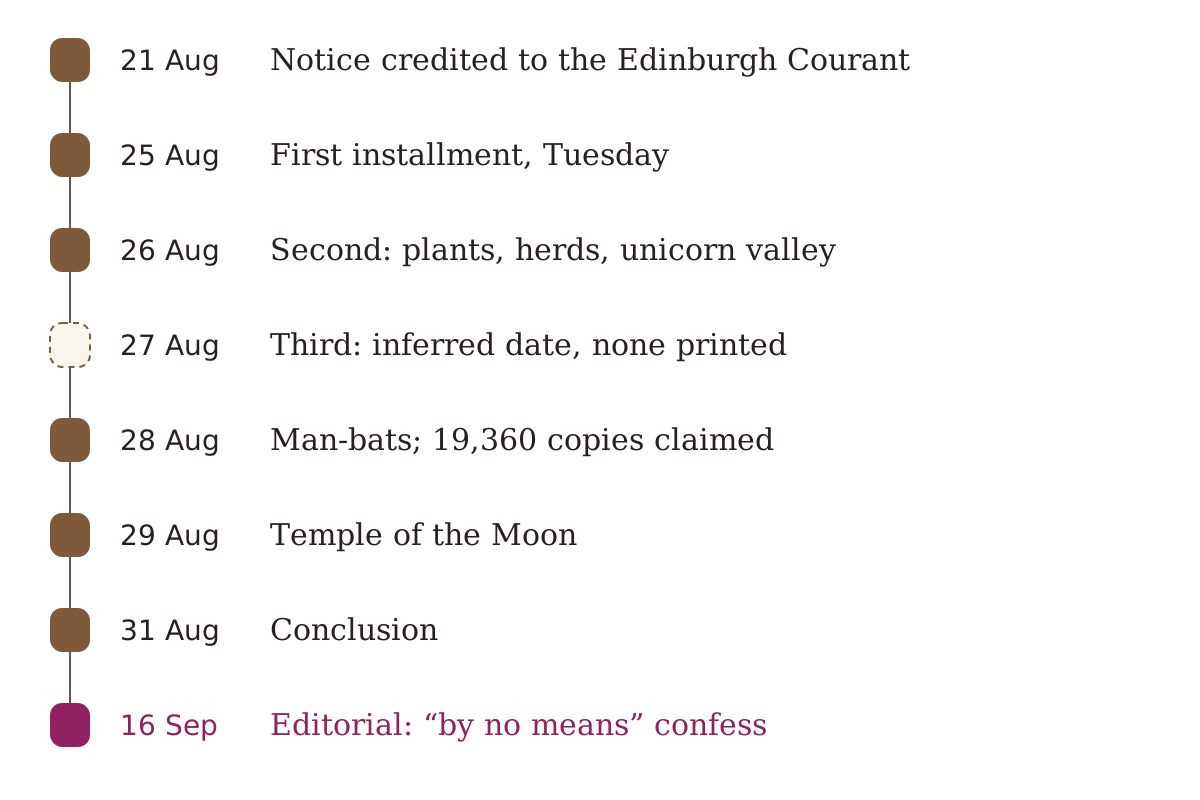
The moon story by date, as O’Brien gives it. The dashed marker is inferred, because no date is printed for that installment. August to September 1835.
"The moon story by date" by Persuasion Dissected — https://persuasiondissected.com/cons/great-moon-hoax/ — licensed CC BY 4.0: https://creativecommons.org/licenses/by/4.0/
| Date in 1835 | What ran | Basis |
|---|---|---|
| 21 August | Notice credited to the Edinburgh Courant | O’Brien, p. 101 |
| 25 August | First installment, on the telescope | O’Brien, p. 101 |
| 26 August | Second: plants, herds, a valley of unicorns | O’Brien, p. 103 |
| 27 August (inferred) | Third: mountains, lakes, a biped beaver | O’Brien, p. 105, no date |
| 28 August | Fourth: the man-bats | O’Brien, p. 105 |
| 29 August | Fifth: the Temple of the Moon | O’Brien, p. 107 |
| 31 August | Conclusion | O’Brien, p. 107 |
| 16 September | Editorial declining to confess | O’Brien, pp. 109–110 |
Each row, with its qualifier, is in the date table (where this data comes from).
The usual answer to who wrote it is Richard Adams Locke, a Sun writer on twelve dollars a week by O’Brien’s account. Poe names Locke too, in a manuscript of 1848, and O’Brien cites the belief of the publisher, Benjamin H. Day, as recorded in 1883. The mathematician Augustus De Morgan credited the astronomer J. N. Nicollet instead. The Smithsonian’s catalog record for the 1859 pamphlet notes that rival attribution and calls its evidence insufficient.
Who did the Sun say its story came from?
The Sun named no single witness. It named a chain, and the chain began on 21 August, four days before the first installment of the 25th, with a paragraph on its second page: “The Edinburgh Courant says—‘We have just learnt from an eminent publisher in this city that Sir John Herschel, at the Cape of Good Hope, has made some astronomical discoveries of the most wonderful description.’”
The serial’s heading then read “From Supplement to the Edinburgh Journal of Science.” Inside, the text credited “the devoted friendship of Dr. Andrew Grant,” said to be Herschel’s assistant. An editorial explained how the supplement reached New York: it “was very politely furnished us by a medical gentleman immediately from Scotland.”
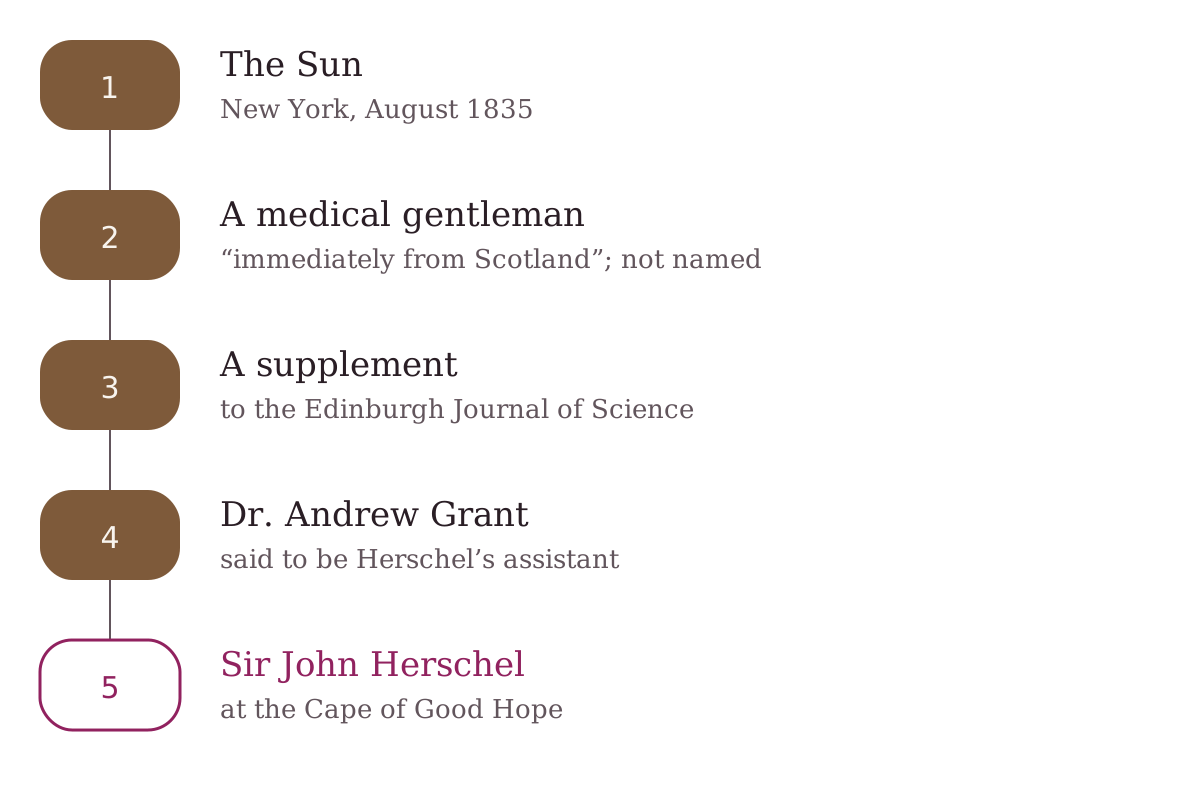
The chain of sources the Sun named, from the paper back to the astronomer. August 1835.
"The chain of sources the Sun named" by Persuasion Dissected — https://persuasiondissected.com/cons/great-moon-hoax/ — licensed CC BY 4.0: https://creativecommons.org/licenses/by/4.0/
O’Brien’s reading is that “the sly Locke” chose a supplement over the journal itself, and he writes that the Edinburgh journal “ceased to exist several years before 1835.” This site could not date that. A footnote in the Philosophical Magazine for 1833 cites the journal’s number for April 1832, which is the latest trace found here.
The text also promised proof later. Herschel’s own volumes would arrive, the editor of the supplement wrote, with “the certificates of the civil and military authorities of the colony.” Claiming a famous expert’s backing is a type of fraud that still exists, and anyone who suspects one today should contact the local authorities.
Why did the details look checkable?
The serial mixed names a reader might know with claims a reader could not test. Herschel was real and, O’Brien writes, had gone to the Cape in January 1834. Sir David Brewster was real, and the story has him leap from his chair crying “Thou art the man!” The lens was specific, at twenty-four feet across and a power of forty-two thousand times, and the views were said to fall on a “canvas of forty-nine feet.”
Poe’s own diagnosis, written in the 1848 manuscript, was that such tales “aim at plausibility through minuteness of scientific detail,” and that they “profess to derive exclusive information from a foreign country.” The first phrase describes the lens and the canvas, and the second describes the chain above. That reading is Poe’s, and he had a stake in it, since he suspected at first that the story drew on his own moon tale.
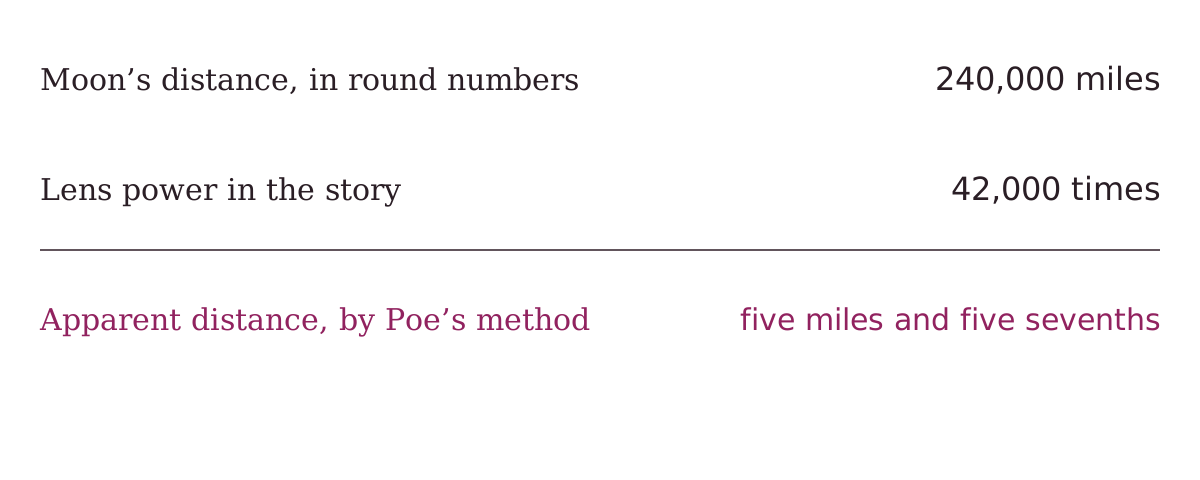
The division as Poe set it out, using the lens power printed in the story. Manuscript of 1848.
"Poe’s division of the moon’s distance" by Persuasion Dissected — https://persuasiondissected.com/cons/great-moon-hoax/ — licensed CC BY 4.0: https://creativecommons.org/licenses/by/4.0/
The serial closed by inviting inspection of a sort. On 31 August the Sun said it had left out “forty pages of illustrative and mathematical notes,” printed one as a sample so that readers “may judge for themselves,” and added: “we know nothing of mathematics beyond counting dollars and cents.” A later Sun item in the 1859 pamphlet says “several eminent mathematicians” had called and praised that note. No names appear.
What did the other papers say?
The 1859 pamphlet reprints a run of press opinions, introduced by a Sun column it dates 1 September 1835. The Mercantile Advertiser wrote that the article “appears to carry intrinsic evidence of being an authentic document.” The Albany Daily Advertiser wrote of “an article from the last Edinburgh Scientific Journal,” and the New Yorker said that “by the late arrivals from England there has been received in this country a supplement.”
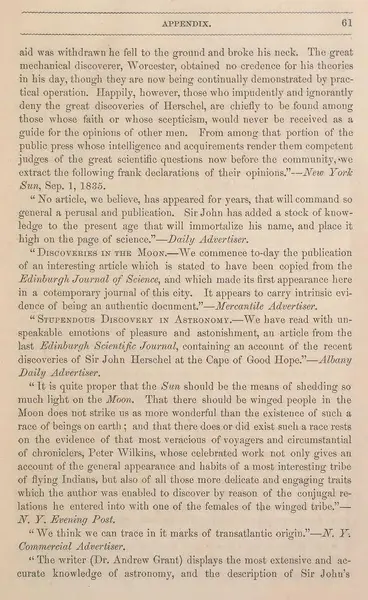
Press opinions as the 1859 reprint gives them, following a Sun column dated 1 September 1835.
"The Moon Hoax (1859), p. 61" by William Gowans (publisher). Public domain.
Full credit
"The Moon Hoax (1859), p. 61" by William Gowans (publisher) — https://archive.org/details/moonhoax00Lock/page/n64 — Public domain — Public domain in the US (published 1859) and in the EU (published 1859 by William Gowans with text by Richard Adams Locke, died 1871, life+70); modified: cropped to the printed page area and reduced to 800 px wide
Some hedged. The New York Sunday News allowed that “our doubts and incredulity may be a wrong to the learned astronomer.” The Philadelphia Inquirer said its readers could “decide for themselves,” and the New York Commercial Advertiser thought it could “trace in it marks of transatlantic origin.” The Sun itself named the Journal of Commerce as an exception, one that “ill-naturedly said that we had fabricated them.”
The 1 September column answered such doubters by rank. “Consummate ignorance is always incredulous to the higher order of scientific discoveries,” it said, “because it cannot possibly comprehend them.” On this site’s reading, that sentence turns a request for proof into a confession of ignorance, so a reader who doubted the story had first to place himself among the ignorant.
The list cannot measure belief, since the Sun chose the quotations and called them “but a handful of the innumerable certificates of credence.” Poe’s later memory points the same way: he wrote that those who questioned the story “were really very few indeed,” but that is one rival’s recollection. What the list shows is what a reader could hold that week: a story, and other papers repeating its source, as the Sun quoted them. A claim about an audience that nobody could inspect returns in the subliminal advertising story.
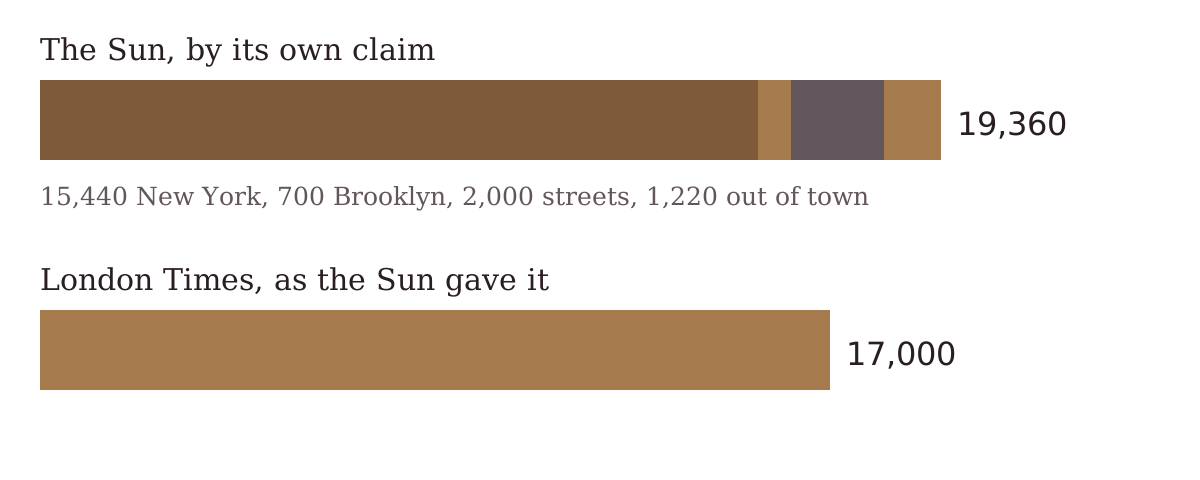
The circulation the Sun claimed for itself on 28 August 1835, as O’Brien reports it. No ledger was read.
"The Sun’s claimed circulation, 28 August 1835" by Persuasion Dissected — https://persuasiondissected.com/cons/great-moon-hoax/ — licensed CC BY 4.0: https://creativecommons.org/licenses/by/4.0/
Data: O’Brien, “The Story of the Sun,” Munsey’s Magazine, June 1917
The paper’s numbers are its own. O’Brien reports that it claimed 15,440 regular subscribers in New York, 700 in Brooklyn, 2,000 street sales and 1,220 out of town, for 19,360 copies, against 17,000 for the London Times. The publisher of the 1859 pamphlet adds that circulation “augmented five fold” and that 60,000 pamphlets sold in less than a month. Neither figure has been checked.
What did the prints add?
O’Brien says the demand for back numbers came with “a cry for pictures,” and that lithographs were offered at twenty-five cents for the set. The Sun promised “all the popular substance” of Herschel’s coming work, priced at fifty dollars, for twelve or thirteen cents. This page cannot say whether the surviving sheet below was one of those lithographs.
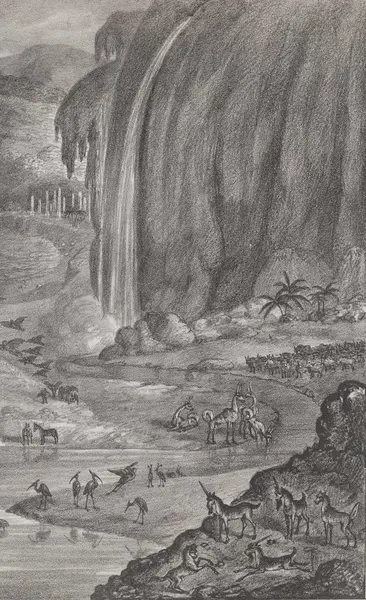
Detail of “Lunar Animals and Other Objects,” a separate lithograph sheet and not a page of the newspaper. 1835.
"Lunar Animals and Other Objects (detail)" by Unknown author. Public domain.
Full credit
"Lunar Animals and Other Objects (detail)" by Unknown author — https://commons.wikimedia.org/wiki/File:Lunar_animals_and_other_objects_Discovered_by_Sir_John_Herschel_in_his_observatory_at_the_Cape_of_Good_Hope_and_copied_from_sketches_in_the_Edinburgh_Journal_of_Science._LCCN2003665049.jpg — Public domain — Public domain in the US (published 1835) and in the EU (artist not named, published 1835, 70 years passed; copyright claimant Benjamin H. Day died 1889); modified: cropped to the right side of the print, removing the winged figures at the left, the handwritten note and the paper edge
The sheet’s printed lines carry the same chain. It says the creatures were “copied from sketches in the Edinburgh Journal of Science,” sends the viewer to a “Pamphlet Published at the Sun Office,” and is entered for copyright by Benj. H. Day, who owned the Sun. A handwritten note reads “Deposited August 29, 1835.” Pictures sold as records of an event also matter in the Boston Massacre trial.
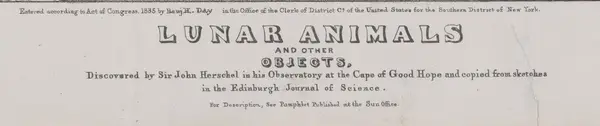
The printed legend of the same sheet, with Day’s copyright line above it. 1835.
"Lunar Animals and Other Objects (printed legend)" by Unknown author. Public domain.
Full credit
"Lunar Animals and Other Objects (printed legend)" by Unknown author — https://commons.wikimedia.org/wiki/File:Lunar_animals_and_other_objects_Discovered_by_Sir_John_Herschel_in_his_observatory_at_the_Cape_of_Good_Hope_and_copied_from_sketches_in_the_Edinburgh_Journal_of_Science._LCCN2003665049.jpg — Public domain — Public domain in the US (published 1835) and in the EU (artist not named, published 1835, 70 years passed; copyright claimant Benjamin H. Day died 1889); modified: cropped to the printed legend and copyright line, removing the picture above
How did the story come apart?
O’Brien tells the leak as a single scene, without a source or a date. A reporter named Finn, sent by the Journal of Commerce to get copies for reprinting, met Locke. “Don’t print it right away,” Locke said. “I wrote it myself.” O’Brien says the Journal then denounced the story, and that James Gordon Bennett’s Herald “named Locke as the author.”
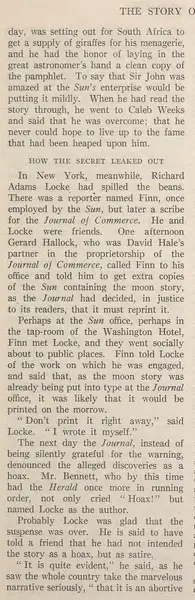
O’Brien’s account of the leak, with no source given for the conversation. Munsey’s Magazine, June 1917, p. 109.
"Munsey’s Magazine, June 1917, p. 109" by Frank M. O’Brien. Public domain.
Full credit
"Munsey’s Magazine, June 1917, p. 109" by Frank M. O’Brien — https://archive.org/details/moonhoax00Lock/page/n78 — Public domain — Public domain in the US (published 1917) and in the EU (Frank M. O’Brien died 1943, life+70); quoted text of 1835 is older; modified: cropped to the left column and reduced
He also tells of a deputation from Yale that asked to see the supplement. Day, he writes, called the request “almost an insult,” and Locke sent the visitors from printer to printer until they had to go home. That story has the same single narrator. O’Brien was no outside witness: his 1943 obituary says he went to the Sun as an editorial writer in July 1916, so this is a house history.
Locke’s own explanation reaches this page at second hand. O’Brien writes that he “is said to have told a friend” the story was meant as satire, calling it “an abortive satire” and himself “the best self-hoaxed man in the whole community.” No letter or date is given, so the claim about his intent stays unproved.
Poe set out the arithmetic that a reader could have run. The story’s lens magnified 42,000 times and the moon is about 240,000 miles away, which he says leaves “five miles and five sevenths.” He wrote that the man-bats should have seemed to walk “heels up and head down,” and that his written objections at the time found “few listeners.” That is his report, about thirteen years on.
What did the Sun say on September 16?
O’Brien reprints the editorial at length, “more than two weeks after the conclusion of the story” in his words. It opens by reporting what doubters said in the story’s favor: that it had diverted the public “from that bitter apple of discord, the abolition of slavery.” Then it offers other people’s theories: “an adroit fiction of our own,” or a satire on “the monstrous fabrications of the political press.” The editorial adopts neither as its own view.
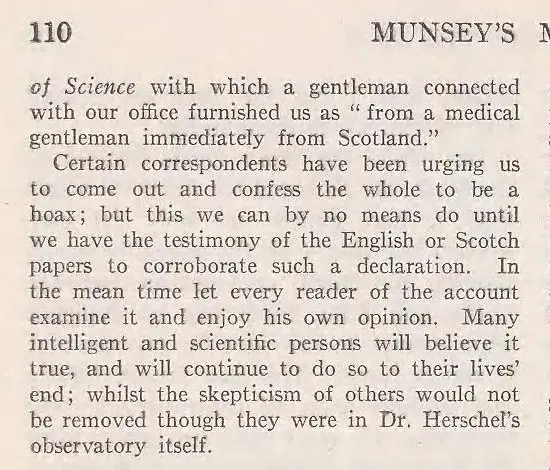
The passage as O’Brien reprinted it: “this we can by no means do.” Munsey’s Magazine, June 1917, p. 110.
"Munsey’s Magazine, June 1917, p. 110" by Frank M. O’Brien. Public domain.
Full credit
"Munsey’s Magazine, June 1917, p. 110" by Frank M. O’Brien — https://archive.org/details/moonhoax00Lock/page/n79 — Public domain — Public domain in the US (published 1917) and in the EU (Frank M. O’Brien died 1943, life+70); quoted text of 1835 is older; modified: cropped to the top of the left column
Then comes a partial concession. “We confess that this idea of intended satire somewhat shook our own faith in the genuineness of the extracts from the Edinburgh Journal of Science,” the paper writes, “with which a gentleman connected with our office furnished us as ‘from a medical gentleman immediately from Scotland.’” The source has moved from Scotland into the office, and that move is the nearest the text comes to an admission.
The refusal follows at once. It comes with a condition: only English or Scotch papers could settle the matter, and until then each reader should “enjoy his own opinion.” The editorial ends by dividing its audience: “Many intelligent and scientific persons will believe it true,” while others would doubt it “though they were in Dr. Herschel’s observatory itself.”
O’Brien gives his own view of why the refusal held: “Barring the casual conversation between Locke and Finn, there was no evidence plain enough to convince the layman that it was a hoax.” Poe’s division, set out above, suggests that the story’s own figures offered a test, though nothing read here shows how many readers tried it.
O’Brien’s two versions, the 1917 article and the 1918 book, are the only texts of this editorial read here.
Where is the last stone in this case?
This site uses the last stone for a premise that no speaker states and the audience supplies for itself. Here it is “someone further up the chain has seen the journal.” The Sun said it had received a supplement, yet nothing read here shows it telling anyone that an outside party had compared it with a journal.
The evidence that readers supplied the step is textual but rests on two quotations: the New Yorker’s “received in this country” and the Albany paper’s “last Edinburgh Scientific Journal” both state more than the Sun’s chain could prove. Because the Sun picked those quotations, this label stays provisional. A distant source that readers could not readily check also sits behind the Fiji Mermaid.
Did the Sun admit it later?
The sources read here do not say. O’Brien’s 1918 book adds that the paper “continued to meet exposure with a calm and almost flippant front,” and that in November 1835 it “was proud to announce” a new series by Locke, on a condemned sailor. That shows the paper still commissioning work from Locke after rivals had named him. O’Brien records no retraction, and the Sun’s later 1835 issues could not be read.
The paper also treated the moon as a shared joke in items O’Brien reprints without dates, so this page cannot place them before or after 16 September. It praised a panorama of “the lunar discoveries,” and its reviewer wrote of a burlesque at the Bowery Theater: “It is quite evident that Hamblin does not believe a word of the whole story.” Herschel’s reaction reaches this page only through O’Brien’s anecdote about a showman who brought him the pamphlet at the Cape, so it is not treated as his statement.
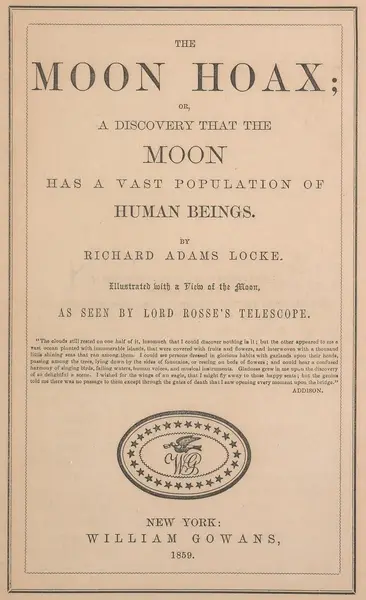
By 1859 a New York bookseller sold the story under the title The Moon Hoax, with Locke’s name on it. Title page, 1859.
"The Moon Hoax (1859), title page" by William Gowans (publisher). Public domain.
Full credit
"The Moon Hoax (1859), title page" by William Gowans (publisher) — https://archive.org/details/moonhoax00Lock/page/n4 — Public domain — Public domain in the US (published 1859) and in the EU (published 1859 by William Gowans with text by Richard Adams Locke, died 1871, life+70); modified: cropped to the printed border and reduced to 760 px wide
By 1859 the label had settled in print, at least for one publisher, William Gowans, who called it “the renowned Moon Hoax, by Richard Adams Locke.” Matthew Goodman’s book-length study, The Sun and the Moon, could not be read for this page.
Crossing map
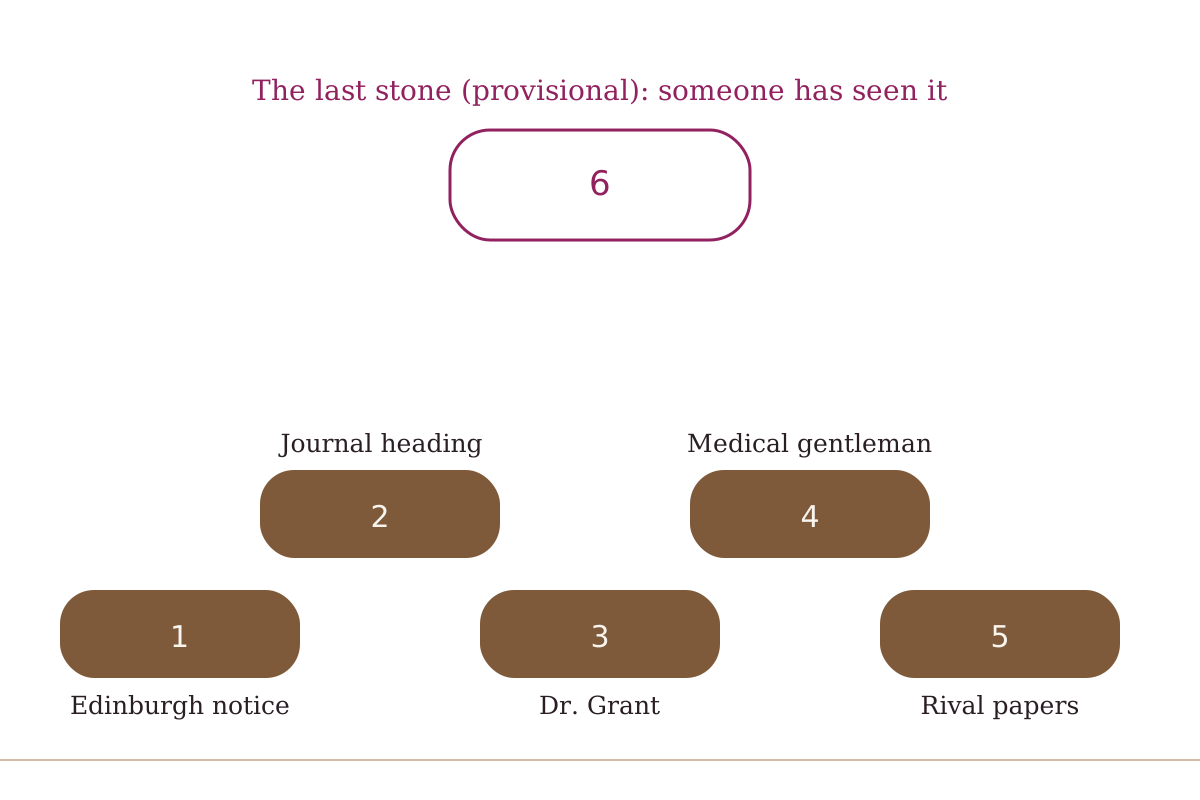
Crossing map of the moon story, each stone as later reprints give it. August to September 1835.
"Crossing map of the moon story" by Persuasion Dissected — https://persuasiondissected.com/cons/great-moon-hoax/ — licensed CC BY 4.0: https://creativecommons.org/licenses/by/4.0/
- Edinburgh notice. A paragraph credited to the Edinburgh Courant announces discoveries, 21 August (p. 101) [1]
- Journal heading. The serial is headed as a supplement to the Edinburgh Journal of Science, 25 August (p. 101) [1]
- Dr. Grant. The text credits Herschel’s assistant as its informant (p. 102) [1]
- Medical gentleman. An editorial says an unnamed doctor from Scotland supplied the supplement (p. 102) [1]
- Rival papers. Other papers repeat the source as the Sun chose to quote them (pp. 61–62) [2]
- The last stone: someone has seen it. Provisional. Nothing read here shows the Sun saying that anyone outside had compared the supplement with a journal; the New Yorker’s “received in this country” goes further than its source (p. 62) [2]
Sources
- Frank M. O’Brien, “The Story of the Sun,” Munsey’s Magazine 61, no. 1 (June 1917): 99–115. Quotes the Sun of 1835. archive.orgRead: full page range of the article, pp. 99–115; pp. 101, 103, 104, 105, 107, 109 and 110 compared against page images
- The Moon Hoax; or, A Discovery That the Moon Has a Vast Population of Human Beings (New York: William Gowans, 1859). archive.orgRead: chapter-length parts: publisher’s advertisement, heading and conclusion of the text, appendix pp. 60–63; pp. 61–62 compared against page images
- Frank M. O’Brien, The Story of the Sun: New York, 1833–1918 (New York: George H. Doran, 1918). gutenberg.orgRead: chapter on the moon hoax, the opening of the next chapter and the copyright page
- Edgar Allan Poe, “Richard Adams Locke,” from Literary America, 1848 manuscript. eapoe.orgRead: full page of Poe’s text; editor’s notes not used
- The London and Edinburgh Philosophical Magazine and Journal of Science, vol. 3 (July–December 1833), footnote citing the Edinburgh Journal of Science for April 1832. archive.orgRead: single value
- “Frank M. O’Brien, N. Y. Sun Editor, Succumbs at 68,” Editor & Publisher, 25 September 1943. archive.orgRead: single value via the obituary; text not compared against a page image
Next crossing
- The Fiji Mermaid — Another New York story of the period with a distant source behind it, told by its own promoter.
- Seward’s Folly — Newspapers and a Congress, and what one vote in the record does and does not say.
Cite this page
Persuasion Dissected. "Great Moon Hoax: The New York Sun Cited a Scottish Journal." Persuasion Dissected. Published 2026-11-11. https://persuasiondissected.com/cons/great-moon-hoax/. Accessed: add the date you read it.
Corrections
No corrections yet.
How pieces are checked · All corrections · Contact · Report an error (contact@persuasiondissected.com)