Montgomery Bus Boycott: 381 Days if Counted From December 5
In three lines
- Who persuaded whom: On the US Courts and Park Service accounts, four Montgomery riders persuaded a federal court, and the Supreme Court affirmed. How organizers kept riders off the buses is not read here.
- Which stones: The boycott ran 381 days by this site’s count, from 5 December 1955 to 20 December 1956. One National Archives sentence starts it on 1 December instead.
- Outcome: It ended the day Browder v. Gayle took effect, on the Park Service’s account, 37 days after the Supreme Court affirmed on 13 November 1956.
Route through this piece (5)
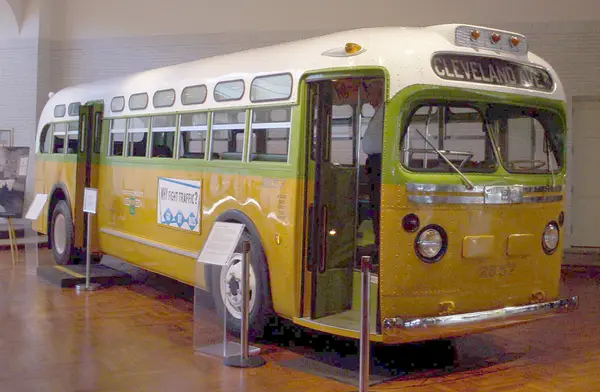
A bus at the Henry Ford Museum, captioned on its file page as the Montgomery City Lines bus that sparked the boycott. Uploaded 18 April 2005.
"Rosa Parks Bus" by Rmhermen — https://commons.wikimedia.org/wiki/File:Rosa_Parks_Bus.jpg — CC BY-SA 3.0 (https://creativecommons.org/licenses/by-sa/3.0/)
On 20 December 1956, Browder v. Gayle took effect, and the Montgomery Bus Boycott ended, by the Park Service’s account. On this site’s reading, that sentence asks a reader to treat the day a court ruling took effect as the end of a movement. The Supreme Court had already affirmed the ruling 37 days earlier, in a sentence that names no day on which any bus had to change.
This page is short because the readable record is short. It rests on US Reports, on later overviews from the National Archives and the National Park Service, and on a federal judiciary news item. The papers of the Montgomery Improvement Association, the organization formed to lead the boycott, were not read, so this page dates the boycott and follows the lawsuit without explaining why riders stayed away.
How long did the Montgomery Bus Boycott last?
From 5 December 1955 to 20 December 1956 is 381 days, and that number is a subtraction, recomputed by this site, that adopts 5 December as the starting date. A National Archives blog post of 30 November 2015 says the boycott “officially began December 5, 1955.” The same post later says it “lasted from December 1, 1955, when Rosa Parks was arrested, to December 20, 1956.”
This page takes 5 December because the post names it as the day the boycott officially began, while its later sentence on the length runs from 1 December, the day of the arrest. Starting from the arrest gives 385 days, and counting both the first day and the last day from 5 December gives 382. All three spans include 29 February 1956, since 1956 was a leap year. A separate National Archives teaching page prints “381 days” without saying which two dates it counted between.
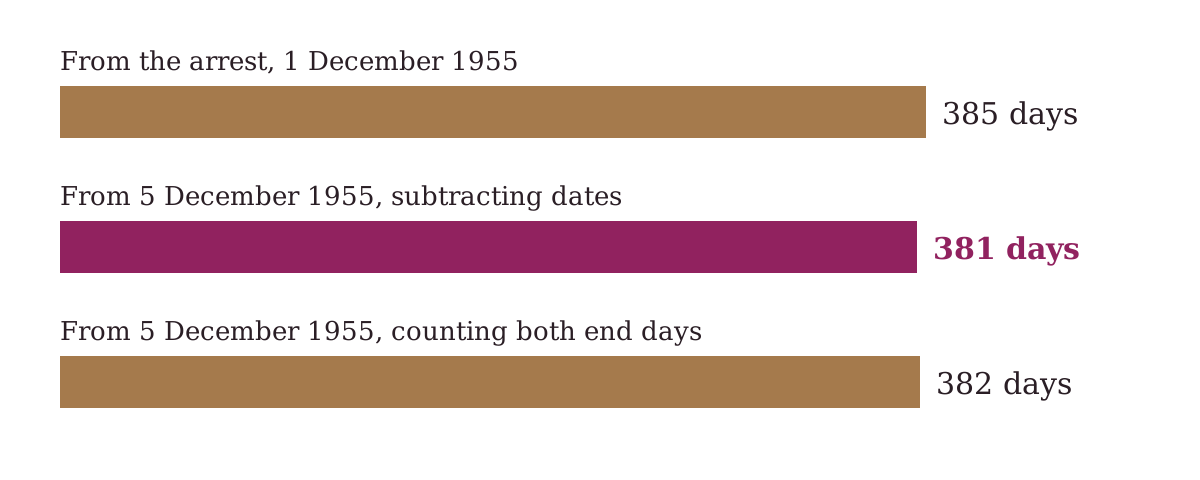
Three counts of one boycott, on this site’s arithmetic. To 20 December 1956.
"Three counts of the Montgomery bus boycott" by Persuasion Dissected — https://persuasiondissected.com/movements/montgomery-bus-boycott/ — licensed CC BY 4.0: https://creativecommons.org/licenses/by/4.0/
Government pages describe the length of the boycott in several different ways. None of these pages is a document from 1956.
| Page | Its words on the length | What that fixes |
|---|---|---|
| National Archives teaching page, reviewed 2016 | “lasted 381 days” | A length, no dates |
| National Archives blog, 2015 | “officially began December 5, 1955”; “lasted from December 1, 1955” | Two starts, one end |
| Park Service, King Memorial page, 2024 | “took effect on December 20, 1956”; “ended on that date” | The end |
| Park Service, Selma trail page, 2015 | “for more than a year” | Neither end |
| Park Service article, 2022 | “seven month long boycott”; buses empty “For nearly a year” | Neither end; the seven months are not dated |
| US Courts news item, 2015 | “the yearlong boycott ended” in “December 1956” | The month |
The timeline’s dates and day counts, each with its source and the way it was reached, are in the CSV (where this data comes from). A movement’s number has a different problem in the Chartist petition of 1848, where the counts of two opposing sides stand 3,730,504 apart. Nobody in the record read here argues over 381. The pages differ on where to begin counting and on how to describe the length.
Was Browder v. Gayle Rosa Parks’s case?
It was not, on the National Archives’ account. Its teaching page says Parks was charged with “refusing to obey orders of bus driver” and convicted under city law, and that her appeal was still tied up in the state court of appeals when federal judges “ruled in another case.” Copies of her arrest records went into that other case as evidence.
A US Courts news item says “four riders sued” in the Middle District of Alabama, and a Park Service article names them as Aurelia Browder, Susie McDonald, Claudette Colvin and Mary Louise Smith. The same article says Fred Gray, a lawyer with the association, gathered the plaintiffs and argued that bus segregation violated their right to equal protection under the Fourteenth Amendment.
A three-judge court ruled in June of 1956. The vote was 2–1 on the Park Service’s account, with Judges Frank M. Johnson Jr. and Richard T. Rives in the majority, according to the US Courts item. US government pages print three different days that month for the decision and the judgment. This site could not open the scan of the judgment to settle the question, so it gives only the month.
The Park Service quotes the majority: “there is now no rational basis upon which the separate but equal doctrine can be validly applied to public carrier transportation.” The full opinion, reported at 142 F. Supp. 707, was not read. The same article says the city appealed and “continued to practice segregation on city busing.”
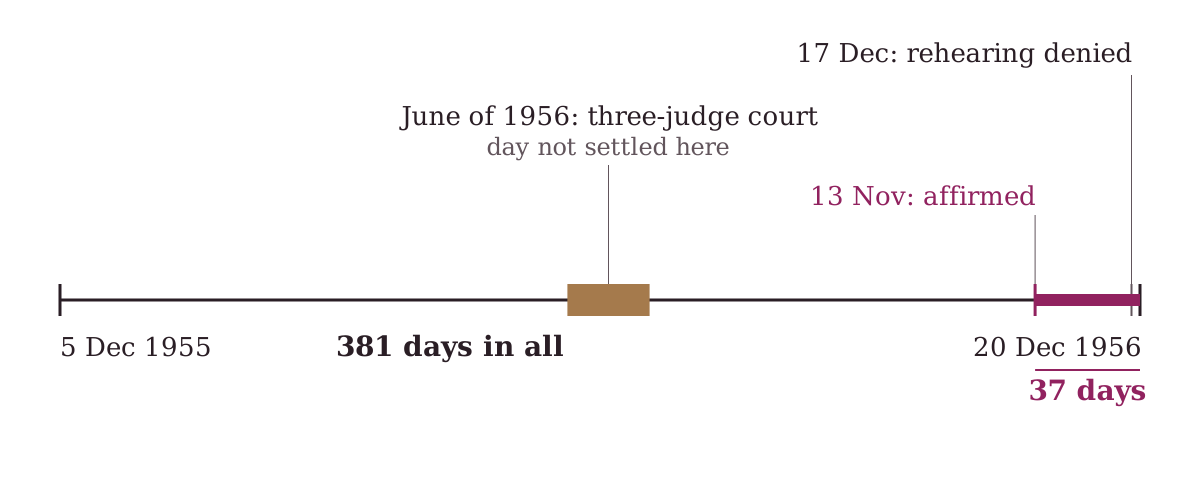
The boycott and the case on one scale. The June mark spans the month because the sources differ on the day. 5 December 1955 to 20 December 1956.
"The boycott and the case on one scale" by Persuasion Dissected — https://persuasiondissected.com/movements/montgomery-bus-boycott/ — licensed CC BY 4.0: https://creativecommons.org/licenses/by/4.0/
On 13 November 1956 the Supreme Court answered in a per curiam, an unsigned decision of the court, whose operative sentence runs 11 words by this site’s count and is followed by three citations, the first to Brown v. Board of Education. US Reports lists Robert L. Carter and Thurgood Marshall as counsel for the appellees in the state’s appeal, No. 343.
The sentence itself mentions neither a bus nor a date. Setting a court record against a public picture of events is also the method used for the Boston Massacre trial.
Why did the boycott go on after the Supreme Court ruled?
US Reports prints one more date between the ruling and the end. On 17 December 1956, 34 days after affirming, the Court entered “Petition for clarification and rehearing denied” in the city commissioners’ appeal, No. 342, and on the same day it denied rehearing in the state’s appeal, No. 343. Three days after that comes 20 December.
The Park Service says the decision “took effect on December 20, 1956,” and that the boycott “ended on that date,” and the National Archives blog gives the same day for the ruling. Another Park Service page says the bus company desegregated “only after November 13, 1956,” but does not name the day.
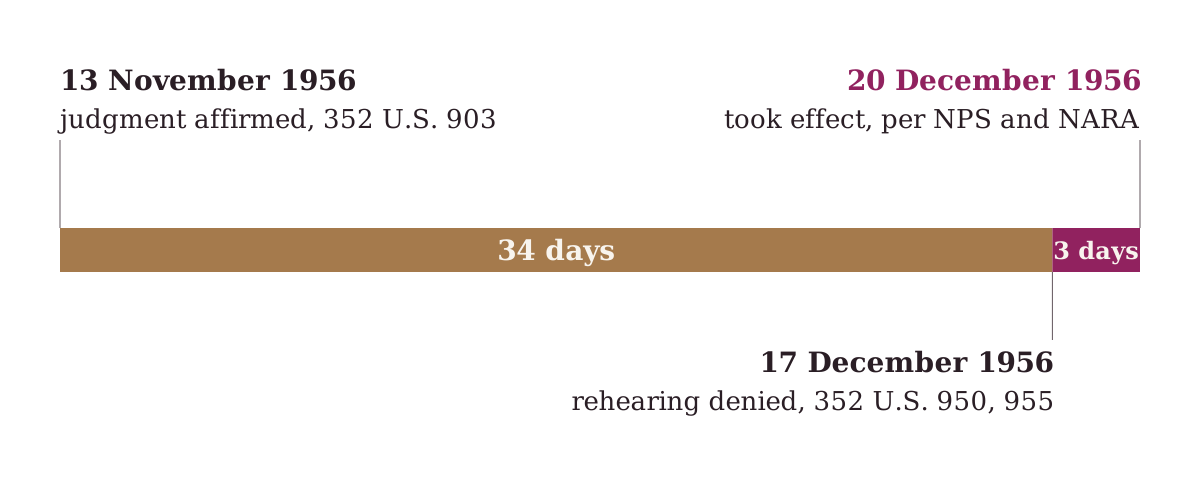
The 37 days between affirmance and effect, with the printed dates from US Reports and the end date from later overviews. 13 November to 20 December 1956.
"The 37 days between affirmance and effect" by Persuasion Dissected — https://persuasiondissected.com/movements/montgomery-bus-boycott/ — licensed CC BY 4.0: https://creativecommons.org/licenses/by/4.0/
No source read here explains why the ruling took effect on 20 December instead of 13 or 17 December. The order of the dates does not show that the petitions caused the wait. This page does not claim that they did.
Whatever riders and organizers said to each other during those 37 days is in papers not read here, so the claim in this page’s title concerns dates and not motives. The distance between a paper and its effect also matters in the Munich Agreement.
What can’t this record show?
The overviews do not agree about who started the boycott. The National Archives blog says E. D. Nixon “called for” it, one Park Service page says King “launched” it, and another says community leaders formed the association on 5 December and “asked him to lead.” A third Park Service page credits Jo Ann Robinson with 50,000 leaflets by 2 December and places the founding of the association at a 4 December meeting.
Their figures carry the same limit, since none of them says where it came from. The Park Service article reports more than 200 people who volunteered their cars, roughly 100 pickup stations and between 30,000 and 40,000 lost bus fares a day, and it says “Over 70%” of riders were African American where the National Archives blog says “three-quarters.” That blog adds that the city restricted cheap taxi fares and pressed insurance companies to drop Black car owners.
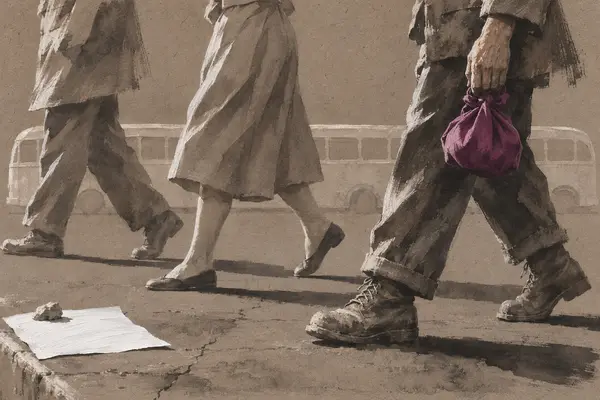
A ruling on paper and people still on foot. The record read here does not date what changed for any one rider. 1956.
Illustration — not a historical depiction
Illustration: Persuasion Dissected. Generated schematic illustration — not a photograph or historical record. Reuse: CC BY 4.0 (https://creativecommons.org/licenses/by/4.0/), to the extent any rights exist.
This page does not rank carpools, speeches and the lawsuit against one another, because these overviews cannot settle that question. The Park Service article argues that the Brown precedent gave boycotters hope. That is an interpretation, not a finding. Histories by Taylor Branch and Jack Bass, listed as suggested reading on the National Archives teaching page, and Robinson’s 1987 memoir were not read, and they appear below as bibliography only.
The exit cost, meaning what leaving the boycott would have cost any one rider, cannot be dated from the record. The documents behind the Luddites leave a similar limit on the question of who gave the orders.
Crossing map
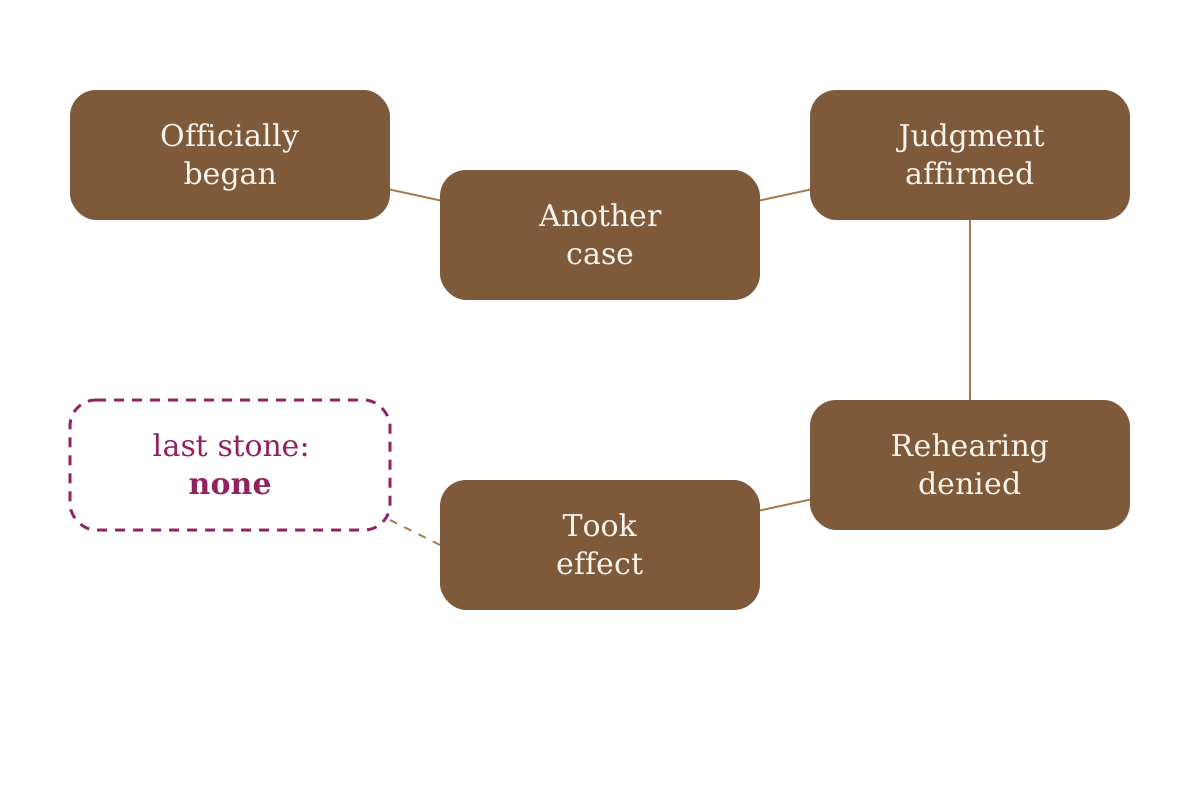
Crossing map of the dates from the boycott’s start to the ruling’s effect. The dashed outline marks that no last stone was found. 5 December 1955 to 20 December 1956.
"Crossing map of the Montgomery dates" by Persuasion Dissected — https://persuasiondissected.com/movements/montgomery-bus-boycott/ — licensed CC BY 4.0: https://creativecommons.org/licenses/by/4.0/
- Officially began. One National Archives sentence starts the boycott on 5 December 1955, and another in the same post uses 1 December [2]
- Another case. Four riders brought the federal suit, which a three-judge court decided in June of 1956 while Parks’s appeal sat in the state courts [6] [5] [4]
- Judgment affirmed. “The motion to affirm is granted and the judgment is affirmed,” 13 November 1956, 352 U.S. 903 [1]
- Rehearing denied. The petitions were denied on 17 December 1956, 352 U.S. 950 and 955 [1]
- Took effect. The decision took effect on 20 December 1956, and the boycott “ended on that date” [3] [2]
- No last stone in this case. The sentences read here state their holdings and dates outright, and no record of what riders assumed could be read [1] [3]
This site uses the last stone for a premise no speaker states and the audience supplies. Finding one here would take the words of riders and organizers in 1956. Those were not read.
Sources
- United States Reports, vol. 352 (October Term 1956): Gayle v. Browder and Owen v. Browder, Nos. 342 and 343, per curiam, 13 November 1956, p. 903; No. 342, petition for clarification and rehearing denied, 17 December 1956, p. 950; No. 343, rehearing denied, 17 December 1956, p. 955. govinfo.govRead: full text of the entries on pp. 903, 950 and 955
- Sarah Basilion, “The Montgomery Bus Boycott,” Pieces of History, US National Archives, 30 November 2015. prologue.blogs.archives.govRead: full text
- National Park Service, “Quote from ‘Montgomery Bus Boycott’ Speech,” Martin Luther King, Jr. Memorial, last updated 3 May 2024. nps.govRead: full text of the description; the inscription is not used
- US National Archives, “An Act of Courage, The Arrest Records of Rosa Parks,” Educator Resources, last reviewed 21 December 2016 (from Bredhoff, Schamel and Potter, Social Education 63, 4, 1999). archives.govRead: full text of the article; records not viewed
- National Park Service, “The Montgomery Bus Boycott,” Selma To Montgomery National Historic Trail, last updated 21 September 2022. nps.govRead: full text
- Administrative Office of the US Courts, “Court’s Legacy Intertwined With Martin Luther King Jr.’s,” Judiciary News, 15 January 2015. uscourts.govRead: full text
- National Park Service, “Rosa Parks,” Selma To Montgomery National Historic Trail, last updated 14 April 2015. nps.govRead: full text
- National Park Service, “U.S. Court Documents,” Martin Luther King, Jr. National Historical Park, last updated 30 June 2026. nps.govRead: single value via the list entry beside the case name
- US National Archives, Judgment from Aurelia Browder et al. v. W. A. Gayle et al., National Archives Identifier 279206, Record Group 21, on DocsTeach. docsteach.orgRead: single value via the catalog citation; the scan of the judgment was not read
- Taylor Branch, Parting the Waters: America in the King Years, 1954–63 (New York: Simon & Schuster, 1988). archives.govRead: bibliography only
- Jack Bass, Taming the Storm: The Life and Times of Judge Frank M. Johnson, Jr. and the South’s Fight over Civil Rights (New York: Bantam Doubleday Dell, 1993). archives.govRead: bibliography only
- Jo Ann Gibson Robinson, The Montgomery Bus Boycott and the Women Who Started It (Knoxville: University of Tennessee Press, 1987). utpress.orgRead: bibliography only
No openly licensed image of the boycott itself located.
Next crossing
- The Chartist petition of 1848 — A movement’s number, and the committee count printed against it.
- The Munich Agreement — Two papers carried home, and the question of what either one bound anyone to do.
Cite this page
Persuasion Dissected. "Montgomery Bus Boycott: 381 Days if Counted From December 5." Persuasion Dissected. Published 2026-11-11. https://persuasiondissected.com/movements/montgomery-bus-boycott/. Accessed: add the date you read it.
Corrections
No corrections yet.
How pieces are checked · All corrections · Contact · Report an error (contact@persuasiondissected.com)