Luddites: Their Song Named Wide Frames, Not All Machines
In three lines
- Who persuaded whom: In Nottinghamshire in 1811–12, frame-breakers signing as Ned Ludd told the stocking trade’s masters, the hosiers, what they would destroy. These Luddites named wide frames and frames that cut prices, not all machines.
- Which stones: A song and a notice set the terms, a general’s name stood behind them, and one house bought safety with a pay rise, by its messenger’s account. At Lenton an owner said five full-price frames were broken anyway.
- Outcome: About 1,000 frames broken, a raise that fell away in 1812, and a law of 20 March 1812 making frame-breaking a capital crime. Yorkshire’s attacks on shearing frames were a separate dispute.
Route through this piece (8)
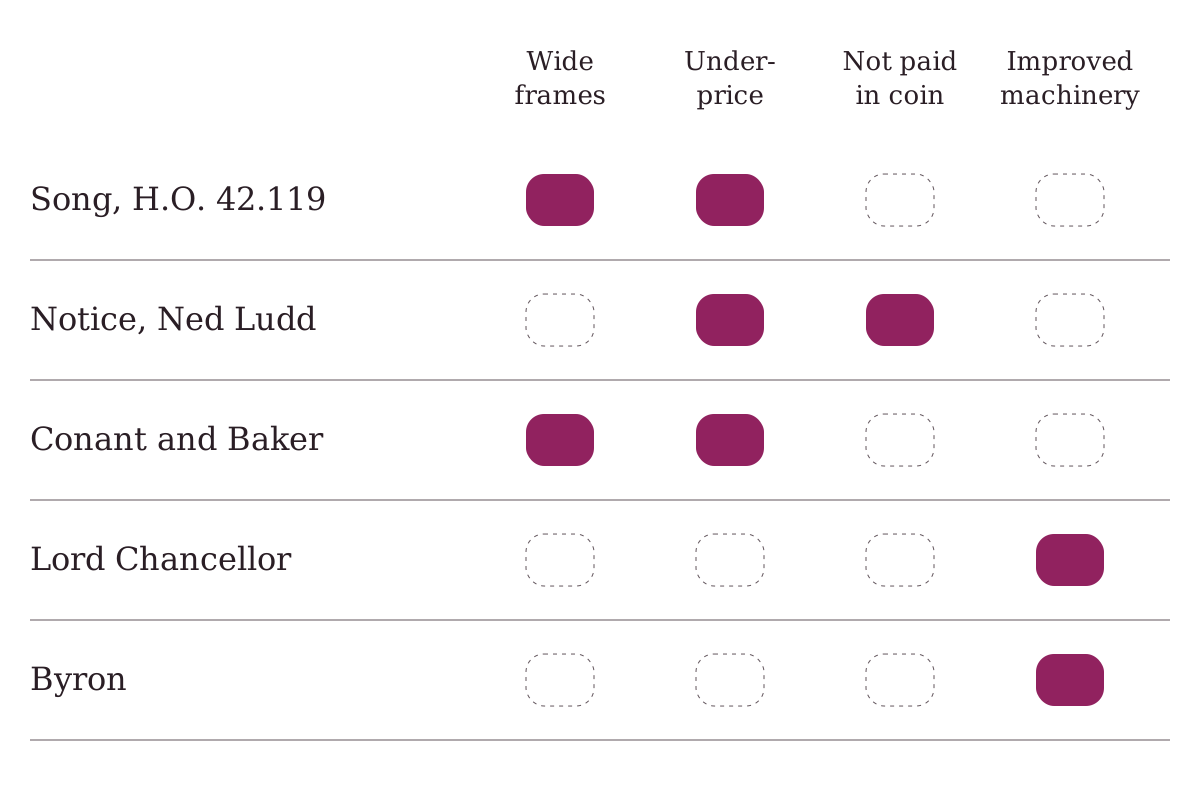
What five documents name as the target. The notice’s price clause is the Hammonds’ summary; its coin clause is quoted. Undated notice to 27 February 1812.
"What five documents name as the target" by Persuasion Dissected — https://persuasiondissected.com/movements/luddites/ — licensed CC BY 4.0: https://creativecommons.org/licenses/by/4.0/
Data: J. L. and Barbara Hammond, The Skilled Labourer (1919), pp. 258–260; HL Deb 27 February 1812, vol. 21, cc. 964–79
Case card
- Case
- Nottinghamshire frame-breaking under the name Ned LuddHammond and Hammond (1919), pp. 259–261
- Date range
- March 1811 to February 1812 for the first wave; the law followed on 20 March 1812Hammond and Hammond (1919), pp. 261, 267
- Place
- Nottinghamshire, spreading to Leicestershire and Derbyshire; the House of Lords, LondonHammond and Hammond (1919), p. 261; HL Deb 27 Feb 1812
- Persuader(s)
- Unnamed frame-breakers writing as Ned Ludd or General Ludd; the song’s author is not recordedHammond and Hammond (1919), pp. 259–260
- Audience
- Hosiers and frame owners; the Ned Ludd notice was also sent to the Home Office. The Lords debated the breaking on 27 February 1812; nothing read shows a peer saw these papersHammond and Hammond (1919), pp. 259–260; HL Deb 27 Feb 1812
- The ask
- “His wrath is entirely confined to wide frames / And to those that old prices abate”H.O. 42.119, 27 January 1812, in Hammond and Hammond (1919), p. 259
- Channel
- Song, notice from “Ned Ludds Office,” threats and broken framesHammond and Hammond (1919), pp. 259–261
- Outcome
- About 1,000 frames broken, by the Hammonds’ figure; a raise of 2s. a dozen that fell away in 1812, by Felkin’s account; frame-breaking made capital on 20 March 1812. Why the wave stopped remains interpretationFrames: Hammond and Hammond (1919), p. 261; raise: Felkin (1867), p. 439; law: Hammond and Hammond (1919), p. 267; why it stopped: Hammond and Hammond (1919), pp. 266–267, and Felkin (1867), p. 241
- Primary record
- Home Office papers H.O. 42.119 as printed by the Hammonds (originals not read); HL Deb 27 Feb 1812, vol. 21, cc. 964–79Hammond and Hammond (1919); UK Parliament historic Hansard
A song filed at the Home Office under 27 January 1812 told its hearers what General Ludd would break. “His wrath is entirely confined to wide frames,” it says, “And to those that old prices abate.” These two lines ask a stocking maker to accept that the Luddites worked by a rule, and that anyone in the trade could read the rule in advance and judge whether his own frames fell under it.
The word now gets used for anyone who distrusts new machines, but this page reads a smaller set of papers: the Nottingham-area documents of 1811–12, mostly as J. L. and Barbara Hammond printed them from the Home Office files in 1919. Those documents name particular frames and particular pay, and they also record frames broken in apparent breach of those terms. Nothing in the pages read here says who wrote the song.
What did the Luddites say they would break?
The notice came from “Ned Ludds Office, Sherwood Forest.” In the Hammonds’ summary, it claimed that a charter from Charles II allowed the trade to destroy frames making goods deceitfully, and it declared the 1788 Act against frame-breaking void. They quote only one sentence of the threat itself: “all Frames of whatsoever description the workmen of whom are not paid in the current coin of the realm will invariably be destroyed.”
That sentence sorts frames by how the worker is paid, so a frame of any design falls under it if the wages come in the wrong form. The complaint behind “current coin” was truck, the payment of wages in goods, which a later bill in Parliament tried to stop.
The song sorts frames in two ways. Wide frames are condemned as a type, whoever owns them, while any other frame is condemned only if it lowers “old prices.” The last verse the Hammonds print states what would end the campaign, which is a condition about pay and workmanship: “Till full fashioned work at the old fashioned price / Is established by Custom and Law.”
Two men sent by the government reported the same pair of targets. Conant and Baker, the London police magistrates dispatched to Nottingham, wrote on 6 February 1812 that “The first emotion was resentment against the Hosiers who paid the under price.” According to their report, the breakers went after the frames of those hosiers, “and also all frames that facilitated the work by being made wider than the old ones.” Each document, its wording, the target it names and its Home Office reference are listed in the CSV (where this data comes from).
What was a wide frame, and what was wrong with it?
The knitters on whose behalf the frames were broken earned their living on frames, and most of them rented their machines from the master hosiers at 1s. to 2s. a week, by the Hammonds’ account. A dispute inside this trade was therefore a dispute among people who already worked machinery every day of their lives.
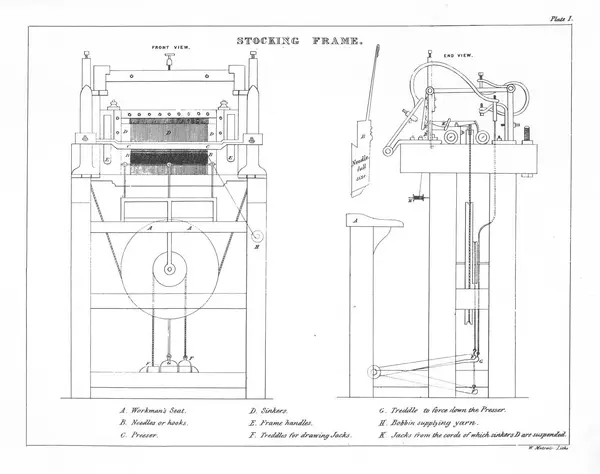
A hand-worked stocking frame, the opening plate of William Felkin’s 1867 history. The plate shows the ordinary machine, and no wide frame is drawn on it. 1867.
"Stocking Frame, plate 1" by W. Metcalf. Public domain.
Full credit
"Stocking Frame, plate 1" by W. Metcalf — https://commons.wikimedia.org/wiki/File:Lee's_knitting_frame.jpg — Public domain — Public domain in the US (published 1867) and in the EU (William Felkin was about seventeen in 1811 by his own account; lithographer W. Metcalf, death not traced, would have needed to live past 1956, 89 years after this plate; published 159 years ago); modified: resized to 1600 px and converted to grayscale JPEG; original kept
Wide frames had originally been built for pantaloons and fancy stockings, and demand for both had fallen away. A writer in the Nottingham Review of 6 December 1811 explained the new use: the frames were “making pieces, which are cut up into gloves, socks, sandals, or stockings,” which were then stitched “in the same manner as a tailor stitches” a garment. The trade called these goods cut-ups.
The objection concerned the goods and what they did to prices. The same writer said that the cut edges gave way, and he finished with some scorn: “we may as well proclaim a new era in the trade, and let tailors and milliners take measure of our legs.” He had a side in the quarrel, and so did some hosiers. Before the first attacks of March 1811, by Felkin’s account, Brocksopp and other hosiers agreed “to give the men unabated wages” if the men helped to “put down cut-up work.”
Behind all of this stood hunger. Felkin, who was a youth in the Nottingham trade at the time, gives 15,350 people relieved from the poor rates in the town’s three parishes on 30 January 1812, which he calls nearly half the population. He puts average earnings for those still in work at about 7s. a week.
Did the frame-breakers keep to their own rule?
The record points both ways, and each witness has an interest. Felkin supplies the case for the rule. In the last week of November 1811, aged not quite seventeen, he rode out for masters who employed about 3,000 frames, carrying the message that if those frames were spared, “one shilling per dozen advance would be paid the following Saturday.” By his own report, “not one of their frames was injured.”
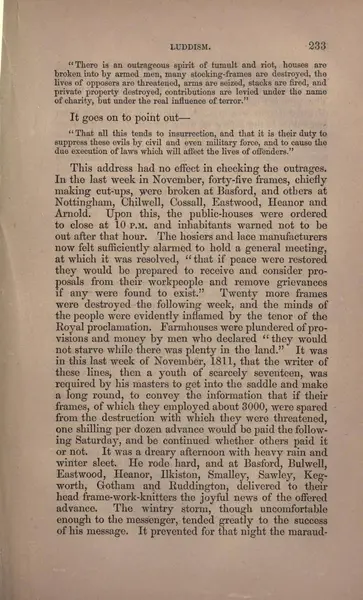
Felkin’s page on the magistrates’ address, the frames “chiefly making cut-ups” broken at Basford and his ride. Printed 1867, of events in November 1811.
"A History of the Machine-Wrought Hosiery and Lace Manufactures, p. 233" by William Felkin. Public domain.
Full credit
"A History of the Machine-Wrought Hosiery and Lace Manufactures, p. 233" by William Felkin — https://archive.org/details/historyofmachine00felkuoft — Public domain — Public domain in the US (published 1867) and in the EU (author about seventeen in 1811 by his own account, p. 233, so life+70 has run; death year not traced back); modified: recompressed JPEG at the same pixel size; page kept whole
The same page says that forty-five frames, “chiefly making cut-ups,” were broken that week at Basford. Felkin also served for a year as a special constable, by his own account. His story of a rule being kept comes from the side that patrolled against the breakers.
A hostile letter from Pentridge in Derbyshire adds detail. On 25 December 1811 a steward told Sir Joshua Banks, as the Hammonds print the name, that two men “who called themselves inspectors from the Committee” had gone from house to house with a list of prices, threatening frames whose workers held no ticket from a master willing to pay them.
Where they found an unapprenticed worker or a woman at a frame, they ordered the worker discharged, and on that promise they left a paper reading “Let this frame stand, the colts removed.” A colt was a worker who had served no regular apprenticeship.
Lenton is the case against. On 25 January 1812 an owner there complained in a handbill that five stocking frames had been broken, “all of which were working at the FULL PRICE,” and he supplied affidavits from the men who worked them. This site has read only the Hammonds’ report of that handbill. The owner had every reason to say so, but the Hammonds accept his account and class it as a mistake by the breakers.
In their account the rule held apart from a very few such mistakes, though they give no tally. A second case comes from Gravener Henson, a trade leader whose manuscript Felkin read, who complained that the men broke Brocksopp’s frames in the first batch at Arnold even though Brocksopp had agreed the terms described above.
The scale offers one more check, with caveats. The Hammonds put the frames broken at about 1,000, with the damage estimated at £6,000 to £10,000. Blackner, the historian of Nottingham, published a census of 1812 whose stocking-frame lines for Nottinghamshire, Leicestershire and Derbyshire sum to 25,218. Felkin reprints it with a warning: “Some of the numbers are evidently approximative only.”
This site’s division gives about 4 percent. That share does not prove the breakers were selective, since a small band could reach only so many houses, but if both figures are near the truth, the great majority of frames in those counties were not among those broken.
None of this was gentle. The magistrates’ address on Felkin’s page says “houses are broken into by armed men” and “the lives of opposers are threatened.” At Bulwell in November 1811, gunfire from a house under attack killed one of the attackers, whom Felkin names as John Westby and the Hammonds as John Wesley.
Why sign it Ned Ludd?
The frame-breakers signed as Ned Ludd, and the song promotes him to General, yet nobody in these pages can say who he was. The Nottingham Review of 20 December 1811 made him an apprentice at Anstey whom a magistrate ordered whipped for idleness, and who then smashed his frame. Felkin made him “one Ludd or Ludlam,” a Leicestershire boy told by his father “to square his needles,” who beat them into heaps with a hammer.
The name brought a chain of command with it. The song says that the frames were “sentenced to die / By unanimous vote of the Trade,” with Ludd as “the grand Executioner.” The notice, by the Hammonds’ summary, denounced bandits who robbed under cover of frame-breaking and offered £1,000 for catching them. At the Home Office, someone endorsed the paper with a dry line: “This letter cannot be answered.”
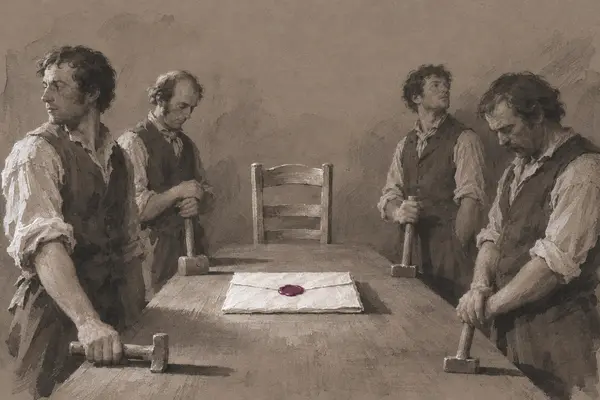
One name over many hands. The papers do not say who gave the orders. 1811 to 1812.
Illustration — not a historical depiction
Illustration: Persuasion Dissected. Generated schematic illustration — not a photograph or historical record. Reuse: CC BY 4.0 (https://creativecommons.org/licenses/by/4.0/), to the extent any rights exist.
A name standing in for an absent authority is also at work in the Fiji Mermaid, where the invented figure was a doctor.
Is there a last stone in this case?
This site uses the last stone for a premise that no speaker states and the audience supplies, with some record of the audience supplying it. The likeliest candidate here is that someone commands the hammers, so that a bargain struck with “the Trade” would hold everywhere. Yet the papers state that much outright, with an office, a vote of the Trade and an executioner. What they leave out is a name: the song stops at “Then shall Ludd sheath his conquering sword” without saying who would give that order.
Some hosiers did act as if terms could be settled. By Felkin’s account, his masters sent their offer to the head frame-work knitters in ten places. The Lenton owner printed sworn proof that he paid full price. In the Nottingham Journal of 1 February 1812, C. Shipley told the men he was stopping the disputed work and hoped they would offer no further violence.
None of these texts records what the men behind them assumed about who gave orders, so this page marks no last stone. The persuasion rested on stated terms, a named authority and broken frames.
Felkin writes that the bands “seem to have implicitly obeyed the command of their leaders,” but he hedges on who led them: “There were said to have been four companies or gangs,” and one Samuel Slater “was said to be a principal leader.” A stronger side that names its terms and leaves one door open is also the setting of the Melian Dialogue.
What did Parliament hear on 27 February 1812?
The Lords heard a different complaint. When the Frame Work Bill came up for its second reading, the Lord Chancellor said that the outrages began in “a mistaken notion” that the men’s interests “were injured by the introduction of certain improvements in machinery.” The Earl of Lauderdale, who opposed the bill, agreed with him on that point, saying that “every improvement of machinery” improved the condition of the people employed.
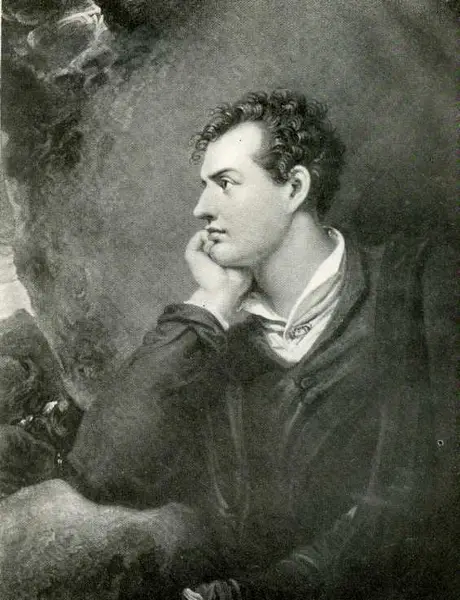
Lord Byron, engraved by Charles Turner after Richard Westall. Published April 1813, the year after the speech.
"Byron, 1813–14" by Charles Turner after Richard Westall — https://commons.wikimedia.org/wiki/File:Byron_1813.jpg — Public domain — Public domain in the US (published 1813) and in the EU (Charles Turner died 1857, Richard Westall died 1836, life+70)
Byron, in his first speech to the House, opposed the bill and also spoke of “improved Frames.” He said that “By the adoption of one species of Frame in particular, one man performed the work of many,” and he added that the work was “inferior in quality” and known in the trade as “Spider work.” That is the nearest the debate comes to the Review’s complaint. Byron frames it around lost jobs.
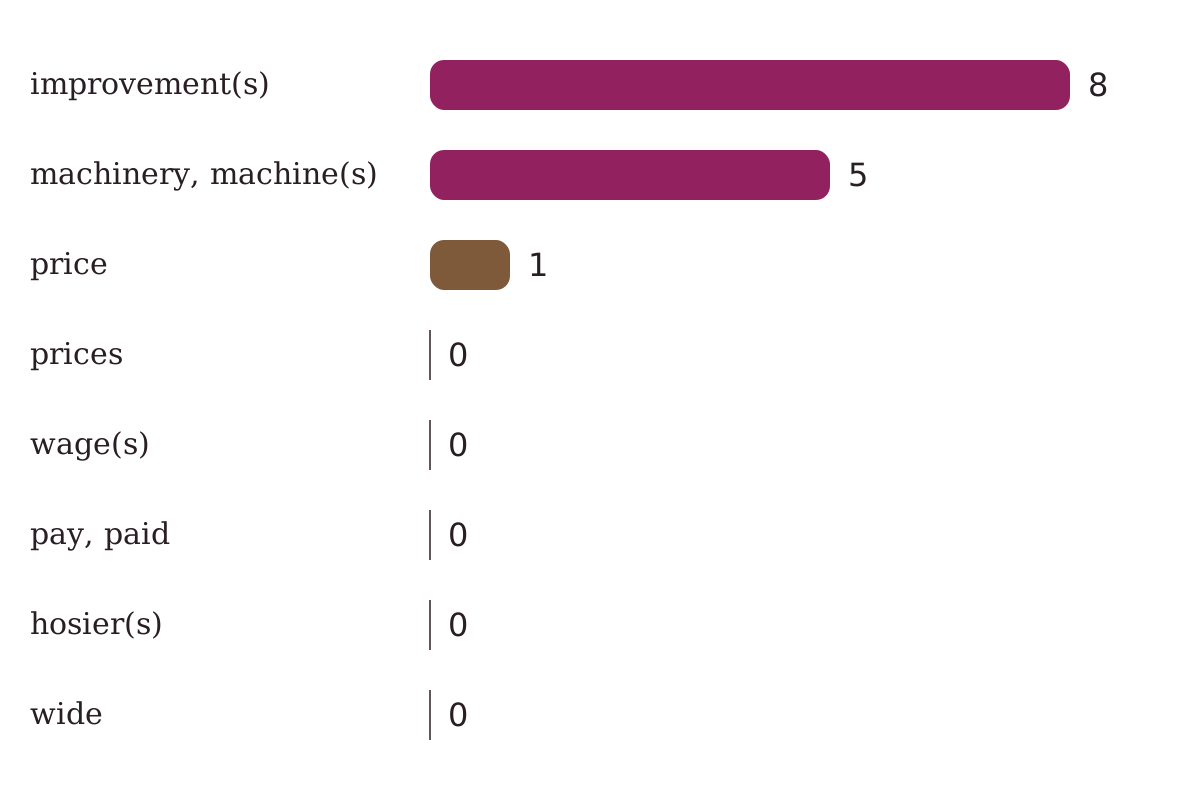
This site’s count of chosen words in the Hansard report of the debate. Hansard condenses speeches, so a missing word does not show a peer was unaware. 27 February 1812.
"Chosen words in the Hansard report of 27 February 1812" by Persuasion Dissected — https://persuasiondissected.com/movements/luddites/ — licensed CC BY 4.0: https://creativecommons.org/licenses/by/4.0/
Data: HL Deb 27 February 1812, vol. 21, cc. 964–79
This site’s count of that report finds “improvement” or “improvements” 8 times and “machinery” or “machines” 5 times. The words “wages,” “prices,” “paid,” “hosiers” and “wide” do not appear. “Price” appears once, in Byron’s line about a man’s life valued at “something less than the price of a stocking-frame.”
Peers did name other causes: Holland named “the fluctuation of the market,” Lauderdale the Orders in Council, and Byron “absolute want.” Conant and Baker’s report on under-pricing was three weeks old by then, and nothing read here shows whether any peer saw it. The House voted 32 to 17 against adjourning and read the bill a second time. Whether a count or a word really answered the question put also runs through the Chartist movement.
The bill received the royal assent on 20 March, raising frame-breaking from fourteen years’ transportation to death. Nottingham’s Town Clerk, Coldham, wrote to the Home Office that his informants would stop: “They cannot they say consent to act where the death of a Fellow Creature must be the consequence.”
Was Yorkshire the same dispute?
The Hammonds treat it as a different one, and so does this page. In the West Riding the target from February 1812 was the shearing frame, machinery that cut the nap off woollen cloth. By their account, one man on the new frame could do the work of four, and the hand workers known as croppers blamed these machines for their troubles and set out to destroy them.
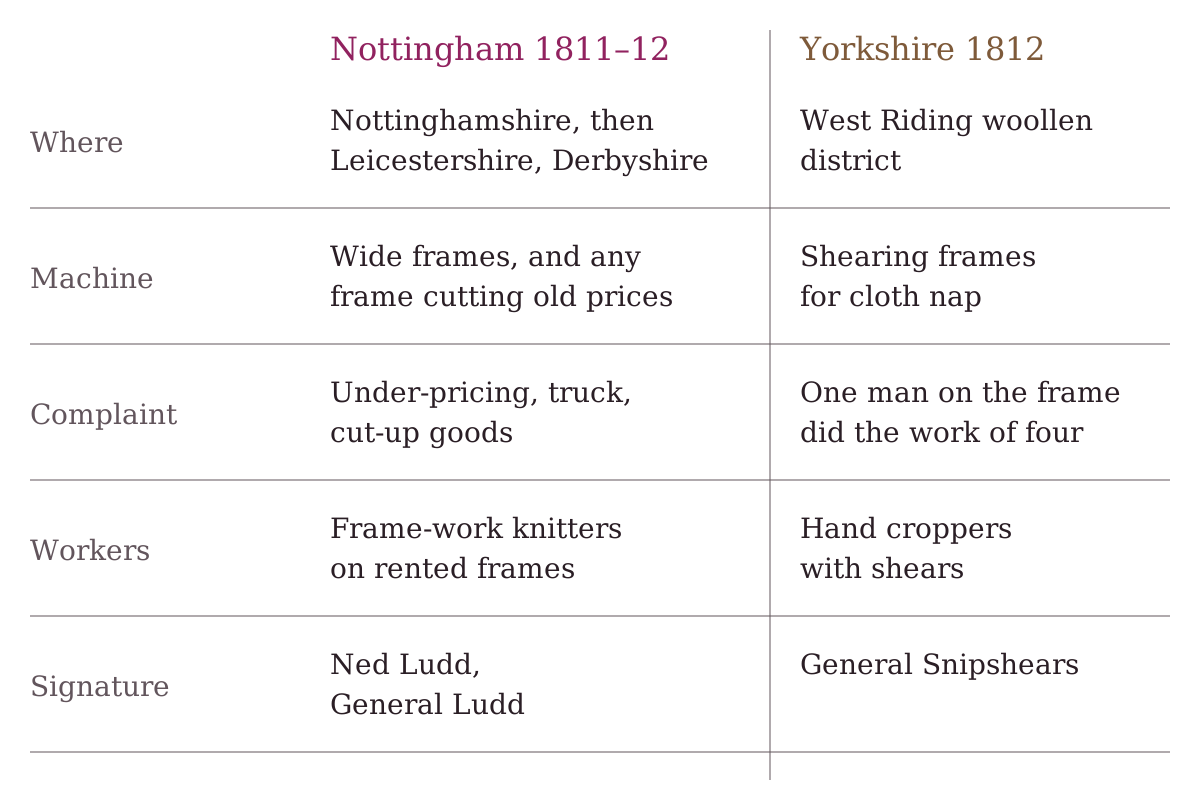
The two disputes side by side, from the Hammonds’ chapters and the documents they print. 1811 to 1812.
"Nottingham and Yorkshire compared" by Persuasion Dissected — https://persuasiondissected.com/movements/luddites/ — licensed CC BY 4.0: https://creativecommons.org/licenses/by/4.0/
The warning letters there came from “General Snipshears,” who told an owner to take his frames down. That campaign sits much closer to the modern sense of the word, because the machine itself was the grievance. The Hammonds give Lancashire a separate chapter, which this page has not read, so the title above holds for the Nottingham papers and goes no further.
Why did the breaking stop?
The first wave died away in February 1812, by the Hammonds’ dating, and later attacks followed. Why it stopped is a matter of interpretation, and the two accounts read here address different end points.
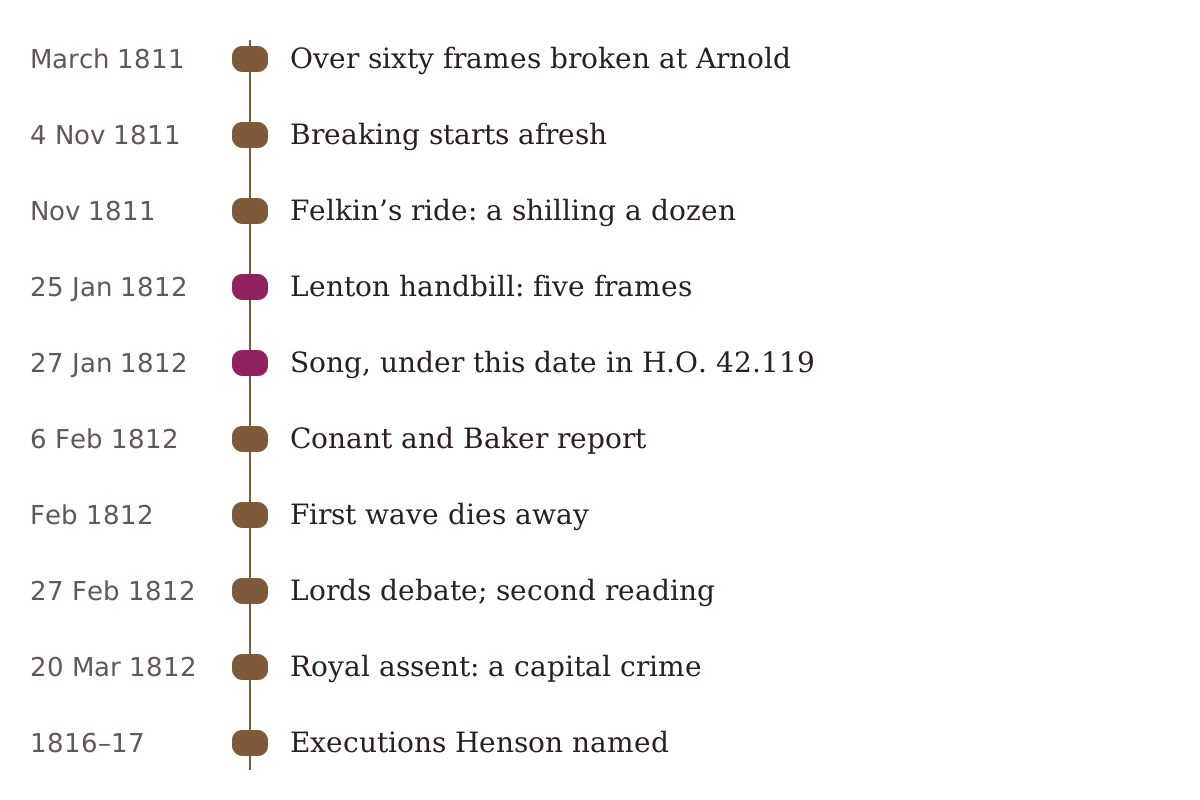
From the first attacks to the executions Henson named. March 1811 to 1817.
"From Arnold to the executions Henson named" by Persuasion Dissected — https://persuasiondissected.com/movements/luddites/ — licensed CC BY 4.0: https://creativecommons.org/licenses/by/4.0/
- J. L. and Barbara Hammond (1919): the 1811–12 wave stopped mainly because the men had won a good part of what they wanted for the time being, and their energy moved to a bill against truck and cut-ups.
- Gravener Henson, as reported by Felkin (1867): “the executions, which took place in 1816-17, were, in his opinion, the efficient cause of the disappearance of Luddism from the midland counties.”
The gains were short-lived. Felkin says that the rate of wages rose 2s. a dozen and “relapsed in 1812,” and that the workmen’s bill passed the Commons and failed in the Lords. At the March 1812 assizes, which fell under the old penalty, four men received fourteen years’ transportation and three received seven. How a movement’s demands fare once a court or a parliament takes them up is also the question in the Montgomery bus boycott.
Later historians have written on all of this, among them E. J. Hobsbawm (1952), E. P. Thompson (1963) and Kevin Binfield (2004). This site has read only their bibliographic details and reports no finding from them.
Crossing map
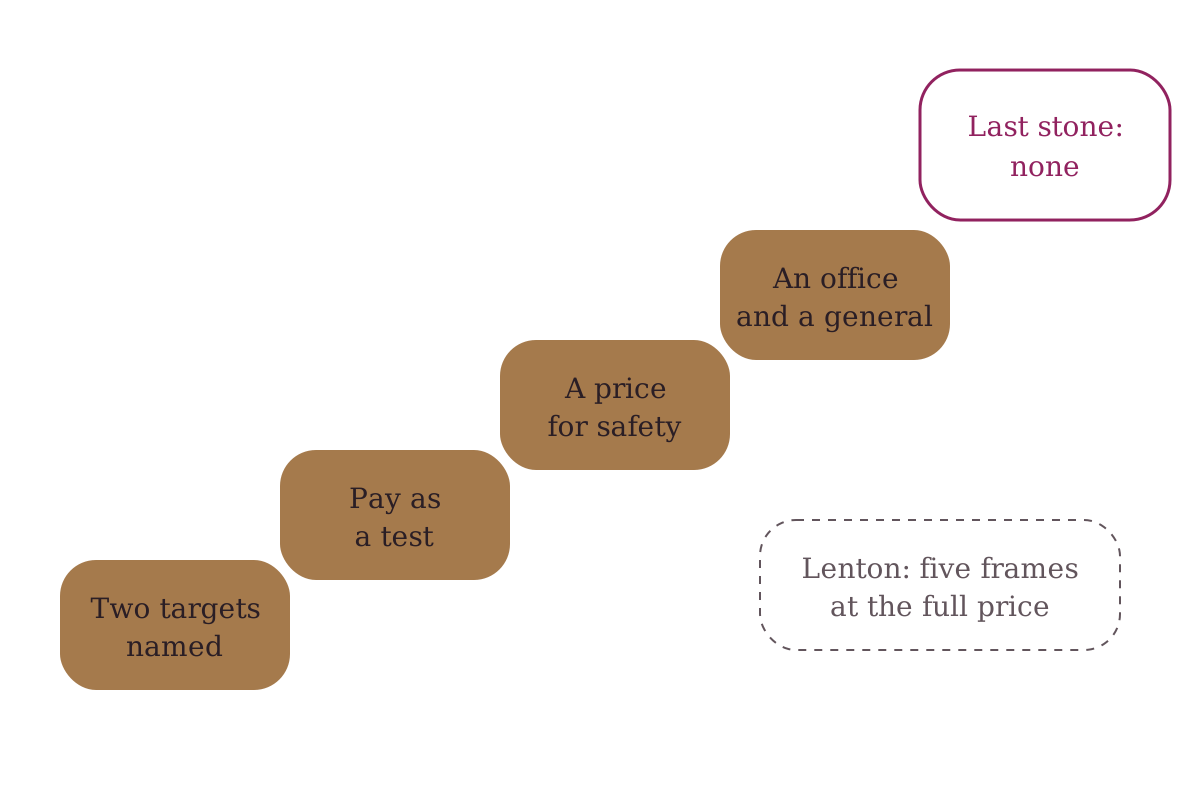
Crossing map of what the Ned Ludd papers asked a hosier to accept. The dashed stone off the path is Lenton. November 1811 to January 1812.
"Crossing map of the Ned Ludd papers" by Persuasion Dissected — https://persuasiondissected.com/movements/luddites/ — licensed CC BY 4.0: https://creativecommons.org/licenses/by/4.0/
- Two targets named. The song names wide frames and frames that abate old prices (H.O. 42.119, Hammond p. 259) [1]
- Pay as a test. The notice threatens frames whose workmen are not paid in coin, “of whatsoever description” (H.O. 42.119, Hammond p. 259) [1]
- A price for safety. One house offers a shilling a dozen and reports that no frame of its own was hurt, by Felkin’s own report (pp. 233–234) [2]
- An office and a general. “Ned Ludds Office,” a charter, a vote of the Trade and an executioner (Hammond pp. 259–260) [1]
- No last stone in this case. The papers state an office, a vote and an executioner but name no one who could call the hammers off, and no hosier’s text records what he assumed about it (Hammond pp. 259–260, 265; Felkin p. 233) [1][2]
Sources
- J. L. Hammond and Barbara Hammond, The Skilled Labourer, 1760–1832 (London: Longmans, Green, 1919). Cited pages: 226–227, 258–261, 263–268, 301–302. archive.orgRead: pages cited; letters, song and reports quoted as printed, the Hammonds’ own text paraphrased
- William Felkin, A History of the Machine-Wrought Hosiery and Lace Manufactures (London: Longmans, Green, Reader, and Dyer, 1867). Cited pages: 231–235, 240–241, 437, 439; opening plate. archive.orgRead: pages cited
- Frame Work Bill, House of Lords debate, 27 February 1812, Hansard, vol. 21, cc. 964–79. api.parliament.ukRead: full text of the report
- E. J. Hobsbawm, “The Machine Breakers,” Past & Present 1 (1952). doi.orgRead: bibliography only
- E. P. Thompson, The Making of the English Working Class (London: Gollancz, 1963). doi.orgRead: bibliography only
- Kevin Binfield, ed., Writings of the Luddites (Baltimore: Johns Hopkins University Press, 2004). doi.orgRead: bibliography only
Next crossing
- The Chartist movement — Another working-class demand, and a Parliament that took up a different question.
- The Melian Dialogue — A stronger side states its terms, and the weaker side has to judge what they are worth.
Cite this page
Persuasion Dissected. "Luddites: Their Song Named Wide Frames, Not All Machines." Persuasion Dissected. Published 2026-11-11. https://persuasiondissected.com/movements/luddites/. Accessed: add the date you read it.
Corrections
No corrections yet.
How pieces are checked · All corrections · Contact · Report an error (contact@persuasiondissected.com)