Munich Agreement: Chamberlain Also Signed a Note With Hitler
In three lines
- Who persuaded whom: The Munich Agreement of 29 September 1938 let Germany occupy the Sudeten German territory of Czechoslovakia by 10 October. Neville Chamberlain then asked Britain to weigh a second paper, signed by Hitler and himself alone.
- Which stones: The paper he showed on his return, by a BBC transcript and later Hansard speeches, was that separate note. It calls the agreement “symbolic” and resolves on consultation, and it holds no deadline, border or penalty.
- Outcome: The Commons approved the policy 366 to 144 on 6 October. On 15 March 1939 German troops entered Bohemia, and Chamberlain said the method was not “in accord with the spirit of the Munich Agreement.”
Route through this piece (9)
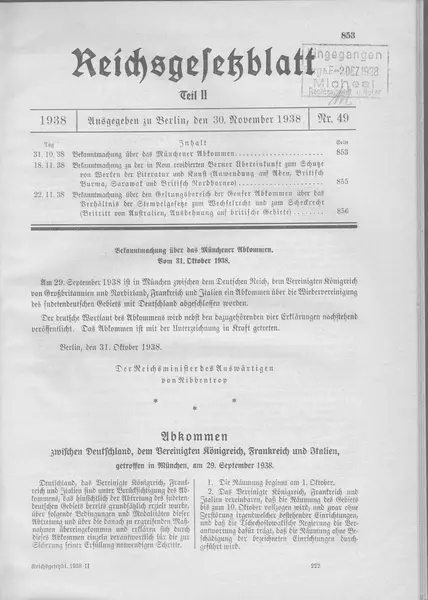
The Munich Agreement as the German law gazette printed it, in the issue dated 30 November 1938. The stamp at top right is a receipt mark, not part of the issue.
"Reichsgesetzblatt 1938, Part II, No. 49, p. 853" by Unknown author. Public domain.
Full credit
"Reichsgesetzblatt 1938, Part II, No. 49, p. 853" by Unknown author — https://commons.wikimedia.org/wiki/File:Deutsches_Reichsgesetzblatt_38T2_049_0853.jpg — Public domain — Public domain in Germany and the EU as an official work (§ 5 UrhG, per the Commons file page; published 1938) and in the US (published 1938; a foreign official work not restored, as it was already public domain in Germany in 1996); modified: resized to 1600 px on the long side; not cropped
Case card
- Case
- The Munich Agreement and the Anglo-German declarationFrench Yellow Book No. 12; HC Deb 3 October 1938, vol. 339, c. 49
- Date range
- 29 September 1938 (agreement) and 30 September 1938 (declaration); debate 3 to 6 October 1938HC Deb vol. 339, cc. 40–162, 324, 499–562
- Place
- Munich; Heston; the House of Commons, LondonBBC broadcast transcript, 30 September 1938; HC Deb vol. 339
- Persuader(s)
- Neville Chamberlain, answered in the Commons by Duff Cooper, Attlee, Sinclair, Eden, Dalton and ChurchillHC Deb vol. 339, cc. 29–162, 337–454
- Audience
- The crowd at Heston, BBC listeners, and the House of CommonsBBC broadcast transcript; HC Deb vol. 339
- The ask
- Treat “the agreement signed last night” and the Anglo-German Naval Agreement as “symbolic of the desire of the two peoples never to go to war with one another again”HC Deb vol. 339, c. 49
- Channel
- Airfield speech and broadcast; statement to the Commons; four days of debateBBC broadcast transcript; HC Deb vol. 339
- Outcome
- Commons approved the policy 366 to 144; the plebiscite was dropped on 13 October 1938; on 15 March 1939 Chamberlain said Britain was no longer bound by the guaranteeHC Deb vol. 339, c. 558; Reichsgesetzblatt 1938 II, p. 854; HC Deb vol. 345, c. 437
- Primary record
- HC Deb 3 October 1938, vol. 339, cc. 40–162; French Yellow Book No. 12UK Parliament historic Hansard; Avalon Project document text
On 3 October 1938, Neville Chamberlain took the Commons through three paragraphs signed only by Hitler and himself. He was defending the Munich Agreement, and those paragraphs ask the House to accept that a line about “the desire of the two peoples” adds something to the terms signed hours earlier. The two documents are separate, and he discussed them separately.
The record here is mostly British: Hansard for the debate of 3 to 6 October, with the agreement’s printed text and American diplomatic telegrams. British Cabinet files and German and Czechoslovak archives were not read. Speakers in the debate were arguing a case, so what they say about the scene is marked as theirs, and no book on Munich was read for this page. Column numbers are from Hansard volume 339 unless marked.
Which paper did Chamberlain hold up?
He named it himself on arrival, under what the BBC’s Richard Dimbleby called “a very dirty and rainy sky.” In a transcript of that broadcast from Heston on 30 September, posted with the recording on Wikimedia Commons, Chamberlain says: “here is the paper which bears his name upon it as well as mine.” He then reads three sentences aloud, and they follow the Anglo-German declaration as he later took it through the Commons. The transcript is unsigned, and this page did not check it against the sound.
Hansard points the same way, though the witnesses are critics of the paper. Mr. Gallacher spoke of “a paper signed by the Fuhrer Chancellor and himself,” which he was “told” Chamberlain waved (c. 278). James Griffiths called it “that piece of paper which was fluttered and televised” (c. 253), Harold Nicolson “the paper which he waved when he arrived” (c. 432), and Mr. Bellenger “a piece of paper,” adding that “many of us might think of it as a scrap of paper” (c. 124).
In March 1939 Commander Bower still described it as “brought back signed by himself and Herr Hitler” (vol. 345, c. 487).
Duff Cooper, the minister who had just resigned, set out the order of events in his speech. Chamberlain “brought home also from Munich something more than the terms to which we had agreed,” a declaration signed “at the farewell meeting” (c. 37).
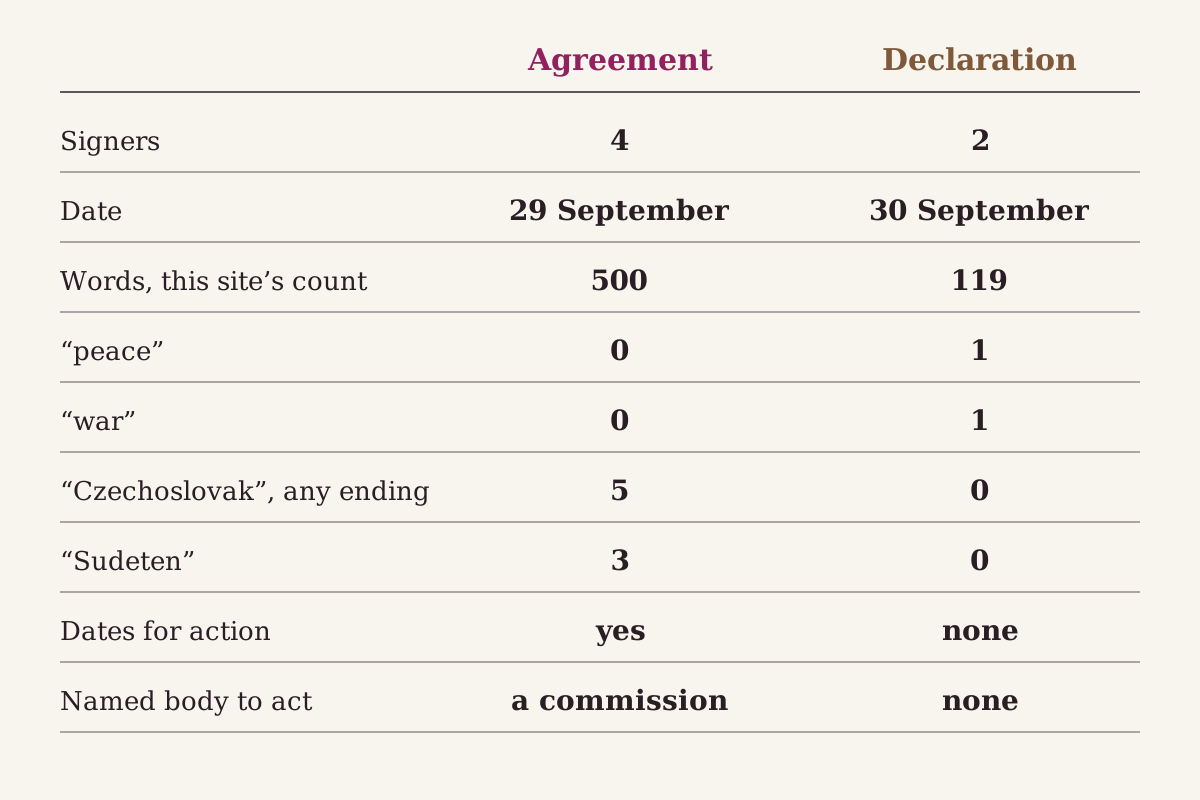
The two papers side by side. Word counts are this site’s, from the printed English texts. 29 and 30 September 1938.
"The two Munich papers side by side" by Persuasion Dissected — https://persuasiondissected.com/bargaining/munich-agreement/ — licensed CC BY 4.0: https://creativecommons.org/licenses/by/4.0/
The difference shows in the wording. This site’s count finds 500 words in the agreement’s preamble and eight paragraphs, leaving out the paragraph numbers, where neither “peace” nor “war” appears. The declaration runs to 119 words in the broadcast transcript, uses each of those words once, and does not mention Czechoslovakia. Each row of the papers CSV (where this data comes from) gives signers, date and coordinates.
What does the Munich Agreement say?
Its opening treats the main question as closed: the four powers act on “the agreement, which has been already reached in principle for the cession to Germany of the Sudeten German territory.” Chamberlain said the same in the House: “We did not go there to decide” whether those areas would pass to the Reich. “That had been decided already” (cc. 41–42). The terms were “the method, the conditions and the time.”
The agreement also binds its signers, who “each hold themselves responsible for the steps necessary to secure its fulfillment.” Evacuation begins on 1 October, and German troops occupy four marked territories in order by 7 October, then the remainder by the 10th. An international commission rules on the rest, including where a plebiscite, a popular vote on the territory, would be held “not later than the end of November.”
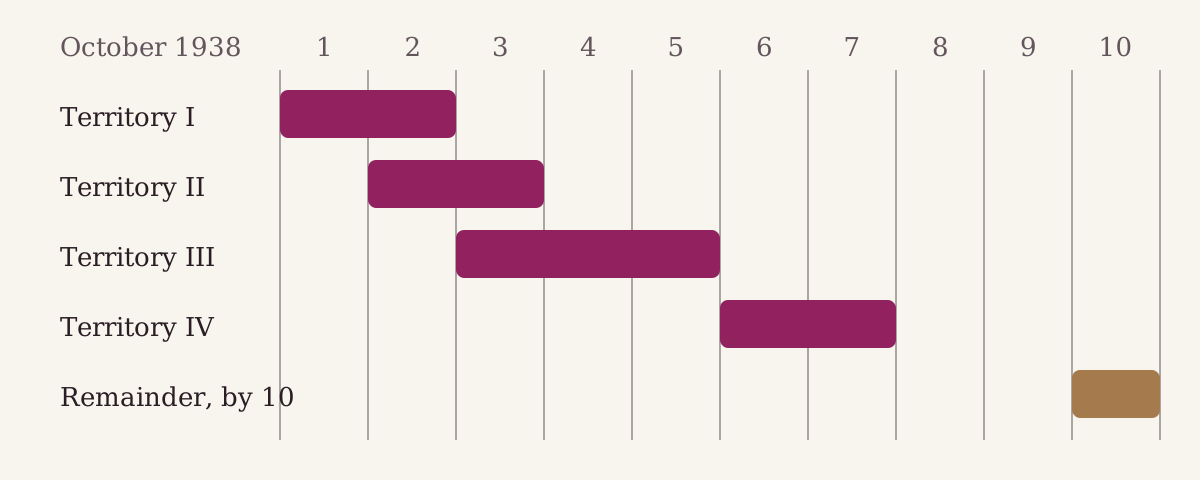
The occupation timetable in paragraph 4 of the agreement. 1 to 10 October 1938.
"The occupation timetable in paragraph 4" by Persuasion Dissected — https://persuasiondissected.com/bargaining/munich-agreement/ — licensed CC BY 4.0: https://creativecommons.org/licenses/by/4.0/
An annex carries the promise made to Czechoslovakia. Britain and France “stand by the offer” of “an international guarantee of the new boundaries,” and Germany and Italy will give one once the Polish and Hungarian minority questions are settled. That is a stated offer, with its own conditions, in a signed text.
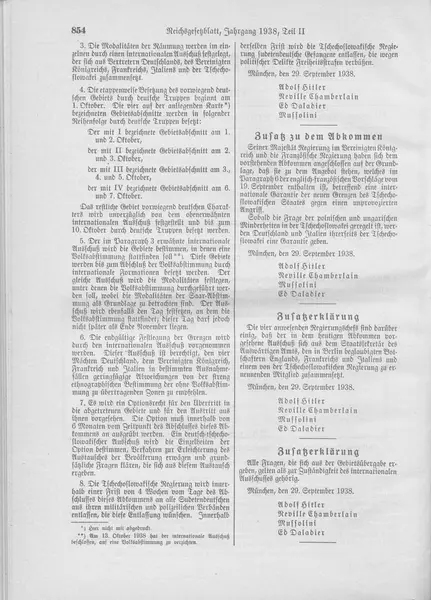
The rest of the agreement in the gazette, with a footnote on the plebiscite at the foot of the page. Issue of 30 November 1938.
"Reichsgesetzblatt 1938, Part II, No. 49, p. 854" by Unknown author. Public domain.
Full credit
"Reichsgesetzblatt 1938, Part II, No. 49, p. 854" by Unknown author — https://commons.wikimedia.org/wiki/File:Deutsches_Reichsgesetzblatt_38T2_049_0854.jpg — Public domain — Public domain in Germany and the EU as an official work (§ 5 UrhG, per the Commons file page; published 1938) and in the US (published 1938; a foreign official work not restored, as it was already public domain in Germany in 1996); modified: resized to 1600 px on the long side; not cropped
Who signed, and where was Czechoslovakia?
The names printed under the agreement are Hitler, Chamberlain, Daladier and Mussolini. The same four sign the annex and three further declarations. No Czechoslovak name appears on any of the six papers in the table, though one declaration gives Prague a seat on the commission, “a representative to be nominated by the Government of Czechoslovakia.”
| Paper | Hitler | Chamberlain | Daladier | Mussolini | Czechoslovakia |
|---|---|---|---|---|---|
| Agreement, 29 September | yes | yes | yes | yes | no |
| Annex on the guarantee | yes | yes | yes | yes | no |
| Declaration on minorities | yes | yes | yes | yes | no |
| Supplementary declaration | yes | yes | yes | yes | no |
| Commission’s composition | yes | yes | yes | yes | no |
| Anglo-German declaration, 30 September | yes | yes | no | no | no |
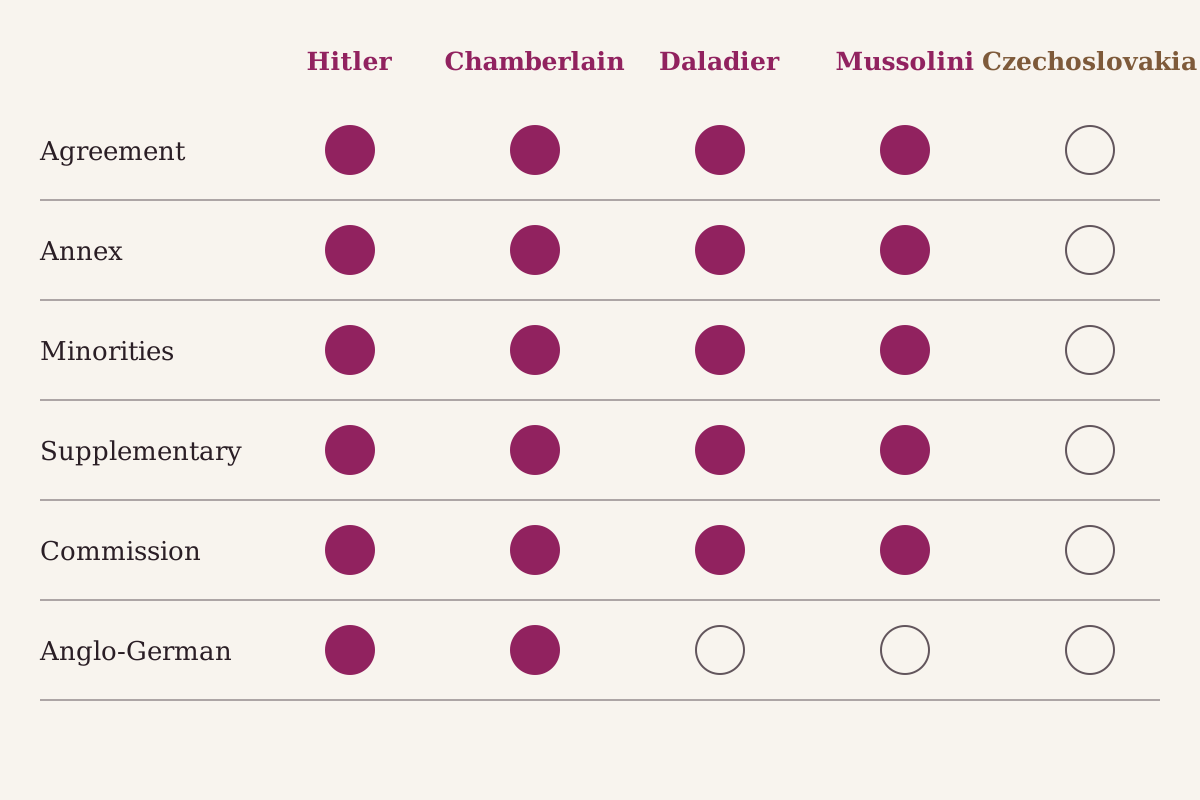
Who signed which paper. The last column is empty on all six. 29 and 30 September 1938.
"Who signed which Munich paper" by Persuasion Dissected — https://persuasiondissected.com/bargaining/munich-agreement/ — licensed CC BY 4.0: https://creativecommons.org/licenses/by/4.0/
What happened around the table is less settled. Hugh Dalton said he was “informed” that “some Czechs were allowed to be present in an ante-room as a great concession” and “were never consulted at all” (c. 147). Two days later he spoke of “the fact that the Czechs were left outside the door,” and Mr. Butler, the Under-Secretary for Foreign Affairs, answered, “That is not the case” (c. 311). Dalton asked ministers to confirm his account, and the reply closing that night’s debate does not mention the ante-room.
Others spoke to the wider pattern from outside the conference. Sir Archibald Sinclair said the Czechs had “never been allowed to meet the Germans face to face” (c. 72), and Anthony Eden said, “Czechoslovakia was not even heard in her own defence” (c. 82). Chamberlain had said earlier that day that Prague had already accepted the Anglo-French proposals (c. 42) and that it was represented on the commission (c. 43). Another conference text on a third country’s future, read in different ways within weeks, is the Yalta Conference.
How did Chamberlain read the declaration to the House?
He read it only after a long comparison with Hitler’s earlier demands at Godesberg. That memorandum, he said, “was in fact an ultimatum, with a time limit of six days,” while Munich spread the occupation over stages, gave the line and the plebiscite areas to a commission, and dropped an appendix under which no foodstuffs, cattle or raw material could be removed (cc. 42–44). The changes, he said, were “all in the same direction” (c. 45).
Not everyone accepted the size of that gain. Mr. Amery said on 4 October that “the time-table” had been presented as extended, and noted that the Czechs “were originally given from 23rd September to 1st October—seven days” (c. 201), though by this site’s count those two dates are eight days apart.
Only then did Chamberlain come to his morning talk with Hitler, “for which I asked.” “I entered into no pact. I made no new commitments. There is no secret understanding” (c. 48).
After that he took the paper paragraph by paragraph. After the first he asked, “Does anyone deny that?” Of the second he said, “The second is an expression of opinion only.” After the third, on “the method of consultation,” he asked, “Who will stand up and condemn that sentence?” (c. 49).
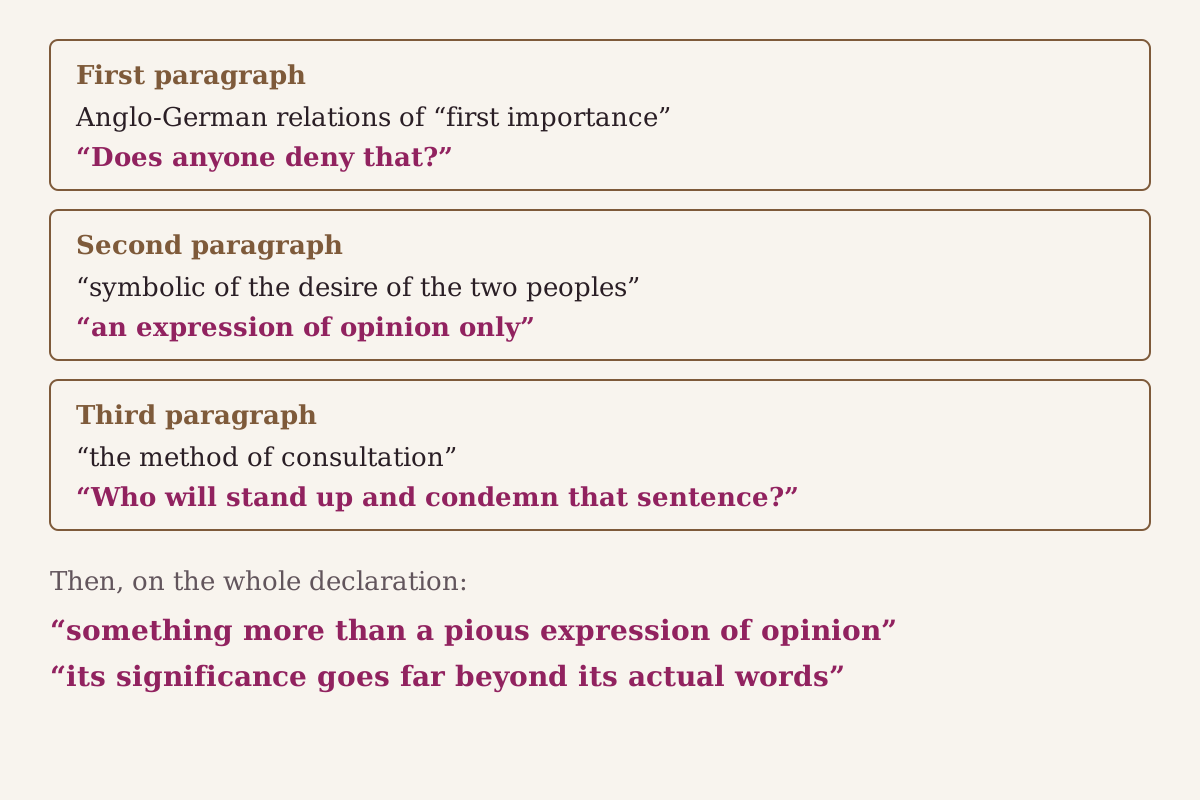
The declaration as Chamberlain took it through the House, with his words beside each paragraph. 3 October 1938.
"The declaration as Chamberlain read it to the House" by Persuasion Dissected — https://persuasiondissected.com/bargaining/munich-agreement/ — licensed CC BY 4.0: https://creativecommons.org/licenses/by/4.0/
The same column then moves the other way. Such a declaration, he said, “is something more than a pious expression of opinion,” and “its significance goes far beyond its actual words.” On this site’s reading, the note therefore stands in Hansard with its second paragraph as an opinion only and the whole as more than an opinion, a few lines apart.
One word also varies: Hansard prints “the two peoples” and the Wikimedia Commons transcript of the broadcast “our two peoples.” The signed original was not read.
How did the House read the paper?
Readers took different things from the same three sentences. Duff Cooper “saw no harm” in the terms, but he objected that it was signed “without consulting with his colleagues,” and he gave the content as “That Great Britain and Germany will not go to war in future and that everything will be settled by negotiation” (cc. 37–38). The text itself states a desire and a resolve.
Chamberlain’s own summary to Daladier, printed in Hansard, runs in a similar direction, saying the two men “have agreed that our respective peoples are united in their desire for peace and for friendly consultation in all differences that may arise” (c. 325). On 5 October G. R. Strauss called it “very unfortunate” not to have consulted France first, and Chamberlain replied, “I do not gather from M. Daladier’s reply that he took that view” (c. 324).
Sinclair said he was “left wondering still whether there is any real meaning and content in it,” and he reminded the House of an assurance about Czechoslovakia that Chamberlain had asked it to rely on that March (c. 76).
Griffiths predicted “disillusionment” once people found they were asked to rearm against “the man who signed that piece of paper” (c. 253). Viscount Cranborne warned on 4 October of “a tendency in some quarters to assume that this declaration in itself ensures peace in our time” (c. 234). In 1939 Bower set it beside the Kellogg Pact and could not “see very much difference between the two of them” (vol. 345, c. 487).
The wider verdicts split just as sharply. Clement Attlee said “we have nothing but an armistice” (c. 51), and Winston Churchill called it “a total and unmitigated defeat” (c. 360).
Chamberlain’s reply on the last day was, “by my action I did avert war,” and he cited more than 20,000 letters and telegrams to Downing Street, of which he had seen “a tiny fraction,” as evidence that people did not feel they had a cause to fight for (cc. 545–546). His own count of that mail cannot be checked here, and later judgments on appeasement are beyond this page, which reads only the debate.
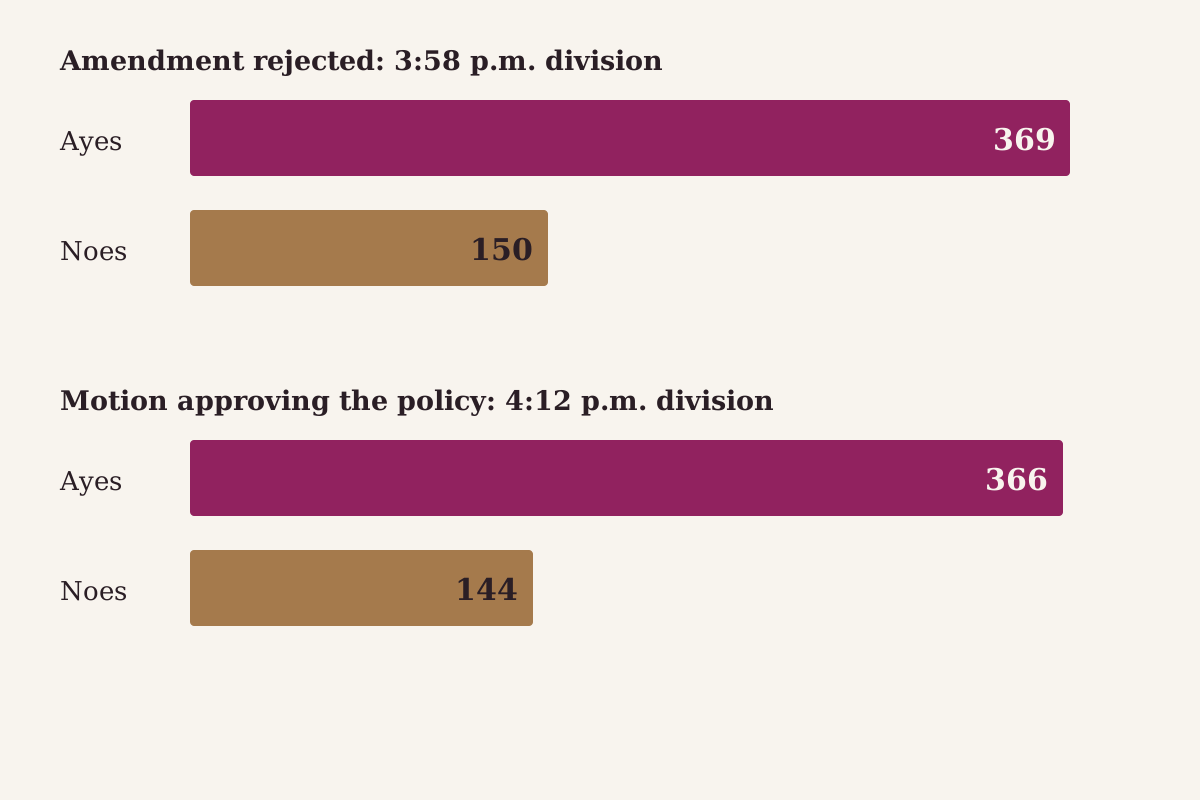
The two divisions that closed the debate. 6 October 1938.
"The two divisions of 6 October 1938" by Persuasion Dissected — https://persuasiondissected.com/bargaining/munich-agreement/ — licensed CC BY 4.0: https://creativecommons.org/licenses/by/4.0/
The House then voted twice. Members rejected the amendment by 369 to 150, then approved the motion by 366 to 144 (cc. 554–558). The motion backed the policy “by which war was averted in the recent crisis.” It did not mention the note.
Where did “peace for our time” come from?
The phrase is not in the Heston transcript. There he calls the settlement “only the prelude to a larger settlement in which all Europe may find peace,” which is a hope about the future and carries no date. Duff Cooper places the claim later that evening, heard from the hall at Downing Street: “from the window above,” Chamberlain said he had returned “like Lord Beaconsfield, with ‘peace with honour,’ claiming that it was peace for our time” (c. 29).
Chamberlain revisited it within the week. On 6 October he said he had been asked how a call for more arms fit “the words which I used when I came back from Munich.” “I hope hon. Members will not be disposed to read into words used in a moment of some emotion, after a long and exhausting day,” he said.
“I do indeed believe that we may yet secure peace for our time,” he went on, “but I never meant to suggest that we should do that by disarmament” (c. 551). The note is one thing and the phrase another, though Griffiths and later speakers ran them together.
Two papers came home from Munich, one far shorter than the other. 30 September 1938.
Illustration — not a historical depiction
Illustration: Persuasion Dissected. Generated schematic illustration — not a photograph or historical record. Reuse: CC BY 4.0 (https://creativecommons.org/licenses/by/4.0/), to the extent any rights exist.
Did the clock decide it?
This site’s working hypothesis is that in the historical negotiations it covers, deadlines and the exit cost, the documented barriers to leaving, often explain the outcome better than opening tactics do. The debate gives that some support for the agreement. Chamberlain called time “one of the essential factors” (c. 42), Mussolini’s suggestion postponed the final stages of mobilization “for 24 hours” (c. 47), and Attlee said “time limits” had been laid down at every stage (c. 51).
The American telegrams show how short the time was in Prague. The minister there reported that the German chargé delivered the text “at 6 o’clock this morning” on 30 September, with evacuation “beginning tomorrow.” In London the American ambassador recorded a Mr. Masaryk saying that a reply was wanted by “12 o’clock,” that Prague felt “sold down the river,” and that mobilization was “costing them $10,000,000 a day.” That deadline and figure reach this page second-hand.
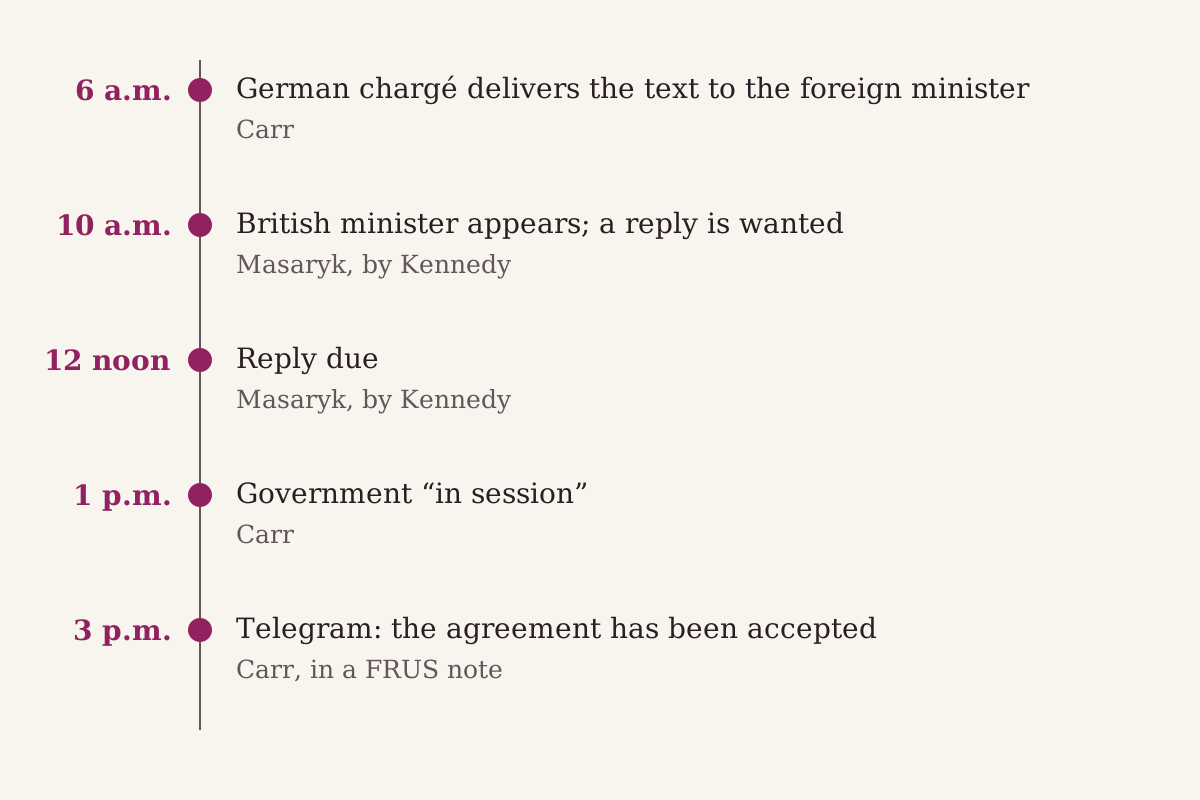
The day of 30 September in Prague, as American telegrams report it. Times are as each telegram gives them.
"The day of 30 September 1938 in Prague" by Persuasion Dissected — https://persuasiondissected.com/bargaining/munich-agreement/ — licensed CC BY 4.0: https://creativecommons.org/licenses/by/4.0/
The note is a counterexample to the hypothesis, because no deadline in the record forced it: the agreement was already signed, Chamberlain says he asked for the talk himself, and he calls it “friendly and entirely non-committal” (c. 48). Nor does the record read here show a price for walking away from that morning’s meeting. A very different exchange between a strong power and a weak one, written up long afterward, is the Melian Dialogue.
What happened to the promises on paper?
The plebiscite went first. A footnote in the German gazette says that on 13 October 1938 the commission decided to do without one. In March 1939 David Grenfell asked, “What has happened to the plebiscite?” and charged that “It never was intended” (vol. 345, c. 446).
The same gazette notice says the agreement took effect on signing, while the gazette printed the German text only in its issue of 30 November. When a text starts to bind is a question the Montgomery bus boycott raises in another form.
The guarantee followed. On 4 October Sir Thomas Inskip said it was technically not yet in force, but that the government felt “under a moral obligation” to treat it as if it were (c. 303). On 15 March 1939 Chamberlain said no agreement on its terms had been reached, and that since Slovakia’s declared independence his government “cannot accordingly hold themselves any longer bound” (vol. 345, c. 437).
The money moved on a similar path. On 3 October Chamberlain had reported Prague’s appeal for help raising a loan of £30,000,000 and announced an advance of £10,000,000, leaving its relation to any final figure “for the future” (c. 46). By 15 March, he said, Czechoslovakia had drawn £3,250,000, and the Bank of England was being asked to make no further payments from the remaining £6,750,000 until the position was clear (vol. 345, cc. 437–438).
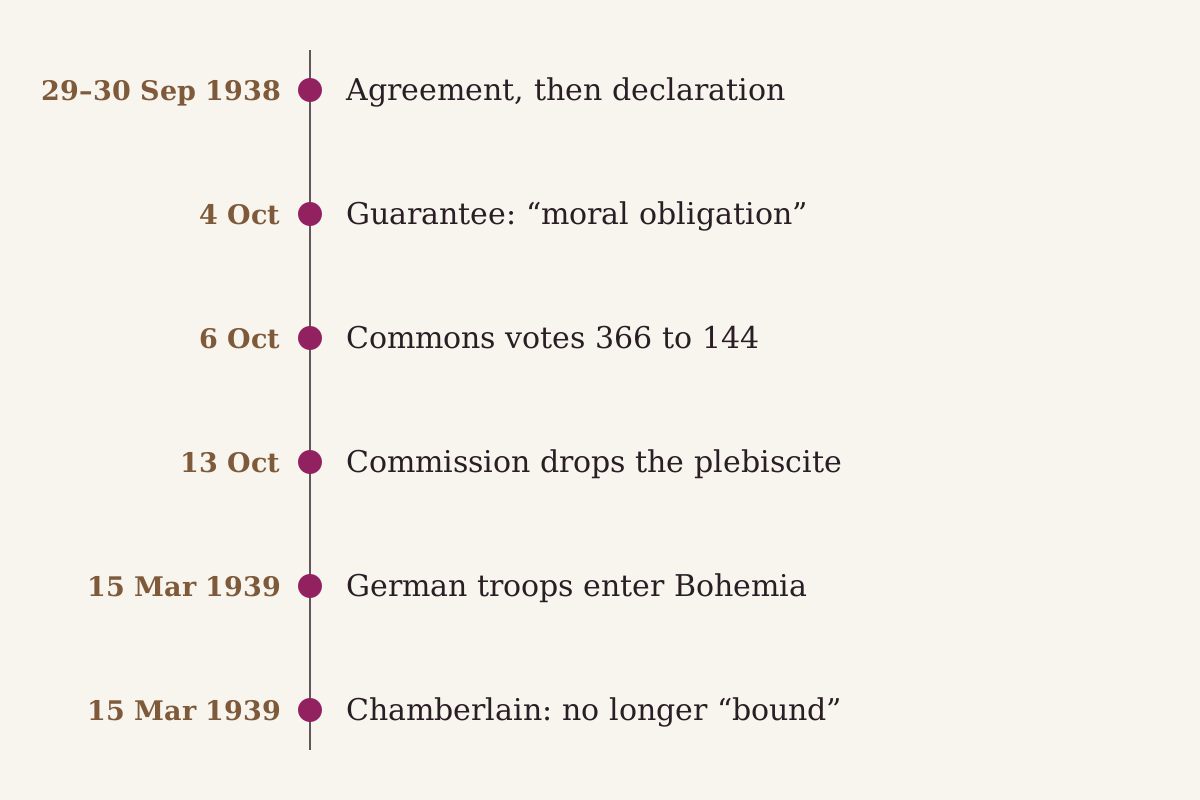
From the signing to the German entry into Bohemia. By this site’s count, 15 March 1939 is 166 days after the declaration of 30 September 1938. September 1938 to March 1939.
"From the signing to March 1939" by Persuasion Dissected — https://persuasiondissected.com/bargaining/munich-agreement/ — licensed CC BY 4.0: https://creativecommons.org/licenses/by/4.0/
The note’s promise of consultation met a test that day, on this site’s reading. Chamberlain told the House that German troops had crossed the Munich line “without, so far as I know, any communication with the other three signatories” (vol. 345, c. 440). He said he did not wish to associate himself with “charges of breach of faith” (c. 439), and that he could not regard the method “as in accord with the spirit of the Munich Agreement.”
Crossing map
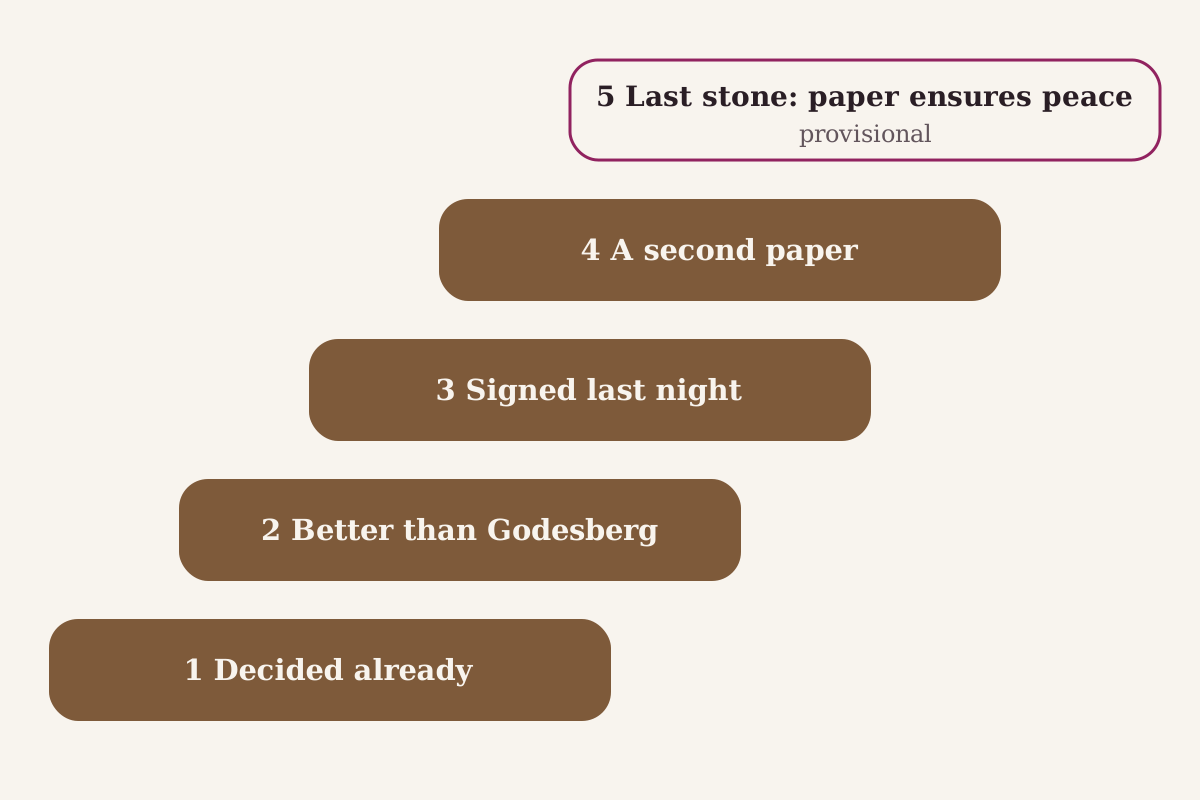
Crossing map of the case Chamberlain made for the two papers. 30 September to 6 October 1938.
"Crossing map of the case for the two papers" by Persuasion Dissected — https://persuasiondissected.com/bargaining/munich-agreement/ — licensed CC BY 4.0: https://creativecommons.org/licenses/by/4.0/
- Decided already. The transfer is off the table, and only “the method, the conditions and the time” remain (cc. 41–42) [1] [2]
- Better than Godesberg. The measure offered is the earlier demand, and “It is no longer an ultimatum” (cc. 42–45) [1]
- Signed last night. The note refers to the agreement as finished business and calls it “symbolic” (c. 49) [1] [4]
- A second paper. Chamberlain’s “paper which bears his name upon it as well as mine” adds Hitler’s signature to a stated desire [4] [1]
- The last stone: this paper ensures peace. Provisional. The text stops at “the desire of the two peoples,” and Chamberlain called that paragraph “an expression of opinion only” (c. 49). Cranborne reported the assumption that it “in itself ensures peace in our time” (c. 234), and Bower recalled a popular view that it “really meant something” (vol. 345, c. 487) [1] [5] [11]
This site uses the last stone for a premise the speaker leaves unsaid and the audience supplies, and the label stays provisional here. Chamberlain did say the note’s significance went “far beyond its actual words,” and by Cooper’s account he claimed “peace for our time” from the window, but the passages read do not have him saying that the note itself secures it. The evidence that others took that step is three speeches by critics of the paper, Cranborne, Griffiths and Bower, each describing what other people assumed, and Griffiths also credits “broadcasts” and “newspaper reports” (c. 253). No speech read here comes from someone who says he held that view, and the record does not show what the cheering crowd or any member privately believed.
Sources
- House of Commons debate, European Situation: Prime Minister’s Statement, 3 October 1938, Hansard, vol. 339, cc. 40–162. api.parliament.ukRead: full text of Chamberlain’s statement; Attlee’s opening; searched passages of the rest
- Agreement concluded at Munich, September 29, 1938, French Yellow Book, No. 12, with annex and declarations. avalon.law.yale.eduRead: full text of the document; editor’s text not used
- House of Commons debate, Personal Explanation (Duff Cooper), 3 October 1938, Hansard, vol. 339, cc. 29–40. api.parliament.ukRead: sections on the declaration and the window speech, cc. 29, 36–38
- BBC broadcast from Heston by Richard Dimbleby with Neville Chamberlain, 30 September 1938; transcript on the Wikimedia Commons file page. commons.wikimedia.orgRead: full transcript on the file page; recording not played, BBC page not traced back
- House of Commons debate, European Situation, 4 October 1938, Hansard, vol. 339, cc. 169–308. api.parliament.ukRead: sections on the paper and the guarantee, cc. 201, 234, 253, 278, 281, 303
- House of Commons debate, Policy of His Majesty’s Government, 5 October 1938, Hansard, vol. 339, cc. 337–454. api.parliament.ukRead: sections on the paper and Churchill’s opening, cc. 360, 432
- House of Commons oral answers, Czechoslovakia, cc. 309–317, and Anglo-German Declaration, cc. 324–325, 5 October 1938, Hansard, vol. 339. api.parliament.ukRead: full text of the Anglo-German Declaration answer; first part of the Czechoslovakia answers
- House of Commons debate, Policy of His Majesty’s Government, 6 October 1938, Hansard, vol. 339, cc. 499–562. api.parliament.ukRead: sections: Chamberlain’s closing speech, cc. 544–554, and the two divisions
- Foreign Relations of the United States, 1938, vol. I (General), doc. 681, Kennedy to the Secretary of State, 30 September 1938; doc. 682, Carr to the Secretary of State, 30 September 1938, pp. 702–703. history.state.govRead: full text of these two documents; Section V list
- Reichsgesetzblatt 1938, Part II, No. 49 (30 November 1938), pp. 853–854: notice of 31 October 1938 and German text of the agreement. commons.wikimedia.orgRead: pages 853–854, read from the page images
- House of Commons debate, Czecho-Slovakia, 15 March 1939, Hansard, vol. 345, cc. 435–555. api.parliament.ukRead: full text of Chamberlain’s statement, cc. 435–440; searched passages of the rest

Next crossing
- The Yalta Conference — Another conference text carried home, and read in different ways within weeks.
- The Zola libel trial — A case where the wording put before an audience was narrower than the argument around it.
Cite this page
Persuasion Dissected. "Munich Agreement: Chamberlain Also Signed a Note With Hitler." Persuasion Dissected. Published 2026-11-11. https://persuasiondissected.com/bargaining/munich-agreement/. Accessed: add the date you read it.
Corrections
No corrections yet.
How pieces are checked · All corrections · Contact · Report an error (contact@persuasiondissected.com)