Seward’s Folly: The 93 to 43 Vote Was to Suspend House Rules
In three lines
- Who persuaded whom: William Seward pressed Russia’s minister to sign overnight, by his son’s account, and bought Alaska for $7.2 million. Critics mocked the deal as “Seward’s Folly,” his son recalled, and the House still had to pay.
- Which stones: The land was bought before the money was voted. On 25 November 1867 the House voted 93 to 43 to suspend its rules for a resolution against further purchases, and its mover said it did not apply to Alaska.
- Outcome: The resolution then passed with no count printed. The House voted the money 113 to 43 on 14 July 1868, and the Treasury warrant is dated 1 August 1868.
Route through this piece (8)
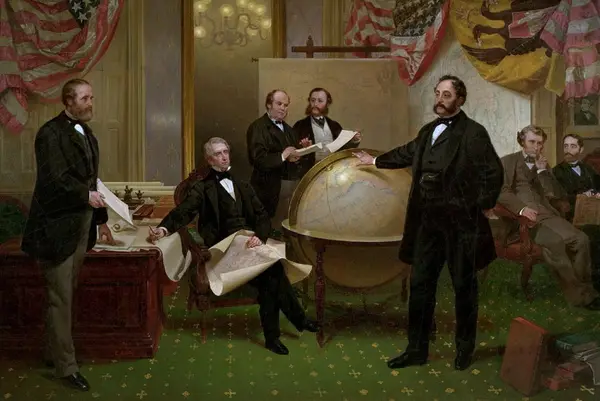
Emanuel Leutze’s painting of the treaty night, made after the event. About 1867.
"Signing the Alaska Treaty of Cessation, painting by Emanuel Leutze" by Emanuel Leutze — https://commons.wikimedia.org/wiki/File:Alaska_purchase.jpg — Public domain — Public domain in the US (painted 1867, author died 1868) and in the EU (Emanuel Leutze died 1868, life+70); modified: the card frame may trim a few pixels
Case card
- Case
- The purchase of Alaska and the House votes that followed itCongressional Globe, 40th Cong.; Treaty of Cession
- Date range
- 29 March 1867 (the treaty night, by his son’s account) to 1 August 1868 (the warrant)F. W. Seward, Reminiscences (1916), p. 361; National Archives
- Place
- Washington; the State Department and the House of RepresentativesF. W. Seward, Reminiscences (1916), p. 362; Congressional Globe
- Persuader(s)
- William H. Seward; in the House, N. P. Banks and Mr. Spalding for payingF. W. Seward, Reminiscences (1916), p. 365; Congressional Globe, pp. 3810, 4055
- Audience
- Edouard de Stoeckl, the Senate, then the House of RepresentativesF. W. Seward, Reminiscences (1916), pp. 361–363
- The ask
- “Let us make the treaty tonight!”, as his son recalled itF. W. Seward, Reminiscences (1916), p. 362
- Channel
- A treaty, then floor debate and roll calls on the moneyTreaty of Cession; Congressional Globe
- Outcome
- House passed the money 113 to 43 on 14 July 1868; warrant dated 1 August 1868Congressional Globe, p. 4055; National Archives
- Primary record
- Treaty text, Treasury warrant and Congressional Globe, with one memoir for the first nightNational Archives; Congressional Globe; F. W. Seward, Reminiscences (1916)
On 29 March 1867, by his son’s account, William Seward left a whist table to write a treaty. The line asks Stoeckl to accept that the sale could not wait for morning. “Seward’s Folly” is the jeer remembered for the deal, yet the House’s 93 to 43 is a different thing: a vote to suspend the rules, on a resolution whose mover said it did not apply to Alaska.
That distinction decides what the numbers can prove, because a motion about procedure cannot carry the weight that a verdict on Alaska would. This page reads the record in order: the night of the treaty, the origin of the nickname, the 1867 vote on more land, and the 1868 roll call on the money.
How did a whist game become a treaty by morning?
One witness supplies the account of the scene read here. F. W. Seward was Assistant Secretary of State in 1867, and his memoir appeared in 1916, so the story comes from a participant and a son, published nearly fifty years afterward. He says his father was playing whist at home on Friday evening when Edouard de Stoeckl, the Russian minister, arrived with a cabled consent from the Emperor and offered to start “tomorrow.”
“But your Department is closed,” Stoeckl objects in this telling. “You have no clerks, and my secretaries are scattered about the town.” Seward told him to gather his legation. By four o’clock on Saturday morning the treaty was “engrossed, signed, sealed.” The son’s reason is a calendar: “There was need of this haste, in order to have it acted upon before the end of the session, now near at hand.”
He also recalls the price. “The Russians thought $10,000,000 would be a reasonable amount. Seward proposed $5,000,000.” The difference was divided, the half million was dropped at Seward’s suggestion, and $200,000 went back on to clear the rights of the Russian fur company. Neither side, he says, “was especially tenacious about the amount.” No Russian account was read for this page.
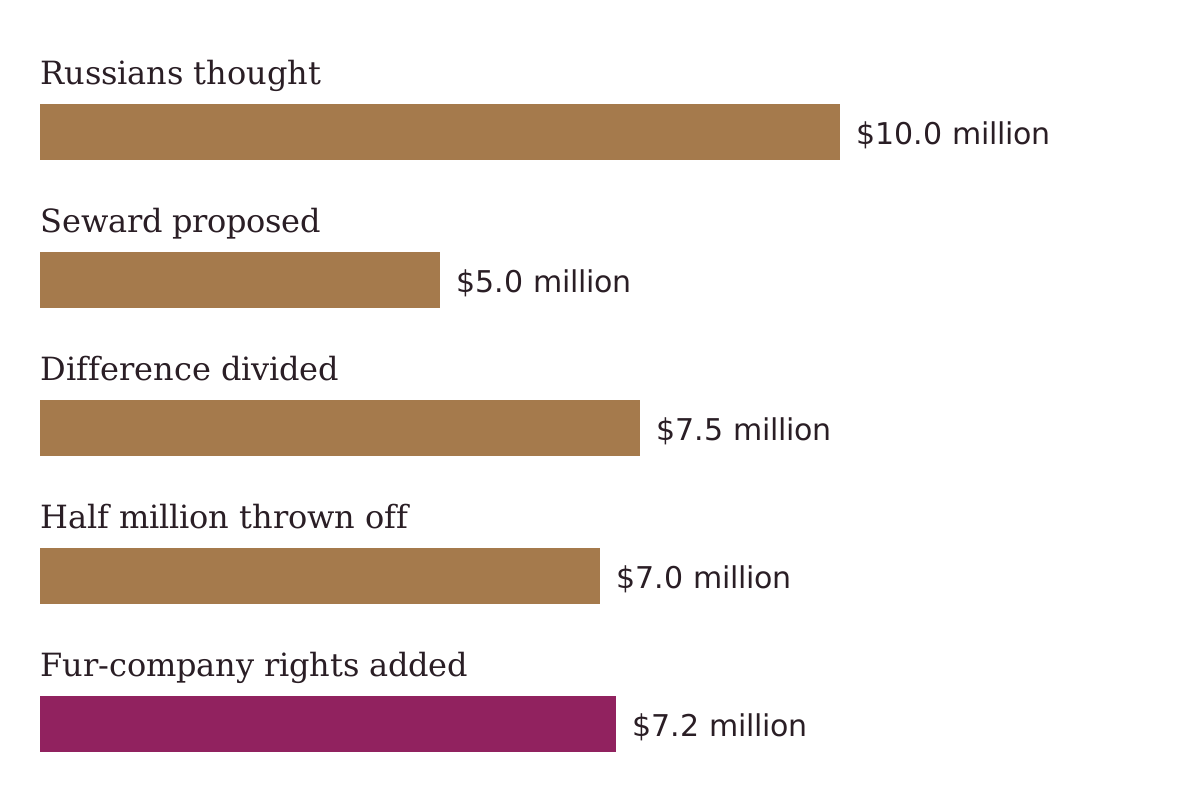
The price steps in the order F. W. Seward recalled them, 1867. Only the last figure is in the treaty.
"Price steps as F. W. Seward recalled them" by Persuasion Dissected — https://persuasiondissected.com/bargaining/sewards-folly/ — licensed CC BY 4.0: https://creativecommons.org/licenses/by/4.0/
Data: F. W. Seward, Reminiscences (1916)
Article VI of the treaty fixes “seven million two hundred thousand dollars in gold,” payable “within ten months after the exchange of the ratifications.” The National Archives puts the land at nearly 600,000 square miles and the cost at “less than 2 cents an acre”; this site’s arithmetic on those figures gives about 1.9 cents. The price table (where this data comes from) holds only the treaty and warrant amounts.
The son says the Senate confirmed the treaty “without serious opposition,” and Mateusz Jeleń’s 2023 study of the press reports the count as 37 to 2 [study stub: archival / review; N not applicable; preregistered: not applicable]. Ratifications were exchanged on 20 June 1867. One step remained that the President and Senate could not take alone, since only Congress could vote the money. As with Talleyrand’s reports from the Congress of Vienna, the first night here rests on an account by someone with a stake in how it looks.
Why was it called Seward’s Folly?
Because critics of the purchase mocked it, by the plainest account read here, though that account is the son’s. He writes of “a storm of raillery in conversation and ridicule in the press,” with the land called “a barren, worthless, God-forsaken region” whose products were “icebergs and polar bears.” Then: “It was ‘Seward’s Folly.’ It was ‘Johnson’s Polar Bear Garden.’” He names no paper and gives no date.
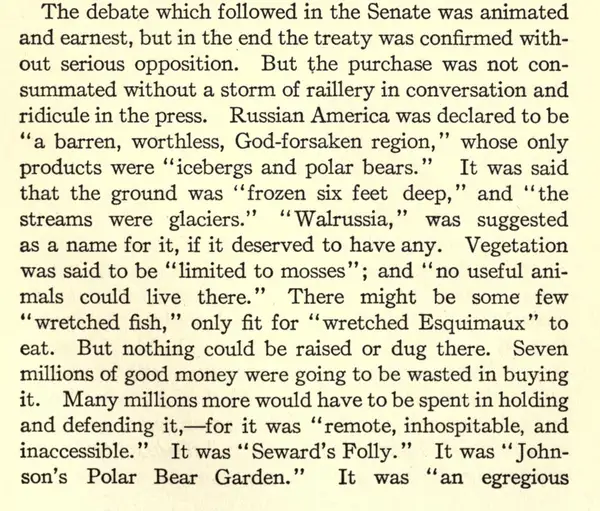
F. W. Seward’s list of the jeers, in his memoir, p. 363. 1916.
"F. W. Seward, Reminiscences of a War-Time Statesman and Diplomat (1916), p. 363" by Frederick W. Seward. Public domain.
Full credit
"F. W. Seward, Reminiscences of a War-Time Statesman and Diplomat (1916), p. 363" by Frederick W. Seward — https://archive.org/details/reminiscencesofw00sewa/page/363 — Public domain — Public domain in the US (published 1916) and in the EU (Frederick W. Seward died 1915, life+70); modified: cropped to the passage listing the jeers
He has an explanation ready too: “Most of these jeers and flings were from those who disliked the President and blamed Seward for remaining in his Cabinet.” That is a son’s reading of his father’s critics, and he hedges the next sentence with “Perhaps.” The National Archives gives a longer span, saying opponents “persisted in calling it ‘Seward’s Folly’ or ‘Seward’s Icebox’ until 1896,” when the Klondike strike changed minds. Its page cites no dated use.
Jeleń’s survey of American papers from 1867 to 1903 reports both praise and attack: the New York Tribune hostile, the New York Times defending Seward. It also dates the shift in opinion to the Klondike rush. Its only use of the phrase, in a note, points to two modern histories rather than an 1867 paper. Richard E. Welch Jr.’s 1958 article is the older study of that opinion; this page cites it from the bibliography only and did not read it.
Seward himself described the same pressure when he testified before a House committee, in words his son reprints. He spoke of “a continued fire all along the line of the press against the Alaska purchase and the purchase of St. John’s and St. Thomas,” and he says he answered by sending a young man to collect old Federalist attacks on Jefferson’s purchase of Louisiana. The nickname does not appear in that testimony.
The nickname’s first printing therefore remains open on this page. The Congressional Globe, the printed record of debates, offers a test. This site searched the scanned text of four Globe volumes holding the 1867 vote and the 1868 debate: “Seward’s Folly” appears 0 times, “Walrussia” at least 8 times, one of them a plural. Scans miss words, and other volumes of that session were not searched, so the zero describes these four volumes only.
| Who, when | The words | Aimed at |
|---|---|---|
| F. W. Seward, memoir, 1916 | “Seward’s Folly” | The purchase; undated talk and press |
| National Archives, web page | “Seward’s Folly” or “Seward’s Icebox” until 1896 | The purchase; no dated use given |
| Washburn, 25 November 1867 | “the purchase of Walrussia” | The purchase, by a name the son lists among the jeers |
| Loan, 7 July 1868 | “the extent of folly to which those in authority are capable” | Officials buying “useless territory” |
| Thaddeus Stevens, 14 July 1868 | “the whole thing is a folly” | A House amendment, not the purchase |
The word was available on the floor, then, and Representative Loan used it against the purchase in the plainest terms. He did not attach Seward’s name to it in the passage read here, and his complaint reached past the land to the officials who had acquired it.
What did the House vote 93 to 43 on?
On 25 November 1867, in a sitting where the Clerk had already read out a resolution to impeach Andrew Johnson, Cadwalader C. Washburn of Wisconsin offered this: “Resolved, That in the present financial condition of the country any further purchases of territory are inexpedient, and this House will hold itself under no obligation to vote money to pay for any such purchase unless there is greater present necessity for the same than now exists.”
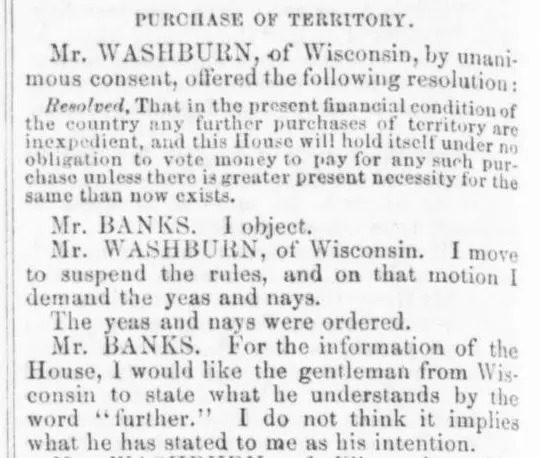
The resolution as printed, Congressional Globe, p. 792. 25 November 1867.
"Congressional Globe, 40th Cong., 1st sess., p. 792 (resolution)" by F. & J. Rives & George A. Bailey. Public domain.
Full credit
"Congressional Globe, 40th Cong., 1st sess., p. 792 (resolution)" by F. & J. Rives & George A. Bailey — https://archive.org/details/sim_united-states-congress-congressional-globe_1867-03-04 — Public domain — Public domain in the US (published 1867) and in the EU (unsigned official debates printed by F. & J. Rives & George A. Bailey, 1867; 70 years passed); modified: cropped to one column, from the heading to the motion to suspend
N. P. Banks objected, which blocked the resolution. Washburn moved to suspend the rules, a step that let the House take it up anyway and that needed two thirds. That motion is what the roll call counts: “yeas 93, nays 43, not voting 45.” Then the record reads: “So (two thirds voting in favor thereof) the rules were suspended, and the resolution was before the House.”
Washburn then demanded the previous question, the House ordered it, and “under the operation thereof the resolution was adopted.” No count is printed for that step. So 93 to 43 is the nearest number to the House’s view on more land, and it is one step removed. Two thirds of the 136 votes cast is 90⅔, so the motion needed 91 yeas, by this site’s count, which means the yeas cleared the bar by two.
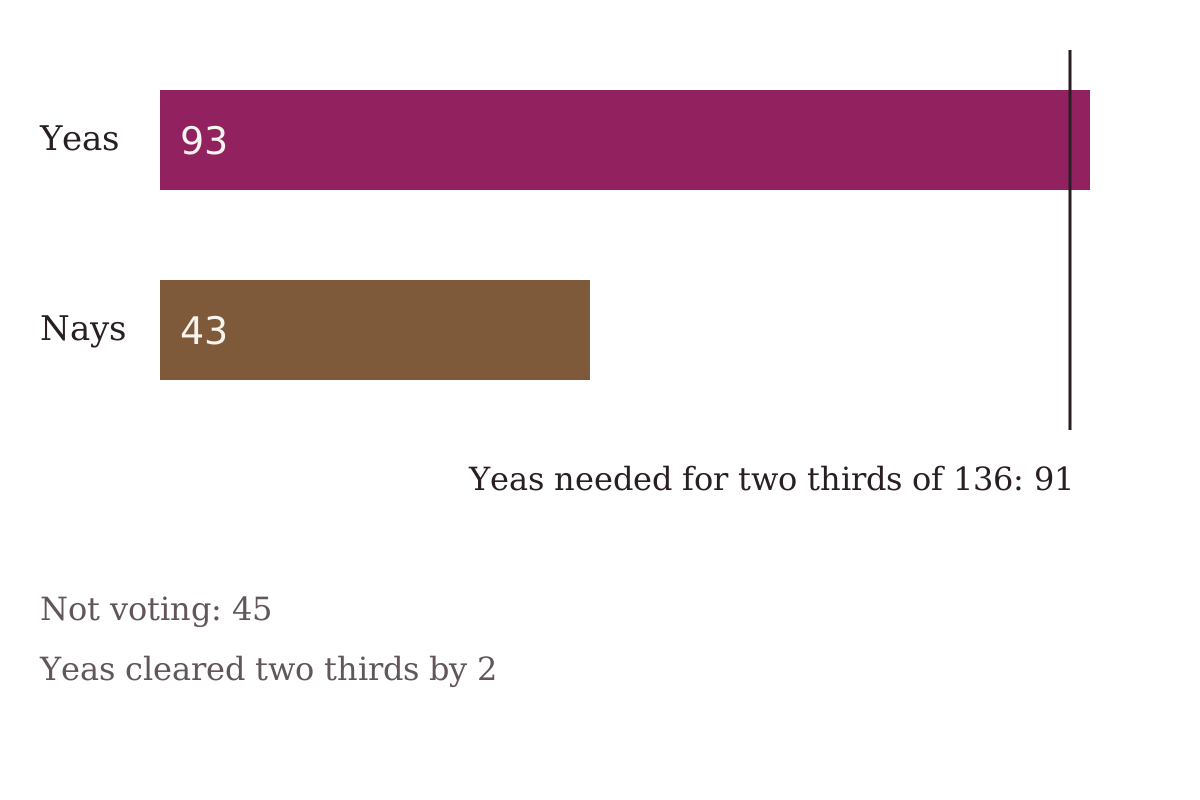
The motion to suspend the rules against the two-thirds line. 25 November 1867.
"The motion to suspend the rules against two thirds" by Persuasion Dissected — https://persuasiondissected.com/bargaining/sewards-folly/ — licensed CC BY 4.0: https://creativecommons.org/licenses/by/4.0/
Data: Congressional Globe, 40th Cong., 1st sess.
A number from the House floor needs the question beside it, which is also true of the count of the Chartist petition of 1848. All the votes in this story are in the table of House votes (where this data comes from), each with its Globe page.
Did Washburn mean to spare Alaska?
In the resolution, by his own words, yes; in his own view of the bill, no. Banks asked what he understood “by the word ‘further,’” and said he did not think it “implies what he has stated to me as his intention.” Washburn answered: “I do not intend that resolution to apply to the purchase of Walrussia. That is something that has already transpired, and it may be that this House will feel itself under obligation to sanction what has been done there. I certainly shall never feel under such obligation.”
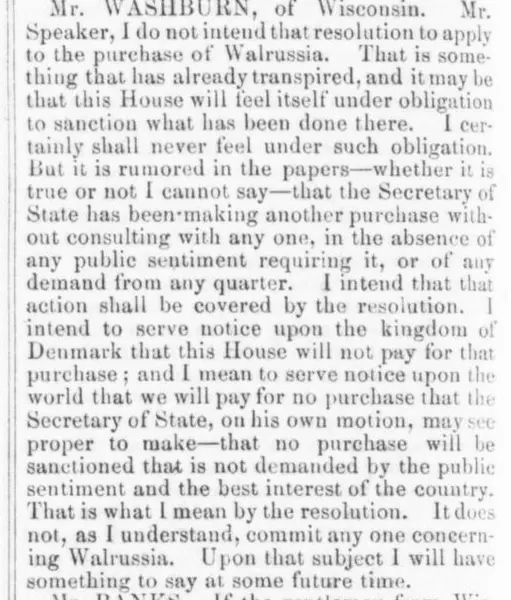
Washburn’s reply to Banks, Congressional Globe, p. 792. 25 November 1867.
"Congressional Globe, 40th Cong., 1st sess., p. 792 (Walrussia)" by F. & J. Rives & George A. Bailey. Public domain.
Full credit
"Congressional Globe, 40th Cong., 1st sess., p. 792 (Walrussia)" by F. & J. Rives & George A. Bailey — https://archive.org/details/sim_united-states-congress-congressional-globe_1867-03-04 — Public domain — Public domain in the US (published 1867) and in the EU (unsigned official debates printed by F. & J. Rives & George A. Bailey, 1867; 70 years passed); modified: cropped to one column, Washburn’s reply to Banks
His target was a rumor of a new purchase: “I intend to serve notice upon the kingdom of Denmark that this House will not pay for that purchase.” Banks stayed on the word. The resolution, he said, “implies what it ought not to imply,” namely that once the Senate approved a treaty the House “would be obliged to make the appropriation, which I do not admit.”
This site checks each case for the last stone, a premise no speaker states and the audience supplies. Here Banks stated the one candidate aloud before the roll call, so the case has none. The members voted with it in plain view, and the later case for paying rested on what speakers said outright, honor and Russia.
The exception then outlived the vote. On 7 July 1868 Representative Spalding read Washburn’s words back to the House, calling the measure “a resolution of warning” and asking members to “mark” what its author had said about Walrussia. Spalding had voted nay in 1867, so he was turning the mover’s words back on the mover. A colleague said on 14 July that Washburn, had he been present, “would have voted no” on the money.
How did the House get from that vote to paying?
By July 1868 the question had changed from whether to buy to whether to back out. Spalding’s case concerned what this site labels the exit cost, a documented barrier to leaving. With the flag already sent, he asked, “are we now, at this late period, to turn on our heel and say that we will not pay the purchase money?”
He would pay, he said, even if the land were “made up of icebergs, and those icebergs covered with walruses,” because “the honor and dignity of this great nation are now involved.”
The calendar is weaker evidence than that speech suggests. The ten months in Article VI ran out on 20 April 1868, by this site’s count, and the House voted 85 days later. The son says Russia “courteously waived any demand for immediate payment,” though that is his account and no Russian paper was read, so the clock cannot be shown to have forced anyone’s hand.
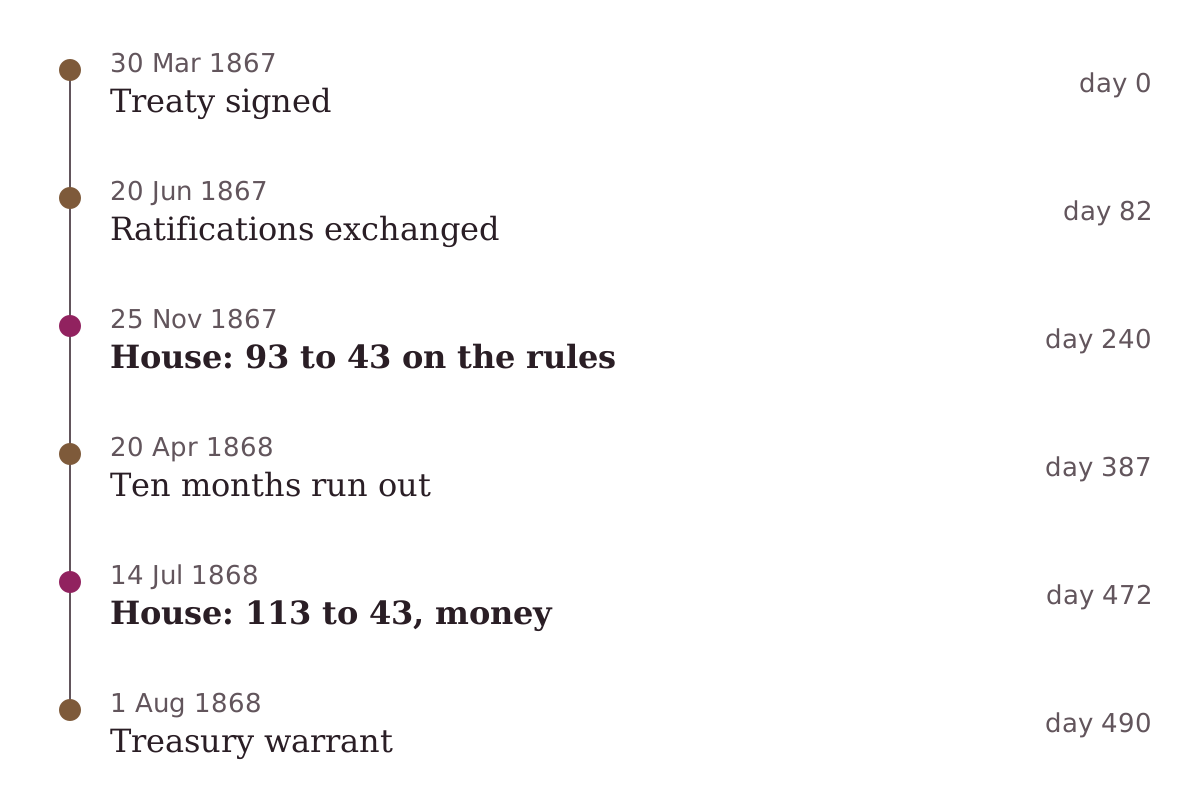
Six dated steps, with days counted from the treaty. 30 March 1867 to 1 August 1868.
"Six dated steps from the treaty to the warrant" by Persuasion Dissected — https://persuasiondissected.com/bargaining/sewards-folly/ — licensed CC BY 4.0: https://creativecommons.org/licenses/by/4.0/
Schenck, closing a speech on 14 July, gave the same reason with less praise. He would vote yes, he said, “not because I believe in the value of the purchase,” adding: “It is on account of Russia, therefore, that I am willing to vote for this bill.” Loan took the opposite view of that same pressure, calling Russia’s claim a “confidence game” and a “swindle,” and warning that approval would furnish “a precedent” for the Executive and two thirds of the Senate to buy territory “to any extent they please.”
Why could the House argue about everything except the price?
The price itself was closed to the House. When Butler of Massachusetts pressed an amendment on the sum, the chair ruled that “no amendment to reduce the amount is germane,” and on 14 July it ruled likewise that “new conditions imposed upon the treaty are not in order.” The argument that remained was about who holds the power to buy, and the last votes were about wording.
A preamble and section asserting that Congress had to consent passed 98 to 49 that day. Eliot’s amendment, saying no purchase could be made “until after provision by law for its payment,” failed 78 to 80. On this site’s reading it would have written something close to Washburn’s warning into the bill, and it lost by two votes, the same margin by which the motion on his resolution had cleared two thirds.
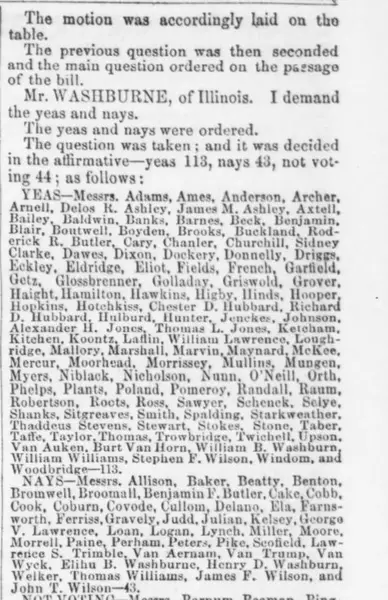
The roll call on the money, Congressional Globe, p. 4055. 14 July 1868.
"Congressional Globe, 40th Cong., 2nd sess., p. 4055 (vote on passage)" by F. & J. Rives & George A. Bailey. Public domain.
Full credit
"Congressional Globe, 40th Cong., 2nd sess., p. 4055 (vote on passage)" by F. & J. Rives & George A. Bailey — https://archive.org/details/sim_united-states-congress-congressional-globe_1868_index_1 — Public domain — Public domain in the US (published 1868) and in the EU (unsigned official debates printed by F. & J. Rives & George A. Bailey, 1868; 70 years passed); modified: cropped to one column, the roll call on passage
The bill then passed, “yeas 113, nays 43, not voting 44.” A conference report cleared the House 91 to 48 on 23 July, after Banks told members it declared that no stipulation could take effect “except by legislation to which the assent of both Houses is necessary.” The son dates final approval to 27 July. Jeleń notes that the National Republican printed the July result as 104 to 42; the Globe prints 113 and 43, and by this site’s count its roll lists that many names.
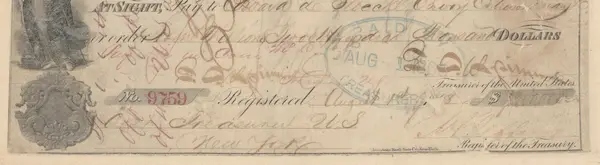
The Treasury warrant, cropped to the payment lines. Issued 1 August 1868.
"Treasury warrant for the purchase of Alaska, 1 August 1868" by United States Treasury. Public domain.
Full credit
"Treasury warrant for the purchase of Alaska, 1 August 1868" by United States Treasury — https://commons.wikimedia.org/wiki/File:Alaska_Purchase_(hi-res).jpg — Public domain — Public domain in the US (work of the US federal government, 1868) and in the EU (unsigned government form of 1868; 70 years passed); modified: cropped to the payment lines, removing most of the engraved vignette and the date line at the top
This site’s working hypothesis is that deadlines and the cost of leaving often explain a negotiation better than opening prices. The House debate fits the second half of that, since speakers argue about honor and Russia and not about the $5 million offer, while the deadline fits it poorly. It is a reading of the speeches printed here, and it does not say what moved any one member.
One more explanation has to be set beside it. The son reports that rumors said purchase money had gone “to buy votes in Congress, or to subsidize newspapers,” and that a House committee found most of the stories “malicious and all of them absurd.” Those are his words, about his father’s accusers. The committee’s own report was not read for this page, so it neither repeats the charge nor clears anyone.
Did the 93 vote against paying for Alaska?
They split, almost evenly, when this site matched the printed names on both roll calls. Of the 93 who voted yea in 1867, 36 voted to pay in 1868, 35 voted against, 19 did not vote, and 3 could not be matched. Of the 43 who voted nay in 1867, 34 voted to pay, 1 voted against and 8 did not vote, and Banks and Spalding are both in that group.
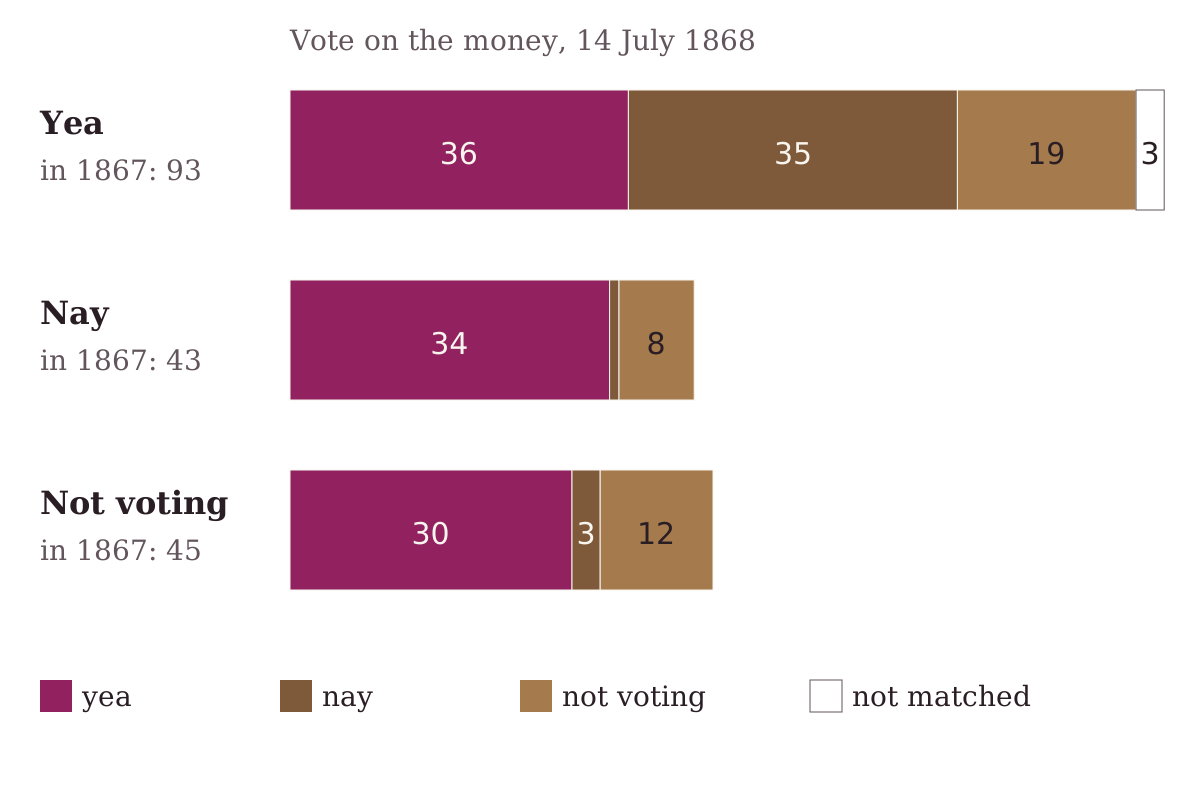
The 1867 roll call against the 1868 roll call, matched by this site on printed names. 25 November 1867 and 14 July 1868.
"The 1867 roll call against the 1868 roll call" by Persuasion Dissected — https://persuasiondissected.com/bargaining/sewards-folly/ — licensed CC BY 4.0: https://creativecommons.org/licenses/by/4.0/
Data: Congressional Globe, 40th Cong.
So a yea in 1867 was a poor guide to a member’s vote on Alaska, although it did mark where the later opposition sat, since 35 of the 43 nays in 1868 came from those 93. The clearer signal runs the other way: only 1 of the 43 nays of 1867 voted against the money, though Boyer, paired and listed as not voting, said he would have voted no. Every name is in the roll-call match (where this data comes from), which shows who moved and says nothing about why they did.
Crossing map
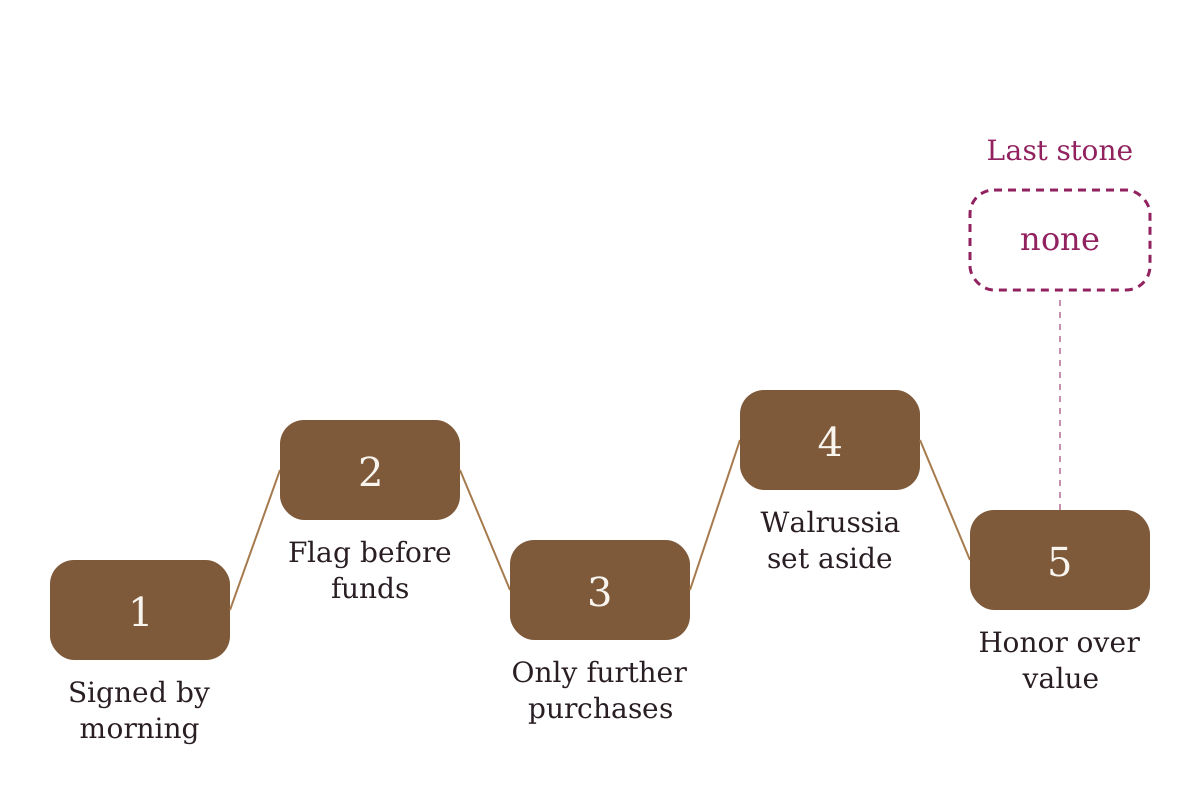
Crossing map of the House’s path to paying. The empty stone marks that no last stone was found. March 1867 to July 1868.
"Crossing map of the House’s path to paying" by Persuasion Dissected — https://persuasiondissected.com/bargaining/sewards-folly/ — licensed CC BY 4.0: https://creativecommons.org/licenses/by/4.0/
- Signed by morning. The treaty is dated 30 March 1867, and the son has it signed by four that morning [1] [6]
- Flag before funds. Spalding says officials and the flag went to the territory before any money was voted (p. 3810) [3]
- Only further purchases. The resolution of 25 November 1867 speaks of “any further purchases” (p. 792) [2]
- Walrussia set aside. Washburn says the resolution is not meant to apply to it (p. 792) [2]
- Honor over value. Spalding and Schenck argue for paying on grounds other than the land’s worth (pp. 3809, 4054) [3]
- No last stone in this case. Banks said the one candidate premise aloud, that a purchase approved by the Senate would oblige the House to pay, before the roll call (p. 792) [2]
Sources
- Frederick W. Seward, Reminiscences of a War-Time Statesman and Diplomat, 1830–1915 (New York: G. P. Putnam’s Sons, 1916), pp. 360–365, 367–368. archive.orgRead: chapter on the treaty, pp. 360–365, and pp. 367–368 on the rumors and the testimony, compared against the page images
- Congressional Globe, 40th Congress, 1st session, 25 November 1867, pp. 792–793. archive.orgRead: chapter of proceedings, pp. 792–793, compared against the page images; full text of the volume searched for names and phrases
- Congressional Globe, 40th Congress, 2nd session, Part IV, 7 and 14 July 1868, pp. 3808–3810, 4053–4055. archive.orgRead: chapter of proceedings, pp. 3808–3810 and 4053–4055, compared against the page images; full text of the part searched for names and phrases
- Congressional Globe, 40th Congress, 2nd session, Part V, 23 July 1868, pp. 4392–4394. archive.orgRead: chapter of proceedings, p. 4394, compared against the page image; p. 4392 report from the text; full text of the part searched for phrases
- Appendix to the Congressional Globe, 40th Congress, 2nd session (Washington: F. & J. Rives & George A. Bailey, 1868). archive.orgRead: full text searched for Seward’s Folly and Walrussia; speeches not read
- National Archives, “Check for the Purchase of Alaska (1868),” Milestone Documents, with the transcript of the Treaty of Cession of 30 March 1867. archives.govRead: full page and treaty transcript
- Mateusz Jeleń, “Zakup Alaski przez Stany Zjednoczone w 1867 roku w świetle prasy amerykańskiej,” Annales UMCS, sectio F, 78 (2023): 79–103. doi.orgRead: chapter-length passages on press reaction, the Senate count, the Klondike and notes 84 and 91, in Polish; not the whole paperText license: CC BY 4.0 (terms)
- Richard E. Welch Jr., “American Public Opinion and the Purchase of Russian America,” American Slavic and East European Review 17, no. 4 (1958). DOI 10.2307/3001132. doi.orgRead: bibliography only
Next crossing
- The Yalta Conference — Another bargain where a later fight turned on what the wording of a signed text committed anyone to do.
- The Great Moon Hoax — A press story of 1835, and what the paper would and would not concede afterward.
Cite this page
Persuasion Dissected. "Seward’s Folly: The 93 to 43 Vote Was to Suspend House Rules." Persuasion Dissected. Published 2026-11-11. https://persuasiondissected.com/bargaining/sewards-folly/. Accessed: add the date you read it.
Corrections
No corrections yet.
How pieces are checked · All corrections · Contact · Report an error (contact@persuasiondissected.com)