Congress of Vienna: Talleyrand Reports a Fight Over ‘Allies’
In three lines
- Who persuaded whom: By his own report, Talleyrand pressed the ministers of Austria, Russia, Britain and Prussia over the word “allies” at the Congress of Vienna on 30 September 1814, then told Louis XVIII about it.
- Which stones: Metternich’s five-line note, one word in a signed protocol, the ministers’ answer that it was only shorthand, and Talleyrand’s refusal to understand the paper.
- Outcome: He reports that the ministers called the word shorthand and took back the paper, not the word. The opening then slipped to 1 November.
Route through this piece (7)
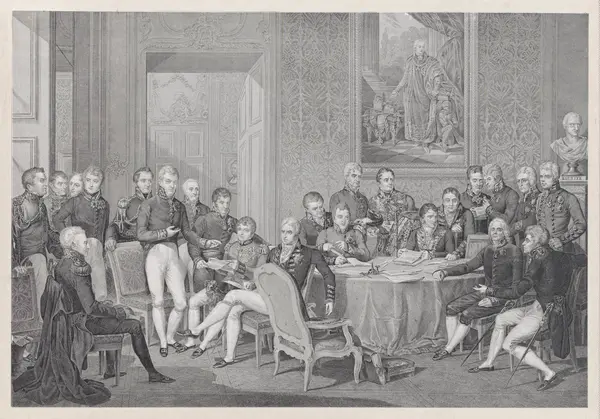
The plenipotentiaries of the eight powers in Dondorf’s lithograph after Isabey, a group scene and not the meeting of 30 September 1814. Print dated 1833–1872.
"Der Wiener Congress 1815. Sitzung der Bevollmächtigten der acht an dem Tractate von Paris betheiligten Mächte" by Bernhard J. Dondorf, after Jean-Baptiste Isabey. Public domain.
Full credit
"Der Wiener Congress 1815. Sitzung der Bevollmächtigten der acht an dem Tractate von Paris betheiligten Mächte" by Bernhard J. Dondorf, after Jean-Baptiste Isabey — https://commons.wikimedia.org/wiki/File:Afgevaardigden_op_het_Congres_van_Wenen,_1814-1815_Der_Wiener_Congress_1815._Sitzung_der_Bevollm%C3%A4chtigten_der_acht_an_dem_Tractate_von_Paris_betheiligten_M%C3%A4chte_(titel_op_object),_RP-P-OB-87.274_(cropped).jpg — Public domain — Public domain in the US (published between 1833 and 1872) and in the EU (Bernhard J. Dondorf died 1902, Jean-Baptiste Isabey died 1855, life+70); modified: reduced to 1600 px wide; Commons file already cropped to the print
Case card
- Case
- Talleyrand and the word “allies” at the Congress of Vienna, by his own reportTalleyrand, Mémoires, ed. Broglie, vol. II (1891), pp. 317–325
- Date range
- Conference of 30 September 1814; letter of 4 October 1814; General Treaty dated 9 June 1815Talleyrand, Mémoires, ed. Broglie, vol. II (1891), pp. 317, 320; General Treaty, English translation
- Place
- Metternich’s house, Vienna, by Talleyrand’s letter and the embassy’s dispatchTalleyrand, Mémoires, ed. Broglie, vol. II (1891), pp. 315, 318
- Persuader(s)
- Talleyrand, with Labrador, the Spanish minister, beside him, by Talleyrand’s reportTalleyrand, Mémoires, ed. Broglie, vol. II (1891), pp. 318–321
- Audience
- Metternich, Nesselrode, Castlereagh, Hardenberg and Humboldt at the table, by Talleyrand’s report; Louis XVIII as the letter’s addresseeTalleyrand, Mémoires, ed. Broglie, vol. II (1891), pp. 317–320
- The ask
- “whether there was war, and against whom?” (this site’s translation from the French)Talleyrand, Mémoires, ed. Broglie, vol. II (1891), p. 320
- Channel
- Replies to a five-line note; questions across the table; a signed note, dated 1 October in his letter and the evening of 30 September in the embassy’s dispatch; letters to ParisTalleyrand, Mémoires, ed. Broglie, vol. II (1891), pp. 317–325
- Outcome
- By his report the ministers called the word shorthand and took back the paper; the opening was later put off to 1 NovemberTalleyrand, Mémoires, ed. Broglie, vol. II (1891), pp. 320–321, 350
- Primary record
- Talleyrand’s letters and the embassy’s dispatches as printed in 1891; the protocol itself was not readTalleyrand, Mémoires, ed. Broglie, vol. II (1891), pp. 314–350, 373, 400–402
On 4 October 1814, Talleyrand told Louis XVIII in a letter from Vienna that he had objected to one word. By his own report, the word was “allies,” written in every paragraph of a paper the four great powers handed him at the Congress of Vienna on 30 September. The letter asks the king to accept that a word from the war had no place in the peace, and that France’s envoy had said so to their faces.
The Congress of Vienna was the meeting the Treaty of Paris of 30 May 1814 had called for. Article XXXII gave every power engaged in the war two months to send plenipotentiaries, envoys with full powers, to Vienna “pour régler, dans un congrès général,” the arrangements that would complete the treaty. Its General Treaty is dated 9 June 1815. Almost everything below about the word rests on one man, a limit the historian Charles Webster stressed in 1918.
What did Talleyrand object to on 30 September 1814?
By his account, “allies” was not his first objection that day. Between nine and ten in the morning he received five lines from Metternich, proposing that he come at two o’clock to “assister” at a preliminary conference, where he would find the ministers of Russia, England and Prussia “réunis.” He read both words as chosen on purpose: “Les mots assister et réunis étaient visiblement employés avec dessein.” To attend, on this site’s reading, is less than to take part.
He answered that he would gladly meet the ministers “de Russie, d’Angleterre, d’Espagne et de Prusse” at Metternich’s house. The embassy’s joint dispatch of 4 October explains the order: Spain placed before Prussia spoiled what Metternich intended. Labrador, the Spanish minister, sent an identical reply. “Nous mêlions ainsi à dessein,” Talleyrand wrote, mixing on purpose what the others seemed to want kept apart.
Arriving before two, he found the four courts already seated at a long table. Castlereagh sat at one end and seemed to preside, and Gentz held the pen at the other. “Un siège entre lord Castlereagh et M. de Metternich avait été laissé vacant, je l’occupai.” A seat had been left empty, and he took it.
Castlereagh said the meeting would tell him what the four courts had done. Metternich then passed him a protocol, a signed record of decisions, carrying the names of Metternich, Nesselrode, Castlereagh and Hardenberg. “Dans cette pièce, le mot d’alliés se trouvait à chaque paragraphe. Je relevai ce mot.” In that paper the word “allies” stood in each paragraph, and he picked it out.
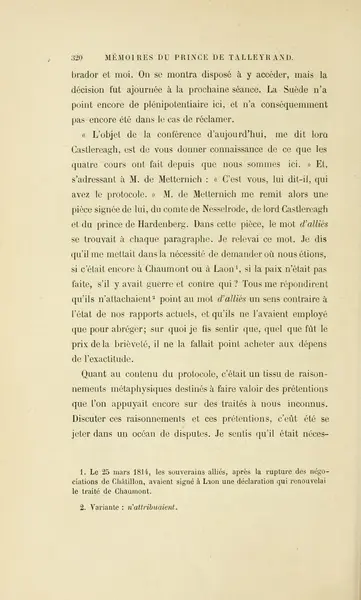
Talleyrand’s letter of 4 October 1814 as printed in the Mémoires, vol. II, p. 320. 1891.
"Mémoires du prince de Talleyrand, vol. II, p. 320" by Charles-Maurice de Talleyrand-Périgord. Public domain.
Full credit
"Mémoires du prince de Talleyrand, vol. II, p. 320" by Charles-Maurice de Talleyrand-Périgord — https://archive.org/details/mmoirespubli02talluoft/page/320 — Public domain — Public domain in the US (published 1891) and in the EU (Talleyrand died 1838, Albert de Broglie died 1901, life+70); modified: reduced to 1000 px wide; page not cropped
The word, he said, forced him to ask where they were: “si c’était encore à Chaumont ou à Laon.” Chaumont was the wartime alliance treaty, and Laon the declaration that renewed it in March 1814, as the editor’s note explains. The ministers answered, all of them, that the word meant nothing against present relations and was used “que pour abréger,” only to shorten. He replied that brevity should not be bought “aux dépens de l’exactitude,” at the cost of accuracy.
A label mattered here because of what stood behind it. Talleyrand’s next paragraph says the protocol leaned on “des traités à nous inconnus,” treaties unknown to France, and the embassy’s dispatch of 4 October has him refusing to recognize any special arrangement made since the Treaty of Paris. If the four were still allies, their wartime agreements could still bind the Congress, whereas if the war was over, the only common text was the peace. That last step is this site’s reading and not a sentence in the letter.
Was the word withdrawn, or the paper?
The paper went back. The word did not. He read several paragraphs and said, “Je ne comprends pas.” He read them again slowly, “de l’air d’un homme qui cherche à pénétrer le sens d’une chose,” like a man trying to grasp the sense of a thing, and said he understood no better. Then his argument: “Il y a pour moi deux dates entre lesquelles il n’y a rien,” two dates with nothing between, 30 May, when the Congress was agreed, and 1 October, when it was due to meet.
The ministers replied that they cared little for “cette pièce” and would gladly take it back, and Labrador observed that they had signed it all the same. “Ils la reprirent; M. de Metternich la mit à part et il n’en fut plus question.”
The pronoun settles the point, because “la” is feminine and points to “pièce,” the paper, while “mot” is masculine. The 1891 English translation by Raphaël Ledos de Beaufort prints “They withdrew it” (p. 232), which can be misread as the word.
The later letters show the word still in use, and each of these lines has only Talleyrand as its reporter, except the last.
| Date | Speaker | On the word | Where |
|---|---|---|---|
| 30 September 1814 | The four ministers, per Talleyrand | Used “que pour abréger” | II, 320 |
| 1 October 1814 (inferred) | Tsar Alexander, per Talleyrand | Blamed “l’habitude,” habit | II, 325, 328 |
| 8 October 1814 | Metternich, per Talleyrand | “Ne parlez plus d’alliés, reprit-il, il n’y en a plus.” Speak no more of allies, there are none left | II, 342 |
| 19 October 1814 | An unnamed informant, per Talleyrand | “Les quatre cours n’ont point cessé d’être alliées,” the four courts had not ceased to be allied | II, 373 |
| 9 June 1815 | General Treaty, English translation | The powers met “with the princes and states their Allies” | Preamble |
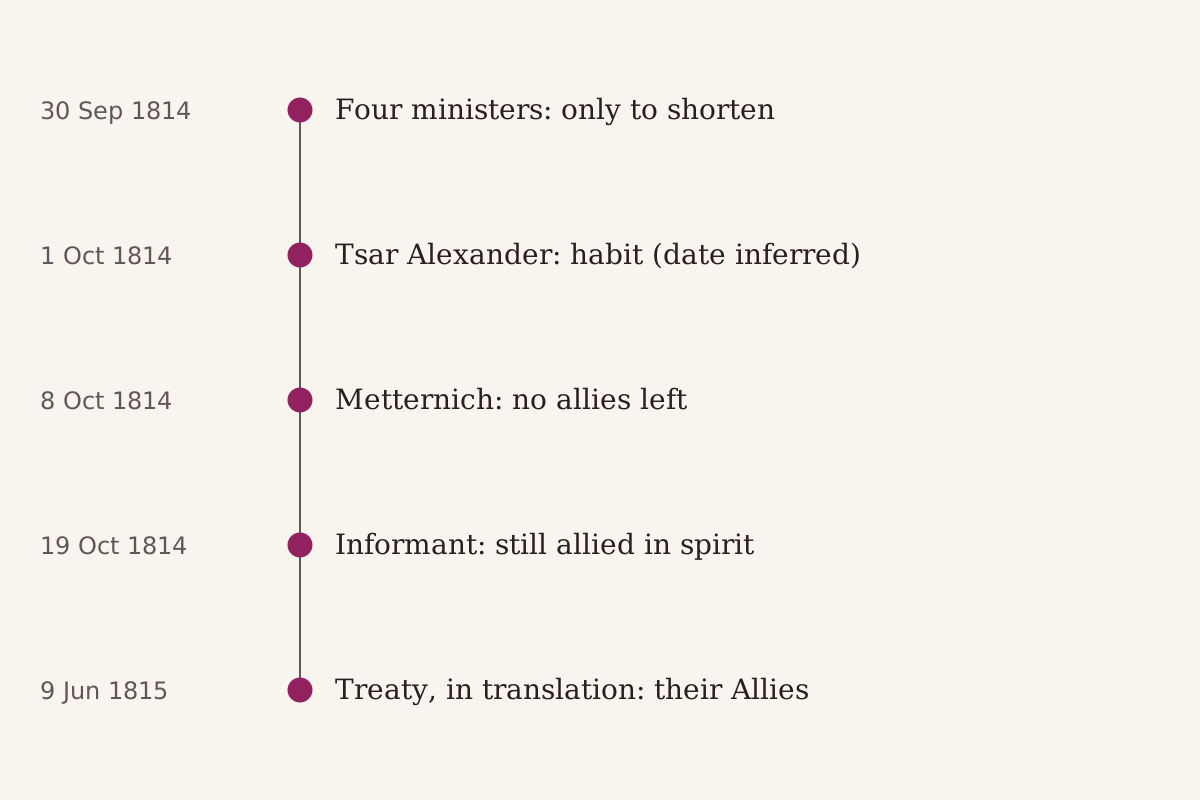
Five dated uses of the word, four by Talleyrand’s report and one from the translated treaty; the Tsar’s date is inferred. 30 September 1814 to 9 June 1815.
"Five dated uses of the word allies" by Persuasion Dissected — https://persuasiondissected.com/bargaining/congress-of-vienna/ — licensed CC BY 4.0: https://creativecommons.org/licenses/by/4.0/
By this site’s count, that English translation of the treaty has “Allies” or “Allied” four times; the French original was not read. How much weight a single word can bear is also the question in the text of the Yalta Conference. The main dated steps, with page and reporter, are in the CSV (where this data comes from).
Who was left out of the room?
Talleyrand’s sums were plain. Under the second paper, a draft declaration, six powers would direct the Congress, and France and Spain, even if they agreed on everything, “ne seraient jamais que deux contre quatre,” would only ever be two against four. He objected that the plan proposed “de finir par où j’avais cru qu’il était nécessaire de commencer,” finishing where he had thought one must begin.
Portugal was outside entirely. Its minister, Palmella, had written to Castlereagh to protest an exclusion he called unjust and humiliating, and he asked that the eight powers who signed the Treaty of Paris form the preparatory body, not six. Sweden, Talleyrand noted, had no plenipotentiary there yet and so had not been in a position to protest. Sweden’s minister first attended on 8 October, by the same letters.
The eight named in the title of the Dondorf print and its catalog description were Austria, Spain, France, Britain, Portugal, Prussia, Russia and Sweden.
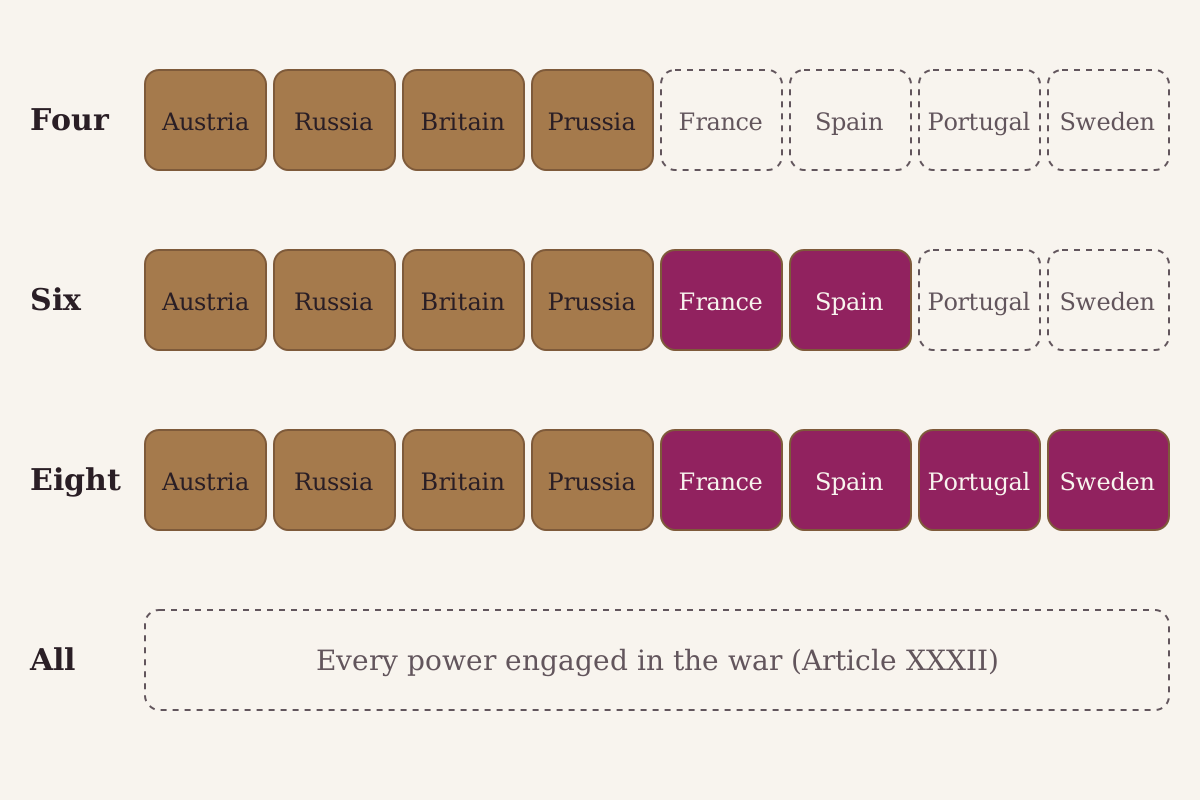
Who would prepare the Congress under each proposal, by Talleyrand’s report. 30 September and 1 October 1814.
"Who would prepare the Congress" by Persuasion Dissected — https://persuasiondissected.com/bargaining/congress-of-vienna/ — licensed CC BY 4.0: https://creativecommons.org/licenses/by/4.0/
Talleyrand’s signed note, dated 1 October in his letter, took up the number eight. As he gives its substance, it said the eight were only “une partie seulement du congrès,” a part of it, and that claiming the Congress’s powers would be “une usurpation.” It did not ask for everyone, though. “Les petits États ne devaient pas sans doute, se mêler des arrangements généraux de l’Europe,” he added: small states, no doubt, should not meddle in Europe’s general arrangements.
Here two sources meet. At Prince Trautmansdorf’s one evening, which his letter seems to place on 3 October and Webster on 1 October, Talleyrand reports, the ministers reproached him for making the note official by signing it: “Je leur dis que comme ils écrivaient et signaient entre eux, j’avais cru qu’il fallait aussi écrire et signer.” Since they wrote and signed among themselves, he told them, so should he. Webster, citing British papers, also has the four disliking its formal character.
Hardenberg had said much the same about small states at the table, that the princes of Leyen and Lichtenstein must not intervene. The editor’s note gives Lichtenstein seven thousand inhabitants. On this site’s reading, the argument from law opened the door to France and stopped at eight. What a small power may say to a large one is the subject of the Melian Dialogue.
Why do Talleyrand’s two accounts differ?
The best-known version of this scene is not the letter. It comes from the narrative that opens Part VIII of the Mémoires, a retrospect that already mentions the events of March 1815. Talleyrand says there that he gives the details because this first sitting “décida de la position de la France au congrès,” decided France’s place at the Congress. Set side by side, the two reports do not match.
| Point | Letters to Louis XVIII, 4 and 19 October 1814 | Mémoires, Part VIII narrative |
|---|---|---|
| Where “allies” appears | Written “à chaque paragraphe” of a signed paper (II, 320) | Spoken by Metternich and Hardenberg (II, 280) |
| His question | “s’il y avait guerre et contre qui ?” whether there was war, and against whom (II, 320) | “Alliées..., dis-je, et contre qui?” Allies, and against whom? (II, 280) |
| The exit line | Not in the letter | “s’il y a encore des puissances alliées, je suis de trop ici,” if allied powers remain, he is one too many (II, 280) |
| The ministers’ answer | The word only shortened things (II, 320) | “l’embarras était sur tous les visages,” embarrassment on every face (II, 282) |
| The paper | Metternich sets it aside (II, 321) | Gentz “détruisit les protocoles des séances précédentes,” destroyed the earlier sittings’ protocols (II, 282) |
| France afterwards | 19 October letter, citing an unnamed informant: the four set France aside in practice (II, 373) | No more conferences without France in them, “sans que la France en fît partie” (II, 282) |
The line “I am one too many here” threatens an exit, and it appears only in the later telling. The dispatch signed by the French embassy on 4 October adds a third shade: Talleyrand twice picked out the word and called it “une insulte” at such a congress (II, 315). That dispatch also places the meeting in the morning and his note that evening, where the letter has two o’clock and 1 October.
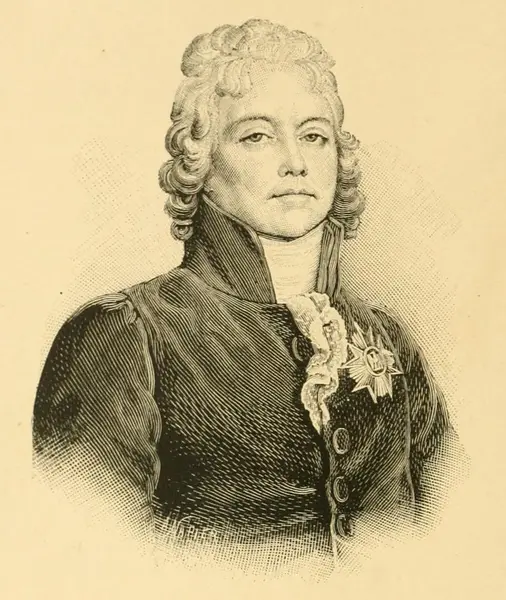
Talleyrand, after F. Gérard, as engraved for the Mémoires, vol. III. 1891.
"Charles-Maurice de Talleyrand-Périgord, prince de Bénévent, after F. Gérard" by Unknown author. Public domain.
Full credit
"Charles-Maurice de Talleyrand-Périgord, prince de Bénévent, after F. Gérard" by Unknown author — https://archive.org/details/mmoirespubli03talluoft/page/n11 — Public domain — Public domain in the US (published 1891) and in the EU (engraver not named, published 1891, more than 70 years ago; after a portrait by François Gérard, who died in 1837, life+70); modified: cropped to the engraving, removing the printed caption and page margin
The later narrative also tidies the outcome. Once offered a way to retreat, it says, the ministers came to regard what they had done as “non avenu,” void, and Talleyrand signed the new record “pour prendre date,” to put the date on record. It adds that every member of the Congress accepted the eight-power committee and that “il ne s’éleva aucune réclamation,” no objection arose. The October letters, with their postponements and the quarrel over his signed note, read far less smoothly.
None of this proves the later version false, since a memoir may compress several sittings into one. It does mean that the most quotable sentence has the weakest footing. A self-report that improves with retelling is also the problem with the Fiji Mermaid, and an organizer’s own accounting is the problem with the Four Minute Men.
What does Charles Webster’s account change?
Webster wrote his history of the Congress for the British Foreign Office’s Historical Section, with its papers in his notes. He agrees that a protocol stressing “Allies” was shown and withdrawn, but he adds in a footnote that its exact form is known only from Talleyrand’s account. He also judges that the scene, as Talleyrand described it, may have been given more weight than it deserves.
His sequence is less flattering. In his telling, the four courts had already recorded their real decisions on 22 September, in protocols that Talleyrand did not learn of until March 1815. On 1 October the four gave up the plan for six and accepted eight, since six had no footing in any document. So Talleyrand’s note did move something, by Webster’s account (pp. 65–66).
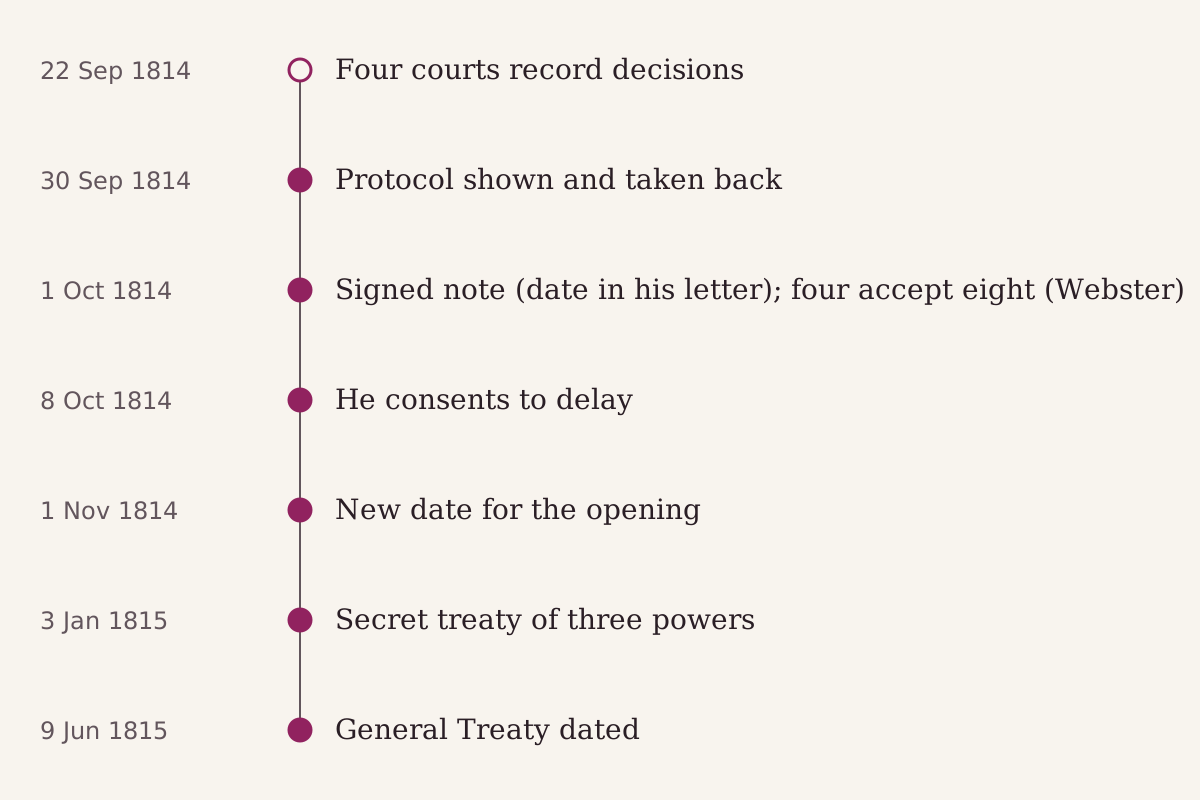
The sequence from several sources, with a hollow mark for the one date known here from Webster alone; four accepting eight is also his. 22 September 1814 to 9 June 1815.
"The sequence from two sources" by Persuasion Dissected — https://persuasiondissected.com/bargaining/congress-of-vienna/ — licensed CC BY 4.0: https://creativecommons.org/licenses/by/4.0/
The date he had argued from did not hold. On 8 October he agreed to put off the opening until 1 November if the text promised conformity with public law. He reports an uproar. Hardenberg called the phrase needless, since it went without saying: “si cela allait bien sans le dire, cela irait encore mieux en le disant,” Talleyrand replied, so it would go even better said.
“Que fait ici le droit public ?” Humboldt shouted, asking what public law had to do with it, and the answer was “Il fait que vous y êtes,” public law being the reason the Prussians sat there at all (II, 346).
On Webster’s reading the added words changed little, because the real business went on in private among the four ministers and the Tsar, with Talleyrand shut out of it (p. 68). That judgment sits awkwardly beside the retrospect’s claim that no conference took place without France, although the two may be counting different kinds of meeting.
This site’s working guess for negotiations is that deadlines and exit costs often explain more than technique. Here the record gives mixed support. The deadline moved against him, and the threat to leave appears only in the retrospect. By 31 October, in the embassy’s dispatch, he was protesting that “l’ouverture ne devait plus être une ouverture,” that the opening was no longer to be an opening, and the sitting ended with a commission to check each envoy’s credentials (II, 402).
How did the fight over “allies” end?
It ended twice, in Talleyrand’s telling. On 3 January 1815 Metternich, Castlereagh and he signed a convention (III, 1), and the editor’s note to the Mémoires calls it a treaty promising common cause against the ambitions of Prussia and Russia (II, 288). “Les alliés se trouvaient ainsi divisés entre eux,” he wrote: the allies now stood divided among themselves.
He credited this to “le seul ascendant de la raison,” reason’s ascendancy alone, and said France had broken an alliance aimed only at her. Webster’s account points elsewhere. Webster has Castlereagh drafting the secret treaty in his own hand, after Prussia’s language and military preparations over Saxony had alarmed him (p. 114). The two explanations can both be partly true, and neither source can settle how much a word contributed.
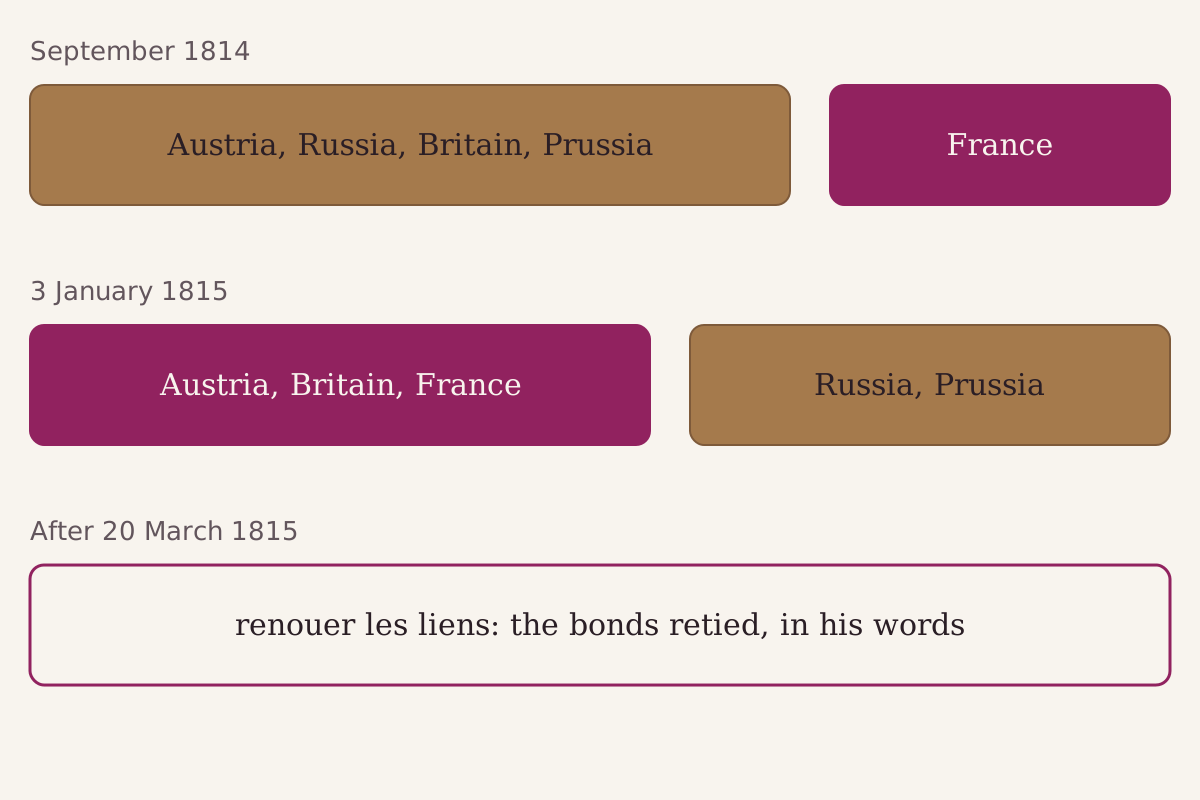
The groupings as Talleyrand describes them, with the secret treaty dated by the editor’s note. September 1814 to March 1815.
"The groupings as Talleyrand describes them" by Persuasion Dissected — https://persuasiondissected.com/bargaining/congress-of-vienna/ — licensed CC BY 4.0: https://creativecommons.org/licenses/by/4.0/
Then it ended the other way. In the same passage he adds a regret in brackets: “Heureuse si la funeste catastrophe du 20 mars n’en fut venu renouer les liens !!” The disaster of 20 March, which the English edition’s chapter summary files under Napoleon’s return from Elba, had retied the bonds. The translated General Treaty of 9 June 1815 opens on the signers of the Treaty of Paris and “their Allies,” and Article CXIX invites “All the Powers assembled in Congress” to accede.
Crossing map
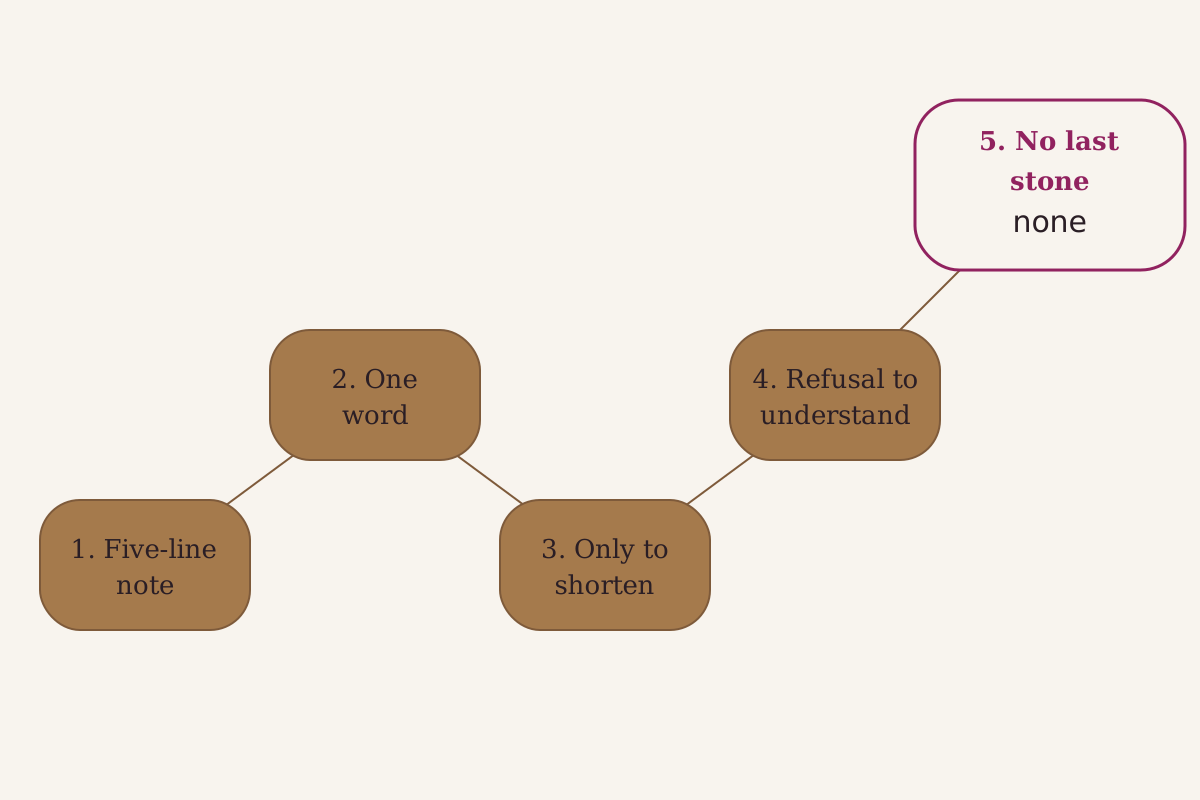
Crossing map of the four powers’ paper as Talleyrand reports it. No last stone is marked. 30 September 1814.
"Crossing map of the four powers’ paper" by Persuasion Dissected — https://persuasiondissected.com/bargaining/congress-of-vienna/ — licensed CC BY 4.0: https://creativecommons.org/licenses/by/4.0/
- Five-line note. Metternich invites Talleyrand to “assister” with ministers “réunis” (II, 317–318) [1]
- One word. A signed protocol has “alliés” in each paragraph (II, 320) [1]
- Only to shorten. The ministers answer that the word carries no meaning against present relations (II, 320) [1]
- Refusal to understand. Talleyrand says “Je ne comprends pas,” refuses the paper’s reasoning, and it is taken back (II, 321) [1]
- No last stone in this case. The unstated premise a reader might name, that a wartime coalition still spoke for the peace, is one Talleyrand, whose report carries every reaction on record, says he refused, and the ministers answered aloud that the word was shorthand. No record read shows anyone supplying it (II, 320–321; Webster, p. 65) [1] [5]
This site uses the last stone for a premise that no speaker states and the audience supplies. The candidate here would be that a wartime coalition still spoke for the peace, but every reaction on record, Labrador’s included, comes through Talleyrand, and by his own report he declined it. Declining a step is not supplying it, so the map marks none.
The record is thin in any case. The enclosures did not survive with the manuscript of the Mémoires, so this site has read his description of the protocol and not the protocol, and it cannot say what the four ministers privately meant.
Sources
- Mémoires du prince de Talleyrand, publiés avec une préface et des notes par le duc de Broglie, vol. II (Paris: Calmann Lévy, 1891), Part VIII, pp. 277–288, 314–350, 373, 400–402. archive.orgRead: chapter: Part VIII narrative opening and the letters and dispatches of 4 to 31 October 1814; pp. 280, 282, 288, 315, 317–322, 325, 328, 332, 342, 346, 350, 373, 402 compared against the page images
- Mémoires du prince de Talleyrand, publiés avec une préface et des notes par le duc de Broglie, vol. III (Paris: Calmann Lévy, 1891), p. 1 and frontispiece. archive.orgRead: single value: opening letter of 6 January 1815 and the frontispiece
- Memoirs of the Prince de Talleyrand, ed. Duc de Broglie, translated by Raphaël Ledos de Beaufort, vol. II (New York: G. P. Putnam’s Sons, 1891), Part VIII. archive.orgRead: chapter: pp. 198–205 and 227–238, used only to compare with the French
- Final Act of the Congress of Vienna: General Treaty, 9 June 1815, English translation as transcribed on Wikisource. en.wikisource.orgRead: full text of the translation; printed source not checked, French original not read
- C. K. Webster, The Congress of Vienna, 1814–1815, Foreign Office Historical Section handbook (London: Oxford University Press, 1918), pp. 64–68, 113–114. archive.orgRead: chapter: pp. 64–68 and 113–114, paraphrased only; pp. 65 and 68 compared against the page images
Translations from the French are ours.
Next crossing
- The Yalta Conference — Three powers sign one word, and within weeks they read it differently.
- The Fiji Mermaid — Another self-report, from a showman with every reason to write himself as the clever one.
Cite this page
Persuasion Dissected. "Congress of Vienna: Talleyrand Reports a Fight Over ‘Allies’." Persuasion Dissected. Published 2026-11-11. https://persuasiondissected.com/bargaining/congress-of-vienna/. Accessed: add the date you read it.
Corrections
No corrections yet.
How pieces are checked · All corrections · Contact · Report an error (contact@persuasiondissected.com)